Dream Story
by Arthur Schnitzler
On This Page
Description
Like his Viennese contemporary Sigmund Freud, the doctor and dramatist Arthur Schnitzler (1862-1931) was a bold pioneer in exploring the dark tangled roots of human sexuality. Schnitzler is probably most famous for La Ronde, a play too scandalous to publish or perform in his own lifetime but whose daisy-chain of couplings inspired both Max Ophuls's classic film and David Hare's modernised version, The Blue Room, which played to sell-out audiences in the West End and on Broadway. Dream show more Storyis an equally erotic work, in which a married couple are first traumatised and then achieve a new depth of understanding by confessing to each other their sexual fantasies, dream-like adventures and might-have beens. Taking us on a guided tour of Vienna's seedy cafes, red-light district, decadent villas, hospitals and morgue, Schnitzler brilliantly uncovers the violence and depravity lurking beneath the surface of civilised society. Dream Storyis the inspiration for the film Eyes Wide Shut, co-written by Stanley Kubrick and Frederic Raphael. show lessTags
Recommendations











Member Recommendations
Member Reviews
Enigmatic and otherworldly. Maybe it's the translation, but Schnitzler writes with a wonderful restraint and an eye only for relevant detail. The novella is just about the perfect length, giving you enough to feel satisfied but not enough for it to suffer from its limited plotting. Schnitzler was an artist. This is everything I want from a novella, nothing more, nothing less, and it's everything weird fiction writers now wish they could do. He just makes it seem effortless.
“A game of gallantry, seduction, resistance and fulfilment” with “a whiff of freedom, danger, and adventure”.
That’s the intention, anyway.
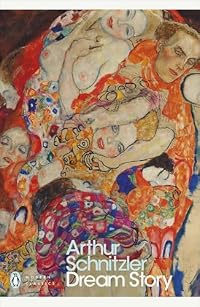
Many editions have one of Klimt’s golden paintings on the cover: a mystical, sexual enticement that seems to fit the dreamy, steamy story. At first. But recreate those pictures with real people, as above, and they become disturbing in a way that is far more appropriate to the full dark arc of the story.
This novella takes place over barely 48 hours. It opens with an idyllic family scene and fond reference to the frisson of flirting at a masked ball the night before. But masks rarely symbolise anything benign, especially not black masks...
Fidelity, Temptation, and Truth
If we promise and show more expect fidelity, we’re usually thinking of sexual exclusivity, but the word also means truth, in the sense of a full and accurate recreation or reportage.
• Where does honest confession of sexual infidelity - real or imagined - fit?
• Is relishing the fantasy of betrayal as bad as committing it in the flesh, as the Bible says?
• Is seeking temptation, but not submitting to it, dishonourable, dangerous, or brave?
• Is true love unconditional, or is that an impossibility?
Love of one’s child would probably survive their deliberate harm of one’s partner, but would the converse be true?
• What if both partners get a thrill from an admission of infidelity?
• What if that flower of arousal then ripens into the toxic fruit of jealousy?
Truth… and Dare?
“Neither the reality of a single night nor even of a person’s entire life can be equated with the full truth about his innermost being.”
Deep, honest, and frequent communication is oft cited as the key to a happy long-term relationship, including sharing (though not necessarily carrying out) fantasies.
“With self-tormenting anxiety and sordid curiosity, each sought to coax admissions from the other.”
Such truths can be exciting and arousing, but are risky too. As Algy says in Wilde’s The Importance of Being Earnest (see my review HERE),
“The truth is rarely pure, and never simple”.
Fridolin is unexpectedly disoriented by Albertine’s fairly innocuous fantasy, despite his encouraging her to share it. He embarks on a night of costumes, passwords, clandestine encounters, secret societies, rituals, dire warnings, confusion, revenge, and redemption. When he returns, he finds Albertine laughing in a dream, and when she awakes, he implores her to describe the dream. Just a dream. But such a dream. It changes everything, and what has been said cannot be unsaid.
Fridolin is unmoored and rudderless, as he sets sail on unfamiliar, choppy waters, for another voyage of strange encounters and enquiries, destination unknown.
Dreams may not be “real”, but their effects can be.
The Reality of Dreams
“No dream… is altogether a dream.”
The pages are suffused with the vocabulary of doubt about reality and free will: melancholy enchantment; secrets; magically infused illusions; masks; dreams; brooding menace; intoxication; mysterious people, events, and places; soporific atmospheres; being enveloped by a sultry fragrance, and surrendering to a swelling melody, as if under compulsion. The dark, disorienting, surreal, sexualised mood reminded me of scenes from Kafka.
“Everything was becoming increasingly unreal… His very identity”.
This confusion is not so strange. Boundaries between dreams and reality can be uncomfortably hard to discern. When my mother-in-law recently came round from a week of heavy post-op sedation, she recounted bizarre events as real. A fortnight later, she began to realise they were drug-induced dreams, even though they still felt too real to be dismissed as such. And when reading this, I had a couple of nights of vivid and memorable dreams – to the extent that during one dream, I remembered the dream from the previous night, and wondered if I was dreaming that imagined world again.
The veil is thin; we are easily confused. How much licence does that give us to explore and experiment, in mind - and maybe body?
Fridolin’s adventures appear to be real, in vengeful response to Albertine’s imagined and dreamed exploits. But readers cannot be certain, and I’m not sure the protagonists are either. (Fridolin, a doctor, questions whether he is hallucinating, and later plans to recount what he thinks are real events as if they were dreams, but neither point is definitive.)
That is the intoxicating essence of the story.
Quotes
• Real people “had all withdrawn into the realm of ghosts”.
• “Those trivial encounters became magically and painfully interfused with the treacherous illusion of missed opportunities.”
• “In every woman with whom I thought I was in love, it was always you that I was searching for.”
• “He quickened his pace, as if to escape all forms of responsibility and temptation.”
• “Her blood-red mouth glistened beneath her black lace mask.”
• “The torment of unsatisfied longing for the mysterious woman’s body, whose fragrance still caressed him.”
• “Fridolin’s eyes roved hungrily from sensuous to slender figures, from budding figures to figures in glorious full bloom; and the fact that each of these naked beauties still remained a mystery… transformed his indescribably strong urge to watch into an almost intolerable torment of desire.”
• “Fridolin was intoxicated, and not merely by her presence, her fragrant body and burning red lips, nor by the atmosphere of the room and the aura of lascivious secrets that surrounded him; he was at once thirsty and delirious.”
• “The breeze… even warmer and more springlike, seemed to bring with it a mild fragrance from the distant wakening woods.”
• “The treacherous warm air, pregnant with dangers.”
• “A triumphant sunbeam coming in between the curtains”. The culmination of many allusions to thawing, spring, and liberation.
Notes
• This story was filmed by Stanley Kubrik as Eyes Wide Shut, starring Tom Cruise and Nicole Kidman. I’ve reviewed and compared the film, via the screenplay HERE, but in summary, the plot is very similar, but the atmosphere is very different.
• A year before Eyes Wide Shut was released, Kidman starred in the premiere of David Hare’s play, The Blue Room, which is based on Schnitzler’s La Ronde. Daily Telegraph theatre critic, Charles Spencer, coined the phrase “theatrical Viagra” for the production.
• It seems appropriate that I reread this around the time Oxford Dictionaries announced “post-truth” as their Word of the Year 2016, albeit from its use in global-political, rather than inter-personal contexts.
• I read this in 2008 and in November 2016. This review replaces my two-sentence one from 2008.
• The image at the top is Inge Prader’s recreation of Klimt’s The Beethoven Frieze. See:
http://flavorwire.com/543239/gustav-klimts-iconic-paintings-recreated-by-real-mo.... show less
That’s the intention, anyway.
Many editions have one of Klimt’s golden paintings on the cover: a mystical, sexual enticement that seems to fit the dreamy, steamy story. At first. But recreate those pictures with real people, as above, and they become disturbing in a way that is far more appropriate to the full dark arc of the story.
This novella takes place over barely 48 hours. It opens with an idyllic family scene and fond reference to the frisson of flirting at a masked ball the night before. But masks rarely symbolise anything benign, especially not black masks...
Fidelity, Temptation, and Truth
If we promise and show more expect fidelity, we’re usually thinking of sexual exclusivity, but the word also means truth, in the sense of a full and accurate recreation or reportage.
• Where does honest confession of sexual infidelity - real or imagined - fit?
• Is relishing the fantasy of betrayal as bad as committing it in the flesh, as the Bible says?
• Is seeking temptation, but not submitting to it, dishonourable, dangerous, or brave?
• Is true love unconditional, or is that an impossibility?
Love of one’s child would probably survive their deliberate harm of one’s partner, but would the converse be true?
• What if both partners get a thrill from an admission of infidelity?
• What if that flower of arousal then ripens into the toxic fruit of jealousy?
Truth… and Dare?
“Neither the reality of a single night nor even of a person’s entire life can be equated with the full truth about his innermost being.”
Deep, honest, and frequent communication is oft cited as the key to a happy long-term relationship, including sharing (though not necessarily carrying out) fantasies.
“With self-tormenting anxiety and sordid curiosity, each sought to coax admissions from the other.”
Such truths can be exciting and arousing, but are risky too. As Algy says in Wilde’s The Importance of Being Earnest (see my review HERE),
“The truth is rarely pure, and never simple”.
Fridolin is unexpectedly disoriented by Albertine’s fairly innocuous fantasy, despite his encouraging her to share it. He embarks on a night of costumes, passwords, clandestine encounters, secret societies, rituals, dire warnings, confusion, revenge, and redemption. When he returns, he finds Albertine laughing in a dream, and when she awakes, he implores her to describe the dream. Just a dream. But such a dream. It changes everything, and what has been said cannot be unsaid.
Fridolin is unmoored and rudderless, as he sets sail on unfamiliar, choppy waters, for another voyage of strange encounters and enquiries, destination unknown.
Dreams may not be “real”, but their effects can be.
The Reality of Dreams
“No dream… is altogether a dream.”
The pages are suffused with the vocabulary of doubt about reality and free will: melancholy enchantment; secrets; magically infused illusions; masks; dreams; brooding menace; intoxication; mysterious people, events, and places; soporific atmospheres; being enveloped by a sultry fragrance, and surrendering to a swelling melody, as if under compulsion. The dark, disorienting, surreal, sexualised mood reminded me of scenes from Kafka.
“Everything was becoming increasingly unreal… His very identity”.
This confusion is not so strange. Boundaries between dreams and reality can be uncomfortably hard to discern. When my mother-in-law recently came round from a week of heavy post-op sedation, she recounted bizarre events as real. A fortnight later, she began to realise they were drug-induced dreams, even though they still felt too real to be dismissed as such. And when reading this, I had a couple of nights of vivid and memorable dreams – to the extent that during one dream, I remembered the dream from the previous night, and wondered if I was dreaming that imagined world again.
The veil is thin; we are easily confused. How much licence does that give us to explore and experiment, in mind - and maybe body?
Fridolin’s adventures appear to be real, in vengeful response to Albertine’s imagined and dreamed exploits. But readers cannot be certain, and I’m not sure the protagonists are either. (Fridolin, a doctor, questions whether he is hallucinating, and later plans to recount what he thinks are real events as if they were dreams, but neither point is definitive.)
That is the intoxicating essence of the story.
Quotes
• Real people “had all withdrawn into the realm of ghosts”.
• “Those trivial encounters became magically and painfully interfused with the treacherous illusion of missed opportunities.”
• “In every woman with whom I thought I was in love, it was always you that I was searching for.”
• “He quickened his pace, as if to escape all forms of responsibility and temptation.”
• “Her blood-red mouth glistened beneath her black lace mask.”
• “The torment of unsatisfied longing for the mysterious woman’s body, whose fragrance still caressed him.”
• “Fridolin’s eyes roved hungrily from sensuous to slender figures, from budding figures to figures in glorious full bloom; and the fact that each of these naked beauties still remained a mystery… transformed his indescribably strong urge to watch into an almost intolerable torment of desire.”
• “Fridolin was intoxicated, and not merely by her presence, her fragrant body and burning red lips, nor by the atmosphere of the room and the aura of lascivious secrets that surrounded him; he was at once thirsty and delirious.”
• “The breeze… even warmer and more springlike, seemed to bring with it a mild fragrance from the distant wakening woods.”
• “The treacherous warm air, pregnant with dangers.”
• “A triumphant sunbeam coming in between the curtains”. The culmination of many allusions to thawing, spring, and liberation.
Notes
• This story was filmed by Stanley Kubrik as Eyes Wide Shut, starring Tom Cruise and Nicole Kidman. I’ve reviewed and compared the film, via the screenplay HERE, but in summary, the plot is very similar, but the atmosphere is very different.
• A year before Eyes Wide Shut was released, Kidman starred in the premiere of David Hare’s play, The Blue Room, which is based on Schnitzler’s La Ronde. Daily Telegraph theatre critic, Charles Spencer, coined the phrase “theatrical Viagra” for the production.
• It seems appropriate that I reread this around the time Oxford Dictionaries announced “post-truth” as their Word of the Year 2016, albeit from its use in global-political, rather than inter-personal contexts.
• I read this in 2008 and in November 2016. This review replaces my two-sentence one from 2008.
• The image at the top is Inge Prader’s recreation of Klimt’s The Beethoven Frieze. See:
http://flavorwire.com/543239/gustav-klimts-iconic-paintings-recreated-by-real-mo.... show less
Stanley Kubrick's Eyes Wide Shut made a real impression on me as a wee sprout--I remember coming out of it with a pile of tortuous metaphors concerning what my recently-become-ex-girlfriend Erin and I could have done to manage our feelings and fears, the most salient as well as the most embarrassing of which had to do with surfboards and just riding the wave, bra. What I didn't realize, watching crazy, WASPy old Tom Cruise mug his way through what should have been a haunting role, was that the source material--Arthur Schnitzler's Dream Story--wasn't really for people like me at all--young, well-adjusted, healthy members of the suburban dominant culture. No, this is a book about outsiderness; more specifically Jewishness; more show more specifically still, bourgeois Viennese trying-to-pass Jewishness in the overcultivated, brutal, imperial-headbirth era of decline presided over by filthy, genial mayor Karl Lueger, some of whose best friends were Jews, as you may have heard. This is a story about relationships, jealousy, recognizing the humanity of the other and what you do with that, and it has a surprisingly sweet ending; but it is also a story of exclusion, fear, colliding inferiority complexes on every street corner, and Schnitzler signals strongly that that sweet ending will turn out to be false or at least temporary--and yikes, you think, Jews of Vienna? Temporary any implied happy ending certainly was. show less
Read this in French since I'm still reading exclusively in the language until further notice but still wanted to take this on - Traumnovelle is probably best known today as the source for the Stanley Kubrick film Eyes Wide Shut and for much of the early sections of the book I found that the film drew quite closely from it outside of changed setting/period, but as it goes along the two diverge in some important ways which made this interesting in its own right. A beautifully written evocation of dreams, fidelity, desires, cities at night, and the seamy underbelly of urban life, wrapped with enough symbolism and mystery to make it worth coming back to again and again.
"Of course, one remembers some dreams, but there must be others one completely forgets, of which nothing remains but a mysterious mood, a curious numbness."Atmospheric and haunting! Schnitzler's novella is a perfect Dream (or dream-like) Story. He doesn't create the kind of dream world that is engineered by hanging two moons from the ceiling. His world only consists of realistic things and events and yet it is shadowed by something intangible and unsettling. He simply colors the world his characters inhabit with a hypnotic quality that seduces the reader into the dream-scape. And how subtly he does that! Little details - one elusive gesture, one innocent-looking piece of the setting, one fleeting thought - all come together beautifully show more to create the atmosphere.
The novella explores the intimate life of a married couple. Schnitzler digs into the psyche of his characters by gently leading them to a space where their hidden thoughts, desires and anxieties find the freedom to manifest themselves. He lets the characters assess what constitutes truth and reality for them. And once the spell breaks, they can go back to continue living the illusion of real life they create for themselves.
"I have gained the impression that you have learned through intuition — though actually as a result of sensitive introspection — everything that I have had to unearth by laborious work on other persons." - Freud in a letter to Schnitzler (Wikipedia).Whether the events in the novella happen for real or was Schnitzler only staging an illusion - I will leave that for you to decide through your own reading. Perhaps it won't even matter.
"Just as sure as I am that the reality of one night, let alone that of a whole lifetime, is not the whole truth."Best read in a sitting or two. show less
"And no dream," he said with a slight sigh, "is entirely a dream."
While reading St Theresa's Interior Castle, I needed a diversion to bring some interest back to my reading. A simple way to ensure I have a steady supply of novels to read is to buy all of the Penguin Classics series. This international series brings to the reader authors and stories that would otherwise be neglected by we Antipodean Anglophones of little news from the Otherphones. Unless the story was the plot of a movie. I knew nothing of Austrian author Arthur Schnitzler, nor of his novella Dream Story. As I read it, I couldn't help but think of Stanley Kubrick's final movie, Eyes Wide Shut. When I looked up Arthur Schnitzler just now, I discovered that the movie was indeed an adaptation of this very novella. Such discoveries are show more pleasing and bring an undeserved sense of achievement, much like becoming a grandfather. But I recall hating the movie when it first came out. Bearing in mind, of course, that at that time I thought Starship Troopers was the greatest movie ever made. But long since my late 20s, I have revisited many of Kubrick's movies (as I have done with Woody Allen), and there is certainly something of the genius there. (I still struggle with Clockwork Orange, but will read the book and see if that helps. After reading this novella, I intend to watch Eyes Wide Shut again and see if my opinion changes.) But as for this novella, I read the lofty dream-like scenes before sleeping rather late, and then awoke to finish off the last few pages where reality hits Fridolin, our protagonist. My state of being suited the plot rather well. One scene in the Kubrick movie had Tom and Nicole smoking a joint, and this must have been where Fridolin's wife, Albertine, tells him of her desire to have an affair with a young naval officer. I recall being annoyed by that scene - Kidman didn't have the innocence that Albertine portrays in the novella. The innocence brings out the stupidity of Fridolin's jealousy in sharp relief, whereas Kidman's character, I recall, was really trying to stir things up. This means some of the key themes of courage and class-based morality are lost in the movie. The movie, too, seems to direct the audience too much, whereas the novella doesn't answer all reader's questions; it is left to the imagination. A very quick read, and of course, the book is better than the movie. show less
There was a lot I liked about this book, especially when I realised that it was the source material for Kubrick's 'Eyes Wide Shut.' But the story wraps up so quickly you almost think that Schnitzler had grown tired of his creation; a better final third would truly have made this a classic.
Members
- Recently Added By
Lists

Read the book and saw the movie
1,170 works; 195 members

In and About the 1920s
181 works; 31 members

Short and Sweet
241 works; 23 members

Love Triangles in Literature
108 works; 15 members
1920s
141 works; 6 members

Les Vases communicants
23 works; 1 member

Die besten Werke der deutschsprachigen Erzählliteratur von 1924 bis 2024
100 works; 2 members

Best literature ever!
39 works; 1 member

Reading LIst
648 works; 1 member

Authors mentioned in The World of Yesterday
68 works; 1 member
Author Information

Arthur Schnitzler, Viennese playwright, novelist, short story writer, and physician, was a sophisticated writer much in vogue in his time. He chose themes of an erotic, romantic, or social nature, expressed with clarity, irony, and subtle wit. Reigen, a series of ten dialogues linking people of various social classes through their physical desire show more for one another, has been filmed many times as La Ronde. As a Jew, Schnitzler was sensitive to the problems of anti-Semitism, which he explored in the play Professor Bernhardi (1913), seen in New York in a performance by the Vienna Burgtheater in 1968. Henry Hatfield calls Schnitzler "second only to Hofmannsthal among the Austrian writers of his generation and one of the most underrated of German authors... . He combined the naturalist's devotion to fact with the impressionist's interest in nuance; in other words, he told the truth" (Modern German Literature). In his most famous story, Lieutenant Gustl (1901), Schnitzler employs the stream-of-consciousness technique in an exposition of the follies and gradual disintegration of society in fin de siecle Vienna. Schnitzler has also been linked with Freud (see Vols. 3 and 5) and is credited with consciously introducing elements of modern psychology into his works. (Bowker Author Biography) show less
Some Editions
Awards and Honors
Series
Belongs to Publisher Series
Biblioteca de Verão (20)
Biblioteca Folha (26)
Mínima minor (81)
Colecção Mil Folhas (56)
Green Integer (94)
Salamanderpockets (167)
Insel-Bücherei (Nr. 1238)
Reclams Universal-Bibliothek (18455)
Work Relationships
Is contained in
Inspired
Has as a commentary on the text
Has as a student's study guide
Has as a teacher's guide
Common Knowledge
- Canonical title
- Dream Story
- Original title
- Traumnovelle
- Original publication date
- 1926
- People/Characters
- Albertine; Fridolin; Nachtigall; Gibiser; Dr Adler; Baroness D. (show all 7); Marianne
- Important places
- Vienna, Austria
- Related movies
- Eyes Wide Shut (1999 | IMDb); Traumnovelle (1969 | IMDb); Ad un passo dall'aurora (1989 | IMDb)
- First words
- 'Twenty-four brown slaves rowed the splendid galley that would bring Prince Amgiad to the Caliph's palace. But the Prince, wrapped in his purple cloak, lay alone on the deck beneath the deep blue, star-spangled night sky, and... (show all) his gaze -'
- Last words
- (Click to show. Warning: May contain spoilers.)And so they both lay there in silence, both dozing now and then, yet dreamlessly close to one another - until, as every morning at seven, there was a knock upon the bedroom door and, with the usual noises from the street, a triumphant sunbeam coming in between the curtains, and a child's gay laughter from the adjacent room, another day began.
- Original language
- German
- Canonical DDC/MDS
- 833.8
- Disambiguation notice
- 3458192387 2002 hardcover German Insel-Bücherei 1238
Classifications
Statistics
- Members
- 2,110
- Popularity
- 9,646
- Reviews
- 34
- Rating
- (3.73)
- Languages
- 15 — Arabic, Catalan, Danish, Dutch, English, Finnish, French, German, Italian, Norwegian (Bokmål), Norwegian, Portuguese, Russian, Spanish, Swedish
- Media
- Paper, Audiobook, Ebook
- ISBNs
- 105
- ASINs
- 38