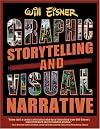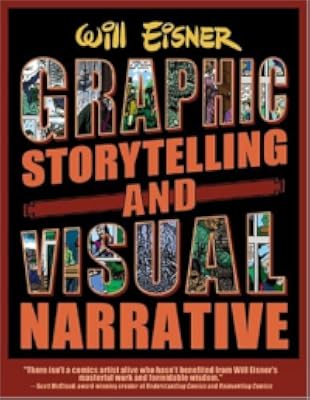
Graphic Storytelling and Visual Narrative: Principles and practices from the legendary cartoonist
by Will Eisner
Comics and Sequential Art (companion)
On This Page
Description
Learn how to control a story effectively using a broad array of techniques. With examples from Will Eisner's own catalog and other masters, this book distills the art of graphic storytelling into principles that every comic artist, writer, and filmmaker should know.Tags
Recommendations









Member Reviews
Will Eisner was a genius. As a matter of personal taste, I prefer some of his proteges both for their written work and their work on how to write--Scott McCloud is, so far, still my top guy--but saying I prefer McCloud to Eisner is like saying I prefer Aristotle to Plato: Eisner is The Source of all modern graphic-narrative theory, and having read this, I see why. Better yet, he is so universal in his approach that he offers some fascinating new ideas for thinking about the craft of writing even when he is focused strictly on the artwork--he is a brilliant reminder that storytelling isn't really about language, it's about communication, and that writing fiction doesn't necessarily require writing text. A fascinating book that I will show more keep on the shelf for quick reference at all times. show less
It was a bit less detailed than I would have liked. But it was an interesting exploration between the link of art and text and narrative flow in comic books.
A workshop on graphic storytelling in 164 pages that contains step-by-step processes for constructing a visual narrative.
Based on Will Eisner’s legendary course at New York’s School of Visual Arts, these guides have inspired generations of artists, students, teachers, and fans. In Comics and Sequential Art, Eisner reveals the basic building blocks and principles of comics, including imagery, the frame, and the application of time, space, and visual forms. Graphic Storytelling and Visual Narrative teaches how to control a story effectively using a broad array of techniques. With examples from Eisner’s own catalog and such masters as H. Foster, R. Crumb, Art Spiegelman, Milton Caniff, Al Capp, and George Herriman, these books distill the art of graphic storytelling into principles that every comic artist, writer, and filmmaker should know.
Ratings
Members
- Recently Added By
Author Information

665+ Works 11,889 Members
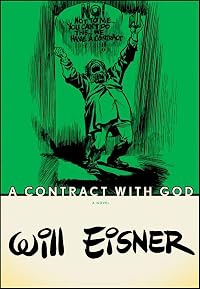
Will Eisner was born March 6, 1917 in Brooklyn, NY. As a child he worked for printers and sold newspapers. He attended De Witt Clinton High School in the Bronx, where his artwork first appeared in the school newspaper. His first job was at the New York American, but he lost that and found a job with WOW What a Magazine! in 1936. He created two show more features for the magazine, Harry Karry and The Flame. After the magazine went under, for a short time, he freelanced and drew stories for Comic Magazines before he and friend Jerry Iger formed a the Eisner-Iger studio. The two went their separate ways when Eisner joined the Quality Comics Group to produce a syndicated 16-page newspaper supplement. It was there that Eisner created his most well known character, the Spirit. In 1942, Eisner was drafted into the army where he produced posters and strips for the troops. After the war, he continued the Spirit strip until 1952. It was during this time that he created the American Visuals Corporation, a commercial art company that created comics for educational and commercial purposes. Some of the company's clients included RCA Records, the Baltimore Colts, and New York Telephone. Eisner had given up on the Spirit strip, but still produced new material for it from time to time. He chose to focus his efforts on a more mature storyline and so produced A Contract With God, which was published in 1978. It was the beginnings of the graphic novel. Eisner also taught cartooning at the School of Visual Arts in New York, in addition to writing Comics and Sequential Art and Graphic Storytelling. The Eisner Awards, one of only two comics industry awards, are named for Eisner and were established in 1988. Eisner's work was showcased in the Whitney Museum's 1996 "NYNY: City of Ambition" show. Will Eisner passed away on Monday January 3, 2005 at the age of 87 after undergoing quadruple bypass heart surgery. (Bowker Author Biography) show less
Awards and Honors
Awards
Series

Belongs to Publisher Series
Common Knowledge
- Canonical title
- Graphic Storytelling and Visual Narrative: Principles and practices from the legendary cartoonist
- Original title
- Graphic Storytelling
- Original publication date
- 1996-02-13
- Canonical DDC/MDS
- 741.5'1; 741.51; 741.5; 741
- Canonical LCC
- PN6710.E57
Classifications
- Genres
- Nonfiction, Graphic Novels & Comics
- DDC/MDS
- 741.5 — Arts & recreation Drawing & decorative arts Drawing Comic books, graphic novels, fotonovelas, cartoons, caricatures, comic strips
- LCC
- PN6710 .E57 — Language and Literature Literature (General) Literature (General) Collections of general literature Comic books, strips, etc.
- BISAC
Statistics
- Members
- 575
- Popularity
- 51,092
- Reviews
- 4
- Rating
- (3.94)
- Languages
- 7 — Danish, English, French, German, Italian, Portuguese, Spanish
- Media
- Paper, Ebook
- ISBNs
- 12
- UPCs
- 1
- ASINs
- 3