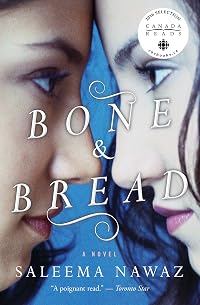
Bone and Bread
by Saleema Nawaz
On This Page
Description
When sisters Beena and Sadhana are orphaned as teenagers and sent to live with their Sikh uncle in Montreal's Hasidic community, their lives take divergent courses as they deal with their grief in different ways.Tags
Recommendations
























Member Recommendations
Member Reviews
Ah, sometimes it feels so good to leave one’s comfort zone and be reminded of the joys inherent in superb storytelling, no matter the content or genre. Nawaz effortlessly cuts back and forth through time, following Beena as adult and child, letting the reader travel alongside her as she slowly pieces together the elements of her life. Her characters breathe real, their pains ache beyond the page. It’s a novel filled with moments of grief, toil, and random cruelty, yet it never feels oppressive, never crumbles under its own weight. Nawaz’s graceful plotting and style keep the story intimate, tender, and surprisingly funny.
Read the full review at The Redeblog.
Read the full review at The Redeblog.
I really liked this story so I was disappointed to learn that it was eliminated on Day 2 of Canada Reads 2016. It is the story of two sisters Sadhanna and Beena Singh who grow up in Montreal in the 1980s. Their father is a Sikh from India and their mother is from Ireland. They run a bagel shop. They girls are being raised In an ideal, loving family until their father dies suddenly. Their Mama, who is a yoga instructor, vegetarian, kind, super friendly person raises them on her own until her untimely death. Their father's brother then steps in to take charge of two teenage girls and the bagel shop.
The narrator is Beena, the eldest, an introvert and an unwed mother at 16. Her sister is an athlete and an extrovert but only discovers that show more she is severely anorexic after she is hospitalized.
The story is well told with flashbacks between Ottawa and Montreal, until the whole truth of Sadie's death and life are uncovered. This is a very well written story about secrets, family, friendships, success and failure, forgiveness and letting go. show less
The narrator is Beena, the eldest, an introvert and an unwed mother at 16. Her sister is an athlete and an extrovert but only discovers that show more she is severely anorexic after she is hospitalized.
The story is well told with flashbacks between Ottawa and Montreal, until the whole truth of Sadie's death and life are uncovered. This is a very well written story about secrets, family, friendships, success and failure, forgiveness and letting go. show less
Compelling and beautifully written. Nawaz accomplishes a tremendous feat by making her difficult and controlling main character's internal voice so realistic, and so reasonable, that she is constantly surprised to find out how negatively (some) other people see her.
Two sisters, having grown up amidst constant loss and change, are alternately suffocatingly close and unbearably distant over the course of this story. Both are fully realized and well-rounded characters struggling to live happy lives. The dialogue is extraordinary--so human it seemed it must have been recorded from real-life conversations. I couldn't put it down.
Two sisters, having grown up amidst constant loss and change, are alternately suffocatingly close and unbearably distant over the course of this story. Both are fully realized and well-rounded characters struggling to live happy lives. The dialogue is extraordinary--so human it seemed it must have been recorded from real-life conversations. I couldn't put it down.
this is a big, heartfelt novel. nawaz has created some very interesting, complicated characters and so much of the dynamics of relationships felt true and real. the psychology at play in this book will have me thinking for ages to come. while the novel very much navigates the terrain of sisterhood, it's also reads a bit like a mystery, as the circumstances of sadhana's death, though known, are more fully explored and, eventually, revealed. i wasn't quite fully captured by the inclusion of the political unrest going on in quebec at the time, and which was included as one arc in the book. it just didn't hit solid footing for me. (another recent read of mine, which i loved and that handled the quebec referendum quite well, elizabeth hay's show more His Whole Life.) otherwise, there are some wonderfully meaty themes going on in the story.
i have owned this book since its publication - yes it's taken me a while to get to it! but i am so glad i have finally read it, and that it made the cut for this year's edition of canada reads. the theme for the show in 2016 is 'starting over'. so this context was very much in mind as i read. i have read 3 of the 5 contenders so far (Minister Without Portfolio, by Michael Winter and The Illegal, by Lawrence Hill being the other two). i have certainly appreciated the resiliency, and ability for the characters in each of the books to carry on and continue moving forward. is this the same as starting over, though? of course, all of these traits/abilities are so important and necessary in a person being able to start over. so it's been interesting to approach each of these stories in the context of 'canada reads'. but, as happens every year, i wonder how my experience with a book would be without the program in my mind??
there is one line in nawaz's novel which completely speaks to the theme, though, and i fully expect it to be noted, quoted and built upon on the show. (context: at a diner for breakfast, celebrating a birthday; the girls were raised as vegetarians. from p. 343.)
"Of all meals, breakfast the way it was served in a diner bore the least connection to anything we had grown up eating. It was nourishment without attachment, merciful food. Every piece of bacon was like starting over as someone else."
but, back to 'bone & bread' (sorry about my 'canada reads' tangent) - nawaz's writing is beautiful and this is a strong debut novel. i hope you will read it, if you haven't already. show less
i have owned this book since its publication - yes it's taken me a while to get to it! but i am so glad i have finally read it, and that it made the cut for this year's edition of canada reads. the theme for the show in 2016 is 'starting over'. so this context was very much in mind as i read. i have read 3 of the 5 contenders so far (Minister Without Portfolio, by Michael Winter and The Illegal, by Lawrence Hill being the other two). i have certainly appreciated the resiliency, and ability for the characters in each of the books to carry on and continue moving forward. is this the same as starting over, though? of course, all of these traits/abilities are so important and necessary in a person being able to start over. so it's been interesting to approach each of these stories in the context of 'canada reads'. but, as happens every year, i wonder how my experience with a book would be without the program in my mind??
there is one line in nawaz's novel which completely speaks to the theme, though, and i fully expect it to be noted, quoted and built upon on the show. (context: at a diner for breakfast, celebrating a birthday; the girls were raised as vegetarians. from p. 343.)
"Of all meals, breakfast the way it was served in a diner bore the least connection to anything we had grown up eating. It was nourishment without attachment, merciful food. Every piece of bacon was like starting over as someone else."
but, back to 'bone & bread' (sorry about my 'canada reads' tangent) - nawaz's writing is beautiful and this is a strong debut novel. i hope you will read it, if you haven't already. show less
The novel begins with the death of Sadhana Singh. Beena, her older sister, is the narrator. As she clears his sister’s apartment and tries to uncover the circumstances behind Sadhana’s sudden death, she narrates the story of her family’s past and her present. The sisters, the daughters of an American yoga instructor and a Sikh baker, grow up above the family’s bagel shop in the Hasidic community in Montreal. Orphaned, they are left in the care of a traditional Sikh uncle. As teenagers, Beena becomes an unwed mother and Sadhana begins a struggle with anorexia.
The book examines the complicated bonds of sisterhood, what Beena calls “the deep trenches of our relationship.” They are very different, almost foils. Beena is show more introverted and self-conscious whereas Sadhana is an extrovert with numerous friends and causes. Beena also lacks Sadhana’s artistic flair. The title seems to refer to the two sisters, Sadhana being the bone and Beena the bread: Sadhana is hard-edged and brittle and physically she is all bone while Beena is softer and physically tends to be heavier. Sibling rivalry is certainly obvious: the girls are competitive. And things are not improved by the fact that they do not really communicate. Beena’s final observation that “the work of getting closer, of loving harder, is the work of a whole life” is a good summary of their relationship: they were not always as close as they should have been and didn’t always love each other as much as they should have.
I found it difficult to like either sister. Each tends to let anger affect her relationship with her sister, and both seem rather selfish. Only after Sadhana dies does Beena try to understand things from her sister’s point of view, and Sadhana’s actions before her death suggest she too was not giving due consideration to her sister’s decisions concerning her son.
Some of the characters lack sparkle. The uncle becomes just a male version of the cruel stepmother, and Evan, Beena’s love interest, is just too good to be true. Even Quinn, Beena’s son, is flat and uninteresting. This problem probably stems from the fact that we see them only from Beena’s viewpoint and are never given their thoughts and feelings.
The novel certainly has emotional depth in its showing the love and resentment and competitiveness of sisters, but I found the book unnecessarily lengthy. The plot seems stretched. For instance, the mystery around Sadhana’s death is supposed to add interest, but the suspense seems forced. It takes Libby so long to tell her story! And her revelation shows behaviour that is unbelievable for someone who supposedly loved Sadhana. There are other events that serve little purpose other than to emphasize the differences between the lives of the two women. The sub-story concerning the immigrants was too detailed, veering as it does into the political realm which has little importance in the relationship between the sisters. Events that should have been detailed, like the meeting between Quinn and Ravi, are only sketched - again, this weakness derives from the point of view chosen for narration.
I read this novel because it appears on the shortlist of Canada Reads 2016 which has the theme of starting over - books about transformation and second chances, stories of people choosing, or being forced, to make major changes in their lives. I shall be listening to the debates with interest because I find the theme of starting over is really not central in this book. Though both girls have to move on after deaths and birth in their family, there is little transformation. There is only the possibility of change in Beena’s life if she accepts “the work of a whole life” and tries harder to be more open in her relationships.
Please check out my reader's blog (http://schatjesshelves.blogspot.ca/) and follow me on Twitter (@DCYakabuski). show less
The book examines the complicated bonds of sisterhood, what Beena calls “the deep trenches of our relationship.” They are very different, almost foils. Beena is show more introverted and self-conscious whereas Sadhana is an extrovert with numerous friends and causes. Beena also lacks Sadhana’s artistic flair. The title seems to refer to the two sisters, Sadhana being the bone and Beena the bread: Sadhana is hard-edged and brittle and physically she is all bone while Beena is softer and physically tends to be heavier. Sibling rivalry is certainly obvious: the girls are competitive. And things are not improved by the fact that they do not really communicate. Beena’s final observation that “the work of getting closer, of loving harder, is the work of a whole life” is a good summary of their relationship: they were not always as close as they should have been and didn’t always love each other as much as they should have.
I found it difficult to like either sister. Each tends to let anger affect her relationship with her sister, and both seem rather selfish. Only after Sadhana dies does Beena try to understand things from her sister’s point of view, and Sadhana’s actions before her death suggest she too was not giving due consideration to her sister’s decisions concerning her son.
Some of the characters lack sparkle. The uncle becomes just a male version of the cruel stepmother, and Evan, Beena’s love interest, is just too good to be true. Even Quinn, Beena’s son, is flat and uninteresting. This problem probably stems from the fact that we see them only from Beena’s viewpoint and are never given their thoughts and feelings.
The novel certainly has emotional depth in its showing the love and resentment and competitiveness of sisters, but I found the book unnecessarily lengthy. The plot seems stretched. For instance, the mystery around Sadhana’s death is supposed to add interest, but the suspense seems forced. It takes Libby so long to tell her story! And her revelation shows behaviour that is unbelievable for someone who supposedly loved Sadhana. There are other events that serve little purpose other than to emphasize the differences between the lives of the two women. The sub-story concerning the immigrants was too detailed, veering as it does into the political realm which has little importance in the relationship between the sisters. Events that should have been detailed, like the meeting between Quinn and Ravi, are only sketched - again, this weakness derives from the point of view chosen for narration.
I read this novel because it appears on the shortlist of Canada Reads 2016 which has the theme of starting over - books about transformation and second chances, stories of people choosing, or being forced, to make major changes in their lives. I shall be listening to the debates with interest because I find the theme of starting over is really not central in this book. Though both girls have to move on after deaths and birth in their family, there is little transformation. There is only the possibility of change in Beena’s life if she accepts “the work of a whole life” and tries harder to be more open in her relationships.
Please check out my reader's blog (http://schatjesshelves.blogspot.ca/) and follow me on Twitter (@DCYakabuski). show less
Set mostly in Montreal, this novel tells the story of two sisters, Beena and Sadhana, who lose their (Sikh) father when they are infants and then their (hippie Irish American) mother when they are young teenagers. They are then raised by their uncle, still in the apartment above the family bagel shop. At 16 Beena becomes pregnant and Sadhana is hospitalized with anorexia for the first time.
At the beginning of the book we learn that Sadhana has just died and Beena and her son Quinn, now living in Ottawa, are struggling to come to terms with this. Each chapter is partly in the present of the need to clear out Sadhana's flat and Quinn's desire to meet his father, and partly describes the girls' childhood and teenage years and so on up to show more the present.
I have mixed feelings about this story. I found it generally interesting, although it was longer than it needed to be and dragged in the middle. Beena was a very passive, closed-off character, who seemed to believe people were unknowable and hard to get close to, but it seemed to me that she avoided ever being direct or straightforward with anyone. Her relationship with Sadhana was well-described and believable; the love and the hate and the inter-connectedness. On the other hand, the refugee story seemed tacked-on to make the story more relevant or something; I would have been more interested in hearing about the sisters' experiences of being partly Sikh.
Sad and well-written, but I wouldn't read it again. show less
At the beginning of the book we learn that Sadhana has just died and Beena and her son Quinn, now living in Ottawa, are struggling to come to terms with this. Each chapter is partly in the present of the need to clear out Sadhana's flat and Quinn's desire to meet his father, and partly describes the girls' childhood and teenage years and so on up to show more the present.
I have mixed feelings about this story. I found it generally interesting, although it was longer than it needed to be and dragged in the middle. Beena was a very passive, closed-off character, who seemed to believe people were unknowable and hard to get close to, but it seemed to me that she avoided ever being direct or straightforward with anyone. Her relationship with Sadhana was well-described and believable; the love and the hate and the inter-connectedness. On the other hand, the refugee story seemed tacked-on to make the story more relevant or something; I would have been more interested in hearing about the sisters' experiences of being partly Sikh.
Sad and well-written, but I wouldn't read it again. show less
3.5 stars
Beena and Sadhana have an East Indian father and a white mother. They were raised in Montreal, Quebec. Sadhana is two years younger than Beena. Their father died when they were young and their mother when they were teenagers; they are then in the custody of their uncle, who runs the bagel shop (originally owned by their father) downstairs. As they grow up, they each run into teen girl problems (serious ones, not small ones), which I won’t mention, as they aren’t revealed until later in the book (though the blurb does reveal them, as do some tags).
The book is told by Beena in the “present day”, just after Sadhana has died. Sadhana lived alone and was not discovered for a week. Beena has to go clean up the apartment, and show more brings along her teenage son to help. The book goes back and forth between present day and Beena’s memories of she and her sister growing up.
It started off slow for me, but it did get better. I didn’t always like Beena and the decisions she made, but I could say the same of Sadhana. I don’t have a sister, but it seems that it was likely a good portrayal of sisters. There really was a Canadian flavour to the book, as well, with a look at some of the politics in Quebec. show less
Beena and Sadhana have an East Indian father and a white mother. They were raised in Montreal, Quebec. Sadhana is two years younger than Beena. Their father died when they were young and their mother when they were teenagers; they are then in the custody of their uncle, who runs the bagel shop (originally owned by their father) downstairs. As they grow up, they each run into teen girl problems (serious ones, not small ones), which I won’t mention, as they aren’t revealed until later in the book (though the blurb does reveal them, as do some tags).
The book is told by Beena in the “present day”, just after Sadhana has died. Sadhana lived alone and was not discovered for a week. Beena has to go clean up the apartment, and show more brings along her teenage son to help. The book goes back and forth between present day and Beena’s memories of she and her sister growing up.
It started off slow for me, but it did get better. I didn’t always like Beena and the decisions she made, but I could say the same of Sadhana. I don’t have a sister, but it seems that it was likely a good portrayal of sisters. There really was a Canadian flavour to the book, as well, with a look at some of the politics in Quebec. show less
Members
- Recently Added By
Published Reviews
ThingScore 75
Bone & Bread is ambitious with easily enough material for two novels. Nawaz successfully portrays a strong yet tumultuous bond between the two sisters, and the author is equally adept at showing the extreme demands of caring for a loved one with anorexia.
However, the economy of words and razor-sharp prose of Mother Superior are not to be found in this novel.....Then there is the issue of the show more baffling similes and metaphors, leaving the reader momentarily distracted by what exactly is being evoked....However, even these problems could have been overlooked if the author had chosen to show rather than tell so much of the story. The result is language that prevents the reader from experiencing the action first-hand......While I was not immediately aware of the problems in Bread & Bone, I eventually realized that I was putting the book down every few pages to catch my breath and make better sense of it. Unfortunately, not everyone will be able to pick it up again. show less
However, the economy of words and razor-sharp prose of Mother Superior are not to be found in this novel.....Then there is the issue of the show more baffling similes and metaphors, leaving the reader momentarily distracted by what exactly is being evoked....However, even these problems could have been overlooked if the author had chosen to show rather than tell so much of the story. The result is language that prevents the reader from experiencing the action first-hand......While I was not immediately aware of the problems in Bread & Bone, I eventually realized that I was putting the book down every few pages to catch my breath and make better sense of it. Unfortunately, not everyone will be able to pick it up again. show less
added by vancouverdeb
While Bone and Bread is gracefully plotted and occasions myriad interesting questions into the nature of the development of any one personality, Nawaz very occasionally missteps in her prose. Some sentences fail to settle into their intended rhythms, and instead seem littered through with claustrophobic clauses....At other times, Nawaz’s use of language is top-notch, evoking thoughts and show more feelings with a piercing clarity....And so this novel, like the family it depicts, is flawed and tragic, but also tender and loving. Nawaz invites her reader into an intimate and devastating history, and holds you right until the end. show less
added by vancouverdeb
Bone and Bread, the first novel by Montreal writer Saleema Nawaz, is an emotionally complex, riveting story. ...Bone and Bread is a poignant read, but it captivates because it brims with humanity. Nawaz hustles the reader along with vivid writing, scintillating characters, and the alluring element of mystery.....Nawaz is able to bind these layers into a cozy blanket that envelops the reader show more with the warmth of her characters and the flow of her story. Beena concludes at the end of the novel that “the work of getting closer to the ones you love, of loving harder, is the work of a whole life.” The wisdom of such a young novelist is staggering. show less
added by vancouverdeb
Lists

CBC Books - Canada's 100 (+ bonus 10): Which have you read?
110 works; 23 members

Canada Reads Winners and Nominees
129 works; 9 members
Author Information

4 Works 295 Members
Awards and Honors
Common Knowledge
- Original publication date
- 2013-03-30
Classifications
Statistics
- Members
- 147
- Popularity
- 222,861
- Reviews
- 13
- Rating
- (3.84)
- Languages
- English
- Media
- Paper, Ebook
- ISBNs
- 3
- ASINs
- 2