
On This Page
Description
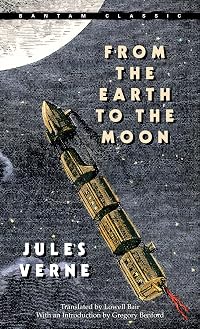
Written almost a century before the daring flights of the astronauts, Jules Verne’s prophetic novel of man’s race to the stars is a classic adventure tale enlivened by broad satire and scientific acumen. When the members of the elite Baltimore Gun Club find themselves lacking any urgent assignments at the close of the Civil War, their president, Impey Barbicane, proposes that they build a gun big enough to launch a rocket to the moon. But when Barbicane’s adversary places a huge wager show more that the project will fail and a daring volunteer elevates the mission to a “manned” flight, one man’s dream turns into an international space race. A story of rip-roaring action, humor, and wild imagination, From the Earth to the Moon is as uncanny in its accuracy and as filled with authentic detail and startling immediacy as Verne’s timeless masterpieces 20,000 Leagues Under the Sea and Around the World in Eighty Days. show lessTags
Recommendations































Member Recommendations
Mind_Booster_Noori The engineering effort to put something beyond our atmosphere is something that made me think of one book while reading the other.
Member Reviews
Warning: this review contains spoilers
With the American Civil War over, the members of the Baltimore Gun Club have nothing to keep themselves entertained. But what if they could create a REALLY BIG GUN—one that could launch a projectile to the moon? The club seizes on this idea enthusiastically, and soon the whole nation is in a state of Moon-projectile fever. But wait, there’s more—someone else proposes sending up an actual human! How will this turn out?
This story is notable for how much Verne got right, namely in the choice of launching site within the US. It’s a surprisingly exciting read, even when the Gun Club members are blathering on about ballistic trajectories and the exact dimensions required of the cannon to fire the show more projectile. Things get particularly tense once humans are added to the projectile equation. And that ending—it’s such a cliffhanger, and is a bit nightmarish to be honest. I had to pick up the sequel, Around the Moon, immediately. show less
With the American Civil War over, the members of the Baltimore Gun Club have nothing to keep themselves entertained. But what if they could create a REALLY BIG GUN—one that could launch a projectile to the moon? The club seizes on this idea enthusiastically, and soon the whole nation is in a state of Moon-projectile fever. But wait, there’s more—someone else proposes sending up an actual human! How will this turn out?
This story is notable for how much Verne got right, namely in the choice of launching site within the US. It’s a surprisingly exciting read, even when the Gun Club members are blathering on about ballistic trajectories and the exact dimensions required of the cannon to fire the show more projectile. Things get particularly tense once humans are added to the projectile equation. And that ending—it’s such a cliffhanger, and is a bit nightmarish to be honest. I had to pick up the sequel, Around the Moon, immediately. show less
Imaginative engineering art of the possible yowza. But beyond that kind of temptation, this book is absolutely hilarious in its commentary about different cultures. The Americans can't have an idea without talking about it, and can't talk about it without forming some kind of governing committee. The commentaries on different countries' financial contributions to the moon landing project, and what those amounts tell us about their mindsets toward science and money. The elegant Europeans versus the ugly ass Americans for whom nothing is impossible. It is absolutely hilarious how much the jokes ring true in both 1867 and 2021.
Jules Verne's From the Earth to the Moon is, objectively, a poor book. The story is breezy and the characters sketchy even by Verne's standards. The plot is incomplete (there's a good reason why many editions include the sequel, Around the Moon, in its pages – the first book ends just as it's about to get interesting) and there's an indulgence of melodrama. There's a mass of dry scientific information; if Verne were a modern writer, he would be accused of cutting and pasting from Wikipedia articles on the cycles of the moon or the various atmospheric pressures of gases.
And yet, there's always something compelling about reading Jules Verne, for all his myriad objective flaws. I think a clue as to what this might be can be found in the show more fact that I instinctively (but deliberately) sought out a Bantam Pathfinder edition of From the Earth to the Moon published in 1967; that is, when Apollo was in full swing and two years before Verne's story became reality (at least in its broadest sweeps). I think a lot of the enjoyment in Verne comes from what the modern reader brings themselves: knowledge of Neil Armstrong in 1969 makes From the Earth to the Moon that much sweeter, just as knowledge of jet planes makes Around the World in Eighty Days seem romantically quaint, or knowledge of submarines makes 20,000 Leagues Under the Sea seem prescient.
This appeal is subjective, of course, and perhaps Verne is only a novelty now, but there's something heartening about a man writing about using technology to go to the Moon just over one hundred years before that became reality; a vindication of mankind's optimism (and Verne's personal enthusiasm for science). Certainly, we could do with hearing more often lines like "in America… mechanical difficulties are dead before they are born" (pg. 15), particularly as the problem nowadays is our society's loss of nerve and incentive to perform the sort of scientific feats Verne was capable of imagining. It's as depressing to remember that we haven't been back to the Moon in fifty years as it is fantastic to remember the hundred years separating Verne and Apollo.
Certainly, this sort of post-modern romanticising of Verne's adventures won't be enough for many readers. Quite fairly, they'll be wanting the author to provide the substance rather than conjuring it themselves, and this Verne fails to provide. As I said, plot and character are sketchy and melodramatic; there's no heavy lifting from the storyteller on these important fronts. Verne's only real objective qualities in From the Earth to the Moon are his humour (surprisingly strong here) and his enthusiasm for scientific progress, so much so that he would write chapters in mankind's adventure a century before they came to fruition. That's not enough for some readers, but it's just about enough for me. show less
And yet, there's always something compelling about reading Jules Verne, for all his myriad objective flaws. I think a clue as to what this might be can be found in the show more fact that I instinctively (but deliberately) sought out a Bantam Pathfinder edition of From the Earth to the Moon published in 1967; that is, when Apollo was in full swing and two years before Verne's story became reality (at least in its broadest sweeps). I think a lot of the enjoyment in Verne comes from what the modern reader brings themselves: knowledge of Neil Armstrong in 1969 makes From the Earth to the Moon that much sweeter, just as knowledge of jet planes makes Around the World in Eighty Days seem romantically quaint, or knowledge of submarines makes 20,000 Leagues Under the Sea seem prescient.
This appeal is subjective, of course, and perhaps Verne is only a novelty now, but there's something heartening about a man writing about using technology to go to the Moon just over one hundred years before that became reality; a vindication of mankind's optimism (and Verne's personal enthusiasm for science). Certainly, we could do with hearing more often lines like "in America… mechanical difficulties are dead before they are born" (pg. 15), particularly as the problem nowadays is our society's loss of nerve and incentive to perform the sort of scientific feats Verne was capable of imagining. It's as depressing to remember that we haven't been back to the Moon in fifty years as it is fantastic to remember the hundred years separating Verne and Apollo.
Certainly, this sort of post-modern romanticising of Verne's adventures won't be enough for many readers. Quite fairly, they'll be wanting the author to provide the substance rather than conjuring it themselves, and this Verne fails to provide. As I said, plot and character are sketchy and melodramatic; there's no heavy lifting from the storyteller on these important fronts. Verne's only real objective qualities in From the Earth to the Moon are his humour (surprisingly strong here) and his enthusiasm for scientific progress, so much so that he would write chapters in mankind's adventure a century before they came to fruition. That's not enough for some readers, but it's just about enough for me. show less
I have no idea who wrote the version of this book that I read, but it was not Jules Verne. It was, at best, some nameless, faceless translator, perhaps a student hired on the cheap by the publisher of the version I have. The publisher of the volume that I read has created a fine leather binding and edged the pages in gold. The paper is of acid-neutral archival quality. A few specially commissioned illustrations are credited to the artist. But who wrote the words? Of that, there is no mention at all. Why does it matter? It matters because there is more to translation than a mere rendering of each French word of Verne's original into its English cognate. The connotation of a phrase is equally as important, if not more so, as its literal show more denotation. Only one who is thoroughly fluent in both languages and who is also cognizant of an author's intent and who is a creative author in his or her own right, coming to the task of translation armed with an abundant word hoard, is equipped to give us a translation we can trust to reproduce the author's tone, the tenor of the author's words, and the original creativity of the author. Oh, for another Vladimir Nabokov! Or we could, in the instance of Verne's novels, strive to become fluent in his native tongue and read the novels in the original French, but some of us do not possess the felicitous skill to accomplish that in a single lifetime.
The possible shortcomings and vagaries of imperfect translation notwithstanding, From the Earth to the Moon is still an enjoyable read—if one approaches it with appropriate expectations. The story line is not strong from the standpoint of what we now envision as science fiction adventure, but that was not Verne's focus. This is a novel of humor: Samuel Clemens' Mark Twain type humor, and much has survived the ordeal of translation.
Suggestion, innuendo, gentle sarcasm, irony, indirect description, plays on stereotypes, bits of hyperbole, and a touch of litotes are all techniques at Verne's command. And what are the objects of his humor, which can be a trifle critical, mind you? Let's begin with the organization itself, the Gun Club, which laments the end of the Civil War because its conclusion spelled the death knell of inventing ever more impressive artillery. The Gun Club members themselves are missing bits and pieces of their bodies, but what of that? To them, those missing pieces are badges of merit testifying that their membership in the club is legitimate. Then there is the ever-excitable, exuberant, bombastic club secretary who can always be counted on to turn any molehill into a mountain at the drop of a hat. As only one small example of Verne's ability to turn a phrase, the Gun Club president, Barbicane, explains to Michel Ardan, that the space walk he envisions would leave him “flattened like a deflated bagpipe” after first exploding, of course.
It is a shame that Verne's novels did not receive the serious literary consideration in America that they did in Europe, which accepted the author's novels as legitimate contributions to the 19th century literary canon. Much of America, however, defined Verne as a fantasy writer to entertain young readers and not worthy of expert translation into English. Nonetheless, From the Earth to the Moon is a delightful example of superb humor in, as noted earlier, a Mark Twainish form. Thanks to Verne's research of scientific facts as they were known at the time, the reader may also be surprised by the extent and the relative accuracy of scientific knowledge in 1865.
By all means, read this novel in French if you can and, if not, search out a version translated by a skillful and identified master of both languages, for the book deserves our contemplation, our appreciation, and our enjoyment. show less
The possible shortcomings and vagaries of imperfect translation notwithstanding, From the Earth to the Moon is still an enjoyable read—if one approaches it with appropriate expectations. The story line is not strong from the standpoint of what we now envision as science fiction adventure, but that was not Verne's focus. This is a novel of humor: Samuel Clemens' Mark Twain type humor, and much has survived the ordeal of translation.
Suggestion, innuendo, gentle sarcasm, irony, indirect description, plays on stereotypes, bits of hyperbole, and a touch of litotes are all techniques at Verne's command. And what are the objects of his humor, which can be a trifle critical, mind you? Let's begin with the organization itself, the Gun Club, which laments the end of the Civil War because its conclusion spelled the death knell of inventing ever more impressive artillery. The Gun Club members themselves are missing bits and pieces of their bodies, but what of that? To them, those missing pieces are badges of merit testifying that their membership in the club is legitimate. Then there is the ever-excitable, exuberant, bombastic club secretary who can always be counted on to turn any molehill into a mountain at the drop of a hat. As only one small example of Verne's ability to turn a phrase, the Gun Club president, Barbicane, explains to Michel Ardan, that the space walk he envisions would leave him “flattened like a deflated bagpipe” after first exploding, of course.
It is a shame that Verne's novels did not receive the serious literary consideration in America that they did in Europe, which accepted the author's novels as legitimate contributions to the 19th century literary canon. Much of America, however, defined Verne as a fantasy writer to entertain young readers and not worthy of expert translation into English. Nonetheless, From the Earth to the Moon is a delightful example of superb humor in, as noted earlier, a Mark Twainish form. Thanks to Verne's research of scientific facts as they were known at the time, the reader may also be surprised by the extent and the relative accuracy of scientific knowledge in 1865.
By all means, read this novel in French if you can and, if not, search out a version translated by a skillful and identified master of both languages, for the book deserves our contemplation, our appreciation, and our enjoyment. show less
This book is bizarre, but (mostly) in a good way. The plot is literally that a bunch of dudes are sad because they like to make guns (they're called The Gun Club), but there are no more wars so no one needs guns and now they are bored, so they decide to go to the moon instead. This might sound extreme but this is just how the average man thinks.
There's a lot of tech babble in the book, which I'm assuming is like 56% inaccurate or so. It just seems that most of it cannot be true, even if it was back when it was written. BUt that's to be expected from something that was published well over a hundred years ago. What was more surprising were some of the assumptions in the book, such as people seriously debating whether or not the moon has show more inhabitants or that surely there was water there. Did people honestly belive that back then?
Other things hold true to this day. My fave is the guy who just happens to do a production of Shakespeare's "Much ado about nothing", and large crowds assuming it's a jab at the main character and violently going to the theater to protest. It seems exactly like the kind of thing that could happen today, and the fact that Americans WERE the first to walk on the moon should prove that a lot of the hysteria from the book were true a hundred years later, and will probably still be true for many hundred years to come.
I did want to know more about the trip in the spaceship, but there's nothing about that in the book. I guess I'll have to read the sequel for that ... show less
There's a lot of tech babble in the book, which I'm assuming is like 56% inaccurate or so. It just seems that most of it cannot be true, even if it was back when it was written. BUt that's to be expected from something that was published well over a hundred years ago. What was more surprising were some of the assumptions in the book, such as people seriously debating whether or not the moon has show more inhabitants or that surely there was water there. Did people honestly belive that back then?
Other things hold true to this day. My fave is the guy who just happens to do a production of Shakespeare's "Much ado about nothing", and large crowds assuming it's a jab at the main character and violently going to the theater to protest. It seems exactly like the kind of thing that could happen today, and the fact that Americans WERE the first to walk on the moon should prove that a lot of the hysteria from the book were true a hundred years later, and will probably still be true for many hundred years to come.
I did want to know more about the trip in the spaceship, but there's nothing about that in the book. I guess I'll have to read the sequel for that ... show less
From the Earth to the Moon is the fourth novel in Verne's Voyages Extraordinaires. In the first part of his career the author was filled with optimism about scientific knowledge, technology and human progress. Previous novels told awe-inspiring tales of exploration and discovery: the exploration of Africa from the air (Five Weeks in a Balloon), the interior of our planet (Journey to the Center of the Earth), and the North Pole (The Adventures of Captain Hatteras). However, he managed to surpass himself in ambition with this one, turning his eyes towards the Moon. This story is an early example of hard science fiction, and would decades later inspire people like Yuri Gagarin, the Russian cosmonaut who became the first human being to show more leave the Earth and reach outer space.
What is it about? (from wikipedia): The Baltimore Gun Club, a post-American Civil War society of weapons enthusiasts, attempts to build an enormous Columbiad space gun and launch three people in a projectile with the goal of a Moon landing.
While this is an early classic of science fiction, one thing you need to know is that this is a very geeky kind of adventure novel. Basically, the story told here is not about traveling to the Moon, but about the planning and preparation stages. Because of that, there is not a lot of action. All Verne novels have some popular science info-dumps, but this one has more than its share of that. That is quite understandable, given the unprecedented difficulties of the task, but it can make for a less dynamic read. That's why I said this is a geeky kind of novel. A lot of the enjoyment comes not from actual adventure, but from the audacity of the project and from how reasonable and possible Verne makes it sound when he tackles the technical details. There are a lot of planning meetings where the characters discuss the details of the project, and a lot of building and testing.
Despite this lack of action, the novel has several things going for it. There is the already mentioned geeky enjoyment of the planning. Looking at it from a modern perspective, Verne's calculations and plans are surprisingly accurate. The main failing that would make the project impractical is that, in order for the passengers not to die due to the acceleration when the projectile was shot, the barrel of the cannon would have to be much longer, to allow the projectile to reach the same escape velocity with a smaller acceleration.
Another thing worth mentioning is the humor. This is the funniest among the Verne novels that I have read so far. The beginning is quite similar to Five Weeks in a Balloon, with a visionary character making a speech to a scientific society (if we can call the Baltimore Gun Club a scientific society) and describing a daring exploration project. However, the Gun Club plays a much greater role here than the Royal Geographical Society played in Five Weeks in a Balloon, and it allows Verne to use his satirical abilities to the maximum.
The Baltimore Gun Club's members are so absorbed in their hobby/profession that they consider the fact that the Civil War ended and the country is at peace as an outrage and personal insult against themselves and against the art of gunnery. Even their physical descriptions are funny, with the ridiculous amount of mutilations among their members becoming a running gag.
Verne certainly makes fun of Americans in this novel, but in my opinion is a fond kind of satire. He makes fun of Americans while at the same time admiring them for their daring, their can-do attitude, and the greatness of their enterprises. There is a moment in the novel mentioning their dream of planting the American flag on the Moon that would come true in an iconic moment a century after this novel was published.
Another thing Verne does to maintain the reader's interest is introduce some personal conflict among the characters, in this case mainly between Impey Barbicane, the president of the Gun Club and the driving force behind the project of reaching the Moon, and his long-time rival and nemesis, Captain Nicholl of Philadelphia, a designer of plate armor and thus the natural rival of cannon-designers. Their antics and bets, including even a duel, help a lot to advance the plot of the novel in an entertaining way.
This is also the first time Verne uses a Frenchman as one of his main characters, Michel Ardan, a French poet and adventurer who conceives the idea of a human crew inside the projectile. Verne tends to use a lot of Anglo-Saxon characters in his novels, probably out of admiration for the ambition of their exploration projects, as I have mentioned. However, from this novel on, often he includes a French character too.
Another big component of the novel is the public's reaction and enthusiasm for the project. There is a public subscription to finance it, and people from all over the world help, allowing Verne to have some satirical fun describing how much each country contributes and why. This is of course part of Verne's general optimism about science and the human spirit, which makes his work very appealing to me.
The novel ends shortly after the cannon is shot, leaving the story somewhat incomplete. A few years later, Verne would continue and finish the story with a sequel novel (Around The Moon), which I'll review in turn.
See all my Verne reviews here: https://www.sffworld.com/forum/threads/reading-vernes-voyages-extraordinaires.58... show less
What is it about? (from wikipedia): The Baltimore Gun Club, a post-American Civil War society of weapons enthusiasts, attempts to build an enormous Columbiad space gun and launch three people in a projectile with the goal of a Moon landing.
While this is an early classic of science fiction, one thing you need to know is that this is a very geeky kind of adventure novel. Basically, the story told here is not about traveling to the Moon, but about the planning and preparation stages. Because of that, there is not a lot of action. All Verne novels have some popular science info-dumps, but this one has more than its share of that. That is quite understandable, given the unprecedented difficulties of the task, but it can make for a less dynamic read. That's why I said this is a geeky kind of novel. A lot of the enjoyment comes not from actual adventure, but from the audacity of the project and from how reasonable and possible Verne makes it sound when he tackles the technical details. There are a lot of planning meetings where the characters discuss the details of the project, and a lot of building and testing.
Despite this lack of action, the novel has several things going for it. There is the already mentioned geeky enjoyment of the planning. Looking at it from a modern perspective, Verne's calculations and plans are surprisingly accurate. The main failing that would make the project impractical is that, in order for the passengers not to die due to the acceleration when the projectile was shot, the barrel of the cannon would have to be much longer, to allow the projectile to reach the same escape velocity with a smaller acceleration.
Another thing worth mentioning is the humor. This is the funniest among the Verne novels that I have read so far. The beginning is quite similar to Five Weeks in a Balloon, with a visionary character making a speech to a scientific society (if we can call the Baltimore Gun Club a scientific society) and describing a daring exploration project. However, the Gun Club plays a much greater role here than the Royal Geographical Society played in Five Weeks in a Balloon, and it allows Verne to use his satirical abilities to the maximum.
The Baltimore Gun Club's members are so absorbed in their hobby/profession that they consider the fact that the Civil War ended and the country is at peace as an outrage and personal insult against themselves and against the art of gunnery. Even their physical descriptions are funny, with the ridiculous amount of mutilations among their members becoming a running gag.
Verne certainly makes fun of Americans in this novel, but in my opinion is a fond kind of satire. He makes fun of Americans while at the same time admiring them for their daring, their can-do attitude, and the greatness of their enterprises. There is a moment in the novel mentioning their dream of planting the American flag on the Moon that would come true in an iconic moment a century after this novel was published.
Another thing Verne does to maintain the reader's interest is introduce some personal conflict among the characters, in this case mainly between Impey Barbicane, the president of the Gun Club and the driving force behind the project of reaching the Moon, and his long-time rival and nemesis, Captain Nicholl of Philadelphia, a designer of plate armor and thus the natural rival of cannon-designers. Their antics and bets, including even a duel, help a lot to advance the plot of the novel in an entertaining way.
This is also the first time Verne uses a Frenchman as one of his main characters, Michel Ardan, a French poet and adventurer who conceives the idea of a human crew inside the projectile. Verne tends to use a lot of Anglo-Saxon characters in his novels, probably out of admiration for the ambition of their exploration projects, as I have mentioned. However, from this novel on, often he includes a French character too.
Another big component of the novel is the public's reaction and enthusiasm for the project. There is a public subscription to finance it, and people from all over the world help, allowing Verne to have some satirical fun describing how much each country contributes and why. This is of course part of Verne's general optimism about science and the human spirit, which makes his work very appealing to me.
The novel ends shortly after the cannon is shot, leaving the story somewhat incomplete. A few years later, Verne would continue and finish the story with a sequel novel (Around The Moon), which I'll review in turn.
See all my Verne reviews here: https://www.sffworld.com/forum/threads/reading-vernes-voyages-extraordinaires.58... show less
I had heard people talk about this book, but had never taken the time to read it. Written in 1865, it is amazing that Verne got most of the science right. The main difference between the book and the actual moon shot some 100 years later was the placement of the propulsion system. The dialogue seems rather basic and the book is probably geared to more of a middle school type audience. The explanations of all the problems to be overcome and the discussions of the solutions became tedious at times, but Verne was just showing he had considered this story very carefully. This is still a classic and I recommend it to any science fiction fan. Jules Verne was truly a man way ahead of his time.
Members
- Recently Added By
Lists

Best Science Fiction Novels
816 works; 430 members

Classics you know you should have read but probably haven't
421 works; 407 members

Best Science Fiction Originally Published in a Language Other Than English
449 works; 34 members

The 5 Parsec Shelf
50 works; 7 members

19th Century
190 works; 16 members

Favourite Books
1,817 works; 316 members
Out of Copyright
244 works; 14 members

Best of French Literature
138 works; 27 members

Books Read in 2015
3,299 works; 129 members

French SF / SF française
52 works; 1 member

French Fiction of the 18th and 19th Centuries in English Translation
169 works; 3 members

Literature in Translation
113 works; 5 members

Speculative Fiction from around the World
610 works; 17 members

Books Read in 2020
4,379 works; 124 members

1860s
25 works; 4 members

La Bibliothèque idéale de la SF (Éditions Albin Michel, 1988)
52 works; 1 member
Talk Discussions
Past Discussions
Inefficient Voyage! in Good Show Sir! — bad science fiction and fantasy covers (February 2025)
Author Information

Jules Verne was born on February 8, 1828 in Nantes, France. He wrote for the theater and worked briefly as a stockbroker. He is considered by many to be the father of science fiction. His most popular novels included Journey to the Center of the Earth, Twenty Thousand Leagues Under the Sea, and Around the World in Eighty Days. Several of his works show more have been adapted into movies and TV mini-series. In 1892, he was made a Chevalier of the Legion of Honor in France. He died on March 24, 1905 at the age of 77. (Bowker Author Biography) Jules Verne (1828-1905) is the author of numerous adventure stories grounded in popularizations of science. (Publisher Provided) show less
Some Editions
Awards and Honors
Series


Belongs to Publisher Series
Fantasia [Bietti] (42)
Biblioteca [Selecta] (288)
El País Aventuras (40)
Elsevier pockets (JVW12)
Tus libros (84)
Vintage Scholastic (T0619)
L&PM Pocket (1281)
Airmont Classics (142)
Work Relationships
Is contained in
The Works of Jules Verne: Twenty Thousand Leagues Under the Sea, A Journey to the Center of the Earth, From the Earth to the Moon, Round the Moon, Around the World in Eighty Days, Short Stories by Jules Verne
Amazing Journeys: Journey to the Center of the Earth, From the Earth to the Moon, Circling the Moon, 20,000 Leagues Under the Seas, and Around the World in 80 Days by Jules Verne
Omnibus of Jules Verne: Around the World in Eighty Days/ From the Earth to the Moon / Twenty Thousand Leagues Under the Sea / The Blockade Runners by Jules Verne
Around the World in Eighty Days / From the Earth to the Moon / 20,000 Leagues Under the Sea by Jules Verne
Collected Novels: Around the World in 80 Days / The Clipper of the Clouds / Journey to the Centre of the Earth / From the Earth to the Moon / Twenty Thousand Leagues Under the Sea by Jules Verne
Jules Verne - Romane (Vier Bände im Schuber): 20.000 Meilen unter den Meeren - In 80 Tagen um die Welt - Reise zum Mittelpunkt der Erde - Von der Erde zum Mond by Jules Verne
International Collector's Library Classics 19 volumes: Crime & Punishment; Twenty Thousand Leagues Under the Sea; Mysterious Island; Magic Mountain; Around the World in 80 Days; Count of Monte Cristo; Camille; Quo Vadis; Hunchback of Notre Dame; Nana; Scaramouche; Pinocchio; Fernande; War and Peace; The Egyptian; From the Earth to the Moon; Candide; Treasure of Sierra Madre; Siddhartha/Steppenwolf by Jules Verne
Has the adaptation
Common Knowledge
- Canonical title
- From the Earth to the Moon
- Original title
- De la Terre à la Lune, trajet direct en 97 heures 20 minutes
- Alternate titles
- From the Earth to the Moon: A Direct Route in 97 Hours, 20 Minutes
- Original publication date
- 1866
- People/Characters
- Impey Barbicane; Captain Nicholl; Michel Ardan; J. T. Maston
- Important places
- Baltimore, Maryland, USA; Maryland, USA; Tampa, Florida, USA; Florida, USA; The Moon
- Important events
- American Civil War; Space exploration; Moon Landing
- Related movies
- A Trip to the Moon (1902 | IMDb); From the Earth to the Moon (1958 | IMDb); Those Fantastic Flying Fools (1967 | IMDb)
- Original language
- French
Classifications
Statistics
- Members
- 3,435
- Popularity
- 4,853
- Reviews
- 62
- Rating
- (3.54)
- Languages
- 23 — Arabic, Catalan, Chinese, Czech, Danish, Dutch, English, Finnish, French, German, Galician, Greek, Hungarian, Italian, Norwegian, Polish, Romanian, Slovak, Slovenian, Spanish, Swedish, Turkish, Portuguese (Portugal)
- Media
- Paper, Audiobook, Ebook
- ISBNs
- 392
- UPCs
- 2
- ASINs
- 169