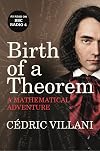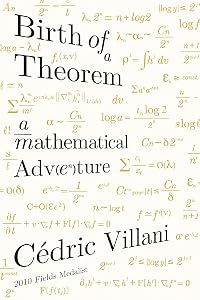
Birth of a Theorem: A Mathematical Adventure
by Cédric Villani
On This Page
Description
"An intimate look inside a mathematician's mind as he wrestles with the theorem that will make his reputation Ce;dric Villani is a rock-star mathematician. An intellect of unusual depth and breadth, he is the director of France's greatest mathematics research institute. In 2010 he received the Fields Medal, the most coveted prize in mathematics, for his proofs resolving one of the most controversial theories of classical physics. Birth of a Theorem is his own account of the year leading up show more to the award. It invites readers inside the mind of a genius as he wrestles with the most important work of his career. But you don't have to understand nonlinear Landau damping to love Birth of a Theorem. It doesn't simplify or overexplain; rather, it invites readers into collaboration. Villani's diaries, e-mails, and musings enmesh you in the process of discovery. You join him in unproductive lulls and late-night breakthroughs. You're privy to the mess-hall conversations of the world's greatest research institutions. Villani discusses his favorite songs, his love of manga, and the imaginative stories he tells his children. Mathematics is like any other creative work in that the thinker's whole life propels discovery--and with Birth of a Theorem, Villani welcomes you into his"-- "An intimate look inside a mathematician's mind as he wrestles with the theorem that will make his reputation"-- show lessTags
Recommendations



Member Reviews
The book gives a great feeling for the process of mathematics, and for the lifestyle of a mathematician. It is hard to give a sense of the actual mathematical research, but everything around that is conveyed well. For example, Villani gives a fantastic sense for developing the main theorem, sketched out in emails with his collaborator, as they write a LaTeX paper (by emailed drafts, without version control) and develop the proofs simultaneously. He conveys the ups and downs, the false breakthroughs, the mistakes as well as the actual breakthroughs. He also gets across the social life and itinerancy of a mathematician, traveling the world between institutes with few solid relationships outside his immediate family.
It mixes in some show more history of mathematics (with brief portraits of famous mathematicians). It does not really attempt to convey any of the mathematics itself, except in a very sketchy, impressionistic way; this was fine for me.
The writing is extremely overindulgent. I could do without reading his random dreams, or the stories he reads to his children, or the list of all his favorite songs on Spotify (with an explanation for why he likes each song, and the lyrics for some of them!). There is lots of filler! His language is often overly flowery; for example, he describes a math conference with, "Revelers swanning about from one event to the next in luxury limos and romantic rickshaws, everywhere celebrating the unity and diversity of mathematics, its ever-shifting shapes and forms; everywhere overcome with joy at what has so far been accomplished and wonder before all that yet remains to be discovered; everywhere, day and night, dreaming of the unknown." Perhaps this was his honest experience—who am I to say? He had just won the Fields Medal. But it rings false.
Additionally, Villani has an incredible ego. He tries to disguise it to some extent, but it still comes through very strongly. He is obsessed, for example, with the Fields Medal, and is convinced that every other mathematician is equally obsessed. (In fact, I think he is in small minority.) I am not sure of his professional ethics—several times he announces a result without having a proof—but he is obviously brilliant. show less
It mixes in some show more history of mathematics (with brief portraits of famous mathematicians). It does not really attempt to convey any of the mathematics itself, except in a very sketchy, impressionistic way; this was fine for me.
The writing is extremely overindulgent. I could do without reading his random dreams, or the stories he reads to his children, or the list of all his favorite songs on Spotify (with an explanation for why he likes each song, and the lyrics for some of them!). There is lots of filler! His language is often overly flowery; for example, he describes a math conference with, "Revelers swanning about from one event to the next in luxury limos and romantic rickshaws, everywhere celebrating the unity and diversity of mathematics, its ever-shifting shapes and forms; everywhere overcome with joy at what has so far been accomplished and wonder before all that yet remains to be discovered; everywhere, day and night, dreaming of the unknown." Perhaps this was his honest experience—who am I to say? He had just won the Fields Medal. But it rings false.
Additionally, Villani has an incredible ego. He tries to disguise it to some extent, but it still comes through very strongly. He is obsessed, for example, with the Fields Medal, and is convinced that every other mathematician is equally obsessed. (In fact, I think he is in small minority.) I am not sure of his professional ethics—several times he announces a result without having a proof—but he is obviously brilliant. show less
A strangely compelling account of a few years in the life of a celebrated french mathematician. There are many equations and descriptions of mathematical techniques that will baffle almost everyone who reads this book. Although I had no clue what he was writing about most of the time, Villani's passion for his chosen profession made me want to read through to the end.
Short and sweet. I would have liked there to be more technical stuff (or at least, some explanation of what the technical stuff was), but hey, what can you expect for a popular autobiography? I'd recommend it.
Cédric Villani was the recipient of the Fields Medal in 2010. He recall the months leading to 2010.
This is an hard act to follow for people who are not mathematics graduate students.
This is an hard act to follow for people who are not mathematics graduate students.
Un livre qui (re-)donne envie de faire des maths, et ce même si l’on ne comprend pas le dixième des formules égrainées au fil des pages par Villani, totalement absconses mais d’une forme si esthétique. Le style est direct et vivant, notamment grâce à la retranscription des courriels qu’il échange avec son collègue. On suit avec grand intérêt la démarche scientifique de l’auteur, au gré de ses rencontres fertiles avec ses pairs, de ses doutes et de ses égarements, jusqu’à la preuve ultime du théorème, acte qui revêt alors une nature quasi-sacrée.
J’apprécie notamment ce trait de caractère mélangeant intrépidité et excès de confiance en soi — ce qui le rapproche ainsi de beaucoup autres hommes et show more femmes qui ont fait l’histoire — lorsqu'il n’hésite pas à présenter à toute la communauté scientifique une preuve encore partielle de son théorème, au risque d’être mis en défaut par ses confrères, mais ce qui lui permet en définitive d’améliorer sa démonstration, prouvant au lecteur la vertu du « trial and error » et de la critique constructive.
On peut juste peut-être regretter que le mathématicien esquisse à peine les contours de sa vie privée, l’homme s’effaçant derrière le chercheur sans doute ici un peu plus que dans la réalité. show less
J’apprécie notamment ce trait de caractère mélangeant intrépidité et excès de confiance en soi — ce qui le rapproche ainsi de beaucoup autres hommes et show more femmes qui ont fait l’histoire — lorsqu'il n’hésite pas à présenter à toute la communauté scientifique une preuve encore partielle de son théorème, au risque d’être mis en défaut par ses confrères, mais ce qui lui permet en définitive d’améliorer sa démonstration, prouvant au lecteur la vertu du « trial and error » et de la critique constructive.
On peut juste peut-être regretter que le mathématicien esquisse à peine les contours de sa vie privée, l’homme s’effaçant derrière le chercheur sans doute ici un peu plus que dans la réalité. show less
Jul 28, 2014French
1
Cédric Villani a reçu en 2010 la prestigieuse médaille Fields (l'équivalent du prix Nobel pour les Mathématiques).
Ce journal revient sur la période allant des premières intuitions autour du théorème qui lui vaudra la médaille, jusqu'à la réception du prix deux ans plus tard. Chaque chapitre se termine par un portrait de mathématicien ou une note historique.
Il y relate les nombreux échanges avec son collaborateur Clément Mouhot, nous confie ses ambitions de carrière (la présidence du centre Henri Poincaré), et insiste sur les hasards qui font avancer la démonstration, les fausses pistes et les doutes, les rêveries solitaires. Rien de bien original.
Les mathématiques sont présentées brutes, sans aucun effort de show more vulgarisation, comme pour impressionner en mettant en avant leur complexité ; on peut ainsi parcourir des extraits de démonstration et des énoncés de théorèmes aux termes inconnus du non initié, les abréviations anglaises et symboles mathématiques reproduits tels quels.
Préférez 'La Symphonie des nombres premiers' de Marcus du Sautoy pour de la vulgarisation de haute volée et un passionnant survol de l'histoire des Mathématiques. Et si vous lisez l'anglais, 'My Brain is Open' la biographie du mathématicien vagabond Paul Erdos, par Bruce Schechter. show less
Ce journal revient sur la période allant des premières intuitions autour du théorème qui lui vaudra la médaille, jusqu'à la réception du prix deux ans plus tard. Chaque chapitre se termine par un portrait de mathématicien ou une note historique.
Il y relate les nombreux échanges avec son collaborateur Clément Mouhot, nous confie ses ambitions de carrière (la présidence du centre Henri Poincaré), et insiste sur les hasards qui font avancer la démonstration, les fausses pistes et les doutes, les rêveries solitaires. Rien de bien original.
Les mathématiques sont présentées brutes, sans aucun effort de show more vulgarisation, comme pour impressionner en mettant en avant leur complexité ; on peut ainsi parcourir des extraits de démonstration et des énoncés de théorèmes aux termes inconnus du non initié, les abréviations anglaises et symboles mathématiques reproduits tels quels.
Préférez 'La Symphonie des nombres premiers' de Marcus du Sautoy pour de la vulgarisation de haute volée et un passionnant survol de l'histoire des Mathématiques. Et si vous lisez l'anglais, 'My Brain is Open' la biographie du mathématicien vagabond Paul Erdos, par Bruce Schechter. show less
Oct 7, 2012French
1
Ratings
Members
- Recently Added By
Lists

Books Read in 2015
3,299 works; 127 members

HS Mathematics class library
79 works; 6 members
Author Information

17+ Works 402 Members
Awards and Honors
Common Knowledge
- Canonical title*
- Il teorema vivente. La mia più grande avventura matematica
- Original publication date
- 2012
*Some information comes from Common Knowledge in other languages. Click "Edit" for more information.
Classifications
Statistics
- Members
- 333
- Popularity
- 95,111
- Reviews
- 6
- Rating
- (3.71)
- Languages
- 5 — English, French, German, Italian, Portuguese
- Media
- Paper, Ebook
- ISBNs
- 12
- ASINs
- 7