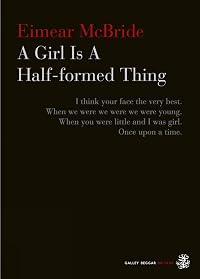
A Girl Is a Half-formed Thing
by Eimear McBride
On This Page
Description
"Winner of the 2013 Goldsmith Prize."Eimear McBride is a writer of remarkable power and originality."-The Times Literary Supplement"An instant classic."-The Guardian"It's hard to imagine another narrative that would justify this way of telling, but perhaps McBride can build another style from scratch for another style of story. That's a project for another day, when this little book is famous."-London Review of Books"A Girl is a Half-formed Thing is simply a brilliant book-entirely show more emotionally raw and at the same time technically astounding. Her prose is as haunting and moving as music, and the love story at the heart of the novel-between a sister and brother-as true and wrenching as any in literature. This is a book about everything: family, faith, sex, home, transcendence, violence, and love. I can't recommend it highly enough."-Elizabeth McCracken"My discovery of the year was Eimear McBride's debut novel A Girl Is a Half-Formed Thing."-Eleanor CattonEimear McBride's acclaimed debut tells the story of a young woman's relationship with her brother, and the long shadow cast by his childhood brain tumor, touching on everything from family violence to sexuality and the personal struggle to remain intact in times of intense trauma.Eimear McBride was born in 1976 and grew up in Ireland. At twenty-seven she wrote A Girl is a Half-formed Thing and spent the next nine years trying to have it published"-- show lessTags
Recommendations













Member Reviews
I almost didn’t make it past page 3 of A Girl is a Half-Formed Thing. I mean, what do you make of prose like this?
He says I can’t be waiting for it all the time. I’d give my eyes to fix him but. The heart cannot be wrung and wrung. And she like calmest Virgin Mary sitting on the bed. Hands warming up her sides for. What’re you saying? Breath. Going? Leaving? But he’s just stopped dying. This one’s to come. Please don’t no I won’t stop you. could never make you do a thing. You’ll support us. Aren’t you great? Oh the house is mine. It’s for the best. For who you me? Board my body up. I’m not for loving. Anymore. I’ll live for housework. Dressing kids. And you for mortgage new shoes spuds. Can’t live short hope show more but gas bills long and paid on time too. Oh so kind. Aren’t you the fine shape of a man.
It took some effort to understand the first chapter of this book in which the girl, still in utero, describes her older brother’s brain tumor and surgery, and the devastating impact of the boy’s illness on his parents’ marriage. And things don’t get any better once the unnamed girl enters the world. Her family is poor. Her brother’s intellectual development is slow and he is teased by classmates. Her mother is deeply religious, and convinced of the power of prayer to solve all of life’s problems. The girl becomes a victim of both verbal and sexual abuse, and lacking much-needed emotional support, she adopts extremely unhealthy behaviors as an adolescent and young adult. Eventually you can see a climax building, and it’s not pretty. In fact, it’s pretty devastating.
This book is unrelentingly bleak. Nothing good happens. Ever. But once I got past the choppy, disjointed writing style I found it surprisingly effective at conveying a mood, a tone. I was immersed in the girl’s world and could almost literally feel her pain. It’s not a book I’d recommend to just anyone, but if you are intrigued by its experimental nature and can deal with some very disturbing themes, you will be rewarded. show less
He says I can’t be waiting for it all the time. I’d give my eyes to fix him but. The heart cannot be wrung and wrung. And she like calmest Virgin Mary sitting on the bed. Hands warming up her sides for. What’re you saying? Breath. Going? Leaving? But he’s just stopped dying. This one’s to come. Please don’t no I won’t stop you. could never make you do a thing. You’ll support us. Aren’t you great? Oh the house is mine. It’s for the best. For who you me? Board my body up. I’m not for loving. Anymore. I’ll live for housework. Dressing kids. And you for mortgage new shoes spuds. Can’t live short hope show more but gas bills long and paid on time too. Oh so kind. Aren’t you the fine shape of a man.
It took some effort to understand the first chapter of this book in which the girl, still in utero, describes her older brother’s brain tumor and surgery, and the devastating impact of the boy’s illness on his parents’ marriage. And things don’t get any better once the unnamed girl enters the world. Her family is poor. Her brother’s intellectual development is slow and he is teased by classmates. Her mother is deeply religious, and convinced of the power of prayer to solve all of life’s problems. The girl becomes a victim of both verbal and sexual abuse, and lacking much-needed emotional support, she adopts extremely unhealthy behaviors as an adolescent and young adult. Eventually you can see a climax building, and it’s not pretty. In fact, it’s pretty devastating.
This book is unrelentingly bleak. Nothing good happens. Ever. But once I got past the choppy, disjointed writing style I found it surprisingly effective at conveying a mood, a tone. I was immersed in the girl’s world and could almost literally feel her pain. It’s not a book I’d recommend to just anyone, but if you are intrigued by its experimental nature and can deal with some very disturbing themes, you will be rewarded. show less
I should preface this review by saying that this book will not be for everyone. Written in a unique voice and style, A Girl is a Half-formed Thing is a stream of consciousness type novel of an unnamed first person protagonist. It’s not an easy read, as the sentence structure is sometimes fragmented and there are made-up words (which have a wonderful onomatopoeia quality to them). As the girl ages, things do become a little more coherent and conventional in terms of language – unless something awful is happening to her, which sadly is often in this book.
The storyline is quite simple – the story of the girl from before her birth (significant as her beloved brother had a brain tumour before she was born) to early adulthood. However, show more it’s what happens during these years that will shock you. Her household is very religious and her mother beats her children and threatens them during their youth. Then there’s an emotional upheaval where the family moves house, followed by the children meeting their aunt and uncle. For our protagonist, this changes her life course and sets her up for many meaningless sexual encounters and an awkward, unhealthy relationship.
In between all these harrowing events, the reader finds out how much the protagonist loves her brother. After his brain tumour, he’s left with an impressive scar and some intellectual impairment – he studies as hard as he can for hours and hours, but only sometimes passes. She protects him best she can, but doesn’t always succeed. Although she loves him, she finds it frustrating to have to look out for him and act as a go-between for him and their mother. She eventually moves away for college, where her brother proves his devotion and she the strength of her love, in harrowing circumstances.
This book is incredibly emotional – there are some parts that are distinctly uncomfortable to read because of the raw, brutal feelings and experiences that are being expressed by the protagonist. It’s quite sickening to think of these things happening to anyone, but when you’re reading about it happening to the main character, it’s almost unbearable. McBride conveys a feeling of reality as our protagonist is trying to block it all out, shown in the way her language starts to fragment and run wild, to focus on anything but what is actually happening to her.
The final section, which focuses on a tragic event involving the whole family, is packed full of emotion. Each person is doing what they think best, which happens to be at cross-purposes to what others think is right. There are tense scenes and things become much more complicated for our protagonist as everyone seems to be using her in some way, but she doesn’t seek help. Like the rest of the book, this part is very dark. It’s not a happy novel.
So why read it if it’s not conventionally structured or happy? I found once I got into the flow of the girl’s language, the whole scene just ‘popped’ into my head – the imagery was stunning. Plus, it’s a book that remained with me long after I closed it – I was thinking about our unnamed girl and her family and what might have been. The way A Girl is a Half-formed Thing makes the reader feel is second to none. It’s very, very powerful in creating strong reactions and emotions to the events that occur.
http://samstillreading.wordpress.com show less
The storyline is quite simple – the story of the girl from before her birth (significant as her beloved brother had a brain tumour before she was born) to early adulthood. However, show more it’s what happens during these years that will shock you. Her household is very religious and her mother beats her children and threatens them during their youth. Then there’s an emotional upheaval where the family moves house, followed by the children meeting their aunt and uncle. For our protagonist, this changes her life course and sets her up for many meaningless sexual encounters and an awkward, unhealthy relationship.
In between all these harrowing events, the reader finds out how much the protagonist loves her brother. After his brain tumour, he’s left with an impressive scar and some intellectual impairment – he studies as hard as he can for hours and hours, but only sometimes passes. She protects him best she can, but doesn’t always succeed. Although she loves him, she finds it frustrating to have to look out for him and act as a go-between for him and their mother. She eventually moves away for college, where her brother proves his devotion and she the strength of her love, in harrowing circumstances.
This book is incredibly emotional – there are some parts that are distinctly uncomfortable to read because of the raw, brutal feelings and experiences that are being expressed by the protagonist. It’s quite sickening to think of these things happening to anyone, but when you’re reading about it happening to the main character, it’s almost unbearable. McBride conveys a feeling of reality as our protagonist is trying to block it all out, shown in the way her language starts to fragment and run wild, to focus on anything but what is actually happening to her.
The final section, which focuses on a tragic event involving the whole family, is packed full of emotion. Each person is doing what they think best, which happens to be at cross-purposes to what others think is right. There are tense scenes and things become much more complicated for our protagonist as everyone seems to be using her in some way, but she doesn’t seek help. Like the rest of the book, this part is very dark. It’s not a happy novel.
So why read it if it’s not conventionally structured or happy? I found once I got into the flow of the girl’s language, the whole scene just ‘popped’ into my head – the imagery was stunning. Plus, it’s a book that remained with me long after I closed it – I was thinking about our unnamed girl and her family and what might have been. The way A Girl is a Half-formed Thing makes the reader feel is second to none. It’s very, very powerful in creating strong reactions and emotions to the events that occur.
http://samstillreading.wordpress.com show less
About two thirds of the way into A Girl… comes this paragraph:
“In the waves. I am the waves by the city in the sea. I’ve come out. To be in the cold. To see again for a long way off. Out there somewhere is. New York. What if I could go? It would be so. So far I cannot even see.”
The narrator is a young adult at this point. Still her world is small. This feels less like a desire than an expression of how proximate her perceptions still are – they are contained within the experience of the body/mind and extremities.
The page before comes this, she is on the phone to her uncle who is significant to the unravelling of this young girl’s life:
Hello. Are you still there? His voice tiny diamond cutting strips out of air.
At first show more I thought this metaphor clumsy. Until I read the next page and remembered that the world around the narrator is close in on her. So of course the air around her is dense, so dense only a diamond can cut through it. It’s as though she experiences the world with a higher density of gravity than the rest of us. Emotions, perceptions, sounds, sights, touch all compress her.
Proprioception is one of our senses, the one we never talk about and the one we never know how to pronounce. It is the sense we form early in life, as babies, of the immediate world around us. Watch a baby in a crib thrashing its arms and legs around uncoordinated, it is learning how to define itself in its own surroundings, as though reaching out towards the outer reaches of itself. Eventually we learn where those places are - where the tip of our fingers, our knees, the tops of our heads and our noses are in space. Then we no longer think about it. It is part of us. When someone loses that sense, say when the brain is damaged in particular locations, they may move and jerk like an insect on its back, they have lost their proprioception. The boundaries of the self is damaged and incapable of fixing itself.
This proprioception sense helps me understand the idea of the self as a location with a boundary. We cultivate boundaries so we don’t get harmed (physically and emotionally) and can go about our business. So it’s kind of the outer limit of our consciousness and sense of self. Every other person has the same sense of space and self around them, we think. With our narrator, this has broken down. The self and its awareness of the space around her was broken from the age of thirteen. Then the body, mind and all the ideas of personal integrity disappear. The narrator since thirteen has become not quite themselves, or another way, not grown up. Without boundaries, the body and self is available for abuse. The narrator can receive and can even instigate it. Her integrity was breached so to speak, she has lost the version of the self that was forming as a young teenager. She becomes an agent in her own self-destruction.
The effect on the page is that the space around our narrator in A Girl… is always close, as though we’re watching a life on a screen in close up.
Fragmentation is the norm for our narrator. The sense of self is bits and pieces, hence the bitsy, piecey, disconnect of data bits.
Qualia are the little units of experience data processed by our neurons, the sights sounds touch thoughts experiences of our immediate world all getting processed into something we want to place an understanding around. A little like narrative in a work of fiction.
Victoria, the teenage character from the comedy TV show Little Britain expresses herself in endless monologues of bits and pieces of her views and perceptions. She is the epitome of solipsism; the world doesn’t exist outside her immediate perception of it.
This immediate world is what we’re exposed to here, not Victoria’s reverie of comical diatribes, but a narrator whose voice and expression of her world is fixed at a point sometime in early teens. Trauma often fixes us into the age when an event happens to us and we don’t grow past it, forever in a state. So all those data bits we receive are processed through this fragmented ‘narrative voice’ too.
Perception, our sensory experience, isn’t received in sentence form and if it was, it’s syntax would be everywhere. The normal parts of speech placement - subject object verb noun adjective need a well formed socialised self to place them in order to articulate clear sentences. But literary narratives don’t need to do that. They can express an approximation of the inner world of the self. So in literature a story can take place with a disrupted syntax. If you listen to someone whose first language is not English tell a story in English, you experience this. But you can fill in the spaces with proper prose and know what they are saying, or you can just get the story from the bits that are there. If you listen hard enough. Similarly, if you listen long enough to street talk, teenage talk etc, all those sub-genres of language, you eventually work out the narrative that at first seems incomprehensible. You get into its flow.
Of course, to see the world the way our narrator does is not unusual. It is how a child experiences before they can articulate in a socialised way. Or just imagine spending a day encountering no one, living out an endless stream of thoughts and perceptions. You only need to order them when you encounter another person, you are OK in your own non-syntactical, grammatically disordered world. But when someone enters the room, you know you have to pull those thoughts back into a grammatical order again. Unless you have lost that ability and all of those thoughts exist right at the surface incapable of getting out.
Trauma may be the primary cause that keeps the narrator experiencing the world and herself the way she does. Though she’s more than a medical case history.
In A girl…, we are taken out of ourselves into a new world not our own. Once you get into the flow of the language, you willingly enter another dimension. When there, it’s not so different from how the world is experienced daily anyway by most of us. When we accept that we want to experience another’s world, we might be transported into one of the many possibilities of being human. show less
“In the waves. I am the waves by the city in the sea. I’ve come out. To be in the cold. To see again for a long way off. Out there somewhere is. New York. What if I could go? It would be so. So far I cannot even see.”
The narrator is a young adult at this point. Still her world is small. This feels less like a desire than an expression of how proximate her perceptions still are – they are contained within the experience of the body/mind and extremities.
The page before comes this, she is on the phone to her uncle who is significant to the unravelling of this young girl’s life:
Hello. Are you still there? His voice tiny diamond cutting strips out of air.
At first show more I thought this metaphor clumsy. Until I read the next page and remembered that the world around the narrator is close in on her. So of course the air around her is dense, so dense only a diamond can cut through it. It’s as though she experiences the world with a higher density of gravity than the rest of us. Emotions, perceptions, sounds, sights, touch all compress her.
Proprioception is one of our senses, the one we never talk about and the one we never know how to pronounce. It is the sense we form early in life, as babies, of the immediate world around us. Watch a baby in a crib thrashing its arms and legs around uncoordinated, it is learning how to define itself in its own surroundings, as though reaching out towards the outer reaches of itself. Eventually we learn where those places are - where the tip of our fingers, our knees, the tops of our heads and our noses are in space. Then we no longer think about it. It is part of us. When someone loses that sense, say when the brain is damaged in particular locations, they may move and jerk like an insect on its back, they have lost their proprioception. The boundaries of the self is damaged and incapable of fixing itself.
This proprioception sense helps me understand the idea of the self as a location with a boundary. We cultivate boundaries so we don’t get harmed (physically and emotionally) and can go about our business. So it’s kind of the outer limit of our consciousness and sense of self. Every other person has the same sense of space and self around them, we think. With our narrator, this has broken down. The self and its awareness of the space around her was broken from the age of thirteen. Then the body, mind and all the ideas of personal integrity disappear. The narrator since thirteen has become not quite themselves, or another way, not grown up. Without boundaries, the body and self is available for abuse. The narrator can receive and can even instigate it. Her integrity was breached so to speak, she has lost the version of the self that was forming as a young teenager. She becomes an agent in her own self-destruction.
The effect on the page is that the space around our narrator in A Girl… is always close, as though we’re watching a life on a screen in close up.
Fragmentation is the norm for our narrator. The sense of self is bits and pieces, hence the bitsy, piecey, disconnect of data bits.
Qualia are the little units of experience data processed by our neurons, the sights sounds touch thoughts experiences of our immediate world all getting processed into something we want to place an understanding around. A little like narrative in a work of fiction.
Victoria, the teenage character from the comedy TV show Little Britain expresses herself in endless monologues of bits and pieces of her views and perceptions. She is the epitome of solipsism; the world doesn’t exist outside her immediate perception of it.
This immediate world is what we’re exposed to here, not Victoria’s reverie of comical diatribes, but a narrator whose voice and expression of her world is fixed at a point sometime in early teens. Trauma often fixes us into the age when an event happens to us and we don’t grow past it, forever in a state. So all those data bits we receive are processed through this fragmented ‘narrative voice’ too.
Perception, our sensory experience, isn’t received in sentence form and if it was, it’s syntax would be everywhere. The normal parts of speech placement - subject object verb noun adjective need a well formed socialised self to place them in order to articulate clear sentences. But literary narratives don’t need to do that. They can express an approximation of the inner world of the self. So in literature a story can take place with a disrupted syntax. If you listen to someone whose first language is not English tell a story in English, you experience this. But you can fill in the spaces with proper prose and know what they are saying, or you can just get the story from the bits that are there. If you listen hard enough. Similarly, if you listen long enough to street talk, teenage talk etc, all those sub-genres of language, you eventually work out the narrative that at first seems incomprehensible. You get into its flow.
Of course, to see the world the way our narrator does is not unusual. It is how a child experiences before they can articulate in a socialised way. Or just imagine spending a day encountering no one, living out an endless stream of thoughts and perceptions. You only need to order them when you encounter another person, you are OK in your own non-syntactical, grammatically disordered world. But when someone enters the room, you know you have to pull those thoughts back into a grammatical order again. Unless you have lost that ability and all of those thoughts exist right at the surface incapable of getting out.
Trauma may be the primary cause that keeps the narrator experiencing the world and herself the way she does. Though she’s more than a medical case history.
In A girl…, we are taken out of ourselves into a new world not our own. Once you get into the flow of the language, you willingly enter another dimension. When there, it’s not so different from how the world is experienced daily anyway by most of us. When we accept that we want to experience another’s world, we might be transported into one of the many possibilities of being human. show less
A Girl is a Half-Formed Thing reads like Eimear McBride wrote the whole thing as a stream of consciousness, hung it on the wall and then fired full stops at it from a sawn-off shotgun. The whole thing is riddled with randomly-placed periods that defy the reader's attempt to engage in the story. Frequently there are three or more periods in what would scan as a normal sentence, ripping your attention back into the mechanics of reading rather than enjoying the novel. Some people can get past this kind of writing; I couldn't.
If the above is no hurdle for you, the novel tells an affecting tale about a young Irish girl growing up with her seriously ill brother and religious single mother. Serious mis-steps during her teens turn her into a show more promiscuous rebel and sadly weakens her relationship with her brother and mother. A family crisis occurs that brings the conflict to a head.
Some of the writing is quite musical and the story is interesting enough but, as I said above, McBride has vandalised her own novel by making it as difficult as possible for the reader to engage with her characters and their lives. Too much artifice has killed the art. show less
If the above is no hurdle for you, the novel tells an affecting tale about a young Irish girl growing up with her seriously ill brother and religious single mother. Serious mis-steps during her teens turn her into a show more promiscuous rebel and sadly weakens her relationship with her brother and mother. A family crisis occurs that brings the conflict to a head.
Some of the writing is quite musical and the story is interesting enough but, as I said above, McBride has vandalised her own novel by making it as difficult as possible for the reader to engage with her characters and their lives. Too much artifice has killed the art. show less
A Girl is a Half-Formed Thing is a both deeply beautiful and deeply unsettling book. Although the structure of the novel itself is in fact fairly conventional and linear, the language is anything but expected or conventional. There are few coherent sentences, and yet the story itself has a coherent flow if you allow the words their own space and their own musicality. I suppose one might think it the author was attempting to write in a stream of consciousness mode, but that is not exactly it. More likely the language seems to be attempting to explore that indistinct bridging between the inner primitive instinctual reaction and conscious thought. The language of the novel seems to float in shifting sands between the rawness of instinct show more and the music of poetry. In fact I would say this novel is far easier to read if you approach it as it was an epic poem. Then the language can capture something elusive, and beautiful, in the story, even though the story itself is tragic. Another point, even though one feels one knows the main character here, this too is an just an impression. We read, and think we know the narrator's thoughts, but just as we ourselves are more than just our instinctual selves, so too this narrator, but we never really see her fully, just as we are never told anything about the physical being of any of the characters. It is a haunting novel of pain and suffering and love, but also of knowing and not-knowing, and as such, I think it will remain with me for a long time show less
To say this demanding, brutal, and fractured novel is not for everyone is a terrific understatement. With a style inspired by James Joyce and a bleakness that Cormac McCarthy would be right at home with, it's no surprise that it took almost a decade to find a publisher, though once it did it took in a number of awards: Irish Novel of the Year, Baileys Women's Prize for Fiction, the Goldsmith's Prize for fiction that "opens up new possibilities".
Essentially, the novel is about a young woman who suffers from a series of emotional and physical abuses and her own self-destructive behavioral responses to this abuse. Her father abandons the family before she's even born, while her toddler brother has a cancerous brain tumor. Her mother show more reacts by submersing herself in obsessive religiosity. Her uncle rapes her when she's 13. She comes of age and escapes to the city, acting out in self-harm but at least free to grope towards something better, but then her brother's cancer returns and she goes home and it all goes rotten.
The novel is written in fractured style, ignoring any and all good rules of grammar. This makes reading it hard work, except for those times when it feels like as the reader you get in a groove and can flow along with the rhythm of the words, understanding meaning on the conscious level, yes, but also catching meaning that seeps up from your subconscious. This didn't always happen for me and when it didn't the book felt like a struggle, but when it did, the book felt like genius. The fractured syntax could be said to reflect the protagonist's damaged state of mind, and this is very effectively the case as the story arc descends into greater horror and the writing becomes even more garbled and inchoate.
To illustrate the style, here's what I thought was a sterling passage describing what you might say was the beginning of her existence as a sexual being, around puberty:
Essentially, the novel is about a young woman who suffers from a series of emotional and physical abuses and her own self-destructive behavioral responses to this abuse. Her father abandons the family before she's even born, while her toddler brother has a cancerous brain tumor. Her mother show more reacts by submersing herself in obsessive religiosity. Her uncle rapes her when she's 13. She comes of age and escapes to the city, acting out in self-harm but at least free to grope towards something better, but then her brother's cancer returns and she goes home and it all goes rotten.
The novel is written in fractured style, ignoring any and all good rules of grammar. This makes reading it hard work, except for those times when it feels like as the reader you get in a groove and can flow along with the rhythm of the words, understanding meaning on the conscious level, yes, but also catching meaning that seeps up from your subconscious. This didn't always happen for me and when it didn't the book felt like a struggle, but when it did, the book felt like genius. The fractured syntax could be said to reflect the protagonist's damaged state of mind, and this is very effectively the case as the story arc descends into greater horror and the writing becomes even more garbled and inchoate.
To illustrate the style, here's what I thought was a sterling passage describing what you might say was the beginning of her existence as a sexual being, around puberty:
Like smoke in my lungs to be coughed out. I'd throw up excitement. What is it? Like a nosebleed. Like a freezing pain. I felt me not me. Turning to the sun. Feel the roast of it. Like sunburn. Like a hot sunstroke. Like globs dropping in. Through my hair. Spat skin with it. Blank my eyes the dazzle. Huge shatter. Me who is just new. Fallen out of the sky. What. Is lust it? That's it. The first splinter. I.show less
Unrelentingly dark.
Unique writing style took a few chapters to get used to before I stopped noticing it, swept away in the beauty of it.
Damn 'literary fiction' and the motherfucking Catholics.
Unique writing style took a few chapters to get used to before I stopped noticing it, swept away in the beauty of it.
Damn 'literary fiction' and the motherfucking Catholics.
Members
- Recently Added By
Published Reviews
ThingScore 81
It is a testament to McBride’s erudite yet brazen originality that the novel can thoughtfully speak back to some of the great texts of Western literature, while at the same time reading as though it were created entirely out of thin air.
added by Widsith
McBride’s language … justifies its strangeness on every page. Her prose is a visceral throb, and the sentences run meanings together to produce a kind of compression in which words, freed from the tedious march of sequence, seem to want to merge with one another, as paint and musical notes can. The results are thrilling, and also thrillingly efficient.
added by Widsith
"Formidable," in both its meanings, best sums it up: This is a novel that initially intimidates, but after we have adapted to McBride's rhythms, its creative and emotional power renders us awe-struck.…This is brave, dizzying, risk-taking fiction of the highest order.
added by Widsith
Lists

1001 Books You Must Read Before You Die
1,448 works; 1,134 members

Your favorite books from the 2014 Baileys Women's Prize for Fiction
20 works; 23 members

Baileys Women's Prize for Fiction Winners and Shortlisted Books
61 works; 11 members

Top Five Books of 2014
1,064 works; 398 members

Women's Prize for Fiction
29 works; 5 members

BBC Radio 4 Bookclub
340 works; 13 members

Kirkus Reviews Best Fiction of 2014
100 works; 7 members
Author Information

7+ Works 2,100 Members
Some Editions
Awards and Honors
Awards
Distinctions
Work Relationships
Has the adaptation
Common Knowledge
- Original title
- A Girl is Half-formed Thing
- Original publication date
- 2013
- Important places
- Ireland
- Dedication
- For Donagh McBride
- First words
- For you. You'll soon. You'll give her name.
- Last words
- (Click to show. Warning: May contain spoilers.)What?
My name is gone. - Blurbers
- Enright, Anne
Classifications
Statistics
- Members
- 1,250
- Popularity
- 19,658
- Reviews
- 65
- Rating
- (3.67)
- Languages
- 9 — Dutch, English, French, German, Italian, Korean, Portuguese, Spanish, Turkish
- Media
- Paper, Audiobook, Ebook
- ISBNs
- 31
- UPCs
- 1
- ASINs
- 13