On This Page
Description
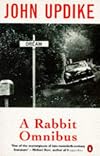
The trilogy comprises of Rabbit, Run, Rabbit Redux and Rabbit is Rich. It is intended as an amusing, sympathetic study of a man, Rabbit Angstron, putting up a fight against the inevitable.Tags
Recommendations














Member Reviews
I've just read the first Rabbit Run so far, I just want to record my thoughts for later comparison once I get through the others.
From the start I was somewhat put off by Updike's style. Every little moment seems to be dissected into a thousand peices, with each characters motives and actions a prism into their psyche. I became somewhat impatient and actually overwelmed as page upon page of these absoutely stunningly insightful paragraphs kept coming at me. I was struggling for breath!
As I adjusted to it I decided to just go with it and follow him into the depths and folds of this story, plumet to the depths of consciousness every second paragraph. Because the plot did actually move on. The closely set type of this edition probably show more doesn't help and I find myself often rereading paragraphs several times.
Now into the second book Rabbit Redux I'm totally hooked on Updike and I think he is truly a genius.
From the beginning of Rabbit Run I was struck by the presence of the mountain. It looms large over the city and seems to loom large in Rabbit's mind, not that he would be aware of that, which is actually the point. Rabbit just takes his life in little impulses, letting them guide and following them, the reason behind it and mass of his self that is unexplored and wild, like a looming wild mountain of his psyche. He runs from one side of the mountain to the other, pushed and pulled but never in command, never sitting in judgement of himself. Which makes the name Mount Judge just so poetic. At the end of the novel as he finally starts to reconcile himself his trip into the wilds of the mountain and emergence out again, a changed man, now truly reconciled with his own self.
So now I've almost finished the second book, Rabbit Redux. I'm still entranced by Updike's utter genius. I just love the reflections running through the books. Rabbit is the taker, what you have he'll take, Jill is the giver, what you want she gives. So of course they end up together. Their meeting in the club so like the meeting of Rabbit and his first girlfriend (forgot her name). Again one outing, one meeting and he's hooked up. Everything in the book just seems to bend to Rabbit, he just glides through life taking what he wants and people just keepin on giving. But he is just sliding through, not actually deciding or acting just floating on through. As is Jill. What can happen to a life like this, the empty space left by all that lack of will has to get filled with something, and whoa here he comes - Skeeter. So out of control he fills their life like a maelstrom. It's going to take something like this to shake Rabbit out of his slumberful life - I'm just waiting for him to wake and see what happens - don't let me down Updike!
So now I finally have Harry Angstrom off my back, well I've finished this volume anyway. My early thoughts about the density of the text were gone by the third volume, not sure if I got used to it or the style changed somewhat. I'm putting this series up there with my all time favourite books. Harry doesn't get any more attractive as a character as the book goes on but you are still compelled to find out how his life pans out. Ever the passive rider in his life, things just unfold in front of Harry and he takes them as they appear. The final volume I may put on my read later list, but I'd be more interested to sample some more Updike just to see if he really is Harry Angstrom, can he really write any other character as real as this one? show less
From the start I was somewhat put off by Updike's style. Every little moment seems to be dissected into a thousand peices, with each characters motives and actions a prism into their psyche. I became somewhat impatient and actually overwelmed as page upon page of these absoutely stunningly insightful paragraphs kept coming at me. I was struggling for breath!
As I adjusted to it I decided to just go with it and follow him into the depths and folds of this story, plumet to the depths of consciousness every second paragraph. Because the plot did actually move on. The closely set type of this edition probably show more doesn't help and I find myself often rereading paragraphs several times.
Now into the second book Rabbit Redux I'm totally hooked on Updike and I think he is truly a genius.
From the beginning of Rabbit Run I was struck by the presence of the mountain. It looms large over the city and seems to loom large in Rabbit's mind, not that he would be aware of that, which is actually the point. Rabbit just takes his life in little impulses, letting them guide and following them, the reason behind it and mass of his self that is unexplored and wild, like a looming wild mountain of his psyche. He runs from one side of the mountain to the other, pushed and pulled but never in command, never sitting in judgement of himself. Which makes the name Mount Judge just so poetic. At the end of the novel as he finally starts to reconcile himself his trip into the wilds of the mountain and emergence out again, a changed man, now truly reconciled with his own self.
So now I've almost finished the second book, Rabbit Redux. I'm still entranced by Updike's utter genius. I just love the reflections running through the books. Rabbit is the taker, what you have he'll take, Jill is the giver, what you want she gives. So of course they end up together. Their meeting in the club so like the meeting of Rabbit and his first girlfriend (forgot her name). Again one outing, one meeting and he's hooked up. Everything in the book just seems to bend to Rabbit, he just glides through life taking what he wants and people just keepin on giving. But he is just sliding through, not actually deciding or acting just floating on through. As is Jill. What can happen to a life like this, the empty space left by all that lack of will has to get filled with something, and whoa here he comes - Skeeter. So out of control he fills their life like a maelstrom. It's going to take something like this to shake Rabbit out of his slumberful life - I'm just waiting for him to wake and see what happens - don't let me down Updike!
So now I finally have Harry Angstrom off my back, well I've finished this volume anyway. My early thoughts about the density of the text were gone by the third volume, not sure if I got used to it or the style changed somewhat. I'm putting this series up there with my all time favourite books. Harry doesn't get any more attractive as a character as the book goes on but you are still compelled to find out how his life pans out. Ever the passive rider in his life, things just unfold in front of Harry and he takes them as they appear. The final volume I may put on my read later list, but I'd be more interested to sample some more Updike just to see if he really is Harry Angstrom, can he really write any other character as real as this one? show less
Rabbit is Rich is the third novel in the Rabbit series. Harry Angstrom is always running away from something (death?) or wanting to run away from something (responsibility?), hence the moniker, “Rabbit.” He was once a high school basketball star, who has now reached a paunchy middle-age. He still lives the small town of his birth, Brewer, Pennsylvania. Harry has inherited the Toyota dealership belonging to his wife’s Janice late father and they are now living quite comfortably with Janice’s mother in Ma Springer’s home. He has problems with his son, Nelson who also has a problem staying put and facing responsibilities. Updike specializes in skewering the American small town life and the Protestant middle class. In Rabbit is show more Rich, Updike continues in this vein. In the series we follow Rabbit has he runs through the decades of the 60’s, 70’s, and 80’s. Although the novels were written contemporaneously, read now, they have an air of nostalgia about them. It is interesting that the problems of the late 70’s and early 80’s are eerily similar today’s problems: rising gas prices, foreign competition, the economy, and the Iranian hostage crisis.
Updike’s work has been described as bourgeois-pornographic fiction that glorifies adultery. While it true Updike's fiction is full of sexual encounters and ruminations, I would not agree to the charge of pornography or gratuitousness. I think, rather it is an exposition of what Updike thinks is the way American males think and how American couples act with each other in this particular milieu. I must say, I agree with him and find this evocation part of the genius of his writing. The other part of his genius is his wonderfully crafted sentences, each one a joy to behold and to read. Rabbit is Rich was awarded the Pulitzer Prize for Fiction, the National Book Award and the National Book Critics Circle Award. Updike has been on the short list for Nobel Prize consideration for years. show less
Updike’s work has been described as bourgeois-pornographic fiction that glorifies adultery. While it true Updike's fiction is full of sexual encounters and ruminations, I would not agree to the charge of pornography or gratuitousness. I think, rather it is an exposition of what Updike thinks is the way American males think and how American couples act with each other in this particular milieu. I must say, I agree with him and find this evocation part of the genius of his writing. The other part of his genius is his wonderfully crafted sentences, each one a joy to behold and to read. Rabbit is Rich was awarded the Pulitzer Prize for Fiction, the National Book Award and the National Book Critics Circle Award. Updike has been on the short list for Nobel Prize consideration for years. show less
Epic American Trilogy of a high school football star and what happens over the course of his life; his post high school disillusionment followed by a sort of happy suburban success.
Ratings
Members
- Recently Added By
Lists

The Guardian's 1000 Novels Everyone Must Read
1,005 works; 546 members

The Telegraph's 110 Best Books: The Perfect Library
101 works; 17 members

TML 200 Best Books 1950-1999
202 works; 10 members
Author Information

338+ Works 53,353 Members
American novelist, poet, and critic John Updike was born in Reading, Pennsylvania on March 18, 1932. He received an A.B. degree from Harvard University, which he attended on a scholarship, in 1954. After graduation, he accepted a one-year fellowship to study painting at the Ruskin School of Drawing and Fine Art in Oxford, England. After returning show more from England in 1955, he worked for two years on the staff of The New Yorker. This marked the beginning of a long relationship with the magazine, during which he has contributed numerous short stories, poems, and book reviews. Although Updike's first published book was a collection of verse, The Carpentered Hen and Other Tame Creatures (1958), his renown as a writer is based on his fiction, beginning with The Poorhouse Fair (1959). During his lifetime, he wrote more than 50 books and primarily focused on middle-class America and their major concerns---marriage, divorce, religion, materialism, and sex. Among his best-known works are the Rabbit tetrology---Rabbit, Run (1960), Rabbit Redux (1971), Rabbit Is Rich (1981), and Rabbit at Rest (1988). Rabbit, Run introduces Harry "Rabbit" Angstrom as a 26-year-old salesman of dime-store gadgets trapped in an unhappy marriage in a dismal Pennsylvania town, looking back wistfully on his days as a high school basketball star. Rabbit Redux takes up the story 10 years later, and Rabbit's relationship with representative figures of the 1960s enables Updike to provide social commentary in a story marked by mellow wisdom and compassion in spite of some shocking jolts. In Rabbit Is Rich, Harry is comfortably middle-aged and complacent, and much of the book seems to satirize the country-club set and the swinging sexual/social life of Rabbit and his friends. Finally, in Rabbit at Rest, Harry arrives at the age where he must confront his mortality. Updike won the Pulitzer Prize for both Rabbit Is Rich and Rabbit at Rest. Updike's other novels range widely in subject and locale, from The Poorhouse Fair, about a home for the aged that seems to be a microcosm for society as a whole, through The Court (1978), about a revolution in Africa, to The Witches of Eastwick (1984), in which Updike tries to write from inside the sensibilities of three witches in contemporary New England. The Centaur (1963) is a subtle, complicated allegorical novel that won Updike the National Book Award in 1964. In addition to his novels, Updike also has written short stories, poems, critical essays, and reviews. Self-Consciousness (1989) is a memoir of his early life, his thoughts on issues such as the Vietnam War, and his attitude toward religion. He was elected to the American Academy of Arts and Letters in 1977. He died of lung cancer on January 27, 2009 at the age of 76. (Bowker Author Biography) John Updike was born in 1932, in Shillington, Pennsylvania. Since 1957 he has lived in Massachusetts. His novels have won the Pulitzer Prize, the National Book Award, the National Book Critics Circle Award, & the Howells Medal. (Publisher Provided) John Updike was born in 1932 and attended Harvard College and the Ruskin School of Drawing and Fine Art in Oxford, England. Form 1955 to 1957 he was a staff member of The New Yorker, which he contributed numerous writings. Updike's art criticism has appeared in publications including Arts and Antiques, The New Republic, The New York Times Book Review, and Realites, among many others. He is the author of such best-selling novels as Rabbit Run and Rabbit is Rich. His many works of fiction, poetry and criticism have been awarded the Pulitzer Prize, the National Book Award, the American Book Award, and the National Book Critics Circle Award. For the past 40 years he has lived in Massachusetts. (Publisher Provided) John Updike is the author of some 50 books, including collections of short stories, poems, & criticism. His novels have won the Pulitzer Prize, the National Book Award, the National Book Critics Circle Award, & the Howells Medal. Born in Shillington, Pennsylvania, in 1932, he has lived in Massachusetts since 1957. (Publisher Provided) show less
Awards and Honors
Series

Work Relationships
Contains
Common Knowledge
- Canonical title
- A Rabbit Omnibus
- Original title
- Rabbit, Run; Rabbit Redux; Rabbit Is Rich
- Original publication date
- 1991; Rabbit, Run (1960) (1960); Rabbit Redux (1971) (1971); Rabbit is Rich (1981) (1981)
- People/Characters
- Harry "Rabbit" Angstrom
- Epigraph
- The motions of Grace, the hardness of heart; external circumstances. ________ PASCAL, Pensee 507
- First words
- Boys are playing basketball around a telephone pole with a backboard bolted to it.
- Last words
- (Click to show. Warning: May contain spoilers.)His.
Classifications
Statistics
- Members
- 414
- Popularity
- 74,429
- Reviews
- 3
- Rating
- (3.99)
- Languages
- English, German
- Media
- Paper
- ISBNs
- 4
- ASINs
- 10