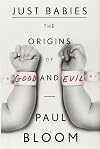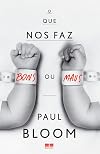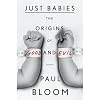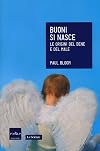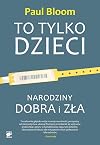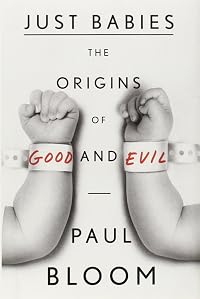
Just Babies: The Origins of Good and Evil
by Paul Bloom
On This Page
Description
A leading cognitive scientist argues that a deep sense of good and evil is bred in the bone.From John Locke to Sigmund Freud, philosophers and psychologists have long believed that we begin life as blank moral slates. Many of us take for granted that babies are born selfish and that it is the role of society—and especially parents—to transform them from little sociopaths into civilized beings. In Just Babies, Paul Bloom argues that humans are in fact hardwired with a sense of morality. show more Drawing on groundbreaking research at Yale, Bloom demonstrates that, even before they can speak or walk, babies judge the goodness and badness of others' actions; feel empathy and compassion; act to soothe those in distress; and have a rudimentary sense of justice.
Still, this innate morality is limited, sometimes tragically. We are naturally hostile to strangers, prone to parochialism and bigotry. Bringing together insights from psychology, behavioral economics, evolutionary biology, and philosophy, Bloom explores how we have come to surpass these limitations. Along the way, he examines the morality of chimpanzees, violent psychopaths, religious extremists, and Ivy League professors, and explores our often puzzling moral feelings about sex, politics, religion, and race.
In his analysis of the morality of children and adults, Bloom rejects the fashionable view that our moral decisions are driven mainly by gut feelings and unconscious biases. Just as reason has driven our great scientific discoveries, he argues, it is reason and deliberation that makes possible our moral discoveries, such as the wrongness of slavery. Ultimately, it is through our imagination, our compassion, and our uniquely human capacity for rational thought that we can transcend the primitive sense of morality we were born with, becoming more than just babies.
Paul Bloom has a gift for bringing abstract ideas to life, moving seamlessly from Darwin, Herodotus, and Adam Smith to The Princess Bride, Hannibal Lecter, and Louis C.K. Vivid, witty, and intellectually probing, Just Babies offers a radical new perspective on our moral lives.
From the Hardcover edition.. show less
Tags
Recommendations
Member Reviews
I could not put this book down. It's an excellent review of the studies done on young children to determine the inborn understanding of morality, but it reads like a mystery novel. Very tightly put together, and it doesn't take you out of the book to explain philosophical concepts or complex experiments. Anyone would be comfortable picking up this book as there's no assumption of knowledge, but even having read about all of the studies cited before, I wasn't bored.
I don't want to spoil anything, but the topic is only partly babies, it expands into adult moral issues and questions which is far more interesting. A lot of familiar ground is covered (for example the trolley question) but the research gives it a new perspective. Very show more reminiscent of Malcolm Gladwell or Dan Ariely, but much more concise. If you are still on the fence about this book, go watch Paul Bloom's TED Global talk. I apologize in advance for your book budget being blown, as he has also written several other books, and Amazon will helpfully recommend similar books you won't be able to resist. show less
I don't want to spoil anything, but the topic is only partly babies, it expands into adult moral issues and questions which is far more interesting. A lot of familiar ground is covered (for example the trolley question) but the research gives it a new perspective. Very show more reminiscent of Malcolm Gladwell or Dan Ariely, but much more concise. If you are still on the fence about this book, go watch Paul Bloom's TED Global talk. I apologize in advance for your book budget being blown, as he has also written several other books, and Amazon will helpfully recommend similar books you won't be able to resist. show less
 This review was written for LibraryThing Early Reviewers.
I signed up to get this book through the LT Early Reviewers program because the premise was interesting - is morality hard-wired? Also, of course, controversial.
The book was not a quick read for me as I found myself both agreeing and disagreeing as I went through. I had to revisit certain bits a few days after mulling over them as well.
In the end, though, I think this has been a book of some revelation to me, while affirming some unvoiced beliefs I've held for a long time. While I'm not a mother myself, I have nephews and nieces and I have watched them grow from babies. And, even as toddlers who could barely articulate their thoughts, yes, there was an instinct that made them behave in certain ways and make certain choices.
I was also show more relieved to know that Bloom does not advocate nature over nurture, which I incorrectly assumed the book would do. He agrees that the early relationships that children have, the familial/tribal bonds they form and the way they are raised has a lot to do with how they eventually turn out. I was also relieved that he does not believe that we are natural-born racists, sexists or, really, any other "-ists".
I enjoyed reading this book and think that many parents might find it very interesting as well. While it challenges many of our assumptions about babies/children, it also allays many fears.
An easy read too - not densely academic. show less
The book was not a quick read for me as I found myself both agreeing and disagreeing as I went through. I had to revisit certain bits a few days after mulling over them as well.
In the end, though, I think this has been a book of some revelation to me, while affirming some unvoiced beliefs I've held for a long time. While I'm not a mother myself, I have nephews and nieces and I have watched them grow from babies. And, even as toddlers who could barely articulate their thoughts, yes, there was an instinct that made them behave in certain ways and make certain choices.
I was also show more relieved to know that Bloom does not advocate nature over nurture, which I incorrectly assumed the book would do. He agrees that the early relationships that children have, the familial/tribal bonds they form and the way they are raised has a lot to do with how they eventually turn out. I was also relieved that he does not believe that we are natural-born racists, sexists or, really, any other "-ists".
I enjoyed reading this book and think that many parents might find it very interesting as well. While it challenges many of our assumptions about babies/children, it also allays many fears.
An easy read too - not densely academic. show less
This review was written for LibraryThing Early Reviewers.Just Babies: The Origins of Good and Evil by Paul Bloom was recommended reading for a class on morality that I took a few months ago. The idea of studying babies to see how they react to determine just how much of morality is hardwired in us fascinated me. I read the book with intense interest, particularly the studies. I couldn't help but wonder if the researchers were reading into the babies' reactions to get the results they wanted, at least at times. Bloom writes an interesting and engaging book, but the skeptic in me kept showing up when he described how the studies were conducted. Just Babies is a fascinating read that feels like a starting point and left me with questions rather than answers, but maybe that was the point. Bloom show more explores many aspects of morality, moral philosophy, and moral psychology in conjunction with the studies conducted on babies. Just Babies struck me as more a book about whether or not babies differentiate between harmfulness and kindness than about the origins of good and evil. show less
Bloom takes on a huge piece of philosophy here, "the origins of good and evil," but doesn't do it justice. The experiments he recounts are pretty basic and just confirm what an intelligent person would know from experience already. His commentary on the subject, while entertaining, is sloppy. In chapter 1, he assumes that Darwinism is fact, not theory, and his errors build from there. He explains with calculations, how selfish genes can create altruistic animals, but doesn't spell out whether calculation and impulse come from the same root.
He does bring up plenty to think about independently, for which I'm grateful; and points to other writers on the subject, such as Adam Smith. While he claims that arguments about terminology are show more boring, he doesn't shy away from being explicative, which is one of his strengths. show less
He does bring up plenty to think about independently, for which I'm grateful; and points to other writers on the subject, such as Adam Smith. While he claims that arguments about terminology are show more boring, he doesn't shy away from being explicative, which is one of his strengths. show less
This review was written for LibraryThing Early Reviewers.In this book, Paul Bloom provides a very good basic overview of the origins of morality. It was a quick and fun read-- he ranges in references from Shakespeare to The Princess Bride to Steven Pinker (all my favorites), and even some of the more complex ideas were easy to follow. I found the studies interesting, although I sometimes wished for more information about how the studies were conducted. I also thought this book might go into a bit more depth, but overall it was a very good general discussion on morality and provided me with some context to ask more questions and do more independent research in the future.
This review was written for LibraryThing Early Reviewers.Having never read Bloom before, I was pleasantly surprised to find myself laughing by page 5. He is a very engaging, easy-to-understand author, at least for the audience this book is intended for. This was a nice intro to the subject matter and I have numerous notes to look further into topics he touched on. While I felt the contents were more skewed toward the "good" and its development in humans, leaving me feeling like I had only read Part 1 of 2, I am interested enough to look into his other works and to mention this one to my acquaintances with a penchant for psychology and philosophy. Early Reviewers.
This review was written for LibraryThing Early Reviewers.***NO SPOILERS***
Is a sense of right and wrong programmed into the human psyche at birth, or is the psyche blank and pliable, able to be fashioned just as easily into that of a conscionable being as into that of a psychopath? Just Babies seeks to answer this question. Author Paul Bloom refers to the sense of right and wrong as "morality" while at the same time acknowledging that that word can be hard to define: "Even moral philosophers don't agree about what morality really is, and many non philosophers don't like to use the word at all. When I tell people what this book is about, more than one has responded with "I don’t believe in morality." Someone once told me—and I'm not sure that she was joking—that morality is nothing more show more than rules about whom you can and can't have sex with." Just Babies grapples with the nature versus nurture question but presents lots of proof favoring nature's role.
The book is divided into seven chapters, with the first explaining the technical aspects of testing babies, along with the results of these various experiments. This first chapter is fascinating not only because of the results but also because of the experiments themselves; the researchers' ingenuity in devising ways to test babies is impressive.
The chapters following explore whether, and to what degree, people are born with a sense of empathy, fairness, disgust (possibly the most intriguing chapter), a desire to punish and seek revenge, and exactly why people are naturally kinder to kin than to strangers. As with the first chapter, the answers to these questions and the examples proving them (via elaborate experiments) are riveting. Just one of a great many that stand out: "Children are sensitive to inequity, then, but it seems to upset them only when they themselves are the ones getting less [...] The psychologists Peter Blake and Katherine McAuliffe paired up four- and eight-year-olds who had never met, placing them in front of a special apparatus that was set up to distribute two trays of candy. One of the children had access to a lever that gave her the choice either to tilt both trays toward the children (so that each got whatever amount of candy was on the nearest tray) or to dump both trays (so that nobody got any candy.)
When there was an equal amount of candy in each tray, the children almost never dumped. They also almost never dumped when the distribution favored themselves—say, four candies on their tray, and one candy on the other child’s tray—though some of the eight-year-olds did reject this choice. But when this distribution was reversed to favor the other child, children at every age group frequently chose to dump both trays. They would rather get nothing than have another child, a stranger, get more than them."
Just Babies is well-organized and written in clear, straightforward language ideal for the everyday reader; Bloom didn't use any specialized science or psychology jargon, so a background in these fields isn't necessary to understand the book. The writing, however, could be better. Certain word choices are jarring and detract from Just Babies's otherwise scholarly tone. The use of "pissed" is one such example: "The researchers find that the dog offered a lesser treat will sometimes act, well, pissed, and refuse it." Along the same lines: "And so, while there might remain some stalwart contributors, the situation gradually goes to hell."
Fortunately the book's strengths—its biggest being that it effectively backs up each of its many claims with compelling experimental evidence—outweigh weaknesses. Bloom took care to convince, leaving little room for doubt or dismissal. show less
Is a sense of right and wrong programmed into the human psyche at birth, or is the psyche blank and pliable, able to be fashioned just as easily into that of a conscionable being as into that of a psychopath? Just Babies seeks to answer this question. Author Paul Bloom refers to the sense of right and wrong as "morality" while at the same time acknowledging that that word can be hard to define: "Even moral philosophers don't agree about what morality really is, and many non philosophers don't like to use the word at all. When I tell people what this book is about, more than one has responded with "I don’t believe in morality." Someone once told me—and I'm not sure that she was joking—that morality is nothing more show more than rules about whom you can and can't have sex with." Just Babies grapples with the nature versus nurture question but presents lots of proof favoring nature's role.
The book is divided into seven chapters, with the first explaining the technical aspects of testing babies, along with the results of these various experiments. This first chapter is fascinating not only because of the results but also because of the experiments themselves; the researchers' ingenuity in devising ways to test babies is impressive.
The chapters following explore whether, and to what degree, people are born with a sense of empathy, fairness, disgust (possibly the most intriguing chapter), a desire to punish and seek revenge, and exactly why people are naturally kinder to kin than to strangers. As with the first chapter, the answers to these questions and the examples proving them (via elaborate experiments) are riveting. Just one of a great many that stand out: "Children are sensitive to inequity, then, but it seems to upset them only when they themselves are the ones getting less [...] The psychologists Peter Blake and Katherine McAuliffe paired up four- and eight-year-olds who had never met, placing them in front of a special apparatus that was set up to distribute two trays of candy. One of the children had access to a lever that gave her the choice either to tilt both trays toward the children (so that each got whatever amount of candy was on the nearest tray) or to dump both trays (so that nobody got any candy.)
When there was an equal amount of candy in each tray, the children almost never dumped. They also almost never dumped when the distribution favored themselves—say, four candies on their tray, and one candy on the other child’s tray—though some of the eight-year-olds did reject this choice. But when this distribution was reversed to favor the other child, children at every age group frequently chose to dump both trays. They would rather get nothing than have another child, a stranger, get more than them."
Just Babies is well-organized and written in clear, straightforward language ideal for the everyday reader; Bloom didn't use any specialized science or psychology jargon, so a background in these fields isn't necessary to understand the book. The writing, however, could be better. Certain word choices are jarring and detract from Just Babies's otherwise scholarly tone. The use of "pissed" is one such example: "The researchers find that the dog offered a lesser treat will sometimes act, well, pissed, and refuse it." Along the same lines: "And so, while there might remain some stalwart contributors, the situation gradually goes to hell."
Fortunately the book's strengths—its biggest being that it effectively backs up each of its many claims with compelling experimental evidence—outweigh weaknesses. Bloom took care to convince, leaving little room for doubt or dismissal. show less
This review was written for LibraryThing Early Reviewers.Members
- Recently Added By
Published Reviews
ThingScore 75
added by danielx
Lists

Books Cited in Blueprint by Nicholas Christakis
261 works; 1 member
Author Information

25+ Works 2,137 Members
Paul Bloom is the Brooks and Suzanne Ragen Professor of Psychology at Yale University and the author or editor of six books, including the acclaimed How Pleasure Works. He lives in New Haven with his wife and two sons.
Awards and Honors
Work Relationships
Common Knowledge
- Canonical title*
- Buoni si nasce. Le origini del bene e del male
- Original title
- Just Babies: The Origins of Good and Evil
- Original publication date
- 2013
- People/Characters
- Thomas Jefferson; Adam Smith; David Cash, Jr.; Herodotus; J. B. S. Haldane; Karen Wynn (show all 40); Ted Bundy; Gary Gilmore; Peter Woodcock; John List; Hannibal Lecter; Dexter Morgan; Peter Singer; Frans de Waal; Robin Hood; Aleksandr Solzhenitsyn; Christopher Boehm; Dan Ariely; Robert Ardrey; Inigo Montoya; David Pizarro; Kenneth Clark; Mamie Clark; Leon Kass; Alison Gopnik; Kwame Anthony Appiah; Primo Levi; Paul Rozin; John Rawls; Peter Singer; John Mikhail; Joshua Greene; Philippa Foot; Richard Shweder; Stanley Milgram; William Edward Hartpole Lecky; Oskar Schindler; Paul Rusesabagina; Rick Blaine; Jonathan Haidt
- Dedication
- Dedicated to Elaine Reiser and Murray Reiser, for their love and support.
- First words
- In 2005, a writer living in Dallas heard that an acquaintance of hers was suffering from kidney disease.
- Last words
- (Click to show. Warning: May contain spoilers.)It is a product of our compassion, our imagination, and our magnificent capacity for reason.
- Blurbers
- Holt, Jim; Pinker, Steven; Haidt, Jonathan; Nussbaum, Martha C.; Harris, Sam; Zimmer, Carl (show all 14); Ariely, Dan; Singer, Peter; Bazelon, Emily; Wright, Robert; Gilbert, Daniel; Foer, Joshua; Shermer, Michael; Satel, Sally
*Some information comes from Common Knowledge in other languages. Click "Edit" for more information.
Classifications
Statistics
- Members
- 386
- Popularity
- 81,238
- Reviews
- 27
- Rating
- (3.50)
- Languages
- 5 — English, German, Italian, Polish, Portuguese
- Media
- Paper, Audiobook, Ebook
- ISBNs
- 11
- ASINs
- 4