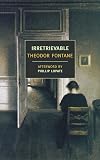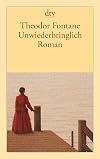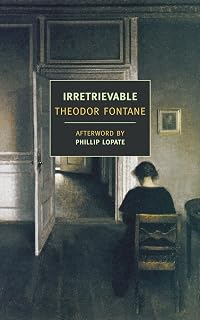
Irretrievable
by Theodor Fontane
On This Page
Description
An unsophisticated rural count is summoned to duty as a gentleman-in-waiting to a Danish royal princess in Copenhagen in 1864. Once in the lively court, his life begins to spiral out of control.Tags
Recommendations






























Member Reviews
A near perfect novel on the death of a marriage due to incompatibility and infidelity. The setting is mid-19th Century Denmark. It is beautifully rendered. The time is that quiet decade between the revolutions of 1848 and the expansion of Prussia. Many of the scenes involve court life in Copenhagen.
The pacing is exquisite. The characters reveal themselves primarily through dialogue and are only minimally explained by the omniscient narrator. The story moves slowly, each scene adding to the plot but never feeling forced or functional.
Were I a teacher of fiction, I would dissect this book. It is a touchstone that makes Madame Bovary seem clumsy in comparison.
The pacing is exquisite. The characters reveal themselves primarily through dialogue and are only minimally explained by the omniscient narrator. The story moves slowly, each scene adding to the plot but never feeling forced or functional.
Were I a teacher of fiction, I would dissect this book. It is a touchstone that makes Madame Bovary seem clumsy in comparison.
This was an "odd" book, not necessarily in a bad way. It was basically the story of a disintegration of a marriage. The author asks the question about what really makes a marriage "happy", or is there even such a thing? The writing and vocabulary were top-notch. The story was very slow moving and annoyingly changed narrators during the last chapter. All of the main characters were silly and I really didn't care for any of them. Perhaps that's what the author wanted? I did learn a lot about Schleswig-Holstein and Denmark, though!
Although the blurb on the back of the NYRB edition that I read describes this book as the story of a married couple drifting apart, that is only part of the novel set in the second half of the 19th century in Schleswig-Holstein, the part of Germany that juts up into the Baltic and borders Denmark (and has, in fact, gone back and forth between them over the years). The bulk of it, which takes place mostly in Copenhagen, where the husband is temporarily serving as lord-in-waiting to an aging Danish princess, vividly depicts the frivolity and triviality of the aristocracy with nothing but time on their hands. Further, in my opinion, it cannot be said that the couple "drifts" apart; it seems more that after their differences become more show more apparent after years of marriage, the husband, weak-willed and self-indulgent, rationalizes his behavior based on the idea that his wife is "cold" to him.
Fontane, who was much admired by Thomas Mann, is a wonderful writer, whose dialogue and descriptions bring the characters, their psychology, and the natural and constructed environment to life. I was drawn into this novel, especially the parts that take place in the castle the couple built overlooking the sea, less so by the parts in the Danish court, although they were equally well written. show less
Fontane, who was much admired by Thomas Mann, is a wonderful writer, whose dialogue and descriptions bring the characters, their psychology, and the natural and constructed environment to life. I was drawn into this novel, especially the parts that take place in the castle the couple built overlooking the sea, less so by the parts in the Danish court, although they were equally well written. show less
Irretrievable is the story of a failing marriage, set in the border area between Germany and Denmark. Helmut Holk and Christine Arne have been married for 19 years and have children who are almost grown. They are very different people - Helmut is outgoing and sociable and Christine is reserved and religious. Even so, things have always been good between them. When we join the story, Helmut is feeling restless and the two are growing apart. He goes across the bay to Denmark to spend time in the aging Princess's court where he meets two lovely young women.
This book has a lovely setting. Helmut and Christine live in a beautiful home they built on a cliff overlooking the sea. And Fontane writes beautiful characters and situations with show more precision and insight. I really enjoyed this book. Recommended for readers who enjoy this era. show less
This book has a lovely setting. Helmut and Christine live in a beautiful home they built on a cliff overlooking the sea. And Fontane writes beautiful characters and situations with show more precision and insight. I really enjoyed this book. Recommended for readers who enjoy this era. show less
Here is the truth, I read this book because of the title. I am taking part on a reading challenge and one of the more interesting tasks was to read 3 books with titles that would form a “spine poem” (you can check more here http://www.tumblr.com/tagged/book spine poetry ). Anyway, I needed to read Irretrievable because I had already invested too much time on the other 2 titles and I was not about to start it all over again. But I got very close to giving it up.
At the end I finished and I am glad I did because the last 1/4 of the book was rewarding. It is just one of those books that takes forever creating a scene and a mood before letting the plot move forward. It is however an interesting commentary on married life, and although show more marriages have changed profoundly in the past 120 since this book was first published, certain aspects of married life are consistent though the ages: we get tired of one another and certain qualities of our personality can became irritating to the other.
I really wish it had been a short story or novella though. show less
At the end I finished and I am glad I did because the last 1/4 of the book was rewarding. It is just one of those books that takes forever creating a scene and a mood before letting the plot move forward. It is however an interesting commentary on married life, and although show more marriages have changed profoundly in the past 120 since this book was first published, certain aspects of married life are consistent though the ages: we get tired of one another and certain qualities of our personality can became irritating to the other.
I really wish it had been a short story or novella though. show less
This stylish social and psychological novel examines early 20th century German and Danish titled societies and their sociosexual mores. The main character is a middle-aged German count with plagued by a galling mid-life crisis that draws him astray and threatens his long-time reasonably happy (but not quite totally satisfying) marriage to a wife he's all too aware he doesn't measure up to; as well as well as risking his treasured family life with two adolescent children, dogs, a beautiful newly constructed castle and all the best, most tasteful furnishings and comforts pertaining thereto.
Ratings
Members
- Recently Added By
Author Information

Fontane's fictional studies of nineteenth-century Berlin society, written in his late maturity, secured him a firm place in literature as a master of the German realist novel; his declared aim was to show "the undistorted reflection of the life we lead." "He introduced his people in spirited conversations at picnics and banquets, and developed a show more broad and yet intimate perspective of background conditions; he was less interested in plots, and often would make a point by silence" (Ernst Rose). Effi Briest (1895), his masterpiece, is a revealing portrait of an individual victimized by outmoded standards. Fontane, on whom Sir Walter Scott had made a deep impression, traveled to England as a journalist and wrote two books based on his experiences: A Summer in London (1854) and Across the Tweed (1860). He also wrote historical novels, poetry, and dramatic criticism. (Bowker Author Biography) show less
Some Editions
Awards and Honors
Series
Belongs to Publisher Series
Work Relationships
Common Knowledge
- Canonical title
- Irretrievable
- Original title
- Unwiederbringlich
- Alternate titles
- Beyond Recall; No Way Back
- Original publication date
- 1892; 1963 (English: Beyond Recall) (English: Beyond Recall); 2010 (English: No Way Back) (English: No Way Back); 2011 (English: Irretrievable) (English: Irretrievable)
- First words
- Holkenäs Castle, the family seat of Count Holks was built on a dune sloping down to the sea, a mile south of Glucksbürg: an impressive sight for the occasional visitor to a district at that time quite off the beaten track.
- Last words*
- (Click to show. Warning: May contain spoilers.)Asta bittet, sich Ihnen empfehlen zu dürfen, ebenso Elisabeth Petersen.
- Ew. Hochwürden ergebenste
Julie von Dobschütz." - Disambiguation notice
- 1963 & 2011 same translation by Douglas Parmée, different titles and publishers.
*Some information comes from Common Knowledge in other languages. Click "Edit" for more information.
Classifications
Statistics
- Members
- 321
- Popularity
- 97,467
- Reviews
- 6
- Rating
- (3.86)
- Languages
- Catalan, English, German, Spanish
- Media
- Paper, Audiobook, Ebook
- ISBNs
- 28
- ASINs
- 11