On This Page
Description
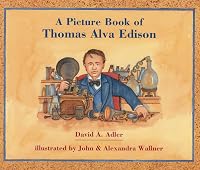
An introduction to the genius with a curious mind who loved to experiment and who invented the phonograph, light bulb, movie camera, and numerous other items.Tags
Recommendations




Member Reviews
This book was pretty cool. I appreciate the attention to detail, "Thomas Alva Edison was issued 1,093 patents." The author walked a thin line with being as informative as possible without being too boring. And although this is a picture book, I was much more interested with the writing. Although we see him as an inventor, early on in the book I had a different feeling. He felt more like a person who improved inventions instead of creating them. He improved the phone and the telegram. So I was at first convinced that he had only invented the light bulb and nothing else. However, you see that over time he created many objects: light bulbs, cement mixers, storage battery, and the movie camera.
The book ended on a pretty sad note. I would show more have preferred the book to end more positive. Yes, we have to cover when he dies, but it would have been better (in my opinion) if we had seen the extent of influence he had on society. The Congressional Medal of Honor seemed more of a foot note than something to emphasize. The author's note also did not help with the mood. I could have finished the book without discussing the deaths of his family members. show less
The book ended on a pretty sad note. I would show more have preferred the book to end more positive. Yes, we have to cover when he dies, but it would have been better (in my opinion) if we had seen the extent of influence he had on society. The Congressional Medal of Honor seemed more of a foot note than something to emphasize. The author's note also did not help with the mood. I could have finished the book without discussing the deaths of his family members. show less
Most people already know who Thomas Edison is, but this book shows readers what his childhood was like and other not as known inventions. This book could be used for a history class where students could then research other of his inventions that less well known. A science could use this book to introduce electricity and learn what today's lightbulbs are made of and what the difference are between lightbulbs. I appreciated the part where Thomas Edison could not pay attention in class. I think many students could relate to that. I think students will also appreciate how Edison failed at things when he was younger as well as when he was older. For example, I had no idea he did experiments on the baggage car of a train he worked on and show more caught it on fire. I also did not know that he had basically thousands of theories about electricity. I think the theme of this book is keep trying. Edison failed many times in his experiments, but that never stopped him. The only thing I would change is to have more about his thought process for his inventions and other not well known inventions. show less
David Adler's picture books are easy to read and fun to follow along with. This book follows Thomas Edison's life. Thomas Edison was born on February 11, 1847 in Milan, Ohio. As a child, Thomas was very curious and often questioned his parents. If they didn't know an answer, he'd ask them why they didn't know! Thomas loved to experiment--which would pay off later in life. He was also a sickly child; he had scarlett fever and had many colds. He went from school to school because one of his teachers told his mother that he simply could not learn, but then became one of the world's greatest inventors. We learn that that Thomas worked as a telegraph operator in Canada, invented the carbon telephone transmitter, first phonograph, electric show more lightbulb, and a motion picture camera! For a child that can't learn, that's pretty amazing! show less
Thomas Edison changed our world in many ways. As a young child he was always very curious. He always had the need to know why things worked. Sometimes his curiosity got the best of him and often times he found himself in some deep trouble. In school, Edison was known as a bad kid. His teachers never thought of him as the brilliant person he actually was. Saving a girl’s life was is where his career started. The young girl’s father rewarded him with teaching him how to work a telegraph. After learning those skills he started to work for a telegraphing company. He was making a good amount of money so he opened up his own lab for research. During this time he invented the quadruplex, carbon telephone transmitter, the phonograph, the show more lightbulb and the first motion picture camera. I felt as if this author focused this book on insignificant details of Edison’s life. Thomas Edison was one of the best inventors of our time and this author could have enhanced this book by really focusing in on his accomplishments more. I appreciate the small details of his childhood that the author added into this biography, but I think more details of his inventions would’ve made this book more enjoyable. show less
The cutely wrapped interpretation of Thomas Edison's rise to prominence as an inventor highlights the main occurrances of his highly successful life. The easily approachable text and visual style allows for younger readers to become familiar with one of America's most culturally and industrially influentual individuals.
This book was definitely one of my favorites! I comprehend books, however I really like when books have pictures for me to look at while I am reading. The pictures help me imagine what is happening and get a better understand of the book. This book had great detailed images on every single page. I enjoyed reading the pages and then examining the images to see what the book was saying and how life was for Thomas Edison. Definitely recommend this book!
This book tells the story of the life of Thomas Alva Edison. The book includes beautiful illustrations of childlike paints, with great detail but pale coloring. The story starts with Thomas being born in Ohio on February 11, 1847. His father owned a mill, so Thomas has many places to preform experiments, and even set a huge fire that his father had to put out. The author tells of Thomas' desire to experiment, and learn by asking many questions. It tells of his many jobs, and how he slowly graduated up the chain of command until he went to work by himself. He was a great inventor who ended his career with 1,093 patents, which is more than any other inventor. He even received the Congressional Medal of Honor for his many contributions. show more This book was very easy to read and would keep a students attention very well with it's simple words, interesting story, and pretty pictures that go along with the story. show less
Members
- Recently Added By
Lists

The Story of the World: Activity Book Four: The Modern Age
333 works; 2 members

The Playful Pioneers
166 works; 1 member
Author Information

311 Works 92,808 Members
David A. Adler was born in New York City. He attended Queen's College in New York City and later, earned an MBA in Marketing from New York University. He writes both fiction and non-fiction. He is the author of Cam Jansen mysteries and the Andy Russell titles. His titles has earned him numerous awards including a Sydney Taylor Book Award for his show more title "The Number on My Grandfather's Arm," "A Picture Book of Jewish Holidays" was named a Notable Book of 1981 by the American Library Association and "Our Golda" was named a Carter G. Woodson Award Honor Book. (Bowker Author Biography) show less
All Editions
Series

Common Knowledge
- Canonical title
- A Picture Book of Thomas Alva Edison
- People/Characters
- Thomas Edison (Thomas Alva Edison)
Classifications
Statistics
- Members
- 443
- Popularity
- 69,357
- Reviews
- 23
- Rating
- (3.83)
- Languages
- English
- Media
- Paper
- ISBNs
- 4
- ASINs
- 1