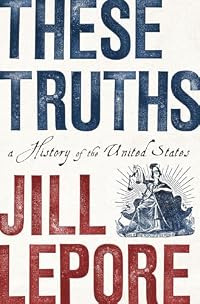
These Truths: A History of the United States
by Jill Lepore
On This Page
Description
"In the most ambitious one-volume American history in decades, award-winning historian Jill Lepore offers a magisterial account of the origins and rise of a divided nation. The American experiment rests on three ideas--"these truths," Jefferson called them--political equality, natural rights, and the sovereignty of the people. And it rests, too, "on a dedication to inquiry, fearless and unflinching," writes Jill Lepore in a groundbreaking investigation into the American past that places show more truth itself at the center of the nation's history. In riveting prose, These Truths tells the story of America, beginning in 1492, to ask whether the course of events has proven the nation's founding truths, or belied them. "A nation born in contradiction, liberty in a land of slavery, sovereignty in a land of conquest, will fight, forever, over the meaning of its history," Lepore writes, finding meaning in those very contradictions as she weaves American history into a majestic tapestry of faith and hope, of peril and prosperity, of technological progress and moral anguish. A spellbinding chronicle filled with arresting sketches of Americans from John Winthrop and Frederick Douglass to Pauli Murray and Phyllis Schlafly, These Truths offers an authoritative new history of a great, and greatly troubled, nation"-- show lessTags
Recommendations











Member Reviews
(5) Whew. What an undertaking. An 800 page densely written narrative political history of America starting in 1492 to Trump! Much of it was fascinating, though some of it was tedious. The central question of the book is - Can a populace govern themselves effectively and thoughtfully through a representative democratic government? The test case in the book is the U.S.A. as derived from the British colonies. Can the people take the reigns or will we be forever the playthings of accident, war, and whimsy? According to Lepore, the jury is still out and the prospects are not good.
I was most amazed at the echoes of today's culture wars and hyper-partisanship in the past. Abolition, the ERA, the Moral Majority. Here I thought opposition to show more teaching evolution in schools was a new beyond-the-pale crazy evangelical thing and it turns out to have been a 19th century hot-button issue embraced by a Democratic populist William Jennings Bryan. The political parties have jockeyed and reversed positions in terms of 'liberalism,' and 'conservatism' throughout our countries history. I was also amazed (and upset) that ultimately it is the 'industry' of political science that has put us at each others throats to better manipulate the electorate and capitalize for "their party," or "their candidate." My own beliefs on things like gun control, abortion, immigration, religious freedom are trumped up by an industry that doesn't necessarily have the nation's best interests at heart. Sigh.
I have come away from this undertaking much more knowledgeable about our country - it has been like a walk down memory lane of the History and Social Studies classes of days long gone by. I do feel like the book had an agenda, a bit of a thesis if you will that was not quite transparent despite the author's very valiant attempt to remain balanced. This is definitely an 'academic' look at history.
Overall though. . . Bravo! I am impressed, though thoroughly exhausted and a bit dispirited after reading which prevents a higher rating. show less
I was most amazed at the echoes of today's culture wars and hyper-partisanship in the past. Abolition, the ERA, the Moral Majority. Here I thought opposition to show more teaching evolution in schools was a new beyond-the-pale crazy evangelical thing and it turns out to have been a 19th century hot-button issue embraced by a Democratic populist William Jennings Bryan. The political parties have jockeyed and reversed positions in terms of 'liberalism,' and 'conservatism' throughout our countries history. I was also amazed (and upset) that ultimately it is the 'industry' of political science that has put us at each others throats to better manipulate the electorate and capitalize for "their party," or "their candidate." My own beliefs on things like gun control, abortion, immigration, religious freedom are trumped up by an industry that doesn't necessarily have the nation's best interests at heart. Sigh.
I have come away from this undertaking much more knowledgeable about our country - it has been like a walk down memory lane of the History and Social Studies classes of days long gone by. I do feel like the book had an agenda, a bit of a thesis if you will that was not quite transparent despite the author's very valiant attempt to remain balanced. This is definitely an 'academic' look at history.
Overall though. . . Bravo! I am impressed, though thoroughly exhausted and a bit dispirited after reading which prevents a higher rating. show less
For a British reader who only knew about key moments of American history, mainly from film or fiction, this was an excellent and easily readable overview of the colonisation of the thirteen original states, creation of the United States and the subsequent political history up to 2018 (although the last chapter feels less like history than good journalism).
Although a big book, with nearly 800 pages of text plus over 100 pages of notes and index, it is well structured and organised to describe the development of the US political system, especially the initial political “fudge” of slavery, the consequences of this fudge as the number of states increased, civil war (covered necessarily briefly in order to maintain momentum), the failure show more of reconstruction with the introduction of Jim Crow laws to impose segregation and the slow fight for racial and sexual equality. Although discussed, I felt that there should have been more about native Americans, but this lack may reflect American political history.
Overarching themes such as the waxing and waning of power between the presidency, Senate/House of Representatives and the Judiciary, and the rise and fall of the power of the press are skilfully interwoven. I found the importance of the Constitution and the referencing of specific “landmark” legal cases and their ongoing political ramifications very interesting (the UK doesn’t have a written constitution).
Highly recommended in providing an understanding of how the United States of America has arrived at where it is today and its complex myths. show less
Although a big book, with nearly 800 pages of text plus over 100 pages of notes and index, it is well structured and organised to describe the development of the US political system, especially the initial political “fudge” of slavery, the consequences of this fudge as the number of states increased, civil war (covered necessarily briefly in order to maintain momentum), the failure show more of reconstruction with the introduction of Jim Crow laws to impose segregation and the slow fight for racial and sexual equality. Although discussed, I felt that there should have been more about native Americans, but this lack may reflect American political history.
Overarching themes such as the waxing and waning of power between the presidency, Senate/House of Representatives and the Judiciary, and the rise and fall of the power of the press are skilfully interwoven. I found the importance of the Constitution and the referencing of specific “landmark” legal cases and their ongoing political ramifications very interesting (the UK doesn’t have a written constitution).
Highly recommended in providing an understanding of how the United States of America has arrived at where it is today and its complex myths. show less
I've commented on this history on the group reading page before, and the last section of the book has not changed my mind about it. It is painful. The mythic history of the United States taught in my public schools did not prepare me for college history courses 50 years ago, and even with considerable learning, I don't feel I was prepared entirely for this history either. The United States is neither exceptional nor based in morality, as much as we would like to believe it. It exhibits all the errors and follies of humankind right from the start, and it doesn't feel these days that it's gotten any better. Presidents and other politicians we may have thought were better than most are shown with all their spots. The intolerable show more partisanship of current days is an echo of our history from the beginning. Our leaders are no more noble than the people who elect them.
Lepore is especially good at detailing the failings of our political system, over and over again, to provide fair, equal and supportive government to all our population. Many of us have heard of individual instances. This history shows the errors and failures in repetition. It is infuriating, heartbreaking, and discouraging, and thus important to know.
Highly recommended, even if you have to put it down from time to time and utter profanities, as I certainly did. show less
Lepore is especially good at detailing the failings of our political system, over and over again, to provide fair, equal and supportive government to all our population. Many of us have heard of individual instances. This history shows the errors and failures in repetition. It is infuriating, heartbreaking, and discouraging, and thus important to know.
Highly recommended, even if you have to put it down from time to time and utter profanities, as I certainly did. show less
Lepore is valiant in her attempt to tell the history of the US, with emphasis on the legacy of slavery in our country's founding, and a realization of how business interests influence politics. It is a very good book. I especially enjoyed the first part, as it's focus on slavery really made me think about the country's founding differently. I had known that slavery was part of the country's history, of course, but she puts it together front and center.
The main problem I have with this book is that she covers so much material in such a short span of time, that some points are over simplified or glossed over. (For example, she discussed Billy Graham's conservative leanings, but not his insistence on racial integration. ) The last part of show more the book felt to me like a piling together of events and facts in rapid succession, rather than thought out analysis.
Of course, if she followed my advise, this would be 10 volumes and I would still be reading! So glad that I read this and I plan to supplement with some books that go in more depth. For example, I have to read more about Eisenhower, because I hadn't realized before that he grew up Mennonite. That is so intriguing.
Some interesting parts:
Frederick Douglass on the Dred Scott decision: "You may close your Supreme Court against the black man's cry for justice, but you cannot, thank God, close against him the ear of a sympthising world, nor shut up the Court of Heaven. ....Slavery lives in this country not because of any paper Constitution, but in the moral blindness of the American people."
Clarence Darrow: "Gentlemen, the world is dark. But it is not hopeless. "
Lepore talking about political divisions between the end of the Cold War and the beginning of the global war on terror: "They fought by tooth and nail and by hook and by crook and they believed they were fighting for the meaning of America, but really, they were fighting for raw political power."
And Lepore, on the internet: "But online, where everyone was, in the end, utterly alone, it had become terribly difficult to know much of anything with any certainty, except how to like and be liked, and especially, how to hate and be hated." show less
The main problem I have with this book is that she covers so much material in such a short span of time, that some points are over simplified or glossed over. (For example, she discussed Billy Graham's conservative leanings, but not his insistence on racial integration. ) The last part of show more the book felt to me like a piling together of events and facts in rapid succession, rather than thought out analysis.
Of course, if she followed my advise, this would be 10 volumes and I would still be reading! So glad that I read this and I plan to supplement with some books that go in more depth. For example, I have to read more about Eisenhower, because I hadn't realized before that he grew up Mennonite. That is so intriguing.
Some interesting parts:
Frederick Douglass on the Dred Scott decision: "You may close your Supreme Court against the black man's cry for justice, but you cannot, thank God, close against him the ear of a sympthising world, nor shut up the Court of Heaven. ....Slavery lives in this country not because of any paper Constitution, but in the moral blindness of the American people."
Clarence Darrow: "Gentlemen, the world is dark. But it is not hopeless. "
Lepore talking about political divisions between the end of the Cold War and the beginning of the global war on terror: "They fought by tooth and nail and by hook and by crook and they believed they were fighting for the meaning of America, but really, they were fighting for raw political power."
And Lepore, on the internet: "But online, where everyone was, in the end, utterly alone, it had become terribly difficult to know much of anything with any certainty, except how to like and be liked, and especially, how to hate and be hated." show less
These Truths is a comprehensive history of the United States from a political perspective, focused largely on who was in power and how they shaped the nation. But rather than idolizing these figures, Jill Lepore shows the far-reaching and sometimes unintended consequences of their actions. The essential questions Lepore aims to answer are these:
Can a political society really be governed by reflection and election, by reason and truth, rather than by accident and violence, by prejudice and deceit? Is there any arrangement of government—any constitution—by which it’s possible for a people to rule themselves, justly and fairly, and as equals, through the exercise of judgment and care? Or are their efforts, no matter their show more constitutions, fated to be corrupted, their judgment muddled by demagoguery, their reason abandoned for fury?
The book is organized in four parts covering major time periods: 1492-1799, 1800-1865, 1866-1945, and 1946-2016. While each part covers the major events that make up any American history textbook, where Lepore really shines is in making connections that put these events in greater context. She also candidly describes the flaws, mistakes, and sometimes corruption of the country’s leaders and systems of government, again providing a broader and more balanced view.
I came to These Truths in a time of despair for the future of the United States. The first three parts helped me understand that this country has always had its issues, from errors, omissions and incompetence to bigotry and hatred, in some respects not much different from today. But Part Four was more difficult to read, because Lepore’s analysis of “how we got here” during my lifetime was jarring, especially to the extent I was a participant. But that very discomfort is what makes this book required reading. show less
Can a political society really be governed by reflection and election, by reason and truth, rather than by accident and violence, by prejudice and deceit? Is there any arrangement of government—any constitution—by which it’s possible for a people to rule themselves, justly and fairly, and as equals, through the exercise of judgment and care? Or are their efforts, no matter their show more constitutions, fated to be corrupted, their judgment muddled by demagoguery, their reason abandoned for fury?
The book is organized in four parts covering major time periods: 1492-1799, 1800-1865, 1866-1945, and 1946-2016. While each part covers the major events that make up any American history textbook, where Lepore really shines is in making connections that put these events in greater context. She also candidly describes the flaws, mistakes, and sometimes corruption of the country’s leaders and systems of government, again providing a broader and more balanced view.
I came to These Truths in a time of despair for the future of the United States. The first three parts helped me understand that this country has always had its issues, from errors, omissions and incompetence to bigotry and hatred, in some respects not much different from today. But Part Four was more difficult to read, because Lepore’s analysis of “how we got here” during my lifetime was jarring, especially to the extent I was a participant. But that very discomfort is what makes this book required reading. show less
Lepore has written an amazing book, one that is as carefully non-partisan as anything can be in these days of an unfettered Internet, fake news, and polarized politics. She’s quite young to have such a fundamental grasp of large issues – 52 – and I admire her scholarship and synthesis of facts, movements, philosophies, wars, and issues into such a powerful book.
Her starting the history in 1492 startled me at first, but as I read her reasons, citations, and justifications, I came to see that the rise of nation-states dated to the collision of the Americas and Europe, the deliberate setting of this early date, of inevitability, of the United States. To ignore this date, manipulated as it was, would have ignored the fact that “the show more idea of equality came out of a resolute rejection of the idea of inequality; a dedication to liberty emerged out of bitter protest against slavery; and the right to self-government was fought for, by sword, and still more fiercely, by pen. Against conquest, slaughter and slavery came the urgent and abiding question, “By what right?”’ p 10
And then she relentlessly and amazingly lays out a history driven by the reaction to slavery and power, to freedom and inequality, to responsibility and abdication of responsibility.
It is profoundly depressing, frankly. It is beautifully written, intricately built one fact at a time, and basically says that nothing has changed. The forces that divide us haven’t gone away, haven’t been ameliorated. They have gained strength then waned, been newly motivated with new generations then gone out of style.
They are racism, sexism, and religious intolerance. They are power, control, and money.
If anybody can find a better way to interpret this book I’d love to hear it. show less
Her starting the history in 1492 startled me at first, but as I read her reasons, citations, and justifications, I came to see that the rise of nation-states dated to the collision of the Americas and Europe, the deliberate setting of this early date, of inevitability, of the United States. To ignore this date, manipulated as it was, would have ignored the fact that “the show more idea of equality came out of a resolute rejection of the idea of inequality; a dedication to liberty emerged out of bitter protest against slavery; and the right to self-government was fought for, by sword, and still more fiercely, by pen. Against conquest, slaughter and slavery came the urgent and abiding question, “By what right?”’ p 10
And then she relentlessly and amazingly lays out a history driven by the reaction to slavery and power, to freedom and inequality, to responsibility and abdication of responsibility.
It is profoundly depressing, frankly. It is beautifully written, intricately built one fact at a time, and basically says that nothing has changed. The forces that divide us haven’t gone away, haven’t been ameliorated. They have gained strength then waned, been newly motivated with new generations then gone out of style.
They are racism, sexism, and religious intolerance. They are power, control, and money.
If anybody can find a better way to interpret this book I’d love to hear it. show less
I’ve been reading this tome since January as part of the group read and the last part which dealt with recent history and right up to the 2016 election was the most riveting, probably because of its presence in our daily lives and the idea that our democracy may be unilaterally damaged by the unfit President that was elected. Lepore went to great lengths to draw lines between historical instances of threats to our democracy and what’s happening today and the biggest takeaway for me was that our country has dealt with issues of incredible tyranny in the past and gone on to mend the fissures and reinvigorate our democracy and we will be able to do it again when this period is over.
"A nation born in revolution will forever struggle show more against chaos. A nation founded on universal rights will wrestle against the forces of particularism. A nation that toppled a hierarchy of birth only to erect a hierarchy of wealth will never know tranquility. A nation of immigrants cannot close its borders. And a nation born in contradiction, liberty in a land of slavery, sovereignty in a land of conquest, will fight, forever, over the meaning of its history.”
There are many instances throughout the book where I realized there were times in our history where I was truly embarrassed and ashamed of our country. This took me by surprise. I won’t forget the names of Leone Baxter and Clem Whitaker, who founded Campaigns Inc. in 1933 and are responsible for the defeat of health insurance for all and began the kind of dirty, scheming politics that have become a way of life for our elections today. Money, money, money has led to where we’re stuck and they can claim a large share of the blame/credit depending on your point of view.
The role of technology, public opinion and polling has not really been beneficial to our democracy in many, many ways.
So much to learn and this book goes a long way toward informing those of us who appreciate being educated. Very highly recommended. show less
"A nation born in revolution will forever struggle show more against chaos. A nation founded on universal rights will wrestle against the forces of particularism. A nation that toppled a hierarchy of birth only to erect a hierarchy of wealth will never know tranquility. A nation of immigrants cannot close its borders. And a nation born in contradiction, liberty in a land of slavery, sovereignty in a land of conquest, will fight, forever, over the meaning of its history.”
There are many instances throughout the book where I realized there were times in our history where I was truly embarrassed and ashamed of our country. This took me by surprise. I won’t forget the names of Leone Baxter and Clem Whitaker, who founded Campaigns Inc. in 1933 and are responsible for the defeat of health insurance for all and began the kind of dirty, scheming politics that have become a way of life for our elections today. Money, money, money has led to where we’re stuck and they can claim a large share of the blame/credit depending on your point of view.
The role of technology, public opinion and polling has not really been beneficial to our democracy in many, many ways.
So much to learn and this book goes a long way toward informing those of us who appreciate being educated. Very highly recommended. show less
Members
- Recently Added By
Published Reviews
ThingScore 69
Lepore doesn’t cop to her own biases. Nor does she argue which systems of government are more insidious than others, though she has no trouble denouncing American slavery, American racism, Jim Crow, segregation and the on-going, never ending war (or so it seems) against African Americans. ...
If I were a good liberal I might say that my criticism of the book does not detract from its glory, show more and that it’s a triumph of scholarship. I can’t say that. I won’t say it. These Truths has moments of glory, but it will not help us as a nation and as a people to cut though the lies and the fake news of the Trump era. show less
If I were a good liberal I might say that my criticism of the book does not detract from its glory, show more and that it’s a triumph of scholarship. I can’t say that. I won’t say it. These Truths has moments of glory, but it will not help us as a nation and as a people to cut though the lies and the fake news of the Trump era. show less
added by paradoxosalpha
Those devoted to an honest reckoning with America’s past have their work cut out for them. Lepore’s book is a good place to start.
added by aprille
It isn’t until you start reading it that you realize how much we need a book like this one at this particular moment.
This book is aimed at a mass audience, driven by anecdote and statistic, memoir and photograph, with all the giants of American history in their respective places. There wasn’t a moment when I struggled to keep reading.
We need this book. Its reach is long, its narrative show more fresh and the arc of its account sobering to say the least. This is not Whig history. It is a classic tale of a unique country’s astonishing rise and just-as-inevitable fall. show less
This book is aimed at a mass audience, driven by anecdote and statistic, memoir and photograph, with all the giants of American history in their respective places. There wasn’t a moment when I struggled to keep reading.
We need this book. Its reach is long, its narrative show more fresh and the arc of its account sobering to say the least. This is not Whig history. It is a classic tale of a unique country’s astonishing rise and just-as-inevitable fall. show less
added by aprille
Lists

Top Five Books of 2020
982 works; 348 members

Top Five Books of 2019
387 works; 108 members

Dim Sum Lunch Reading
43 works; 2 members

Books Read in 2020
4,379 works; 123 members

2024-2025 Ezra Klein Guest Recommendations
213 works; 5 members

United States
35 works; 1 member

Books in the Bibliography of Contested Continent by Peter Mancall
495 works; 1 member
Author Information

34+ Works 9,011 Members
Jill Lepore is the David Woods Kemper '41 Professor of American History at Harvard University and a staff writer at The New Yorker. She has written several books including Book of Ages: The Life and Opinions of Jane Franklin, The Whites of Their Eyes: The Tea Party's Revolution and the Battle over American History, The Secret History of Wonder show more Woman, Joe Gould's Teeth, and These Truths: A History of the United States. (Bowker Author Biography) show less
Awards and Honors
Awards
Distinctions
Common Knowledge
- Canonical title
- These Truths: a History of the United States; These Truths: A History of the United States
- Original title
- These Truths: a History of the United States
- People/Characters
- Noah Webster; Christopher Columbus; William Thornton; Constantin Volney; George Guess; Sequoyah (show all 14); John Pickering; Thomas Hopkins Gallaudet; John Flournoy; Abd al-Rahman Ibrahima; Samuel Morse; Alexander Melville Bell; Alexander Graham Bell; Mabel Gardiner Hubbard Bell
- Important places
- USA
- Epigraph
- We must disenthrall ourselves,
and then we shall save our country.
- Abraham Lincoln, 1862 - First words
- "WE SAW NAKED PEOPLE," A BROAD-SHOULDERED SEA
captain from Genoa wrote in his diary, nearing land after weeks of staring at nothing but blue-black sea. - Quotations
- "To write something down doesn't make it true. But the history of truth is lashed to the history of writing like a mast to a sail. ....
To write something down is to make a fossil record of the mind. Stories are full ... (show all)of power and force; they seethe with meaning, with truth and lies, evasions and honesty." p12
...it has been the question ever since...Can a political society really be governed by reflection and election, by reason and truth, rather than by accident and violence, by prejudice and deceit?" (introduction) - Last words
- (Click to show. Warning: May contain spoilers.)But remorse would wait for another day. And so would a remedy.
- Blurbers
- Wood, Gordon S.; Taylor, Alan; Countryman, Edward; Appiah, Kwame Anthony; O'Connell, Barry; Hunt, Lynn (show all 9); Gerstle, Gary; Gates, Henry Louis, Jr.; Isaacson, Walter
- Original language
- English US
- Canonical DDC/MDS
- 973
- Canonical LCC
- E178
Classifications
Statistics
- Members
- 2,113
- Popularity
- 9,653
- Reviews
- 49
- Rating
- (4.29)
- Languages
- 6 — Dutch, English, German, Italian, Polish, Portuguese (Portugal)
- Media
- Paper, Audiobook, Ebook
- ISBNs
- 28
- ASINs
- 12