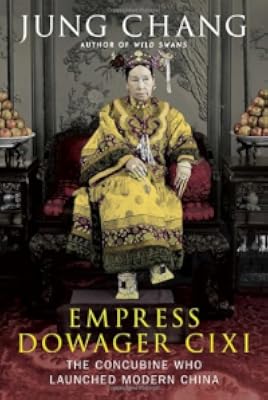
Empress Dowager Cixi: The Concubine Who Launched Modern China
by Jung Chang
On This Page
Description
Empress Dowager Cixi (1835-1908) is the most important woman in Chinese history. She ruled China for decades and brought a medieval empire into the modern age. At the age of 16, in a nationwide selection for royal consorts, Cixi was chosen as one of the emperor's numerous concubines and sexual partners. When he died in 1861, their 5-year-old son succeeded to the throne. Cixi at once launched a palace coup against the regents appointed by her husband and made herself the real ruler of China - show more behind the throne, literally, with a silk screen separating her from her officials who were all male. In this ground-breaking biography, Jung Chang vividly describes how Cixi fought against monumental obstacles to change China. Under her the ancient country attained virtually all the attributes of a modern state: industries, railways, electricity, telegraph, and an army and navy with up-to-date weaponry. It was she who abolished gruesome punishments like 'death by a thousand cuts' and put an end to foot-binding. She inaugurated women's liberation, and embarked on the path to introduce parliamentary elections to China. Jung Chang comprehensively overturns the conventional view of Cixi as a die-hard conservative and cruel despot. Cixi reigned during extraordinary times and had to deal with a host of major national crises: the Taiping and Boxer Rebellions, wars with France and Japan - and the invasion by 8 allied powers including Britain, Germany, Russia and the United States. Jung Chang not only records the Empress Dowager's conduct of domestic and foreign affairs, but also takes the reader into the depths of her splendid Summer Palace and the harem of Beijing's Forbidden City, where she lived surrounded by eunuchs - with one of whom she fell in love, with tragic consequences. The world Jung Chang describes here, in fascinating detail, seems almost unbelievable in its extraordinary mixture of the very old and the very new. Based on newly available, mostly Chinese, historical documents such as court records, official and private correspondence, diaries and eye-witness accounts, this biography will revolutionise historical thinking about a crucial period in China's - and the world's - history. Packed with drama, fast-paced and gripping, it is both a panoramic depiction of the birth of modern China and an intimate portrait of a woman: as the concubine to a monarch, as the absolute ruler of a third of the world's population, and as a unique stateswoman. show lessTags
Recommendations








Member Reviews
What a character! In 1852 the 16-year-old "woman of the Nala family" was selected as a sixth-class concubine for the Emperor of China. She had considerable intelligence and determination, which she used to rise to being Empress, and when the Emperor Xianfeng died, Dowager Empress. In this capacity she blindsided the Grand Council who acted as regents to the new child-emperor, and ran the country for 40 years, until her death in 1908. Whereupon the place erupted into chaos that it's still recovering from. In more detail, Ms Chang has used a mountain of archival material only recently released for study (in Beijing), and contemporary Western accounts, to paint a picture of Cixi totally at odds with the one we're used to. No, she wasn't a show more bloodthirsty dragon; she "only" compassed the demise of some two dozen people (even if one of them was her adoptive son), rather than the 70 million that Mao chalked up. No, she wasn't a narrow-minded traditionalist; half the book details the steps she took to thwart the mandarins and bring China into the 19th century (at all times having to hasten slowly because the person a French diplomat apostrophised as "the only [proper man in China" was the wrong sex to be listened to). The book is occasionally heavy but mostly the pages turn themselves easily; the overall effect is riveting. And the thesis chimes in well with the Cixi-ana on public display to this day in the Summer Palace. Item: she was given a car (I'm sure the guide said she bought it, which would seem to have been in character), but only when it was delivered did someone realize there was a protocol problem: everybody had to kneel (or, with her permission, stand) in the presence of the Empress Dowager, and neither position is exactly conducive to safe driving. So she never got to try it out, and today it is parked in a museum hall in the Summer Palace.
I see this is Ms Chang's third book, and the library has one of the others. I can't wait go grab it. show less
I see this is Ms Chang's third book, and the library has one of the others. I can't wait go grab it. show less
A largely entertaining and informative account of the Manchu Empress Dowager Cixi who was the guiding force in China during the era in which it was most under direct pressure from the West to modernise.
Part of Jung Chan's mission is to rehabilitate Cixi from historical criticism and to a great extent she succeeds in restoring some balance.
However, she goes too far, almost certainly because Jung Chang is something of a liberal-conservative and wants to think the best of a fellow woman - you have to see the book through this gender prejudice.
A more considered opinion is that Cixi was a highly intelligent woman who knew how to play the peculiar anthropology of imperial political rule for traditionalist ends - but those ends were show more absurd.
She was a naturally gifted ruler amongst traditionalist fools, largely male by the nature of things, in an inherently corrupt and feudal system that had ceased to be able to protect its own people.
The insights into the international politics of the era are useful in understanding modern tensions and there are no surprises.
The British had matured into patronising assistants to the local ruler much as they did in India, the French were opportunists, the Germans were little more than global thugs and the Japanese had a plan ...
The role of the Japanese in destabilising China is well articulated here and it is clear both that they had many allies within China, traditionalist and revolutionary, and were extremely clever.
The Japanese aim might simply be summarised as to rule China by replacing the Manchus on the basis that the Han Chinese and tributaries would not care if one set of foreigners replaced another.
Much that drives the fierce Chinese nationalist response today to Japan can be traced back to the politics of the 1890s onwards. This reached its natural end with the invasion of China in the 1930s.
America comes out well as a non-patronising friend of China and as a sensitive moderniser. It is no accident that non-Communist Chinese nationalism eventually orientated itself towards the US.
The more one reads of history, the more the US appears to be the best of nations except when it becomes obsessed by ideological bugaboos - whether communist or 'terrorist'.
Cixi herself has a story of three parts - influential in opening up China to the West, then making serious mistakes in trying to challenge it and, finally, too late, being a force for constitutional monarchy.
Jung Chang occasionally errs in trying 'clean' Cixi's reputation beyond credibility - the constraints of Imperial practice may have obligated cruelties but cruelties there were.
If we think that there was a possibility of a foreign imperial and obscurantist dictatorship based on humiliation being transformed from within to make China strong, then Cixi might be regarded as 'heroic'.
Regrettably the whole imperial project was absurd once greedy forces with superior technology emerged. Cixi's constant ducking and diving to preserve a political corpse strikes me as often just self interest.
Stories of women in power before the modern age are always fascinating, precisely because they tell us so much not about 'patriarchy' but about how the clever can always work a system.
We should get out of the malign modern habit of being impressed with such women without any serious analysis of the system they command - whether Byzantium or China.
What we have here is not a world dominated by men as such but one ruled by small cliques with a history whose mentality is that of thieves who will hang together lest they hang separately.
The bottom line is that China was trapped in a weak economy surrounded by technologically superior enemies and arriving at that situation was precisely down to traditionalism and magical thinking.
Empress Dowager Cixi did little more than permit a jaded system to survive for long enough that its degeneracy had become clear to everyone but the most ignorant peasant.
Perhaps that was a major achievement of sorts. show less
Part of Jung Chan's mission is to rehabilitate Cixi from historical criticism and to a great extent she succeeds in restoring some balance.
However, she goes too far, almost certainly because Jung Chang is something of a liberal-conservative and wants to think the best of a fellow woman - you have to see the book through this gender prejudice.
A more considered opinion is that Cixi was a highly intelligent woman who knew how to play the peculiar anthropology of imperial political rule for traditionalist ends - but those ends were show more absurd.
She was a naturally gifted ruler amongst traditionalist fools, largely male by the nature of things, in an inherently corrupt and feudal system that had ceased to be able to protect its own people.
The insights into the international politics of the era are useful in understanding modern tensions and there are no surprises.
The British had matured into patronising assistants to the local ruler much as they did in India, the French were opportunists, the Germans were little more than global thugs and the Japanese had a plan ...
The role of the Japanese in destabilising China is well articulated here and it is clear both that they had many allies within China, traditionalist and revolutionary, and were extremely clever.
The Japanese aim might simply be summarised as to rule China by replacing the Manchus on the basis that the Han Chinese and tributaries would not care if one set of foreigners replaced another.
Much that drives the fierce Chinese nationalist response today to Japan can be traced back to the politics of the 1890s onwards. This reached its natural end with the invasion of China in the 1930s.
America comes out well as a non-patronising friend of China and as a sensitive moderniser. It is no accident that non-Communist Chinese nationalism eventually orientated itself towards the US.
The more one reads of history, the more the US appears to be the best of nations except when it becomes obsessed by ideological bugaboos - whether communist or 'terrorist'.
Cixi herself has a story of three parts - influential in opening up China to the West, then making serious mistakes in trying to challenge it and, finally, too late, being a force for constitutional monarchy.
Jung Chang occasionally errs in trying 'clean' Cixi's reputation beyond credibility - the constraints of Imperial practice may have obligated cruelties but cruelties there were.
If we think that there was a possibility of a foreign imperial and obscurantist dictatorship based on humiliation being transformed from within to make China strong, then Cixi might be regarded as 'heroic'.
Regrettably the whole imperial project was absurd once greedy forces with superior technology emerged. Cixi's constant ducking and diving to preserve a political corpse strikes me as often just self interest.
Stories of women in power before the modern age are always fascinating, precisely because they tell us so much not about 'patriarchy' but about how the clever can always work a system.
We should get out of the malign modern habit of being impressed with such women without any serious analysis of the system they command - whether Byzantium or China.
What we have here is not a world dominated by men as such but one ruled by small cliques with a history whose mentality is that of thieves who will hang together lest they hang separately.
The bottom line is that China was trapped in a weak economy surrounded by technologically superior enemies and arriving at that situation was precisely down to traditionalism and magical thinking.
Empress Dowager Cixi did little more than permit a jaded system to survive for long enough that its degeneracy had become clear to everyone but the most ignorant peasant.
Perhaps that was a major achievement of sorts. show less
Jung Chang’s [b:Wild Swans: Three Daughters of China|1848|Wild Swans Three Daughters of China|Jung Chang|https://images.gr-assets.com/books/1440643710s/1848.jpg|2969000] is one of my favourite books of all time. Here, she again tells the story of transformational change in China through the life of a woman. Her biography of Empress Dowager Cixi greatly increased my knowledge of late 19th and early 20th Chinese history. The titular Cixi emerges as a fascinating figure, the strong leader behind a series of weak and inept emperors. Her life story demonstrates repeatedly the quixotic implications of treating women as lesser. Cixi was able to end up ruling China due to the oddly meritocratic method of choosing concubines for the emperor, show more whereas no man of equivalent status could have risen so. Cixi’s success began in part due to her luck in having a son with the emperor, which greatly increased her status, but this merely enabled her to make use of her undoubtedly great gifts as a statesperson. Nonetheless, for several periods she was pushed aside, as her status was not formally recognised as emperor-equivalent. Also interesting to me is how convention obliged her to form relationships with the wives and children of foreign dignitaries rather than the male dignitaries themselves, which in turn gave those women greater status. An anecdote exemplifies the situation:
Jung Chang presents Cixi as someone who made serious mistakes (the Boxer Rebellion, notably) and could undoubtedly be ruthless, but also had an incredible positive impact on China. In the first eight years of the twentieth century, she presided over transformational changes, which were apparently very popular. Electricity, trains, and telephones were introduced. Foot binding was abolished and died out within a generation, freeing women from agony. (Although, I was amused to discover, court women sometimes commented that the wearing of corsets by their Western counterparts was ‘pitiable!’) Economic reforms were enacted, the army and navy were modernised (albeit not sufficiently to repel repeated aggression from Europe and Japan), and initial steps towards democracy taken. Jung Chang points out that the press freedom allowed by Cixi in China between 1902 and 1908 ‘was unprecedented and arguably unsurpassed since’.
The amount of research that went into this book is quite staggering and it provides a convincing picture of a woman poised between tradition and modernity. I was especially struck by Cixi’s final actions, mere hours before her death. She had the emperor, her adopted son, fatally poisoned and placed ultimate authority over ‘exceptionally critical matters’ in the hands of his widow, the new empress dowager. This poor woman had had little political involvement previously and was largely overlooked. However, the book argues that Cixi foresaw the need for someone with humility to surrender the Manchu dynasty’s power once holding onto it become untenable. On her deathbed, the dowager empress seemingly understood that her democratic reforms were incompatible with continued rule by a Manchu minority. This again demonstrates the power that women can end up wielding from a lesser position. The poisoning meanwhile shows her ruthlessness. What an extraordinary woman, whose achievements have apparently been ascribed to men by popular history. I’m very glad that I read this biography. show less
The American minister, Edwin H. Conger was as impressed as his wife. When an American admiral asked Mrs. Conger [a friend of Cixi’s], “What do you ladies talk about - dress and jewels?”, he replied, “Quite the contrary. They talk about the Manchurian troubles, political questions, and many things pertaining to their Government.”
Jung Chang presents Cixi as someone who made serious mistakes (the Boxer Rebellion, notably) and could undoubtedly be ruthless, but also had an incredible positive impact on China. In the first eight years of the twentieth century, she presided over transformational changes, which were apparently very popular. Electricity, trains, and telephones were introduced. Foot binding was abolished and died out within a generation, freeing women from agony. (Although, I was amused to discover, court women sometimes commented that the wearing of corsets by their Western counterparts was ‘pitiable!’) Economic reforms were enacted, the army and navy were modernised (albeit not sufficiently to repel repeated aggression from Europe and Japan), and initial steps towards democracy taken. Jung Chang points out that the press freedom allowed by Cixi in China between 1902 and 1908 ‘was unprecedented and arguably unsurpassed since’.
The amount of research that went into this book is quite staggering and it provides a convincing picture of a woman poised between tradition and modernity. I was especially struck by Cixi’s final actions, mere hours before her death. She had the emperor, her adopted son, fatally poisoned and placed ultimate authority over ‘exceptionally critical matters’ in the hands of his widow, the new empress dowager. This poor woman had had little political involvement previously and was largely overlooked. However, the book argues that Cixi foresaw the need for someone with humility to surrender the Manchu dynasty’s power once holding onto it become untenable. On her deathbed, the dowager empress seemingly understood that her democratic reforms were incompatible with continued rule by a Manchu minority. This again demonstrates the power that women can end up wielding from a lesser position. The poisoning meanwhile shows her ruthlessness. What an extraordinary woman, whose achievements have apparently been ascribed to men by popular history. I’m very glad that I read this biography. show less
Revisionist history, ahoy!
Revisionism seems to be a bad word in history, but sometimes things really do need a second look. That time has come for Empress Dowager Cixi, who has had a reputation as a ruthless, xenophobic, power-hungry ruler. According to this version of her story, she was actually the force behind China's overtures to foreigners and its moves toward modernization, although others got the credit. Cixi rose to power through a coup carried out jointly by her and Empress Dowager Ci'an, stepping into the power vacuum created by the death of Emperor Xianfeng. Ci'an had been the official Empress, and Cixi was the mother of the only heir, Tongzhi.
Cixi was in power almost continuously for over 50 years, and they were tumultuous show more years indeed. Court intrigue and plots, deaths, power struggles, questions of how much to trust foreign powers, wars both internal and external, the coming of the modern world; Cixi dealt with all of them. Occasionally when I was reading, I'd want to look up some more information on something, so I'd search on the internet. Reading about her there was reading a completely different story. According to common theory, she had poisoned people, she had tried to keep China from changing along with the world, and she was basically everything that was wrong with China in her era. The book, on the other hand, showed her to be the force for change and insisted that there was no evidence that she poisoned anyone (well, with one exception).
I wondered how this completely different view could possibly be true, but apparently not a lot was available in English about Cixi, and there were many reasons to heap the blame for everything under the sun at her feet. History can always be told differently depending on the sources you choose to use or ignore, and this is a prime example. I thought that sometimes the author went a bit too far in declaring Cixi's innocence and pure motives, but I can understand the temptation to counterbalance Cixi's vilified reputation. All in all, it's a fascinating tale of a woman in power and a country in transition. show less
Revisionism seems to be a bad word in history, but sometimes things really do need a second look. That time has come for Empress Dowager Cixi, who has had a reputation as a ruthless, xenophobic, power-hungry ruler. According to this version of her story, she was actually the force behind China's overtures to foreigners and its moves toward modernization, although others got the credit. Cixi rose to power through a coup carried out jointly by her and Empress Dowager Ci'an, stepping into the power vacuum created by the death of Emperor Xianfeng. Ci'an had been the official Empress, and Cixi was the mother of the only heir, Tongzhi.
Cixi was in power almost continuously for over 50 years, and they were tumultuous show more years indeed. Court intrigue and plots, deaths, power struggles, questions of how much to trust foreign powers, wars both internal and external, the coming of the modern world; Cixi dealt with all of them. Occasionally when I was reading, I'd want to look up some more information on something, so I'd search on the internet. Reading about her there was reading a completely different story. According to common theory, she had poisoned people, she had tried to keep China from changing along with the world, and she was basically everything that was wrong with China in her era. The book, on the other hand, showed her to be the force for change and insisted that there was no evidence that she poisoned anyone (well, with one exception).
I wondered how this completely different view could possibly be true, but apparently not a lot was available in English about Cixi, and there were many reasons to heap the blame for everything under the sun at her feet. History can always be told differently depending on the sources you choose to use or ignore, and this is a prime example. I thought that sometimes the author went a bit too far in declaring Cixi's innocence and pure motives, but I can understand the temptation to counterbalance Cixi's vilified reputation. All in all, it's a fascinating tale of a woman in power and a country in transition. show less
This is a well researched biography by the author better known for Wild Swans. Cixi was the most powerful woman in Chinese history effectively exercising executive power over the largest state in the world for most of the period between 1861, when her young son became Emperor Tongzhi, and 1908 when she died. The role of the concubine in the Chinese imperial hierarchy could be very powerful if she was the mother of the emperor, and she exercised power in the early years of this period with her husband's Empress, Zhen, a much weaker figure personally and politically, though apparently they got on well. Tongzhi assumed power for himself for just a couple of years before he died, possibly of syphilis, in 1875. The next Emperor was Cixi's show more adopted son (actually nephew) Guangxu, another boy over whom she could exert influence and rule herself (though there no real other candidates for the imperial role). She struggled to bring China into the modern age through bringing in trains, telegraphs and industry through more positive relations with foreign countries. There were several foreign invasions with nearly all the Western powers, plus Japan, invading and obtaining chunks of Chinese territory in the name of trade and economic expansion. So the difficult balance for Cixi was to learn from the west to bring China into the modern age, while patriotically fighting their imperial pretensions against Chinese territory. This contradiction was most clearly demonstrated in the nationalist Boxer uprising in 1900. After nearly being dethroned, she managed to draw on deep wells of support and come back to power, instituting what by Chinese standards, a fairly radical programme of reform, including abolishing footbinding and torture, a wider curriculum for mandarins beyond the Confucian classics and including travel abroad, promoting education for women, legal reform and even an outline for a form of parliamentary democracy, albeit still with imperial executive power ultimately still intact. Historians differ over the interpretation of these events, with the author challenging the traditional view that Guangxu was behind these reforms and Cixi conservatively opposing them. Jung Chang's interpretation seems more likely given the thrust of her life and policies over the decades of her rule and Chang considers that "Few of her achievements have been recognised and, when they are, the credit is invariably given to the men serving her. This is largely due to a basic handicap: that she was a woman and could only rule in the name of her sons – so her precise role has been little known." Cixi seems a fascinating and contradictory figure, a mixture of the Medieval and modern, a cautious reformer but with a capacity for ruthlessness that shocks on occasion. show less
Jung Chang's biography of the Empress Cixi is a fascinating look at a period of history about which I know very little. As I'm not familiar with the existing historiography, I don't know to what extent exactly this is a revisionist biography—certainly, if Chang's characterisation of previous historical works on Cixi is true, then this is a swing of the pendulum in the other direction. Chang presents a picture of a woman who was not without her faults, who could be ruthless if necessary, and who was firmly rooted in a traditionalist and monarchist worldview, but who was also a reformer and a moderniser. Chang bases this, she claims, in large part on Chinese-language sources which have been largely disregarded by Chinese scholars and show more inaccessible to Anglophone ones.
I think there's much to consider here, and Chang is good at unpicking the ways in which gender shaped both how Cixi had to present herself and the ways in which both her contemporaries and later scholars have viewed her. However even I could see that there was special pleading in operation here. Telling me that Cixi rarely used torture or execution as a political tool when diplomacy and tact would do instead is one thing—but you cannot then gloss over in a couple of lines the fact that Cixi ordered that her adoptive son be poisoned when she was on her own deathbed, or his favourite concubine thrown down a well because there wasn't enough room for her in their entourage when fleeing Beijing!
Empress Dowager Cixi really reads like the first salvo in a broader reassessment of Cixi's life—Chang has probably been too laudatory here, but I think this biography should lead to further study and reassessment.
(To nitpick as a historian, I really disliked the citation style—why do publishers seem to think that a popular audience will faint away if footnotes are used? I also really, really wish that people would stop using the word 'medieval' as a synonym for 'barbaric.') show less
I think there's much to consider here, and Chang is good at unpicking the ways in which gender shaped both how Cixi had to present herself and the ways in which both her contemporaries and later scholars have viewed her. However even I could see that there was special pleading in operation here. Telling me that Cixi rarely used torture or execution as a political tool when diplomacy and tact would do instead is one thing—but you cannot then gloss over in a couple of lines the fact that Cixi ordered that her adoptive son be poisoned when she was on her own deathbed, or his favourite concubine thrown down a well because there wasn't enough room for her in their entourage when fleeing Beijing!
Empress Dowager Cixi really reads like the first salvo in a broader reassessment of Cixi's life—Chang has probably been too laudatory here, but I think this biography should lead to further study and reassessment.
(To nitpick as a historian, I really disliked the citation style—why do publishers seem to think that a popular audience will faint away if footnotes are used? I also really, really wish that people would stop using the word 'medieval' as a synonym for 'barbaric.') show less
I seem to be giving lots of books five stars recently, and I'm not going to stop until I read a book that isn't fantastic.
This had me from the first paragraph. Going from girl, to concubine, to mother of the heir, to mother of the emperor, to "Oh god if we women don't do something the men are going to screw everything up; I know, let's run a simple dodge on them that'll work because they think we're just women," to bam! (co-)ruler of a third of Earth's population for the majority of the next half a century.
And a damn good one too. The author is possibly overly sympathetic to her, but then most of history has been overly antagonistic to her, with a lot more ulterior motive. Reading the Wikipedia article after this book is a surreal show more experience. But it is hard to really credit a theory of Cixi that says with a straight face "Ironically, Cixi sponsored the implementation of a reform program more radical than the one proposed by the reformers she had beheaded in 1898" (really, 'ironically'? do they think she did this by accident? or that she was the world's first hipster?) and "Cixi may have known of her imminent death and may have worried that Guangxu would continue his reforms after her death" and generally fails to recognise that just possibly it wasn't his reforms that she was opposed to, actually?
Likewise, apparently some people think she didn't get on with the Empress Dowager Ci'an, but I see no way a co-ruling arrangement could last for twenty years omg in that environment if they didn't.
So, though I think the book could have been more critical of the mistakes Cixi did make, as a read I don't much care. It's a riveting story with a powerful character achieving amazing things against tremendous odds. show less
This had me from the first paragraph. Going from girl, to concubine, to mother of the heir, to mother of the emperor, to "Oh god if we women don't do something the men are going to screw everything up; I know, let's run a simple dodge on them that'll work because they think we're just women," to bam! (co-)ruler of a third of Earth's population for the majority of the next half a century.
And a damn good one too. The author is possibly overly sympathetic to her, but then most of history has been overly antagonistic to her, with a lot more ulterior motive. Reading the Wikipedia article after this book is a surreal show more experience. But it is hard to really credit a theory of Cixi that says with a straight face "Ironically, Cixi sponsored the implementation of a reform program more radical than the one proposed by the reformers she had beheaded in 1898" (really, 'ironically'? do they think she did this by accident? or that she was the world's first hipster?) and "Cixi may have known of her imminent death and may have worried that Guangxu would continue his reforms after her death" and generally fails to recognise that just possibly it wasn't his reforms that she was opposed to, actually?
Likewise, apparently some people think she didn't get on with the Empress Dowager Ci'an, but I see no way a co-ruling arrangement could last for twenty years omg in that environment if they didn't.
So, though I think the book could have been more critical of the mistakes Cixi did make, as a read I don't much care. It's a riveting story with a powerful character achieving amazing things against tremendous odds. show less
Members
- Recently Added By
Published Reviews
ThingScore 38
Chinese biography tends to render even its most colorful subjects in monochrome. Once the Communist Party has determined whether an individual worth writing about is hero or villain the biographer's task is to burnish or darken an image until its true outline is lost. Information that contradicts the chosen narrative is casually dismissed or simply omitted. There's no nuance, no debate, no show more shades of gray.
So there's particular excitement whenever fresh material on a key figure escapes China and obtains uncensored publication overseas, such as is promised by Chinese émigré Jung Chang's new biography "Empress Dowager Cixi: The Concubine Who Launched Modern China." New access is claimed to "court records, official and private correspondence, diaries and eye-witness accounts."
But despite 35 years in England, Ms. Chang has not thrown off the habits of the regime from which she fled. There's a courtroom-style approach to her biographies; once she chooses a position every possible fact or argument, however spurious, is marshalled in support of that side.
...
During her lengthy unofficial reign, Cixi stands accused of usurping power, suppressing development and executing reformers who would have strengthened the empire against foreign encroachments. She is also supposed to have spent vital naval funds on the refurbishment of the Summer Palace and connived with the Boxer rebels to kill or drive out every foreigner in China.
Ms. Chang's Cixi is largely a mirror image of this figure: a campaigner for women's rights, an ardent supporter of modernization, a friend to foreigners and a victim of unfounded accusations. But her account is thin on references to reliable primary sources. It frequently quotes clueless foreigners (notably the British attaché Algernon Freeman-Mitford ) when their remarks happen to suit, as well as works by Chinese historians prevented by politics from publishing frank and accurate accounts. Rumors that appeal are passed on uncritically, while those that do not are dismissed as "just a story."
Professional historians are unlikely to take the book seriously, not least because we are frequently told what Cixi was thinking or feeling. And despite ample material, Ms. Chang doesn't possess the narrative skills to turn her story into a ripping yarn. The only suspense comes as the reader waits to discover how each of Cixi's crimes will be explained away. show less
So there's particular excitement whenever fresh material on a key figure escapes China and obtains uncensored publication overseas, such as is promised by Chinese émigré Jung Chang's new biography "Empress Dowager Cixi: The Concubine Who Launched Modern China." New access is claimed to "court records, official and private correspondence, diaries and eye-witness accounts."
But despite 35 years in England, Ms. Chang has not thrown off the habits of the regime from which she fled. There's a courtroom-style approach to her biographies; once she chooses a position every possible fact or argument, however spurious, is marshalled in support of that side.
...
During her lengthy unofficial reign, Cixi stands accused of usurping power, suppressing development and executing reformers who would have strengthened the empire against foreign encroachments. She is also supposed to have spent vital naval funds on the refurbishment of the Summer Palace and connived with the Boxer rebels to kill or drive out every foreigner in China.
Ms. Chang's Cixi is largely a mirror image of this figure: a campaigner for women's rights, an ardent supporter of modernization, a friend to foreigners and a victim of unfounded accusations. But her account is thin on references to reliable primary sources. It frequently quotes clueless foreigners (notably the British attaché Algernon Freeman-Mitford ) when their remarks happen to suit, as well as works by Chinese historians prevented by politics from publishing frank and accurate accounts. Rumors that appeal are passed on uncritically, while those that do not are dismissed as "just a story."
Professional historians are unlikely to take the book seriously, not least because we are frequently told what Cixi was thinking or feeling. And despite ample material, Ms. Chang doesn't possess the narrative skills to turn her story into a ripping yarn. The only suspense comes as the reader waits to discover how each of Cixi's crimes will be explained away. show less
added by peternh
While Chang’s admiration can approach hagiography, her extensive use of new Chinese sources makes a strong case for a reappraisal.
added by pbirch01
Lists

Non-Fiction Worth Reading
1,016 works; 255 members

All Things China
205 works; 3 members

Club Read's Recommended Nonfiction Written by Women
618 works; 30 members

Biographies: Women
112 works; 1 member
Author Information

19+ Works 14,015 Members
Jung Chang was born in Yibin, Sichuan Province, China, in 1952. She left China for Britain in 1978 and obtained a Ph.D. in linguistics from the University of York in 1982. She is the first person from the People¿s Republic of China to receive a doctorate from a British university. She lives in London with her husband, Jon Halliday, with whom she show more wrote Mao: The Unknown Story. Her non-fiction book, Wild Swans: Three Daughters of China, was a New York Times bestseller in 2014. (Bowker Author Biography) show less
Awards and Honors
Awards
Distinctions
Common Knowledge
- Canonical title*
- De keizerin
- Original title
- Empress Dowager Cixi: The Concubine Who Launched Modern China
- Original publication date
- 2013-10-29
- People/Characters
- Empress Dowager Cixi; Xianfeng Emperor; Prince Chun; Prince Gong; Empress Zhen; Guangxu Emperor (show all 18); Prince Ching; Prince Duan; Empress Longyu; Imperial Concubine Pearl; Imperial Concubine Jade; Li Hongzhang; Sarah Conger; Louisa Pierson; Katharine Carl; Tongzhi Emperor; Empress Xiaozheyi; W. Somerset Maugham
- Important places
- China; Forbidden City, Beijing, China; Summer Palace, Beijing, China
- Dedication
- To Jon
- First words
- In spring 1852, in one of the periodic nationwide selections for imperial consorts, a sixteen-year-old girl caught the eye of the emperor and was chosen as a concubine.
- Last words
- (Click to show. Warning: May contain spoilers.)Looking back over the many horrific decades after Cixi's demise, one cannot but admire this amazing stateswoman, flawed though she was.
- Canonical DDC/MDS
- 951.035092
- Canonical LCC
- DS763.63.C58
*Some information comes from Common Knowledge in other languages. Click "Edit" for more information.
Classifications
Statistics
- Members
- 1,095
- Popularity
- 23,279
- Reviews
- 41
- Rating
- (4.00)
- Languages
- 13 — Danish, Dutch, English, Finnish, French, German, Italian, Norwegian (Bokmål), Polish, Portuguese, Spanish, Swedish, Chinese, traditional
- Media
- Paper, Audiobook, Ebook
- ISBNs
- 47
- ASINs
- 15