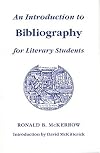
An introduction to bibliography for literary students
by Ronald B. McKerrow
On This Page
Description
The authoritative guide to those who study literature and early printed books in general. Indispensable for graduate students.Tags
Recommendations


















Member Reviews
“No worthwhile book has ever been written that didn’t have footnotes.”
Terry Pratchett
I made that quotation up, but it’s the kind of thing he might have said. This book has hardly a page without footnotes. They often run into the next page. Some pages have more footnote than main text.
This is a book about books as interesting as its title is dull. I don’t know what the OUP’s dysfunction was back in the day but they seemed determined to restrict sales as much as possible. McKerrow says in his Preface that it deals with “the problem of the relation of the printed book to the written word of the author. So far as it was in my power I have dealt with everything which seemed to me to bear on this relation”. This is broadly show more correct. He goes on to say “I have here and there put in something for no better reason than that it interested me”. That is more accurate.
Parts of this book are quite technical. I was unable to understand his description of the body of the printing press. This is not McKerrow’s fault. I struggle to construct flat-pack furniture. I found that as long as I understood the paper and bit that puts the ink on it then all was well.
McKerrow describes what 16th and 17th century books should be like when all goes according to plan. It would be useful if you had a book of the period to hand. I did not, but I did have a 1784 edition from the John Bell’s Poets series that was made using the same methods (Bell is mentioned several times as it happens. Apparently he was the first printer to abandon the long s). If you’re in the UK or somewhere with a similar culture try a charity shop with an antiquarian section. They’ll probably have a damaged copy of something like that which they don’t know what to do with and will let you have it for one or two quid. Damaged is good as you’ll be able to investigate it’s inner construction.
Most of the book explores the minutiae of the signs you’ll find in books when the plan has failed and something has gone wrong during production. McKerrow has an excellent analytical mind and from the smallest details can tell what the printer has done and open for you a window into some dark print room whose walls rotted away five hundred years ago. More than that, he can infer what the writer did that interfered with the process. He can tell you what the writer wrote when the printer has failed to follow the manuscript. And if you pay attention and stop picking at your nails you be able to do that too. show less
Terry Pratchett
I made that quotation up, but it’s the kind of thing he might have said. This book has hardly a page without footnotes. They often run into the next page. Some pages have more footnote than main text.
This is a book about books as interesting as its title is dull. I don’t know what the OUP’s dysfunction was back in the day but they seemed determined to restrict sales as much as possible. McKerrow says in his Preface that it deals with “the problem of the relation of the printed book to the written word of the author. So far as it was in my power I have dealt with everything which seemed to me to bear on this relation”. This is broadly show more correct. He goes on to say “I have here and there put in something for no better reason than that it interested me”. That is more accurate.
Parts of this book are quite technical. I was unable to understand his description of the body of the printing press. This is not McKerrow’s fault. I struggle to construct flat-pack furniture. I found that as long as I understood the paper and bit that puts the ink on it then all was well.
McKerrow describes what 16th and 17th century books should be like when all goes according to plan. It would be useful if you had a book of the period to hand. I did not, but I did have a 1784 edition from the John Bell’s Poets series that was made using the same methods (Bell is mentioned several times as it happens. Apparently he was the first printer to abandon the long s). If you’re in the UK or somewhere with a similar culture try a charity shop with an antiquarian section. They’ll probably have a damaged copy of something like that which they don’t know what to do with and will let you have it for one or two quid. Damaged is good as you’ll be able to investigate it’s inner construction.
Most of the book explores the minutiae of the signs you’ll find in books when the plan has failed and something has gone wrong during production. McKerrow has an excellent analytical mind and from the smallest details can tell what the printer has done and open for you a window into some dark print room whose walls rotted away five hundred years ago. More than that, he can infer what the writer did that interfered with the process. He can tell you what the writer wrote when the printer has failed to follow the manuscript. And if you pay attention and stop picking at your nails you be able to do that too. show less
Ratings
Members
- Recently Added By
Lists

Books Read in 2019
4,052 works; 110 members
Author Information
17+ Works 290 Members
Common Knowledge
- Original publication date
- 1927
Classifications
- Genres
- Nonfiction, General Nonfiction, History
- DDC/MDS
- 010.42 — Computer science, information & general works Bibliographies (books containing lists of books) Bibliographies & catalogs Essays
- LCC
- Z1001 .M16 — Bibliography, Library Science and Information Resources General bibliography Introduction to bibliography. Theory, philosophy,
Statistics
- Members
- 242
- Popularity
- 134,698
- Reviews
- 1
- Rating
- (4.34)
- Languages
- English, Spanish
- Media
- Paper
- ISBNs
- 4
- ASINs
- 16