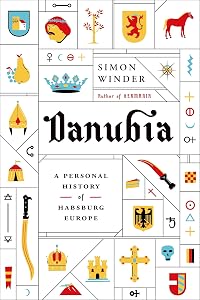
Danubia: A Personal History of Habsburg Europe
by Simon Winder
On This Page
Description
The Habsburg Empire was a ramshackle, lumbering old giant centered in the Danube Valley that held a central place in European politics from the Middle Ages to the end of WW I, ruled by the dominant dynasty of Europe for four centuries, the Habsburg family. Winder set out to wander through the lands that used to constitute the Empire, describing and reflecting on what he sees now, particularly in terms of the appearance of villages, towns, and cities, and what he knows through his research as show more to how things used to look when the Habsburgs held sway. The sentiment around which he builds his colorful narrative is that the longevity of the Habsburg dynasty was due to a mix of cunning, dimness, luck, and brilliance. (About one particular archduke, Winder says, he was one of the Habsburgs who make the family worthwhile, who make up for all the pious timeservers who congest the family tree.) This personalized, almost you-are-there view of history results in an arresting combination of anecdote and scholarly examination, where the interests of serious armchair travelers and devoted students of European history meet.--Brad Hooper, Booklist show lessTags
Recommendations














Member Reviews
All those Philips and Ferdinands and Franzes.
Winder’s idiosyncratic account of the rise and fall of the Habsburg Dynasty is great good fun, wry, informal, erudite. By a combination of accident, luck and ruthlessness, the Habsburgs held sway in Central Europe from the Middle Ages to WWI. They were at center stage for the creation of a Spanish empire in the Americas, the Italian wars that ended the Renaissance, the Protestant Reformation, the expansion of the Ottoman Empire under Suleiman the Magnificent that was finally checked at the Battle of Lepanto, the Thirty Years War, Napoleon’s destruction of the Holy Roman Empire, the Revolutions of 1848 and the Balkan Wars. All these events look and feel different when considered from the show more Habsburg (and Winder’s) perspective.
Winder doesn’t really spend a lot of time on the battles and high politics that a more conventional history might emphasize; he is more interested in the eccentric, odd and peculiar bits that enliven our view of the past. Through a tour of castles, chapels, crypts, fortresses, hunting lodges, armories and provincial museums in obscure villages we encounter mummies, bear moats, devil-dolls, bezoars and glyptics. The Habsburgs put great stock in the cultic power of imperial heirlooms (a unicorn horn, the Holy Grail) and regalia (red samite gloves, gold scabbards, an imperial mantle decorated in Arabic script) and ceremony. We hear of the dodo acquired by Rudolph II from the Fuggers’ warehouse of exotic beasts in Antwerp; the ‘demented enthusiasms’ of Athanasius Kircher (a tower built to reach the moon would require 374,731,250,000,000 bricks); the supernova witnessed by Tycho Brahe in Prague in 1604; Ludwig Viktor, the transvestite uncle of Franz Ferdinand who outlived the Dynasty. The Habsburgs were patrons of great painters and composers—Titian, Bosch, Rubens, Arcimboldo; Mozart, Haydn and Beethoven—and some ‘engagingly semi-competent’ ones as well. Maximilian I’s advantage over all subsequent Holy Roman Emperors, according to Winder, was that his portrait was painted by Dürer.
Winder uses the ‘teetering plausibility’ of a basilisk preserved in a glass jar at the Vienna Museum of Natural History (actually a ray from some far-away port, cut, folded and sewn to form legs, wings and horns) to make a keen point about how difficult it is for humans of the present to really make sense of humans from the past. Not for Winder the pop-historian fallacy that they were just like us! The scientific and magical preoccupations of medieval and early modern Europe were ‘drawn from intellectual streams so rich, various and contradictory,’ writes Winder, that we can read and study and ponder but never fully grasp the assumptions and motivations that shaped their mental worlds. Winder is constantly making us aware that the history of Central Europe and the Habsburgs means something different to us than it did to the people who lived through it.
At the end of WWI, patches of the Austrian Tyrol were handed over to Italy. Outside the town of Bolzano, in a region dominated by German-speakers, Winder comes across a castle—
In Italian it is called Castel Roncolo, which implies maidens in gauzy outfits skipping about to tambourines and lutes with weedy youths in coloured tights looking on. In German it is called Schloß Runkelstein, which implies a brandy-deranged old soldier-baron with a purple face and leg-iron lurching around darkened dank corridors, beating a servant to death with his crutch. Seeing the two names everywhere side by side is deeply confusing, like having one eye always out of focus. show less
Winder’s idiosyncratic account of the rise and fall of the Habsburg Dynasty is great good fun, wry, informal, erudite. By a combination of accident, luck and ruthlessness, the Habsburgs held sway in Central Europe from the Middle Ages to WWI. They were at center stage for the creation of a Spanish empire in the Americas, the Italian wars that ended the Renaissance, the Protestant Reformation, the expansion of the Ottoman Empire under Suleiman the Magnificent that was finally checked at the Battle of Lepanto, the Thirty Years War, Napoleon’s destruction of the Holy Roman Empire, the Revolutions of 1848 and the Balkan Wars. All these events look and feel different when considered from the show more Habsburg (and Winder’s) perspective.
Winder doesn’t really spend a lot of time on the battles and high politics that a more conventional history might emphasize; he is more interested in the eccentric, odd and peculiar bits that enliven our view of the past. Through a tour of castles, chapels, crypts, fortresses, hunting lodges, armories and provincial museums in obscure villages we encounter mummies, bear moats, devil-dolls, bezoars and glyptics. The Habsburgs put great stock in the cultic power of imperial heirlooms (a unicorn horn, the Holy Grail) and regalia (red samite gloves, gold scabbards, an imperial mantle decorated in Arabic script) and ceremony. We hear of the dodo acquired by Rudolph II from the Fuggers’ warehouse of exotic beasts in Antwerp; the ‘demented enthusiasms’ of Athanasius Kircher (a tower built to reach the moon would require 374,731,250,000,000 bricks); the supernova witnessed by Tycho Brahe in Prague in 1604; Ludwig Viktor, the transvestite uncle of Franz Ferdinand who outlived the Dynasty. The Habsburgs were patrons of great painters and composers—Titian, Bosch, Rubens, Arcimboldo; Mozart, Haydn and Beethoven—and some ‘engagingly semi-competent’ ones as well. Maximilian I’s advantage over all subsequent Holy Roman Emperors, according to Winder, was that his portrait was painted by Dürer.
Winder uses the ‘teetering plausibility’ of a basilisk preserved in a glass jar at the Vienna Museum of Natural History (actually a ray from some far-away port, cut, folded and sewn to form legs, wings and horns) to make a keen point about how difficult it is for humans of the present to really make sense of humans from the past. Not for Winder the pop-historian fallacy that they were just like us! The scientific and magical preoccupations of medieval and early modern Europe were ‘drawn from intellectual streams so rich, various and contradictory,’ writes Winder, that we can read and study and ponder but never fully grasp the assumptions and motivations that shaped their mental worlds. Winder is constantly making us aware that the history of Central Europe and the Habsburgs means something different to us than it did to the people who lived through it.
At the end of WWI, patches of the Austrian Tyrol were handed over to Italy. Outside the town of Bolzano, in a region dominated by German-speakers, Winder comes across a castle—
In Italian it is called Castel Roncolo, which implies maidens in gauzy outfits skipping about to tambourines and lutes with weedy youths in coloured tights looking on. In German it is called Schloß Runkelstein, which implies a brandy-deranged old soldier-baron with a purple face and leg-iron lurching around darkened dank corridors, beating a servant to death with his crutch. Seeing the two names everywhere side by side is deeply confusing, like having one eye always out of focus. show less
Half an hour's drive north of me, following the path of the River Reuss, is the little hamlet of Habsburg. The first time I saw it on a roadsign, I assumed it was a coincidence, since the House of Habsburg is something I would generally associate with the bustling metropolises of Austria and Hungary, not a damp cowfield in the back end of the Aargau. But sure enough, this turns out to be where the whole gargantuan dynasty acquired its name.
The ‘castle’ here was built in the 1020s, when castle technology was still pretty basic – it's really just a biggish drafty house with a little donjon tower attached, perched on a drab hillock. A minor count called Radbot built it, dubbing it, rather aspirationally, Habsburg or ‘Hawk show more Castle’. From the top of its low tower, you can pick your way around the splotches of pigeon poo (and indeed around the pigeons themselves), and peer hesitantly out of the embrasure – towards Vienna.
It seems an inauspicious beginning for what would become the most powerful family in continental history, and indeed I only mention it here because even Simon Winder, in this mad, exuberant, generous history of Habsburg Europe, chooses not to begin until four centuries later, when one of them first became Holy Roman Emperor. It's one of many things that Winder cheerfully skips over, as he makes a great show of the sheer unmanageable scale of his subject – he is not averse to rattling off comments like the following:
Incidentally, it is generally around here that anybody writing about the Habsburg Empire is obliged to have a section on people like the Empress Elisabeth and her son Crown Prince Rudolf, but really if these people are of interest you should probably just look them up on Wikipedia, which has excellent entries.
With even a smidgen less authority this would all seem dreadfully flippant, but fortunately it is soon obvious that Winder's knowledge, and his grasp of the material, is much greater than he's letting on. The mock-dilettantism is just one aspect of a fantastically engaging and discriminating narrative style, a style that sometimes seems to owe as much to Douglas Adams as it does to AJP Taylor or John Julius Norwich. The result feels rather like talking to a great historian in the bar after their lecture.
This was one of those books that had me throwing up my hands with a renewed sense of how little I know: every chapter, every page, revealed enormous new vistas of my own ignorance. It was particularly galling since I've travelled a fair bit in the Balkans and other parts of ‘eastern Europe’ (an unsatisfactory phrase, as this book makes plain), and had quietly prided myself on knowing something of the area's history and culture. But in fact what was totally obscure to me was the extent to which this region had been connected to the west; the extent to which cities such as Lviv, Debrecen or Cluj were (in Winder's words) ‘part of a culture rooted in mainstream European values’, indeed a culture that was thought of as being at the heart of Europe's identity and character until really the twentieth century.
Though Winder is careful to stress again and again the problems and contradictions in the Empire, it is hard not to be a little swept up in the sheer romance of a single entity that stretched from Bregenz on the shores of Lake Constance all the way to Braşov in the middle of what's now Romania, from Kraków or Prague in the north down to Trieste, Sarajevo, and the Croatian coast. In the context of the tumultuous convulsions that this region experienced over the last five hundred years, the Habsburgs themselves emerge as a rather baffling constant: always rather distant, sometimes downright inconsequential.
Many are scarcely distinguishable – a tangle of Ferdinands and Leopolds – though some have attained a kind of legendary status, such as Rudolf II, who was obsessed with the occult and who had a lion and a tiger wandering round Prague Castle. And most of them were afflicted by various abnormalities that resulted from the generations of in-breeding – notably the famous ‘Habsburg jaw’, which makes a family tree of the Habsburgs look like a series of Jay Lenos in fancy dress; it affected one of the Leopolds so badly that his mouth would fill with water every time it rained.
Winder keeps you distracted with bear-moats and lunatics while sneaking in a huge amount of geopolitical history under the radar. And approaching European history from this direction gave me a very new, and sometimes quite revelatory, angle on things like the Reformation, the Thirty Years War, or the revolutions of 1848. This is especially the case towards the end of the book as the First World War looms into view. From a British perspective, 1914–1918 is vaguely thought of as having been about fighting Germany, along with a few of their allies; this is all very well, but it does mean that the killing of some pooh-bah named after a post-punk indie band in an obscure part of Yugoslavia seems like an inexplicable reason for a global conflict. Here, though, coming at it through the morass of Imperial nationalisms and separatist movements, I felt things slotting into place in a completely novel way.
It's perhaps surprising that a book this chunky – upwards of five hundred pages, before you hit the bibliography – ends up feeling so selective, but such is the result of Winder's faux-snap decisions about what is and is not of interest: he succeeds in building a powerful cumulative argument. This has to do with the fact of the Empire's being a ‘chaos of nationalities’, where ‘the very idea of “nation” was an unresolvable nightmare’.
Instances of quite how contingent Central Europe is, in linguistic or political terms, are everywhere. Béla Bartók can stand for innumerable other examples: generally thought of as a ‘Hungarian’ composer, almost none of the places that formed him lie within the borders of the modern Hungarian state. He was born in Nagyszentmiklós (now the Romanian town of Sânnicolau Mare), then moved to Nagyszőllős (now the Ukrainian town of Vynohravdiv), then to Nagyvárad (now the Romanian city of Oradea), and then to Pozsony (now the Slovakian capital Bratislava). Indeed Bratislava itself only acquired its name in 1918, plucked more or less out of thin air by Slovak nationalists squinting heavily at some old manuscripts – before that, it had only ever had German and Hungarian names (Preßburg and Pozsony).
Similar examples are piled up, until the overall sense is of an entire gigantic region whose multilingual, multiethnic nature has been obscured only by successive (and recent) waves of expulsions and massacres. The point is not a fluffy one of the necessity of getting on with each other (though certainly Winder comes to have an extremely negative view of nationalism, comparing it at one point to bubonic plague); no, the point is just that the borders and divisions of Central Europe are characterised by their near-total arbitrariness, with most of the modern nation-states having only the most cursory historical justification once the poetic myth-making has been set aside.
I found this very moving, for reasons that are difficult to explain – or, perhaps, that are too obvious to go into. Winder enriches his story with just the right amount of personal anecdotes about his travels around the region – it never feels like someone talking through their holiday photos armed with a stack of museum pamphlets, which is the danger with this kind of project. And his constant references to the music and literature mean you will come away with a healthy further reading list.
It was a pleasant surprise, reaching the end, to find a note saying that an underlying inspiration had been Rebecca West's Black Lamb and Grey Falcon, which is perhaps the single book that impresses me more than any other. Danubia is not at that level, but the comparison – which hadn't occured to me while I was reading – helped me understand why I liked this so much. Though it's not perfect, it has a similar ability to uncover a wealth of fascinating detail, and also manages to draw a plausible, cumulative thread out of such an overwhelming historical and geographic scope. I thought it was fantastic, and every farmhouse in the Aargau should have a copy. show less
The ‘castle’ here was built in the 1020s, when castle technology was still pretty basic – it's really just a biggish drafty house with a little donjon tower attached, perched on a drab hillock. A minor count called Radbot built it, dubbing it, rather aspirationally, Habsburg or ‘Hawk show more Castle’. From the top of its low tower, you can pick your way around the splotches of pigeon poo (and indeed around the pigeons themselves), and peer hesitantly out of the embrasure – towards Vienna.
It seems an inauspicious beginning for what would become the most powerful family in continental history, and indeed I only mention it here because even Simon Winder, in this mad, exuberant, generous history of Habsburg Europe, chooses not to begin until four centuries later, when one of them first became Holy Roman Emperor. It's one of many things that Winder cheerfully skips over, as he makes a great show of the sheer unmanageable scale of his subject – he is not averse to rattling off comments like the following:
Incidentally, it is generally around here that anybody writing about the Habsburg Empire is obliged to have a section on people like the Empress Elisabeth and her son Crown Prince Rudolf, but really if these people are of interest you should probably just look them up on Wikipedia, which has excellent entries.
With even a smidgen less authority this would all seem dreadfully flippant, but fortunately it is soon obvious that Winder's knowledge, and his grasp of the material, is much greater than he's letting on. The mock-dilettantism is just one aspect of a fantastically engaging and discriminating narrative style, a style that sometimes seems to owe as much to Douglas Adams as it does to AJP Taylor or John Julius Norwich. The result feels rather like talking to a great historian in the bar after their lecture.
This was one of those books that had me throwing up my hands with a renewed sense of how little I know: every chapter, every page, revealed enormous new vistas of my own ignorance. It was particularly galling since I've travelled a fair bit in the Balkans and other parts of ‘eastern Europe’ (an unsatisfactory phrase, as this book makes plain), and had quietly prided myself on knowing something of the area's history and culture. But in fact what was totally obscure to me was the extent to which this region had been connected to the west; the extent to which cities such as Lviv, Debrecen or Cluj were (in Winder's words) ‘part of a culture rooted in mainstream European values’, indeed a culture that was thought of as being at the heart of Europe's identity and character until really the twentieth century.
Though Winder is careful to stress again and again the problems and contradictions in the Empire, it is hard not to be a little swept up in the sheer romance of a single entity that stretched from Bregenz on the shores of Lake Constance all the way to Braşov in the middle of what's now Romania, from Kraków or Prague in the north down to Trieste, Sarajevo, and the Croatian coast. In the context of the tumultuous convulsions that this region experienced over the last five hundred years, the Habsburgs themselves emerge as a rather baffling constant: always rather distant, sometimes downright inconsequential.
Many are scarcely distinguishable – a tangle of Ferdinands and Leopolds – though some have attained a kind of legendary status, such as Rudolf II, who was obsessed with the occult and who had a lion and a tiger wandering round Prague Castle. And most of them were afflicted by various abnormalities that resulted from the generations of in-breeding – notably the famous ‘Habsburg jaw’, which makes a family tree of the Habsburgs look like a series of Jay Lenos in fancy dress; it affected one of the Leopolds so badly that his mouth would fill with water every time it rained.
Winder keeps you distracted with bear-moats and lunatics while sneaking in a huge amount of geopolitical history under the radar. And approaching European history from this direction gave me a very new, and sometimes quite revelatory, angle on things like the Reformation, the Thirty Years War, or the revolutions of 1848. This is especially the case towards the end of the book as the First World War looms into view. From a British perspective, 1914–1918 is vaguely thought of as having been about fighting Germany, along with a few of their allies; this is all very well, but it does mean that the killing of some pooh-bah named after a post-punk indie band in an obscure part of Yugoslavia seems like an inexplicable reason for a global conflict. Here, though, coming at it through the morass of Imperial nationalisms and separatist movements, I felt things slotting into place in a completely novel way.
It's perhaps surprising that a book this chunky – upwards of five hundred pages, before you hit the bibliography – ends up feeling so selective, but such is the result of Winder's faux-snap decisions about what is and is not of interest: he succeeds in building a powerful cumulative argument. This has to do with the fact of the Empire's being a ‘chaos of nationalities’, where ‘the very idea of “nation” was an unresolvable nightmare’.
Instances of quite how contingent Central Europe is, in linguistic or political terms, are everywhere. Béla Bartók can stand for innumerable other examples: generally thought of as a ‘Hungarian’ composer, almost none of the places that formed him lie within the borders of the modern Hungarian state. He was born in Nagyszentmiklós (now the Romanian town of Sânnicolau Mare), then moved to Nagyszőllős (now the Ukrainian town of Vynohravdiv), then to Nagyvárad (now the Romanian city of Oradea), and then to Pozsony (now the Slovakian capital Bratislava). Indeed Bratislava itself only acquired its name in 1918, plucked more or less out of thin air by Slovak nationalists squinting heavily at some old manuscripts – before that, it had only ever had German and Hungarian names (Preßburg and Pozsony).
Similar examples are piled up, until the overall sense is of an entire gigantic region whose multilingual, multiethnic nature has been obscured only by successive (and recent) waves of expulsions and massacres. The point is not a fluffy one of the necessity of getting on with each other (though certainly Winder comes to have an extremely negative view of nationalism, comparing it at one point to bubonic plague); no, the point is just that the borders and divisions of Central Europe are characterised by their near-total arbitrariness, with most of the modern nation-states having only the most cursory historical justification once the poetic myth-making has been set aside.
I found this very moving, for reasons that are difficult to explain – or, perhaps, that are too obvious to go into. Winder enriches his story with just the right amount of personal anecdotes about his travels around the region – it never feels like someone talking through their holiday photos armed with a stack of museum pamphlets, which is the danger with this kind of project. And his constant references to the music and literature mean you will come away with a healthy further reading list.
It was a pleasant surprise, reaching the end, to find a note saying that an underlying inspiration had been Rebecca West's Black Lamb and Grey Falcon, which is perhaps the single book that impresses me more than any other. Danubia is not at that level, but the comparison – which hadn't occured to me while I was reading – helped me understand why I liked this so much. Though it's not perfect, it has a similar ability to uncover a wealth of fascinating detail, and also manages to draw a plausible, cumulative thread out of such an overwhelming historical and geographic scope. I thought it was fantastic, and every farmhouse in the Aargau should have a copy. show less
Danubia is a very quirky book - part history, part travelogue - written by a very witty Englishman. It describes the land once ruled by the Habsburg family, who formed governments dominated by Germans and Hungarians, even though the people over whom they presided were a mixture of various and numerous Slavic nationalities (Polish, Croatian, Czech, Slovak, Ruthenian, Slovenian, Galician, Bukovenian, etc.). In addition, the history of the area requires a discussion of the influence of the Serbs, Romanians, Bulgarians, Kosovars, Albanians, and Turks, not to mention the Avars, Huns, and Ostrogoths.
Through most of their reign, the Habsburgs each took the title of “Emperor.” Often the "empire" in question referred to the Holy Roman show more Empire, founded by Charlemagne, but which (in Voltaire’s mot juste) was neither holy, Roman, nor an empire. In the 19th and early 20th centuries, the title referred to the Austro-Hungarian Empire. In all years, the extent and degree of power exercised by the Emperor differed greatly among various corners of the empire.
Winder’s droll observations about the ramshackle “government” operated by the Habsburgs are informative and often downright hilarious. For example, he first describes the results of a “final flourish of Habsburg genetic stupidity” when Emperor Franz I married his first cousin and sired an heir (Ferdinand) who suffered from physical handicaps and could not father children himself. Rather than seek a competent successor to rule, the Emperor insisted on maintaining “legitimism.” Winder states:
"Charles X may have been stupid, vengeful and incompetent, but he was the rightful King of France. For Franz I to pass over his son Ferdinand for a more suitable heir would be dangerous as well as virtually republican. So the inflexible and God-fearing Franz insisted on being succeeded by someone effectively incapable of ruling.”
Winder withal is often trenchant and original. For example, he notes that in the spring of 1918, every conceivable Habsburg war aim had been met:
"…[with their] borders not only secure but all the countries beyond them prostrate. No Russian army could ever invade Hungary again, no Serb army Croatia, no Romanian army Transylvania. All that remained was to stand by and wait for the Germans to defeat the British, French, and Americans and all would be well.”
However, even though none of the soon-to-be victorious powers had made any commitment to break up the Empire, its internal ethnic tensions were so great that the Empire simply ceased to exist.
The organization of the book is somewhat whimsical. Rather than proceeding in a strictly chronological manner, Winder writes of his peregrinations in the area, and regales the reader with stories associated with each particular location at which he happens to stop. He can be a bit frustrating in that he frequently refers to specific paintings or buildings (with which he seems to assume the reader is familiar) to illustrate a point, but does not furnish the reader with a picture or reproduction that would clarify those illustrations. Nevertheless, I can overlook that flaw because most of the writing is quite sprightly and irreverent — one can almost hear a British accent in his prose.
A number of maps are included.
Evaluation: It would be hard for anyone to find this playful and entertaining history tedious. Winder gleefully adds snarky commentary to his descriptions of “the very peculiar Habsburg family: an unstable mixture of wizards, obsessives melancholics, bores, musicians and warriors….” As Winder argues, the history of Europe hardly makes any sense without the Habsburgs, so he tries (successfully) to make the process of learning about it as painless as possible. Not only does he inject plenty of humor into the story, but he simplifies the details as much as necessary to spare readers a “pedantic horror show.” (For example, the full title for Philip “The Handsome” was Philip I of Castile, Philip II of Luxemburg, Philip III of Brabant, Philip IV of Burgundy, and so on and so on. Winder just calls him “Philip The Handsome.”)
Even if you ordinarily avoid history, this book is pretty fun. Yes, you learn about wars and rebellions, but also about alchemy, bear-moats, hunting with cheetahs, decorative bull skulls, Maria Teresa’s breakfast nook in the zoo, and the complications of the huge jaw characteristic of the inbred Habsburgs. (It was said Charles V could not eat in public because of it, and “the women in portrait after portrait appear to have a sort of awful pink shoe attached to their lower faces.”)
(JAB) show less
Through most of their reign, the Habsburgs each took the title of “Emperor.” Often the "empire" in question referred to the Holy Roman show more Empire, founded by Charlemagne, but which (in Voltaire’s mot juste) was neither holy, Roman, nor an empire. In the 19th and early 20th centuries, the title referred to the Austro-Hungarian Empire. In all years, the extent and degree of power exercised by the Emperor differed greatly among various corners of the empire.
Winder’s droll observations about the ramshackle “government” operated by the Habsburgs are informative and often downright hilarious. For example, he first describes the results of a “final flourish of Habsburg genetic stupidity” when Emperor Franz I married his first cousin and sired an heir (Ferdinand) who suffered from physical handicaps and could not father children himself. Rather than seek a competent successor to rule, the Emperor insisted on maintaining “legitimism.” Winder states:
"Charles X may have been stupid, vengeful and incompetent, but he was the rightful King of France. For Franz I to pass over his son Ferdinand for a more suitable heir would be dangerous as well as virtually republican. So the inflexible and God-fearing Franz insisted on being succeeded by someone effectively incapable of ruling.”
Winder withal is often trenchant and original. For example, he notes that in the spring of 1918, every conceivable Habsburg war aim had been met:
"…[with their] borders not only secure but all the countries beyond them prostrate. No Russian army could ever invade Hungary again, no Serb army Croatia, no Romanian army Transylvania. All that remained was to stand by and wait for the Germans to defeat the British, French, and Americans and all would be well.”
However, even though none of the soon-to-be victorious powers had made any commitment to break up the Empire, its internal ethnic tensions were so great that the Empire simply ceased to exist.
The organization of the book is somewhat whimsical. Rather than proceeding in a strictly chronological manner, Winder writes of his peregrinations in the area, and regales the reader with stories associated with each particular location at which he happens to stop. He can be a bit frustrating in that he frequently refers to specific paintings or buildings (with which he seems to assume the reader is familiar) to illustrate a point, but does not furnish the reader with a picture or reproduction that would clarify those illustrations. Nevertheless, I can overlook that flaw because most of the writing is quite sprightly and irreverent — one can almost hear a British accent in his prose.
A number of maps are included.
Evaluation: It would be hard for anyone to find this playful and entertaining history tedious. Winder gleefully adds snarky commentary to his descriptions of “the very peculiar Habsburg family: an unstable mixture of wizards, obsessives melancholics, bores, musicians and warriors….” As Winder argues, the history of Europe hardly makes any sense without the Habsburgs, so he tries (successfully) to make the process of learning about it as painless as possible. Not only does he inject plenty of humor into the story, but he simplifies the details as much as necessary to spare readers a “pedantic horror show.” (For example, the full title for Philip “The Handsome” was Philip I of Castile, Philip II of Luxemburg, Philip III of Brabant, Philip IV of Burgundy, and so on and so on. Winder just calls him “Philip The Handsome.”)
Even if you ordinarily avoid history, this book is pretty fun. Yes, you learn about wars and rebellions, but also about alchemy, bear-moats, hunting with cheetahs, decorative bull skulls, Maria Teresa’s breakfast nook in the zoo, and the complications of the huge jaw characteristic of the inbred Habsburgs. (It was said Charles V could not eat in public because of it, and “the women in portrait after portrait appear to have a sort of awful pink shoe attached to their lower faces.”)
(JAB) show less
There are not many books that I read twice; life is short, there are so many books to read, and my attention span does not get longer over the years. Simon Winder’s “Danubia” is however well worth the sacrifice. It is a richly layered non-historians’ history of the Hapsburgs and the Holy Roman Empire over which they presided for 300 years or more. Although it does roughly follow a chronology, the reader is not aware of the usual historiographical sequence of kings, wars and battles. The author deliberately eschews this approach, and focuses instead on the personalities of various Hapsburgs and – even more – on the personalities of the many places in the vast lands that they controlled. His descriptions of places of which you show more have never heard – many because they have changed their nationality and names so many times – slide effortlessly in and out, from a narrow focus on an obscure objet in a dusty display cabinet, or a long forgotten coat of arms on the wall, to a broad perspective of the town or its locality during centuries of war, the annihilation of populations, the movements of people, and the changing of national identities and languages. The many places that the author knows so well – from their minutiae to their macroscopica – have transformed a latent interest in Hapsburg Europe, into one which now has me actively planning road trips in Bohemia, the Tyrol, Serbia, Hungary, Romania, and Transylvania. Prior to reading this book, I was as likely to ever be making any of these trips as I was to read the book a second time. Winder’s knowledge of both the history and the lands is equaled only by his broad and deep historical sensibility, and his wonderful sense of humor. Apart from its many other delights, this book made me frequently laugh out loud – even the second time around. I don’t exclude the possibility of a third round. show less
Régen olvastam ilyen felhőtlen örömmel történelmi könyvet. Winder stílusa sziporkázó és összetéveszthetetlen – úgy kell elképzelni, mintha Terry Pratchett vagy Douglas Adams állna neki megírni Közép-Európa históriáját. Van benne egy jó nagy adag tiszteletlenség, amivel minden emberi ostobaságot szemlél, köztük nem utolsósorban minden ostobaságok cárját, a vak nacionalizmust. (Legyen szó akár magyar, akár román, akár német, akár pánszláv nacionalizmusról.) Mindazonáltal nem fél attól, hogy egy történelmi pillanatot valamely személyes élményhez kössön hozzá – mondjuk egy kolozsvári kirándulás hangulatából kiemelkedve világítson meg egy 17. századi eseményt. Ez ugyan show more meglehetősen unortodox történészi hozzáállás, de gyakran megvilágosodásszerű felismerésekhez vezet. Ami pedig Winder asszociációs hajlamát illeti, hát őrületes. Túlfinomodott Habsburgokat koalákkal vet össze, hódoltsági hajdú szabadcsapatokat az Iron Maidennel… abszurd hasonlatok ezek, de valahogy mégis ott van mögöttük az igazság felvillanó fénye.
Egy csillagot szőrös szívem határozott óhajára azért vonok le, mert bár egy korszak pillanatnyi hangulatát talán Winder képes a legjobban megragadni, de néha mégis mintha elveszne saját szavainak szentkuthys áradásában – így a mélyebb összefüggések helyenként homályban maradnak. De azért ne rettentsen ez a szigor el senkit, a Habsburg birodalomról (így nem kis részben rólunk, magyarokról) magyarul megjelent könyvek közül így is magasan kiemelkedik a Danubia. (Mondjuk olyan sok könyv közül nem kell kiemelkednie…) Winder helyenként csípősen szarkasztikus, de mindig szeretve csipkelődő szavait pedig kifejezetten ajánlom azoknak, akik kíváncsiak arra, hogyan fest ez a régió egy kívülálló szemével. show less
Egy csillagot szőrös szívem határozott óhajára azért vonok le, mert bár egy korszak pillanatnyi hangulatát talán Winder képes a legjobban megragadni, de néha mégis mintha elveszne saját szavainak szentkuthys áradásában – így a mélyebb összefüggések helyenként homályban maradnak. De azért ne rettentsen ez a szigor el senkit, a Habsburg birodalomról (így nem kis részben rólunk, magyarokról) magyarul megjelent könyvek közül így is magasan kiemelkedik a Danubia. (Mondjuk olyan sok könyv közül nem kell kiemelkednie…) Winder helyenként csípősen szarkasztikus, de mindig szeretve csipkelődő szavait pedig kifejezetten ajánlom azoknak, akik kíváncsiak arra, hogyan fest ez a régió egy kívülálló szemével. show less
More infuriating history from the general region of Germany and such, this time with a focus on the Hapsburgs and their often very ramshackle empire. All the usual awful, and not so awful, things in European history, only this time from the point of view of the Franz Ferdinands and such. Entertaining, informative and as always, horribly sad.
I can never seen to get to the end of World War I with these Central European history books. I had to return this one through ILL before I finished it, but I'm planning on getting a card at a local university library and will have to borrow it again.
This is an amazingly readable history of the Habsburgs and the world they created (sometimes quite by accident). "Habsburgs" does not sound like a promising topic for any book, but Winder is more interested in social and cultural history than military conflict and interpersonal drama. The book that results is part chatty history, part travelogue of his wanderings across Europe. Sometimes Winder's editorializing is a little much, but for the most part he's an entertaining narrator.
I can now show more say that European history makes some kind of sense to me—the rise of, for instance, the Swedish Empire now feels inevitable rather than mildly surprising. show less
This is an amazingly readable history of the Habsburgs and the world they created (sometimes quite by accident). "Habsburgs" does not sound like a promising topic for any book, but Winder is more interested in social and cultural history than military conflict and interpersonal drama. The book that results is part chatty history, part travelogue of his wanderings across Europe. Sometimes Winder's editorializing is a little much, but for the most part he's an entertaining narrator.
I can now show more say that European history makes some kind of sense to me—the rise of, for instance, the Swedish Empire now feels inevitable rather than mildly surprising. show less
Members
- Recently Added By
Lists

Summer Reads 2014
207 works; 70 members
Author Information

8+ Works 2,045 Members
Awards and Honors
Common Knowledge
- Canonical title
- Danubia: A Personal History of Habsburg Europe
- Original title
- Danubia
- Original publication date
- 2013
- Important places
- Austro-Hungarian Empire
- Epigraph
- What is 'known' in civilized countries, what people may be assumed to 'know'. is a great mystery.
Saul Bellow, 'To Jerusalem and back'.
The fat volunteer rolled onto the other straw mattress and went on:
'It's obvious that one day it will all collapse. It can't last forever. Try to pump glory into a pig and it will burst in the end.'
Jaroslav H... (show all)ašek, ' The Good Soldier Švejk' - Dedication
- For Martha Frances
- First words
- Danubia is a history of the huge swathes of Europe which accumulated in the hands of the Habsburg family.
- Last words
- (Click to show. Warning: May contain spoilers.)On every visit since, over some twenty years, I have found myself looking up to see if the Austrians have at last demolished it. But it is still there.
- Original language*
- Engels
*Some information comes from Common Knowledge in other languages. Click "Edit" for more information.
Classifications
- Genres
- History, Nonfiction, Travel, General Nonfiction
- DDC/MDS
- 943.6 — History & geography History of Europe Central Europe: Germany, Austria, Switzerland, Czech, Poland, Hungary Austria and Liechtenstein
- LCC
- DB36.3 .H3 .W56 — History of Europe, Asia, Africa and Oceania Austria – Liechtenstein – Hungary – Czechoslovakia History of Austria. Liechtenstein. Hungary. Czechoslovakia History General
- BISAC
Statistics
- Members
- 631
- Popularity
- 46,159
- Reviews
- 14
- Rating
- (3.84)
- Languages
- Dutch, English, German, Hungarian
- Media
- Paper, Audiobook, Ebook
- ISBNs
- 19
- UPCs
- 1
- ASINs
- 7