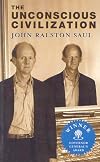
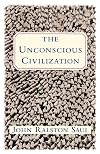
The Unconscious Civilization
by John Ralston Saul
On This Page
Description
Our society, John Ralston Saul argues in the 1995 Massey Lectures, is only superficially based on the individual and democracy. Increasingly it is conformist and corporatist, a society in which legitimacy lies with specialist or interest groups and decisions are made through constant negotiations between these groups. The paradox of our situation is that knowledge has not made us conscious. Instead, we have sought refuge in a world of illusion where language is cut off from reality. show more Reconnecting language to reality, clarifying what we mean by individualism and democracy, making these realities central to the citizen's life, identifying ideologies in order to control them, these are among the first elements of equilibrium which Saul proposes in these lectures. show lessTags
Recommendations






























Member Reviews
I have read his book Voltaire's Bastards and cant say I understood much of the intellectual philosophising it contained. This book is transcribed from a series of speeches the author did in 1995, called the Massey Series, and reads a little easier.
I was very impressed with the authors ability to take popular political arguments and remove them from the left/right standpoints. He manages to take a step back from this sometimes pointless argument, and talk about societal issues in general philosophical terms. It is a big step back too, right back to Socrates and Plato. We are talking democracy, basic right and wrongs and society here. And it is all linked to the now all pervasive phenomena of corporate supremacy.
He managed to articulate show more so nicely the moral argument for unions, for doing what is best for all rather than what is just best for some, for open governments and for the necessity of public sector jobs. He gave options, or at least starting points for discussion, on alternatives to the way we live these modern lives that we do. (ie: the packing in of education and race to employment that we do in our early lives, to leave until retirement the time to choose, to relax and to volunteer.) There is a lot of discussion on language, and how it is used to gain power- to exclude sections of the population from gaining the information that is supposed to be so available nowdays.
All very interesting and useful stuff, presented in a palatable, if intellectual, way. show less
I was very impressed with the authors ability to take popular political arguments and remove them from the left/right standpoints. He manages to take a step back from this sometimes pointless argument, and talk about societal issues in general philosophical terms. It is a big step back too, right back to Socrates and Plato. We are talking democracy, basic right and wrongs and society here. And it is all linked to the now all pervasive phenomena of corporate supremacy.
He managed to articulate show more so nicely the moral argument for unions, for doing what is best for all rather than what is just best for some, for open governments and for the necessity of public sector jobs. He gave options, or at least starting points for discussion, on alternatives to the way we live these modern lives that we do. (ie: the packing in of education and race to employment that we do in our early lives, to leave until retirement the time to choose, to relax and to volunteer.) There is a lot of discussion on language, and how it is used to gain power- to exclude sections of the population from gaining the information that is supposed to be so available nowdays.
All very interesting and useful stuff, presented in a palatable, if intellectual, way. show less
This is a book of Massey lectures about the lack of real progress and the interface of economic policy and intellectual stagnation since 1980. Smoothly written and fairly penetrating. Sort of backup for my theories on 1980 as the end of Western Civilization's growth.
A concise and precise diagnosis of the fundamental ills of modern civilisation. (Yes, I know how hyperbolic that sounds.) Urgent and, from the vantage point of today's post September 11/Irag War/GFC world, thoroughly prescient.
Saul's arguments on the state of our society depend too much on inappropriate literary connections, and some of his facts (for instance, on Mexico) are wrong and biased.
Our society, John Ralston Saul argues, is only superficially based on the individual and democracy.
Increasingly it is conformist and corporatist, a society in which legitimacy lies with specialist or interest groups and decisions are made through constant negotiations between these groups.
http://www.anansi.ca/titles.cfm?pub_id=44
Increasingly it is conformist and corporatist, a society in which legitimacy lies with specialist or interest groups and decisions are made through constant negotiations between these groups.
http://www.anansi.ca/titles.cfm?pub_id=44
Ratings
Members
- Recently Added By
Lists

Books Read in 2006
422 works; 8 members

Books Read in 2010
631 works; 11 members

Read in 2006
140 works; 1 member

Read in 2010
48 works; 1 member

ISBN
7 works; 1 member
Author Information

23+ Works 3,794 Members
John Ralston Saul is an award-winning essayist and novelist and the president of PEN International. He holds a PhD from King's College London. His books are available in thirty-one countries and have been translated into twenty-three languages. He is the recipient of Chile's Pablo Neruda Medal, Canada's Governor General's Award and Italy's Premio show more Letterario Internazionale, among others. He is a Chevalier de l'Ordre des Arts et des Lettres de France. He lives in Toronto. show less
Awards and Honors
Series
Belongs to Publisher Series
CBC Massey Lectures (1995)
Common Knowledge
- Canonical title
- The Unconscious Civilization
- Original title
- The unconscious civilization
- Original publication date
- 1995
- Dedication
- For my parents
- First words
- "Who is more contemptible than he who scorns knowledge of himself?"
- Last words
- (Click to show. Warning: May contain spoilers.)And the acceptance of psychic discomfort is the acceptance of consciousness.
Classifications
Statistics
- Members
- 708
- Popularity
- 40,277
- Reviews
- 6
- Rating
- (3.73)
- Languages
- 6 — English, French, German, Italian, Spanish, Swedish
- Media
- Paper, Ebook
- ISBNs
- 15
- ASINs
- 8