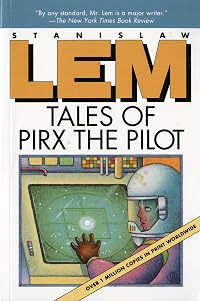
Tales of Pirx the Pilot
by Stanisław Lem
On This Page
Description
In Pilot Pirx, Lem has created an irresistibly likable character: an astronaut who gives the impression of still navigating by the seat of his pants-a bumbler but an inspired one. By investing Pirx with a range of human foibles, Lem offers a wonderful vision of the audacity, childlike curiosity, and intuition that can give humans the courage to confront outer space. Translated by Louis Iribarne. A Helen and Kurt Wolff Book.Tags
Recommendations





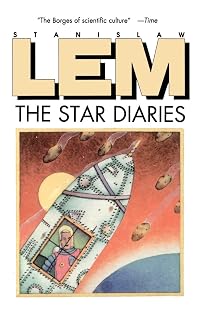






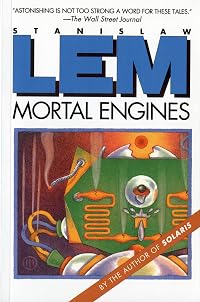




















Member Recommendations
codeeater Die nicht ganz todernsten, episoden-haften Geschichten von Pirx erinnern mich an Stahlratte.
Member Reviews
Older sci-fi stories are often difficult for me to get into because of their lack of character focus. Authors like Arthur C Clarke tend toward a focus on the science, or the big philosophical idea, rather than establishing a believable cast and seeing them explore these worlds. Lem is not like this. Pirx is alive. He's at times grumpy, excited, fearful, nervous, and bored in real ways that bring you into the story with him.
The format of the book is episodic. Many of the stories at this time were magazine publications brought together into a larger volume. I'm not sure if that's the case here, but it feels like it. In this sense, some stories work better than others. Terminus, the final in the book, is absolutely the strongest. It has so show more many aspects to explore, so many questions left lingering, and an absolutely devastating ending that will stick with me for a long time to come.
I'm looking forward to reading more Pirx stories soon. show less
The format of the book is episodic. Many of the stories at this time were magazine publications brought together into a larger volume. I'm not sure if that's the case here, but it feels like it. In this sense, some stories work better than others. Terminus, the final in the book, is absolutely the strongest. It has so show more many aspects to explore, so many questions left lingering, and an absolutely devastating ending that will stick with me for a long time to come.
I'm looking forward to reading more Pirx stories soon. show less
I think I’ve encountered Pirx before in Lem’s [b:Fiasco|28766|Fiasco|Stanisław Lem|https://i.gr-assets.com/images/S/compressed.photo.goodreads.com/books/1287614689l/28766._SY75_.jpg|1762117], which I found a bit confusing without any context for who the heck he was. This collection of five short stories amply explains that he is Just Some Guy. I do not mean that pejoratively; Pirx is an excellent protagonist. Lem introduces him as an everyman character whose spacefaring adventures are amusingly mundane yet dangerous. In this future, being a space pilot is another job that requires passing tiresome exams, waiting around for colleagues and information that may never turn up, and managing technical problems. Most of the stories deal show more ingeniously with the fact that more complicated technology can go wrong in more complicated ways. Writing in the 1970s, Lem predicted accurately that depending upon computers creates a myriad of exciting new risks, problems, and frustrations that are only solved by trial and error. Pirx’s world is unusually vivid and convincing thanks to details like poorly fitting space suits (available in small, medium, or large), annoying flies getting into the pilot cabin, and the chaotic lead-up to a freighter’s departure:
Lem is not merely making space travel mundane, however. He is also keenly aware of its eerie and uncanny characteristics. Mechanical failures are easily mistaken for alien activity, ghosts, or madness. The psychological pressure on pilots, entirely alone in the emptiness of space, is immense and Pirx grapples with this. He would like to be a great hero, particularly in the first story of him training. In subsequent stories, the reader is shown that dramatic heroism is nonsense in Pirx’s world. He undoubtedly saves lives, including his own, by identifying things that have gone wrong with equipment. It is nonetheless clear that he and other pilots are wholly dependent upon the technology they use and thus the people who design, build, and maintain it. For stories about one guy, the [b:Tales of Pirx the Pilot|28769|Tales of Pirx the Pilot|Stanisław Lem|https://i.gr-assets.com/images/S/compressed.photo.goodreads.com/books/1382940439l/28769._SY75_.jpg|513218] are really good at showing interdependence. They are also very witty and entertaining. I’m glad that this LRB article spurred me to read more of Lem’s work. show less
Meanwhile, last-minute deliveries continued right up until countdown: cranes, girders, bales of fibreglass, cement vats, crude oil, medical supplies… At the sound of a warning buzzer, the ground crews would take cover wherever they could – in the antiradiation bunkers, in special armoured crawlers – and were back at their jobs before the pads had had time to cool. By ten o’clock a smoky, crimson, bloated sun hung over the horizon, the concrete safety barriers dividing the stands were already cracked, blackened with soot, and eaten away by exhaust. The deeper fissures were immediately doused with quick-dry cement, which shot up out of the hoses in a fountainlike sprat, while antiradiation crews in helmeted suits piled out of transport vehicles and sandblasted the residue of radioactive fallout. Black-and-red-checkered patrol jeeps careened in and out, their sirens wailing. Someone in the control tower was yelling himself hoarse over a megaphone. Hude, boomerang-shaped radar dishes combed the skies from the tops of gaunt towers… In a word, a routine workday.
Lem is not merely making space travel mundane, however. He is also keenly aware of its eerie and uncanny characteristics. Mechanical failures are easily mistaken for alien activity, ghosts, or madness. The psychological pressure on pilots, entirely alone in the emptiness of space, is immense and Pirx grapples with this. He would like to be a great hero, particularly in the first story of him training. In subsequent stories, the reader is shown that dramatic heroism is nonsense in Pirx’s world. He undoubtedly saves lives, including his own, by identifying things that have gone wrong with equipment. It is nonetheless clear that he and other pilots are wholly dependent upon the technology they use and thus the people who design, build, and maintain it. For stories about one guy, the [b:Tales of Pirx the Pilot|28769|Tales of Pirx the Pilot|Stanisław Lem|https://i.gr-assets.com/images/S/compressed.photo.goodreads.com/books/1382940439l/28769._SY75_.jpg|513218] are really good at showing interdependence. They are also very witty and entertaining. I’m glad that this LRB article spurred me to read more of Lem’s work. show less
DNF. I love the idea of this book. But unfortunately the 30 words per sentence writing style just does not play well with my ADHD brain.
This book comprises five stories. I read the first, ‘The Test’.
Someone else wrote that this book will leave you thinking, ‘yeah, that’s probably how space travel will work’ — and not in a good way. And from the one story I read, that’s an absolutely accurate description.
This book comprises five stories. I read the first, ‘The Test’.
Someone else wrote that this book will leave you thinking, ‘yeah, that’s probably how space travel will work’ — and not in a good way. And from the one story I read, that’s an absolutely accurate description.
Pirx is not the best I have read by Lem, but, for me, these simple tales are very satisfying. The progression is chronological but with large gaps as Lem captures interesting episodes of Prix career from young cadet to full-fledged navigator. Over time, Pirx loses his air of the preening day-dreamer spinning fantasies of glory. While Prix grows into his profession and into adulthood, Lem never let's us forget that space flight is a serious business and that the cost of getting better at it is often gained in the postmortem of events that went tragically awry. Pirx is not the brightest tool in the shed, but he is steady and keeps his head in a scrape. While never achieving the almost elemental status of Conrad's captains who reveal their show more metal when the storm is raging, Prix muddles his way through and his instincts are good.
Lem keeps the tales simple but he knows how to find small seams of gold. Lem just clicks for me and did the very first time I read him. I could never recommend Lem with great confidence to another reader without some understanding of their sensibilities. As for me, I like the quirkiness, the wryness, the balancing on a razor's edge between the real and what lies just on the other side of it. Most of all, Lem never loses sight of the human being(s) at the heart of all good stories. show less
Lem keeps the tales simple but he knows how to find small seams of gold. Lem just clicks for me and did the very first time I read him. I could never recommend Lem with great confidence to another reader without some understanding of their sensibilities. As for me, I like the quirkiness, the wryness, the balancing on a razor's edge between the real and what lies just on the other side of it. Most of all, Lem never loses sight of the human being(s) at the heart of all good stories. show less
According to my Goodreads page, I didn’t care for the one Stanislaw Lem book (IMAGINARY MAGNITUDES) I read 36 years ago. I have a vague memory of it being leant to me by someone I was attempting to humor by reading it. Not a good way to approach a book so I will have to revisit that one. Reading and enjoying TALES OF PIRX THE PILOT has encouraged me to read more. This collection of Sci-Fi stories starts out as one thing and then along with it’s main character melds into something else. The first four stories set up the last. Something of the silliness of youth permeates Pirx the Pilot in the first story THE TEST until the end reveals something else has really been going on. Each story has some of that youth but it seems to dissipate show more faster and faster. We learn along with Pirx to see the workings of his world and it’s patterns and that the threat of repeating the previous mistakes of others is ever present. The fourth story, THE ALBATROSS shifts nicely to setting up the mood for the final story. And the final story, TERMINUS, is fantastic. Replaying the theme of the other stories of history being a kind of loop we have to struggle not to repeat, TERMINUS is a haunting echo caught in our ear. The ending of the story solidly defines who Pirx the Pilot has become—snuffing out the last of his youth. show less
Tales of Pirx the Pilot is a strong and varied collection from Stanislaw Lem. I found this book quite a bit more enjoyable than Star Diaries. The five stories offer a blend of mystery and adventure with touches of dark humor, all in the context of the reasonably near future settlement of the solar system. Pirx is a likable, if not particularly brilliant, protagonist. “Terminus,” a sort of robot ghost story, is the star of the collection.
This is my first Lem book. It was not an easy read. There were many words I had to look up or re-read parts to grasp the meaning. And I probably didn't fully get some of the stories. But there is a satisfied feeling that I am left with. These are intriguing stories told by a master. Terminus, for example, is one of those stories that I know I will keep thinking about.
Members
- Recently Added By
Lists

Best Science Fiction Originally Published in a Language Other Than English
449 works; 31 members

XB-1: Osobnosti zanru doporucuji
67 works; 1 member

Blue Pyramid 1,276 Best Books of All Time
1,248 works; 32 members

Reading LIst
648 works; 1 member
Author Information

363+ Works 32,380 Members
Polish science fiction writer Stanislaw Lem was born on September 12, 1921. A medical graduate of Cracow University, he is at home both in the sciences and in philosophy, and this broad erudition gives his writings genuine depth. He has published extensively, not only fiction, but also theoretical studies. His books have been translated into 41 show more languages and sold over 27 million copies. He gained international acclaim for The Cyberiad, a series of short stories, which was first published in 1974. A trend toward increasingly serious philosophical speculation is found in his later works, such as Solaris (1961), which was made into a Soviet film by Russian director Andrei Tarkovsky in 1972 and remade by Steven Soderbergh in 2002. He died on March 27, 2006 in Krakow at the age of 84. (Bowker Author Biography) show less
Some Editions
Awards and Honors
Distinctions
Series
Belongs to Publisher Series
Dzieła Stanisława Lema (Wydawnictwo Gazety Wyborczej)
suhrkamp taschenbuch (740)
Work Relationships
Is contained in
Contains
Common Knowledge
- Canonical title*
- Terminus und andere Geschichten vom Piloten Pirx
- Original title
- Opowieści o pilocie Pirxie
- Original publication date
- 1968; 1982 (Pirx's Tale) (Pirx's Tale)
- People/Characters
- Pirx
- First words
- "Cadet Pirx!"
Bullpen's voice snapped him out of his daydreaming. - Last words
- (Click to show. Warning: May contain spoilers.)And with a perfectly rigid face, he signed it:
Pirx, first navigator. - Original language
- Polish
*Some information comes from Common Knowledge in other languages. Click "Edit" for more information.
Classifications
- Genres
- Science Fiction, Fiction and Literature
- DDC/MDS
- 891.8537 — Literature & rhetoric Literatures of other languages East Indo-European and Celtic literatures West and South Slavic languages (Bulgarian, Slovene, Polish, Czech, Slovak, Serbo-Croatian, and Macedonian) Polish Polish fiction 1919–1989
- LCC
- PG7158 .L39 .O613 — Language and Literature Slavic languages and literatures. Baltic languages. Albanian language Slavic. Baltic. Albanian Slavic Polish
- BISAC
Statistics
- Members
- 1,082
- Popularity
- 23,601
- Reviews
- 17
- Rating
- (3.82)
- Languages
- 10 — Czech, English, German, Hebrew, Hungarian, Italian, Polish, Russian, Spanish, Swedish
- Media
- Paper, Audiobook, Ebook
- ISBNs
- 43
- ASINs
- 8