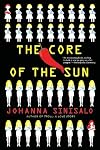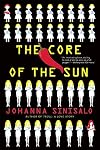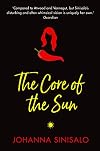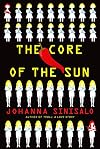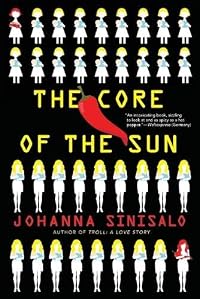
The Core of the Sun
by Johanna Sinisalo
On This Page
Description
Set in an alternative historical present, in a "eusistocracy"--An extreme welfare state -- that holds public health and social stability above all else, it follows a young woman whose growing addiction to illegal chili peppers leads her on an adventure into a world where love, sex, and free will are all controlled by the state.Tags
Recommendations
























Member Recommendations
by vwinsloe
Member Reviews
So this is "Finnish weird," huh? I like it and I want more, especially from Johanna Sinisalo.
This book is... well, it's a suspenseful mystery set in a horrifying and plausible dystopian now with some magical realism woven between it all.
Vanna is an addict. A chile addict. In Finland in 2016 chiles, along with other dangerous and addictive substances like alcohol and drugs, are banned. Vanna is also a "morlock"--a woman who doesn't meet societal standards and isn't allowed to breed--except Vanna is also an "eloi," or at least she was raised pretending to be one. Her sister, Manna, is an eloi, the type of "femiwoman" Finland has been selectively breeding for for generations. Vanna is also Vera, and Manna is Mira, because soft elois show more can't have hard Rs in their names. Rs and other special things--like independence and nearly Stepford-like wives--are saved for mascos.
This story is told with letters Vanna/Vera writes to Manna/Mira, which tells their life stories from the beginning when their parents died and they moved to Finland to live with their only relative to the end where Vanna finds out what happend to her missing sister; in excerpts from fictional (and occasionally real!) books and articles about the history of Finland, which explain the history and realities of modern Finland; and through Vanna (and occasionally her masco friend Jare's) present-day actions from Vanna's chile highs and confused grief to Jare's future plans and their shared chile-dealing business with a bit of capsaicin-spirituality over and above it all.
I loved this book. I was shocked by Vanna, I pitied her, her sister, and everyone trapped as they were, I was frightened by the very plausible history of Finnish society the author created, and I was always, always entertained. Also, I really want some spicy peppers now, but Vanna can keep the core of the sun for herself.
[I received this book free from NetGalley in exchange for an unbiased review.] show less
This book is... well, it's a suspenseful mystery set in a horrifying and plausible dystopian now with some magical realism woven between it all.
Vanna is an addict. A chile addict. In Finland in 2016 chiles, along with other dangerous and addictive substances like alcohol and drugs, are banned. Vanna is also a "morlock"--a woman who doesn't meet societal standards and isn't allowed to breed--except Vanna is also an "eloi," or at least she was raised pretending to be one. Her sister, Manna, is an eloi, the type of "femiwoman" Finland has been selectively breeding for for generations. Vanna is also Vera, and Manna is Mira, because soft elois show more can't have hard Rs in their names. Rs and other special things--like independence and nearly Stepford-like wives--are saved for mascos.
This story is told with letters Vanna/Vera writes to Manna/Mira, which tells their life stories from the beginning when their parents died and they moved to Finland to live with their only relative to the end where Vanna finds out what happend to her missing sister; in excerpts from fictional (and occasionally real!) books and articles about the history of Finland, which explain the history and realities of modern Finland; and through Vanna (and occasionally her masco friend Jare's) present-day actions from Vanna's chile highs and confused grief to Jare's future plans and their shared chile-dealing business with a bit of capsaicin-spirituality over and above it all.
I loved this book. I was shocked by Vanna, I pitied her, her sister, and everyone trapped as they were, I was frightened by the very plausible history of Finnish society the author created, and I was always, always entertained. Also, I really want some spicy peppers now, but Vanna can keep the core of the sun for herself.
[I received this book free from NetGalley in exchange for an unbiased review.] show less
I'm not sure how I came across this book but I'm glad I did. Sinisalo invents a uchronic Finland where a human female sub-species has been bred. Known as Eloi, they are submissive, receptive and bred for sex and procreation. Intelligent, independent women, Morlocks, are not permitted to reproduce and are doomed to a life of menial labour. The Eusistocratic Republic of Finland benefits and strengthens the patriarchy.
Vana looks like an Eloi but isn't. She wants to rescue her Eloi sister Manna. To do it she needs the money and teams up with a male friend, Jare, to sell chilli. Chilli is considered to be an extremely dangerous stimulant by the Finnish Health authority and the growing or possession of it is illegal. To complicate matters, show more Vana is an addict and her addiction is getting worse.
Sinisalo tells a truly twisted tale through multiple viewpoints (Vana's and Jare's), letters that Vana writes to Manna that provide the backstory for their current predicament, snatches of government publications, education publications, and excerpts from magazines. The result is an unapologetic social commentary. Sinisalo's satire kicks the patriarchy, and the mechanisms that support it, where it's needed. A highly recommended read from the queen of 'Finnish Weird'. show less
Vana looks like an Eloi but isn't. She wants to rescue her Eloi sister Manna. To do it she needs the money and teams up with a male friend, Jare, to sell chilli. Chilli is considered to be an extremely dangerous stimulant by the Finnish Health authority and the growing or possession of it is illegal. To complicate matters, show more Vana is an addict and her addiction is getting worse.
Sinisalo tells a truly twisted tale through multiple viewpoints (Vana's and Jare's), letters that Vana writes to Manna that provide the backstory for their current predicament, snatches of government publications, education publications, and excerpts from magazines. The result is an unapologetic social commentary. Sinisalo's satire kicks the patriarchy, and the mechanisms that support it, where it's needed. A highly recommended read from the queen of 'Finnish Weird'. show less
In a parallel Finland, in the near future, the society is split into almost casts - women are bred to be feminine and submissive; men to be powerful and manly. Unfortunately Vanna is not born to be submissive but thanks to her little sister manages to hide it. (A little sidetrack here - I have a younger sister. I would have done anything to stay with her in similar circumstances - so that part really rang true). And even though she is classified as eloi (the feminine women), she grows up as an independent woman - she learns to read, to think, to feel.
Women have no rights - they are the property of their husbands after they are married; their only goal in life is to marry and bring correct children in the world.
At the same time, the show more government is forbidding substances and anything that may make people think. Or feel. Including hot peppers. And that is what a cult is started around - finding the hottest pepper that can be bred.
It is a frustrating novel - I loved the depiction of the society and the subtle (and not so subtle) changes that made the society so different from ours. It is scary and relevant and so well done. And at the same time, there is the story of the cult and the chase of the hot pepper. And that one simply did not work for me -- and the end of the novel ties that story line. I am not a huge fan of weird stories - I prefer the straight SF. And Sinisalo had always been on the fringes - weird is her thing. But I am still happy that I read the novel - her anti-utopian society is one of the best depicted ones I had read lately. show less
Women have no rights - they are the property of their husbands after they are married; their only goal in life is to marry and bring correct children in the world.
At the same time, the show more government is forbidding substances and anything that may make people think. Or feel. Including hot peppers. And that is what a cult is started around - finding the hottest pepper that can be bred.
It is a frustrating novel - I loved the depiction of the society and the subtle (and not so subtle) changes that made the society so different from ours. It is scary and relevant and so well done. And at the same time, there is the story of the cult and the chase of the hot pepper. And that one simply did not work for me -- and the end of the novel ties that story line. I am not a huge fan of weird stories - I prefer the straight SF. And Sinisalo had always been on the fringes - weird is her thing. But I am still happy that I read the novel - her anti-utopian society is one of the best depicted ones I had read lately. show less
Hey guys. This book was like riding a rollercoaster and it's nice and smooth at first so you get overconfident about how not fucked up you're going to get on that first drop - and then suddenly it hits, your ass leaves the seat, you're clawing at the harness, and swearing you will NEVER ride another coaster again. And when it's done you're like HOLY FUCK THAT WAS COOL.
So yeah. I liked it. There were moments where I was like "this could be more interesting" and in other places I thought the translation maybe seemed lacking although it's hard to tell, but once I finished I think I would've been less stunned after being punched in the face.
I'd definitely recommend for people that like modern dystopian settings mixed with a bit of the show more unbelievable.
Ending spoilers ahead:
I loved how the end was open to interpretation. If you think the spirit possession was real you can attribute this idea into how spiritualism/ritualism is discriminated against by "polite" society and that the chilis here represent other means of trance inducement from other cultures, such as peyote.
And if you don't believe that the spirit possession was real it can be explained by the fact that Vera is a very intelligent woman and once she had the background information on Harri and his gambling, plus the information he told her in the bathroom, that she could've deduced the human trafficking scenario and hallucinated that she saved Mira's spirit and keeps it safe inside her mind, either to ease her own guilt or a way to keep Mira in her thoughts always etc.
In the end I do like how the message is that humans will always corrupt - no matter how strict, well meaning, and kind those in power are (even though the Authority here really is NOT), there will always be others that take advantage of the unseen places and gouge out 'seedy underbellies'. show less
So yeah. I liked it. There were moments where I was like "this could be more interesting" and in other places I thought the translation maybe seemed lacking although it's hard to tell, but once I finished I think I would've been less stunned after being punched in the face.
I'd definitely recommend for people that like modern dystopian settings mixed with a bit of the show more unbelievable.
Ending spoilers ahead:
And if you don't believe that the spirit possession was real it can be explained by the fact that Vera is a very intelligent woman and once she had the background information on Harri and his gambling, plus the information he told her in the bathroom, that she could've deduced the human trafficking scenario and hallucinated that she saved Mira's spirit and keeps it safe inside her mind, either to ease her own guilt or a way to keep Mira in her thoughts always etc.
In the end I do like how the message is that humans will always corrupt - no matter how strict, well meaning, and kind those in power are (even though the Authority here really is NOT), there will always be others that take advantage of the unseen places and gouge out 'seedy underbellies'.
What an odd little book! Of course, after reading Sinisalo's 'Troll,' I was expecting some oddness.
This alternate-history gives us a Handmaid's Tale/Brave New World-type mirror of modern-day Finland; one where an exceedingly restrictive social plan has been instituted, and women have been relegated to second-class citizens. The government calls this 'new' Finland a 'eusistocracy, ' claiming that it values the happiness and well-being of its citizens above all else. Eugenics is being used to breed 'proper' citizens; those who don't meet certain standards are sterilized. The decadence and decay of more-liberal countries is frequently emphasized in propaganda.
Part of that foreign decay is the production of food containing that dangerous show more and addictive drug, capsaicin. All spicy foods are banned, and there's an underground drug trade in chili peppers.
Our main character, Vanna, has 'passed' as an eloi femiwoman her whole life, due to her attractive looks. However, she knows she's really a morlock, and that if she shows curiosity, initiative or other 'unfeminine' traits, she'll be doomed to a life of hard labor. Her life has been devoted to caring for her twin sister, who's always been a model of eloi domestic passivity. The desire to provide for her helpless sister led her to drug dealing. But now, her twin is missing, presumed dead, Vanna suspects her brother-in-law of murder, and in her grief she has turned to dipping into her own stock - she's become a chili pepper addict.
Vanna wants to escape repressive Finland with her dealer/partner Jare - but she also wants to find - or find justice for - her sister.
The tone of the book is a bit odd, teetering between silly satire and earnest social critique. I think it would've been more successful if it moved more wholeheartedly toward the satire end of things, partly because the 'science' here really doesn't hold up, and partly because the social elements that are critiqued here have been critiqued before, oh so many times. The mix reminded me quite a lot of Atwood's recent 'The Heart Goes Last' - I'd highly recommend this book to fans of that one.
Many thanks to NetGalley and Grove Atlantic for the opportunity to read. As always, my opinions are solely my own. show less
This alternate-history gives us a Handmaid's Tale/Brave New World-type mirror of modern-day Finland; one where an exceedingly restrictive social plan has been instituted, and women have been relegated to second-class citizens. The government calls this 'new' Finland a 'eusistocracy, ' claiming that it values the happiness and well-being of its citizens above all else. Eugenics is being used to breed 'proper' citizens; those who don't meet certain standards are sterilized. The decadence and decay of more-liberal countries is frequently emphasized in propaganda.
Part of that foreign decay is the production of food containing that dangerous show more and addictive drug, capsaicin. All spicy foods are banned, and there's an underground drug trade in chili peppers.
Our main character, Vanna, has 'passed' as an eloi femiwoman her whole life, due to her attractive looks. However, she knows she's really a morlock, and that if she shows curiosity, initiative or other 'unfeminine' traits, she'll be doomed to a life of hard labor. Her life has been devoted to caring for her twin sister, who's always been a model of eloi domestic passivity. The desire to provide for her helpless sister led her to drug dealing. But now, her twin is missing, presumed dead, Vanna suspects her brother-in-law of murder, and in her grief she has turned to dipping into her own stock - she's become a chili pepper addict.
Vanna wants to escape repressive Finland with her dealer/partner Jare - but she also wants to find - or find justice for - her sister.
The tone of the book is a bit odd, teetering between silly satire and earnest social critique. I think it would've been more successful if it moved more wholeheartedly toward the satire end of things, partly because the 'science' here really doesn't hold up, and partly because the social elements that are critiqued here have been critiqued before, oh so many times. The mix reminded me quite a lot of Atwood's recent 'The Heart Goes Last' - I'd highly recommend this book to fans of that one.
Many thanks to NetGalley and Grove Atlantic for the opportunity to read. As always, my opinions are solely my own. show less
A strange and quirky book with some very dark themes but fairly light execution considering. I don’t know enough about Finland to know how close to possible the societal evolution feels but it seemed believable enough to me, if not likely. The book is fairly evenly split between plot and world building and I liked it more for that - I didn’t like any of the characters enough to enjoy a book fully devoted to them so the world building sections gave some nice breaks. On the other hand, some of the expositionary sections seemed a bit heavy-handed but the different styles of information sharing and having them interspaced by plot kept it from being too much. The ending gets a by mystical/shamanistic but nothing near as whack-a-doodle show more and H. Murakami regularly throws in so I went with it.
Overall an enjoyable read with some through-provoking dystopian aspects that invite but don’t require deeper contemplation combined with a quirky plot that gives a lighter treatment of serious topics. show less
Overall an enjoyable read with some through-provoking dystopian aspects that invite but don’t require deeper contemplation combined with a quirky plot that gives a lighter treatment of serious topics. show less
Gosh, I hadn't read a dystopian book in a long time. I actually enjoyed this one. Even though it is described as "Finnish weird", I still can't find it weird. (My son assured me the idea/summary of the book seems weird but that I'm just desensitized to weird because I read too much off-the-wall stuff.)
The book is told from a couple of different viewpoints, some letters, some inserted "articles" (from supposed scientific texts or magazines), etc. I'm used to a variety of storytelling methods like that being used within one work, but I realize others may not be, so maybe that adds to its reputation as "weird"...? It also works in some Native American shamanism as well as Incan mythology surrounding chili peppers, so I think it's a bit show more unique incorporating those aspects. There's a definite bow to (& wide use of) of H. G. Wells' eloi & morlock designations. I saw some comparisons to The Handmaid's Tale, but I haven't read that (tried it years ago & dropped it pretty early on), but there is much subjugation of women (especially in societal & sexual roles) so I'm assuming those are apt comparisons too.
It's a pretty quick, easy read. It does touch on some deep, dark issues (like all dystopian books) but not in an extremely haunting way (imo). And it even ends on a bit of a positive note. Kind-of a dystopian-lite, perhaps? It wasn't really deep or complex but it was entertaining enough & kept me reading. show less
The book is told from a couple of different viewpoints, some letters, some inserted "articles" (from supposed scientific texts or magazines), etc. I'm used to a variety of storytelling methods like that being used within one work, but I realize others may not be, so maybe that adds to its reputation as "weird"...? It also works in some Native American shamanism as well as Incan mythology surrounding chili peppers, so I think it's a bit show more unique incorporating those aspects. There's a definite bow to (& wide use of) of H. G. Wells' eloi & morlock designations. I saw some comparisons to The Handmaid's Tale, but I haven't read that (tried it years ago & dropped it pretty early on), but there is much subjugation of women (especially in societal & sexual roles) so I'm assuming those are apt comparisons too.
It's a pretty quick, easy read. It does touch on some deep, dark issues (like all dystopian books) but not in an extremely haunting way (imo). And it even ends on a bit of a positive note. Kind-of a dystopian-lite, perhaps? It wasn't really deep or complex but it was entertaining enough & kept me reading. show less
Members
- Recently Added By
Lists

Best Dystopias
280 works; 276 members

Best Feminist Science Fiction
188 works; 35 members

Favorite Science Fiction by Women Authors
737 works; 202 members

2017 Hugo Eligible Novels
145 works; 14 members

SF & Fantasy in Translation
95 works; 18 members
Best Science Fiction Originally Published in a Language Other Than English
449 works; 32 members

Speculative Fiction from around the World
610 works; 17 members

Global Reads: Books Set in Western Europe
186 works; 10 members

Books recommended by Calgary Public Library staff
1,588 works; 4 members

Favorite Books in Translation
320 works; 133 members
Author Information

25+ Works 2,387 Members
Some Editions
Awards and Honors
Awards
Distinctions
Common Knowledge
- Canonical title*
- Finnisches Feuer
- Original title
- Auringon ydin
- Alternate titles
- The Core of the Sun (English) (English)
- Original publication date
- 2013
- People/Characters
- Vanna / Vera Neulapää; Jare Valkinen; Harri Nissilä; Manna / Mira; Mirko; Terhi (show all 8); Valtteri; Aulikki Neulapää
- Important places
- Tampere, Finland
- Epigraph
- Teach me, chile, and I shall Learn.
Take me, chile, and I shall Escape.
Focus my eyes, chile, and I shall See.
Consume more chiles.
I feel no pain, for the chile is my teacher.
I feel no pain, for the chile ... (show all)takes me beyond myself.
I feel no pain, for the chile gives me sight.
Transcendental Capsaicinophilic Society,
"Litany Against Pain"
My boat is light and swift.
--Chukchi shaman Ukwun - Dedication
- Dedicated to the Freedom Trust Conglomerate
(you know who you are) - First words
- I lift my skirt, pull aside the waistband of my underwear, and push my index finger in to test the sample.
- Last words
- (Click to show. Warning: May contain spoilers.)"Yes, she's all right again now," Jare says, and squeezes my hand. "The little lady's just a bit nervous. She's not used to flying."
- Blurbers
- Butler, Robert Olen
- Original language
- Finnish
*Some information comes from Common Knowledge in other languages. Click "Edit" for more information.
Classifications
- Genres
- Fiction and Literature, Science Fiction
- DDC/MDS
- 894.54134 — Literature & rhetoric Asian Literature Literatures of Altaic, Uralic, Hyperborean, Dravidian languages; literatures of miscellaneous languages of south Asia Finno-Ugric languages Finnic languages Finnish Finnish fiction 2000–
- LCC
- PH355 .S5445 .A8713 — Language and Literature Uralic languages. Basque language Uralic. Basque Finnish
- BISAC
Statistics
- Members
- 344
- Popularity
- 90,583
- Reviews
- 17
- Rating
- (3.75)
- Languages
- 7 — Czech, English, Finnish, French, German, Hungarian, Spanish
- Media
- Paper, Audiobook, Ebook
- ISBNs
- 16
- ASINs
- 2