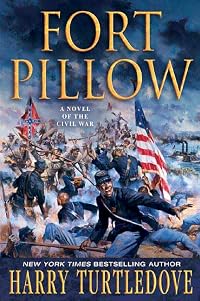
Fort Pillow: A Novel of the Civil War
by Harry Turtledove
On This Page
Description
In April 1864, the Union garrison at Fort Pillow was composed of almost 600 troops, about half of them black. The Confederacy, incensed by what it saw as a crime against nature, sent its fiercest cavalry commander, Nathan Bedford Forrest, to attack the fort with about 1,500 men. The Confederates overran the fort and drove the Federals into a deadly crossfire. Only sixty-two of the colored Union troops survived the fight unwounded. Many accused the Confederates of massacring the black troops show more after the fort fell, when fighting should have ceased. The "Fort Pillow Massacre" became a Union rallying cry and cemented resolve to see the war through to its conclusion.Harry Turtledove has written a dramatic re-creation of an astounding battle, telling a bloody story of courage and hope, freedom and hatred. With brilliant characterizations of all the main figures, this is a novel that reminds us that Fort Pillow was more than a battle-it was a clash of ideas between men fighting to define what being an American ought to mean. show lessTags
Recommendations



Member Reviews
There were two areas I most appreciated in Harry Turtledove' Fort Pillow: A Novel of the Civil War. Looking back I realize that I liked these aspects the most, because I learned something from them. The first is that I got a real sense of race relations during the Civil War. I haven't spent extensive time studying this era, a class or two in high school and two courses in college. I gained some knowledge of what happened and a consensus of why. This book showed me the dynamics of how. My history lessons left me with an impression of clear cut race relations along the Mason-Dixon line. Fort Pillow reminded me that attitudes towards race and racism is dynamic. i.e. At the beginning of the war most whites on both sides might have believed show more that black men simply cannot fight. They believed the propaganda at different levels that have been hammered into them for generations. But when the black heroes proved them wrong they reacted differently. People with an open attitude and those who fought alongside with them welcomed them and started to treat them more equally. On the other side, where the general opinion was that blacks cannot be brave by default the fight caused more confusion. This cognitive dissonance led to the massacre depicted in the book.
My first lesson was the diffusion of the idea that racism existed only one one side and one shape, along with the idea that people's attitude can be changed via experience. The second lesson came, when I was about third way through the book. That's when I started to read the “historical note” at the end of the book. I was curious to what extent the author made up the story and the characters and which part of it is actual historical truth. There I learned about the four major sources Turtledove used and how he worked their contradicting storylines into one coherent narrative. He even explained on what principles he based his decisions on which version to believe when. The principle was simple (consider the bias of the sources) the execution of integration was not.
Having described what I gained from the book maybe I should mention what it was about. It describes the siege, capture and demolition of Fort Pillow by Confederate soldiers in 1864. The characters include real, documented historical figures, mostly the higher ranks soldiers, and fictional privates. The story starts before the siege, introducing the era, the geography and the main players; goes through the various stages of the fight (most of the book is “war talk”) and concludes with the massacre of black and white Union soldiers. The people depicted are complex enough characters with conflicting values and thoughts to make it an interesting read beyond the history lessons. show less
My first lesson was the diffusion of the idea that racism existed only one one side and one shape, along with the idea that people's attitude can be changed via experience. The second lesson came, when I was about third way through the book. That's when I started to read the “historical note” at the end of the book. I was curious to what extent the author made up the story and the characters and which part of it is actual historical truth. There I learned about the four major sources Turtledove used and how he worked their contradicting storylines into one coherent narrative. He even explained on what principles he based his decisions on which version to believe when. The principle was simple (consider the bias of the sources) the execution of integration was not.
Having described what I gained from the book maybe I should mention what it was about. It describes the siege, capture and demolition of Fort Pillow by Confederate soldiers in 1864. The characters include real, documented historical figures, mostly the higher ranks soldiers, and fictional privates. The story starts before the siege, introducing the era, the geography and the main players; goes through the various stages of the fight (most of the book is “war talk”) and concludes with the massacre of black and white Union soldiers. The people depicted are complex enough characters with conflicting values and thoughts to make it an interesting read beyond the history lessons. show less
This is the author's recreation of the action at Fort Pillow during the US Civil War. Unlike many of his books, this is not alternate history. Turtledove has attempted to create a plausible story of the events out of what little is known today. The battle is sometimes described as a massacre, mostly based on after the fact newspaper reports. I found it realistic, enlightening and enjoyable. It felt a little bit more like fiction than history, but the basic facts are all valid.
Ratings
Members
- Recently Added By
Author Information

279+ Works 43,046 Members
Harry Turtledove was born in Los Angeles, California on June 14, 1949. He received a Ph.D. in Byzantine history from UCLA in 1977. From the late 1970's to the early 1980's, he worked as a technical writer for the Los Angeles County Office of Education. He left in 1991 to become full-time writer. His first two novels, Wereblood and Werenight, were show more published in 1979 under the pseudonym Eric G. Iverson because his editor did not think people would believe that Turtledove was his real name. He used this name until 1985 when he published Herbig-Haro and And So to Bed under his real name. He has received numerous awards including the Homer Award for Short Story for Designated Hitter in 1990, the John Esthen Cook Award for Southern Fiction for Guns of the Southand in 1993, and the Hugo Award for Novella for Down in the Bottomlands in 1994. (Bowker Author Biography) show less
Classifications
- Genres
- Fiction and Literature, General Fiction, Historical Fiction, Science Fiction
- DDC/MDS
- 813.54 — Literature & rhetoric American literature in English American fiction in English 1900-1999 1945-1999
- LCC
- PS3570 .U76 .F67 — Language and Literature American literature American literature Individual authors 1961-
- BISAC
Statistics
- Members
- 129
- Popularity
- 250,138
- Reviews
- 2
- Rating
- (3.60)
- Languages
- English
- Media
- Paper, Audiobook, Ebook
- ISBNs
- 10
- ASINs
- 4