On This Page
Description
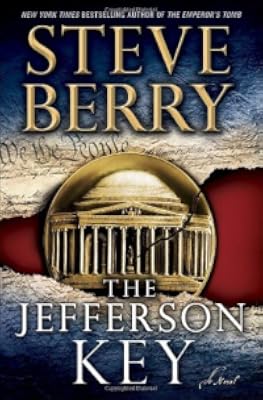
Cotton Malone battles a group of families whose influence dates back to U.S. Constitution and who seek to crack a code devised by Thomas Jefferson himself in their quest for power.Tags
Recommendations


















Member Reviews
This is a painful review to write as I’ve been a Steve Berry fan since The Amber Room. The Jefferson Key is my 8th Berry novel, 6th Cotton Malone (missed The Emperor’s Tomb), and possibly my last.
Berry’s always been my go to guy for fun mass market historical thrillers but that seems to be changing. With each new book it seems there is a steady substance decline in the Cotton Malone series. Although Berry’s history is still accurate and interesting, apparently the “mass market” needs little story substance, absolutely no depth to characters and -- pirates. Really Steve? Pirates? Hard to believe that was the best you could do with Thomas Jefferson’s decoder ring but I bet the marketing department loved that idea!
At this show more point, The Cotton Malone series formula is not only stale but so annoying everything seems contrived and predictable. I didn’t actually count the amount of characters (or agencies) running around but it was like the Keystone Cops and smacked of a movie script. Instead of moving the narrative along, the quick scene cuts made me lose interest. Please Steve – get a new editor or we’re not far from Cotton Malone taking on vampires who infiltrate the CIA.
Having gotten that off my chest, The Jefferson Key story is somewhat better than The Paris Vendetta and The Venetian Betrayal. That’s enough to give me a glimmer of hope for better Berry novels (he can do SO much better) and gets The Jefferson Key 3 stars (Scale of 1 to 10 it’s a 6). show less
Berry’s always been my go to guy for fun mass market historical thrillers but that seems to be changing. With each new book it seems there is a steady substance decline in the Cotton Malone series. Although Berry’s history is still accurate and interesting, apparently the “mass market” needs little story substance, absolutely no depth to characters and -- pirates. Really Steve? Pirates? Hard to believe that was the best you could do with Thomas Jefferson’s decoder ring but I bet the marketing department loved that idea!
At this show more point, The Cotton Malone series formula is not only stale but so annoying everything seems contrived and predictable. I didn’t actually count the amount of characters (or agencies) running around but it was like the Keystone Cops and smacked of a movie script. Instead of moving the narrative along, the quick scene cuts made me lose interest. Please Steve – get a new editor or we’re not far from Cotton Malone taking on vampires who infiltrate the CIA.
Having gotten that off my chest, The Jefferson Key story is somewhat better than The Paris Vendetta and The Venetian Betrayal. That’s enough to give me a glimmer of hope for better Berry novels (he can do SO much better) and gets The Jefferson Key 3 stars (Scale of 1 to 10 it’s a 6). show less
 This review was written for LibraryThing Early Reviewers.
I remember reading The DaVinci Code and thinking, "You know what this is missing? Pirates!"
All kidding aside, Berry has taken a regularly neglected clause from our constitution - that Congress shall have the right to grant letters of marque - and spun from that a fairly entertaining tale that includes Andrew Jackson, Thomas Jefferson, a secret code, a 400+ year old conspiracy, a spy v spy war between super-secret intelligence agencies, and a group of modern-day privateers who may (or may not) be Congressionally sanctioned to declare war and mayhem on the U.S.'s enemies.
Yes, the story is formulaic. Ever since Robert Ludlum it seems as if the elements of a successful spy thriller have been defined as: capable but humble super-spy show more protagonist + beautiful, capable girlfriend + secret rogue intelligence agency(s) + tons of action (shootouts, car chases, pirate torture, presidential assassinations, etc.) + complex plot that you could figure out if you had to, but with so much action keeping the story moving, it's simpler just to take it on faith and keep reading. Now add super-short chapters that jump between storylines + prose that's competent without any distracting dazzle + lots of italicized stream-of-consciousness eavesdropping on what the characters are thinking (so you don't need to draw those inferences yourself). Sure, it's formulaic - but if 20+ years of "Law and Order" has taught us anything, it's taught us that if a formula works, why mess with it?
In summary, this is a perfect pick for those occassions when you're in the mood for "Law and Order" rather than "The Sopranos" - formulaic, yes, but also competent and engaging for what it is. show less
All kidding aside, Berry has taken a regularly neglected clause from our constitution - that Congress shall have the right to grant letters of marque - and spun from that a fairly entertaining tale that includes Andrew Jackson, Thomas Jefferson, a secret code, a 400+ year old conspiracy, a spy v spy war between super-secret intelligence agencies, and a group of modern-day privateers who may (or may not) be Congressionally sanctioned to declare war and mayhem on the U.S.'s enemies.
Yes, the story is formulaic. Ever since Robert Ludlum it seems as if the elements of a successful spy thriller have been defined as: capable but humble super-spy show more protagonist + beautiful, capable girlfriend + secret rogue intelligence agency(s) + tons of action (shootouts, car chases, pirate torture, presidential assassinations, etc.) + complex plot that you could figure out if you had to, but with so much action keeping the story moving, it's simpler just to take it on faith and keep reading. Now add super-short chapters that jump between storylines + prose that's competent without any distracting dazzle + lots of italicized stream-of-consciousness eavesdropping on what the characters are thinking (so you don't need to draw those inferences yourself). Sure, it's formulaic - but if 20+ years of "Law and Order" has taught us anything, it's taught us that if a formula works, why mess with it?
In summary, this is a perfect pick for those occassions when you're in the mood for "Law and Order" rather than "The Sopranos" - formulaic, yes, but also competent and engaging for what it is. show less
I have always loved Steve Berry's novels. I was disappointed after the last one, afraid that he had "sold out" to the popular practice of ramping up the publishing schedule and turning out mediocre, poorly conceived novels. "The Jefferson Key" does not disappoint. Berry is back with a fast paced, well constructed story that keeps the reader turning pages well into the night. Berry weaves a fascinating story of modern day pirates into the American history of presidential assassinations. He does an excellent job of incorporating actual historical fact into his imaginative process and it is great to have Cotton Malone back on American soil. Full of action, suspense and intrigue - this is a great book to take to the beach this summer.
This review was written for LibraryThing Early Reviewers.It’s no secret that Steve Berry’s Cotton Malone series is one of my favorites. In this installment, Cotton is drawn back to America by a mysterious note from his former boss, Stephanie Nelle. He quickly finds himself in the middle of a setup and must foil an attempt to assassinate President Daniels. Afterwards, Cotton has to figure out not only who is behind the attempt on the President but also who tried to frame Cotton him for it. Plus, Stephanie is now missing and may be in danger. Cotton’s investigation puts him up against a secret society of pirates who call themselves the Commonwealth. The families of the Commonwealth were privateers during the American Revolution and given extraordinary latitude by the government. The show more Commonwealth is on a mission to protect their privateering rights and gain power by locating a missing government document.
Berry injects history into his mystery as he always does, which is what makes me love the Cotton Malone series. However, there are fewer flashbacks to the past in The Jefferson Key. Berry leaves us primarily in the present and we learn our history secondhand. This is the first time a Cotton Malone mystery has been set in the U.S. Because of this, I missed some of the fascination for another culture of which I know nothing that I usually get from the series. I also wish I’d sprung for my new iPad before reading this book so I could have read Berry’s short story/eBook Original, The Devil’s Gold, in which he introduces a key character in The Jefferson Key first.
However, I still greatly enjoyed The Jefferson Key. I love the cast of characters Steve Berry has created and was excited to find Cotton and Cassiopeia becoming more of a couple. I love the history Berry draws on to create fascinating and conspiratorial mysteries. I hate waiting for the next Cotton Malone book. If you are a fan of Cotton Malone, I don’t think you’ll be disappointed by The Jefferson Key.
http://iubookgirl.blogspot.com/2011/09/review-jefferson-key.html show less
Berry injects history into his mystery as he always does, which is what makes me love the Cotton Malone series. However, there are fewer flashbacks to the past in The Jefferson Key. Berry leaves us primarily in the present and we learn our history secondhand. This is the first time a Cotton Malone mystery has been set in the U.S. Because of this, I missed some of the fascination for another culture of which I know nothing that I usually get from the series. I also wish I’d sprung for my new iPad before reading this book so I could have read Berry’s short story/eBook Original, The Devil’s Gold, in which he introduces a key character in The Jefferson Key first.
However, I still greatly enjoyed The Jefferson Key. I love the cast of characters Steve Berry has created and was excited to find Cotton and Cassiopeia becoming more of a couple. I love the history Berry draws on to create fascinating and conspiratorial mysteries. I hate waiting for the next Cotton Malone book. If you are a fan of Cotton Malone, I don’t think you’ll be disappointed by The Jefferson Key.
http://iubookgirl.blogspot.com/2011/09/review-jefferson-key.html show less
This review was written for LibraryThing Early Reviewers.Let me start by saying that I don't want to write this review.
I have had the occasion to meet Mr. Berry and hear him speak. He is a gracious, intelligent, well-spoken gentleman. On a personal level, I liked him immensely. As I am very interested in the historical thriller genre, but had never read any of his books, I was excited to receive The Jefferson Key through LibraryThing Early Reviewers and eager to get started.
And now I get to the reason that I didn't want to write this review. I really didn't like the book. I thought it was incredibly flawed and frankly, too long. The only reason I am giving it two stars is because it is obvious that Mr. Berry did his research and accurately portrayed some interesting tidbits of American show more history. I liked the background on the theories of the assassinations/attempts. I find Thomas Jefferson to be a fascinating character and his Monticello is a beautiful and distinct example of innovative architecture. He did a nice job of relaying these facts and descriptions and weaving them into the story. That said, I found reading this book to be a slog. Usually I am chomping at the bit to have free time to read, but in this case, I had to force myself to sit down with the book with the singular goal of finishing.
I found the book to be incredibly and annoyingly repetitive. Is Quentin Hale a pirate or a privateer? By the end of the book, when he had embraced his pirate nature despite arguing repetitively that he was a noble privateer, I didn't bloody care! And I get it; the birds around the Nova Scotia Fort Dominion stank. I mean, they smelled really bad. I will not claim to be enlightened on the nature of Intelligence in the United States Government. Perhaps there are that many intelligence agencies that are in play in any given situation, but I found their working descriptions laughable. And the author has made them out to be stunningly incompetent in basically every situation. That bothered me. Maybe it's fact, but still, it took me out of the story, because their incompetence made me reluctant to even root for or care about them. And what can I say about Andrea Carbonell? I wish they had found her body, because I think that's the set-up for a sequel.
I can honestly say that given the hype surrounding Steve Berry and my personal feelings upon meeting him, I expected more. This novel felt phoned-in, forced. Like maybe he was under deadline to turn it in and they jumped straight to publication without any editing. Hundreds of pages could have been cut and I might have enjoyed the story. In the end, the character I liked the most was Wyatt. I'm not sure that was the point. And I know, I know. These are recurring characters and since I wasn't with the series from the beginning, there may be a perfectly good explanation for their names/characteristics, but Cassiopeia? Really? Her name bothers me. And the little "do I really love him? Is he really the man for me?" moments that would happen in the middle of the action were ridiculous and to me did nothing to drive the story forward.
I wish I had liked this book as much as I liked the author. But I flat out didn't. I can't recommend it. And I feel generous in giving it two stars. show less
I have had the occasion to meet Mr. Berry and hear him speak. He is a gracious, intelligent, well-spoken gentleman. On a personal level, I liked him immensely. As I am very interested in the historical thriller genre, but had never read any of his books, I was excited to receive The Jefferson Key through LibraryThing Early Reviewers and eager to get started.
And now I get to the reason that I didn't want to write this review. I really didn't like the book. I thought it was incredibly flawed and frankly, too long. The only reason I am giving it two stars is because it is obvious that Mr. Berry did his research and accurately portrayed some interesting tidbits of American show more history. I liked the background on the theories of the assassinations/attempts. I find Thomas Jefferson to be a fascinating character and his Monticello is a beautiful and distinct example of innovative architecture. He did a nice job of relaying these facts and descriptions and weaving them into the story. That said, I found reading this book to be a slog. Usually I am chomping at the bit to have free time to read, but in this case, I had to force myself to sit down with the book with the singular goal of finishing.
I found the book to be incredibly and annoyingly repetitive. Is Quentin Hale a pirate or a privateer? By the end of the book, when he had embraced his pirate nature despite arguing repetitively that he was a noble privateer, I didn't bloody care! And I get it; the birds around the Nova Scotia Fort Dominion stank. I mean, they smelled really bad. I will not claim to be enlightened on the nature of Intelligence in the United States Government. Perhaps there are that many intelligence agencies that are in play in any given situation, but I found their working descriptions laughable. And the author has made them out to be stunningly incompetent in basically every situation. That bothered me. Maybe it's fact, but still, it took me out of the story, because their incompetence made me reluctant to even root for or care about them. And what can I say about Andrea Carbonell? I wish they had found her body, because I think that's the set-up for a sequel.
I can honestly say that given the hype surrounding Steve Berry and my personal feelings upon meeting him, I expected more. This novel felt phoned-in, forced. Like maybe he was under deadline to turn it in and they jumped straight to publication without any editing. Hundreds of pages could have been cut and I might have enjoyed the story. In the end, the character I liked the most was Wyatt. I'm not sure that was the point. And I know, I know. These are recurring characters and since I wasn't with the series from the beginning, there may be a perfectly good explanation for their names/characteristics, but Cassiopeia? Really? Her name bothers me. And the little "do I really love him? Is he really the man for me?" moments that would happen in the middle of the action were ridiculous and to me did nothing to drive the story forward.
I wish I had liked this book as much as I liked the author. But I flat out didn't. I can't recommend it. And I feel generous in giving it two stars. show less
This review was written for LibraryThing Early Reviewers.The quick take: Good idea, poor execution
The long take:
The prologue to “The Jefferson Key” opens with a true event, the first assassination attempt on a U.S. President, Andrew Jackson, in Washington D.C. on January 30, 1835. Berry portrays Jackson as old and weakening, no longer really interested in politics. The attempt on his life revitalizes him. And from there we jump to New York in the present, and our protagonist Cotton Malone, as the first chapter begins.
The story starts off quite well. Cotton Malone is an ex covert operative, something of a super-spy, and he has received a summons from his former boss Stephanie Nelle. He goes to the requested meeting place and is quickly in the midst of a plot to assassinate the sitting show more U.S. President Danny Daniels. Has Cotton been set up to take the blame, sent to stop the assassination, or both? We see the events unfold both from Cotton’s viewpoint and from that of the mysterious Jonathan Wyatt, another former operative, who has presumably set Cotton up. At the same time we cut to events unfolding at sea off the coast of North Carolina where an unusual murder is taking place. All in all it is a very exciting beginning to the story.
I don’t want too many overt spoilers here, but the story revolves around a group of 4 modern privateers, pirates legitimated by an Act of Congress, known as The Commonwealth. They have a rather ruthless inflexible code. Their history goes back to the American Revolution and Letters of Marque issued to them by Congress and George Washington to legalize their nastiness for the benefit of the country. Andrew Jackson, in retaliation for the assassination attempt that opens the novel, has had their congressional record of their authorization hidden. Assassination and attempts on U.S. Presidents through history are revealed to be linked to The Commonwealth. An interesting plot idea, but the motivations of the pirates to do this, as much as we can gather anyway, came across to me as a stretch. Not the least of which was the opening scene and attempt on the current President’s life.
The story unfolds as a reasonably good thriller, interwoven with little known U.S. history and a cipher created by Thomas Jefferson. Berry provides a nice “Writer’s Note” at the end of the book to let the reader know how much of the story was from true events, and what parts were fictionalized.
That said, I have mixed feelings about the book. If this were the first Steve Berry novel I had read, I’m not sure I would be running out looking for more. I’ve read several of his earlier novels and this was less satisfying then them. I’m not sure this novel will bring in a lot of new fans and I think existing fans of Steve Berry’s work may be a bit disappointed.
The writing style used in “The Jefferson Key” seems to have revved up a bit. The story at times jumps a lot in the telling, and although this may create a bit of excitement, as if it is trying to create a quick cut cinematic action experience, it was more of an annoyance to me. Some people may like this, but it puts me off as a reader and I prefer more in depth scenes and studies, which the author certainly handles well at other times in the book. For the most part I enjoyed this historical fiction for the history lesson and imagination. I am disappointed though in the telling, and I can’t give it better than a low average rating.
I received an ARC copy of this book through the LibraryThing early reviewers program. show less
The long take:
The prologue to “The Jefferson Key” opens with a true event, the first assassination attempt on a U.S. President, Andrew Jackson, in Washington D.C. on January 30, 1835. Berry portrays Jackson as old and weakening, no longer really interested in politics. The attempt on his life revitalizes him. And from there we jump to New York in the present, and our protagonist Cotton Malone, as the first chapter begins.
The story starts off quite well. Cotton Malone is an ex covert operative, something of a super-spy, and he has received a summons from his former boss Stephanie Nelle. He goes to the requested meeting place and is quickly in the midst of a plot to assassinate the sitting show more U.S. President Danny Daniels. Has Cotton been set up to take the blame, sent to stop the assassination, or both? We see the events unfold both from Cotton’s viewpoint and from that of the mysterious Jonathan Wyatt, another former operative, who has presumably set Cotton up. At the same time we cut to events unfolding at sea off the coast of North Carolina where an unusual murder is taking place. All in all it is a very exciting beginning to the story.
I don’t want too many overt spoilers here, but the story revolves around a group of 4 modern privateers, pirates legitimated by an Act of Congress, known as The Commonwealth. They have a rather ruthless inflexible code. Their history goes back to the American Revolution and Letters of Marque issued to them by Congress and George Washington to legalize their nastiness for the benefit of the country. Andrew Jackson, in retaliation for the assassination attempt that opens the novel, has had their congressional record of their authorization hidden. Assassination and attempts on U.S. Presidents through history are revealed to be linked to The Commonwealth. An interesting plot idea, but the motivations of the pirates to do this, as much as we can gather anyway, came across to me as a stretch. Not the least of which was the opening scene and attempt on the current President’s life.
The story unfolds as a reasonably good thriller, interwoven with little known U.S. history and a cipher created by Thomas Jefferson. Berry provides a nice “Writer’s Note” at the end of the book to let the reader know how much of the story was from true events, and what parts were fictionalized.
That said, I have mixed feelings about the book. If this were the first Steve Berry novel I had read, I’m not sure I would be running out looking for more. I’ve read several of his earlier novels and this was less satisfying then them. I’m not sure this novel will bring in a lot of new fans and I think existing fans of Steve Berry’s work may be a bit disappointed.
The writing style used in “The Jefferson Key” seems to have revved up a bit. The story at times jumps a lot in the telling, and although this may create a bit of excitement, as if it is trying to create a quick cut cinematic action experience, it was more of an annoyance to me. Some people may like this, but it puts me off as a reader and I prefer more in depth scenes and studies, which the author certainly handles well at other times in the book. For the most part I enjoyed this historical fiction for the history lesson and imagination. I am disappointed though in the telling, and I can’t give it better than a low average rating.
I received an ARC copy of this book through the LibraryThing early reviewers program. show less
This review was written for LibraryThing Early Reviewers.In a word, “The Jefferson Key” was disappointing. I’ve read the three non-Cotton Malone novels by Steve Berry and really enjoyed all but “The Amber Room.” However, I’d never read one of his Malone books. I feel like I might have gotten more out of “The Jefferson Key” had I had more familiarity with Malone and his previous exploits.
Steve Berry was going for something similar to Dan Brown’s more recent books, but it just didn’t hold my interest. Its idea—that a group of four families called The Commonwealth had aided a fledgling America as privateers and gained letters of marquee from George Washington—was a great one. Basically, these letters gave the families the latitude to do what they wished, so long as they show more adhered to certain rules. I imagine the idea is similar to diplomatic immunity. Anyway, throughout our history, several presidents disagreed with the letters and Andrew Jackson decided to remove the granting of said marquee from Congress’ official records. He then hid the pages in a secret location, revealed only via a letter Jackson wrote to The Commonwealth using Thomas Jefferson’s "unbreakable" code.
Because the marquee has been removed, it’s technically legally unenforceable. As a result, the current president doesn’t want to give The Commonwealth the latitude the marquee is supposed to guarantee. Therefore, The Commonwealth decides to assassinate the president. (Berry weaves the reality of the US’ previous presidential assassinations into his story as a result of efforts made by The Commonwealth.) Anyway, it’s up to Malone and others to thwart the Commonwealth’s efforts in finding these lost pages, thereby making the marquee legal.
Had Berry focused more on the secret codes, secret locations and such, it would have been a stronger book. But there are so many subplots, double agents, and such, the story quickly gets convoluted and messy.
I’m looking to my LT friends to tell me if I should try other Cotton Malone books. Because based on this one, I probably won’t. show less
Steve Berry was going for something similar to Dan Brown’s more recent books, but it just didn’t hold my interest. Its idea—that a group of four families called The Commonwealth had aided a fledgling America as privateers and gained letters of marquee from George Washington—was a great one. Basically, these letters gave the families the latitude to do what they wished, so long as they show more adhered to certain rules. I imagine the idea is similar to diplomatic immunity. Anyway, throughout our history, several presidents disagreed with the letters and Andrew Jackson decided to remove the granting of said marquee from Congress’ official records. He then hid the pages in a secret location, revealed only via a letter Jackson wrote to The Commonwealth using Thomas Jefferson’s "unbreakable" code.
Because the marquee has been removed, it’s technically legally unenforceable. As a result, the current president doesn’t want to give The Commonwealth the latitude the marquee is supposed to guarantee. Therefore, The Commonwealth decides to assassinate the president. (Berry weaves the reality of the US’ previous presidential assassinations into his story as a result of efforts made by The Commonwealth.) Anyway, it’s up to Malone and others to thwart the Commonwealth’s efforts in finding these lost pages, thereby making the marquee legal.
Had Berry focused more on the secret codes, secret locations and such, it would have been a stronger book. But there are so many subplots, double agents, and such, the story quickly gets convoluted and messy.
I’m looking to my LT friends to tell me if I should try other Cotton Malone books. Because based on this one, I probably won’t. show less
This review was written for LibraryThing Early Reviewers.Members
- Recently Added By
Lists

Cryptology - non-fiction and fiction
57 works; 4 members
Talk Discussions
Past Discussions
Chat in Book Discussion : The Jefferson Key by Steve Berry (January 2018)
Author Information

57+ Works 35,092 Members
Steve Berry was born in 1955. He is a graduate of Mercer University's Walter F. George School of Law. He was a practicing attorney when he started writing in 1990. His first book, The Amber Room, was published in 2003. His other works include The Romanov Prophecy, The Third Secret, The Columbus Affair, The Patriot Threat and the Cotton Malone show more series. He also writes e-book original short stories including The Balkan Escape, The Devil's Gold, and The Admiral's Mark. He and his wife founded History Matters, a nonprofit organization dedicated to aiding the preservation of our heritage. In 2015, The Patriot Threat made The New York Times Best Seller List. (Bowker Author Biography) show less
Some Editions
Awards and Honors
Distinctions
Series

Work Relationships
Common Knowledge
- Canonical title
- The Jefferson Key
- Original title
- The Jefferson Key
- Original publication date
- 2011
- People/Characters
- Cotton Malone; Cassiopeia Vitt; Danny Daniels; Jonathan Wyatt; Quentin Hale; Clifford Knox (show all 19); Scott Parrott; Edwin Davis; Andrea Carbonell; Stephanie Nelle; Charles Cogburn; Edward Bolton; John Surcouf; Gary Voccio; Shirley Kaiser; Andrew Jackson; Levi Woodbury; Richard Lawrence; Pauline Daniels
- Important places
- New York, New York, USA; Bath, North Carolina, USA; Garver Institute, La Plata, Maryland, USA; Fredericksburg, Virginia, USA; Monticello, Charlottesville, Virginia, USA; White House, Washington, D.C., USA (show all 11); Fort Dominion, Nova Scotia, Canada; Mahone Bay, Nova Scotia, Canada; Washington, D.C., USA; Oak Island, Nova Scotia, Canada; Paw Island, Nova Scotia, Canada (fictional)
- Dedication
- For Zachary and Alex,
The next generation - First words
- President Andrew Jackson faced the gun aimed at his chest.
- Last words
- (Click to show. Warning: May contain spoilers.)"Not everything but I am sure you can fill in the gaps"
Classifications
Statistics
- Members
- 1,585
- Popularity
- 14,291
- Reviews
- 87
- Rating
- (3.51)
- Languages
- 9 — Czech, Dutch, English, French, German, Hungarian, Italian, Polish, Portuguese
- Media
- Paper, Audiobook, Ebook
- ISBNs
- 40
- ASINs
- 9
