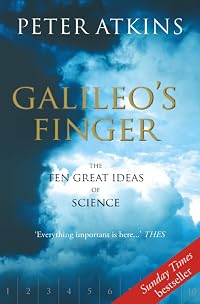
Galileo's Finger: The Ten Great Ideas of Science
by Peter Atkins
On This Page
Description
Publisher's description: Galileo's Finger takes the reader on an extraordinary journey that embraces the ten central ideas of current science. "By a great idea," writes Peter Atkins, "I mean a simple concept of great reach, an acorn of an idea that ramifies into a great oak tree of application, a spider of an idea that can spin a great web and draw in a feast of explanation and elucidation." With wit, charm, and patience, Atkins leads the reader to an understanding of the essence of the show more whole of science, from evolution and the emergence of complexity, to entropy, the spring of all change in the universe; from energy, the universalization of accountancy, to symmetry, the quantification of beauty; and from cosmology, the globalization of reality, to spacetime, the arena of all action. show lessTags
Recommendations





Member Reviews
Chemistry professor Atkins examines the epochal ideas of science, including evolution, the role of DNA in heredity, entropy, the atomic structure of matter, symmetry, wave-particle duality, the expansion of the universe and the curvature of spacetime. Exploring the history of these concepts from the ancient Greeks onward, the chapters amount to case studies in the power of the Galilean paradigm of the "isolation of the essentials of a problem," and mathematical theorising disciplined by real-world experiment, as humanity's understanding moves from armchair speculation and observational lore to testable theories of great explanatory power. Atkins presents this progress as a search for evermore fundamental abstractions: DNA emerges as the show more fleeting physical instantiation of immortal information; thermodynamics is a universal tendency to disorder; and much of physics itself a logical corollary of pure geometry. Writing in lucid, engaging prose illustrated with many ingenious diagrams, Atkins often succeeds brilliantly in conveying the deep conceptual foundations of scientific disciplines to readers lacking a mathematical background. He falters a little, like most science popularizers, at the frontiers of modern physics, where things get very abstract indeed. Atkins's examples are excellent and his prose a marvel of economy and the elegant style, wide-ranging scope, and unusually high ratio of enlightening explanation to baffling abstruseness make this book one of the best of its kind.
Condensing scientific knowledge into 10 concepts, such as the conservation of energy, Atkins offers a primer on the essential ideas of Western science. This is a work descriptive of abstract principles,and it is easily grasped, for Atkins, in the humouring manner of a popular lecturer at the blackboard, illustrates underlying connections that unite dissimilar phenomena, such as waves and particles inquantum mechanics. Although the material does not include equations,readers still must acclimatise to significant brain-bending, especially on the subject of symmetry and on dimensions beyond our familiar three, crucial to getting a grip on the string and M-theory so current with physicists. Where does Galileo's finger figure in this? Reclining in a cup displayed in Florence, it represents to its curators and to Atkins the scientific method, the way of "unpacking" (in the author's recurring phrase) the appearances of nature to reveal its essence. show less
Condensing scientific knowledge into 10 concepts, such as the conservation of energy, Atkins offers a primer on the essential ideas of Western science. This is a work descriptive of abstract principles,and it is easily grasped, for Atkins, in the humouring manner of a popular lecturer at the blackboard, illustrates underlying connections that unite dissimilar phenomena, such as waves and particles inquantum mechanics. Although the material does not include equations,readers still must acclimatise to significant brain-bending, especially on the subject of symmetry and on dimensions beyond our familiar three, crucial to getting a grip on the string and M-theory so current with physicists. Where does Galileo's finger figure in this? Reclining in a cup displayed in Florence, it represents to its curators and to Atkins the scientific method, the way of "unpacking" (in the author's recurring phrase) the appearances of nature to reveal its essence. show less
On the sites that want you to give a star rating, I've given this a 5. I feel it's a 4.75, but, quite sensibly, they don't let you make such small fractions. The only reason I don't give it the full 5 stars is that there's a few diagrams where you can tell the book was originally printed in colour and not much thought was given the the shade of grey it becomes when you press the grey-scale button, there's a couple of places where an extra diagram would have been a good idea (the section on genetics was crying out for a Punnet square) and there's a couple of minor typos that, although they are small, are in the worst possible places.
Other than that, I loved the book, because it explained some tricky concepts incredibly well, and in a way show more that meant I could transfer the understanding to other things (I'm thinking particularly of the 4D cube). I was a bit dubious about the structure to start with but, once you got to chapter 6 and 7 it started to make a lot more sense.
Thoroughly recommended. show less
Other than that, I loved the book, because it explained some tricky concepts incredibly well, and in a way show more that meant I could transfer the understanding to other things (I'm thinking particularly of the 4D cube). I was a bit dubious about the structure to start with but, once you got to chapter 6 and 7 it started to make a lot more sense.
Thoroughly recommended. show less
This is a fine attempt to make some advanced ideas accessible to the layman, but I think it comes up a bit short of that goal. The discussions on some seminal ideas are a bit complex, but not unreasonably so. The writing is light-hearted, with some jokes and puns slapped in here and there, in a typical British fashion. There are particularly interesting discussions of Einsteinian spacetime, matter at the atomic and subatomic levels and a good overview of genetics, but the chapter on mathematics was a bit over the top. It tried to show the difficulty of formulating a logic system from a few basic axioms, or assumptions, a la Euclid's Planar Geometry, but it just serves up a confusing mish mash of set theory summaries that do more harm show more than good. I still enjoyed reading it, and it would make a fine choice for a bookshelf spot near you, as long as you are interested and moderately well versed in the sciences. show less
What would you say are the greatest scientific ideas that mankind has discovered? Most of us chemists would say that the notion that matter consists of atoms would have to be one of them, and physical chemist Peter Atkins does not disappoint us on that score. He also treads ground familiar to us when he describes entropy and energy, and evolution and DNA. However, even his remarks about these topics are worth reading, because he demonstrates how important scientific ideas can be explained to an interested layperson. One of the other subjects in his "Top Ten" list sounds as if it might be a topic in a chemistry course, but he brings a broader perspective to "Symmetry" than that, including the gauge symmetries of forces and particles. show more Another of the great ideas of science has to be the quantum theory (Chapter Seven), for which Symmetry makes a nice introduction. Atkins finishes with two excellent chapters on Cosmology and Spacetime, and what I thought was the most surprising choice, a chapter on Arithmetic: The Limits of Reason. Teachers of chemistry and other sciences will likely have their horizons extended by Galileo's Finger. show less
Atkins's top ten: evolution, DNA, energy, entropy, atoms, symmetry, quanta, cosmology, spacetime, arithmetic. I like his non-adulation of Aristotle, who was dead wrong about almost every aspect of nature and im my opinion is one of history's most overrated people.
Page 1 "Prologue" Atkins seems to believe that the Scientific Method actually is used. "The procedure that gets taught as "The Scientific Method" is entirely misleading. Studying what scientists actually do is far more interesting." (http://www.dharma-haven.org/science/myth-of-scientific-method.htm)
I find that how things are actually discovered is much more interesting than the story that is concocted later to make it sound logical. That was sufficient to cause me to set the book aside for a few years. Now I am putting it back into my to-read queue since the book is about 10 great discoveries. It might even have something interesting about how they were discovered.
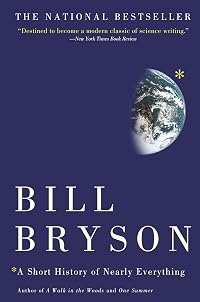
Another reviewer recommended A Short History of Nearly Everything as show more being less dry. show less
I find that how things are actually discovered is much more interesting than the story that is concocted later to make it sound logical. That was sufficient to cause me to set the book aside for a few years. Now I am putting it back into my to-read queue since the book is about 10 great discoveries. It might even have something interesting about how they were discovered.
Another reviewer recommended A Short History of Nearly Everything as show more being less dry. show less
Ratings
Members
- Recently Added By
Lists

Falling for Science
56 works; 3 members
Author Information

28+ Works 2,012 Members
Awards and Honors
Awards
Notable Lists
Common Knowledge
- First words
- Why his finger?
- Last words
- (Click to show. Warning: May contain spoilers.)But then, that's science.
Classifications
Statistics
- Members
- 388
- Popularity
- 80,256
- Reviews
- 6
- Rating
- (3.86)
- Languages
- 10 — Chinese, English, French, German, Italian, Norwegian (Bokmål), Norwegian, Polish, Portuguese, Spanish
- Media
- Paper, Ebook
- ISBNs
- 13
- ASINs
- 3