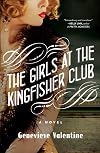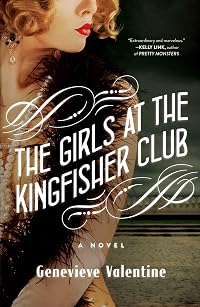
The Girls at the Kingfisher Club
by Genevieve Valentine
On This Page
Description
This reimagining of the "Twelve Dancing Princesses" traces the story of a family of flappers who work in a 1920s speakeasy until their suspicious father decides to marry them off, prompting a confrontation with a bootlegger from the eldest sister's past.Tags
Recommendations























Member Recommendations



Member Reviews
Loosely based upon the fairy tale 'Twelve Dancing Princesses.' Eldest sister Jo is the closest thing her eleven sisters have to a mother in a household run by a distant, controlling father. She teaches them to dance and herds them to and from the dance clubs to keep them safe and secret, until one day her father decides it's time to for them to marry -- to his benefit -- and not only that, but he suspects that they have not been keeping to their attic abode, but instead sneaking out to dance.
I listened to this as an audio book.
I don't really have much to say about The Girls at the Kingfisher Club except that it was a jazz age glory, and it both broke my heart and kept me up all evening -- and then all night -- finishing the book. I show more staggered into work the next day running on three hours of sleep with red eyes and exhausted, and then had a hard time reading anything else for more than a month. Do you hear that, Valentine? You wrecked my reading goal for the year, thanks a lot.
I don't tend to push books at my friends, mostly because I never know if they share my interests enough to enjoy my reading habits, but I've been singing this one to anyone who will listen to me for thirty seconds. The audio book is great. The story is great. It ended just where I think it ought to have, and no, I do not want a sequel, just more like it. Hosannah, hosannah, The Girls of the Kingfisher Club rocks, hosannah. show less
I listened to this as an audio book.
I don't really have much to say about The Girls at the Kingfisher Club except that it was a jazz age glory, and it both broke my heart and kept me up all evening -- and then all night -- finishing the book. I show more staggered into work the next day running on three hours of sleep with red eyes and exhausted, and then had a hard time reading anything else for more than a month. Do you hear that, Valentine? You wrecked my reading goal for the year, thanks a lot.
I don't tend to push books at my friends, mostly because I never know if they share my interests enough to enjoy my reading habits, but I've been singing this one to anyone who will listen to me for thirty seconds. The audio book is great. The story is great. It ended just where I think it ought to have, and no, I do not want a sequel, just more like it. Hosannah, hosannah, The Girls of the Kingfisher Club rocks, hosannah. show less
A retelling of "The Twelve Dancing Princesses" set during the 1920s. It succeeds at giving twelve sisters distinct personalities partly because Valentine remembers to give them flaws along with differing tastes and personality quirks. They have qualities that make them unlikeable to each other.
Of course, it is even more believable that the Hamilton sisters - shut up in their house, neglected by their parents - would have difficult relationships. Jo, the eldest, earns the nickname of "the General" - but being strict allows Jo to keep her sisters safe. They can to bear their daytime imprisonment because they have a nightly escape, dancing in the underground clubs of New York, and they survive those nightly escapades because they have show more rules. And then their father announces his intention to see his daughters married, and the cops raid the Kingfisher, and everything begins to unravel.
I couldn't put The Girls at the Kingfisher Club down. The story is compelling, and the writing is so effective. Gorgeous, sparse, heartbreaking.
I love the way it focuses so much on the sisters and their relationships with each other. I love Jo, because because she is so... selfless and heartbreakingly fierce, in trying to protect her sisters. And then, when she has to let go, in trying to let go.
The Girls at the Kingfisher Club is one of the best books I've read this year. (Reviewed August 2014)
Never tell a man your name. Never mention where you live, or any place we go. Never let a man take you anywhere; if you take one into the alley to neck, tell one of your sisters, and come back as soon as you can.
Never fall for a man so hard you can't pull your heart back in time.
We'll leave without you if we have to. show less
Of course, it is even more believable that the Hamilton sisters - shut up in their house, neglected by their parents - would have difficult relationships. Jo, the eldest, earns the nickname of "the General" - but being strict allows Jo to keep her sisters safe. They can to bear their daytime imprisonment because they have a nightly escape, dancing in the underground clubs of New York, and they survive those nightly escapades because they have show more rules. And then their father announces his intention to see his daughters married, and the cops raid the Kingfisher, and everything begins to unravel.
I couldn't put The Girls at the Kingfisher Club down. The story is compelling, and the writing is so effective. Gorgeous, sparse, heartbreaking.
I love the way it focuses so much on the sisters and their relationships with each other. I love Jo, because because she is so... selfless and heartbreakingly fierce, in trying to protect her sisters. And then, when she has to let go, in trying to let go.
The Girls at the Kingfisher Club is one of the best books I've read this year. (Reviewed August 2014)
Never tell a man your name. Never mention where you live, or any place we go. Never let a man take you anywhere; if you take one into the alley to neck, tell one of your sisters, and come back as soon as you can.
Never fall for a man so hard you can't pull your heart back in time.
We'll leave without you if we have to. show less
A smashing confection of sharp edges and glittering pretense. Everything is brittle and dazzling. Just marvellous. It left me crying on the train, and dazed and unfocused at work because my head was still spinning about a dancefloor. The author's taut, tense style worked a treat for delicate, restrained portraits of a dozen girls - all individuals, all imprisoned within themselves as surely as within the attic, and seething with it. Jo - the General - in particular is an absolute masterpiece, and my heart broke at least five times for her. She's so strong, and so complex, that while the last third of the book might seem oddly paced (Mr Dee - who also loved the book - pondered on a "gentle 70-page epilogue") I found myself drawn through show more in increasing demand for the last piece of Jo's soul to be returned. show less
The Girls at the Kingfisher Club takes the fairytale of the Twelve Dancing Princesses and imagines it taking place in Twenties New York instead, where the twelve Hamilton sisters defy their overbearing father each night by taking to the dance floor in vibrant Prohibition-era nightclubs. This was solid but never quite clicked with me—perhaps because of the slightly mannered prose style, perhaps because of the challenge of keeping so many sisters straight in my mind. Genevieve Valentine also didn't seem to have much to say here, beyond the bald fact of "treating women as things is bad." Yes—and? It all felt a bit surface, and this may be an example of the kind of book that would work better as a movie.
Retelling something as familiar as a fairy tale can be a risky proposition. In some cases, magic can come out of the details as an author elaborates on a classic. For instance, I happen to love Robin McKinley’s book [b:Beauty|17430162|Beauty|Robin McKinley|https://d.gr-assets.com/books/1381298207s/17430162.jpg|2321285], a take on the old tale “Beauty and the Beast.” On the other hand, when she re-told the story again twenty years later in [b:Rose Daughter|8089|Rose Daughter (Folktales #2)|Robin McKinley|https://d.gr-assets.com/books/1398552029s/8089.jpg|2321287], I didn’t care for it at all. So I brought few expectations to my reading of The Girls at the Kingfisher Club, a retelling of the fairy tale “The Twelve Dancing show more Princesses.” To my delight, I found a creative, emotionally complex story that takes the original in an empowering direction.
In most versions of the fairytale “The Twelve Dancing Princesses” (a German version is titled “The Worn-Out Shoes“), the story focuses on a challenge to discover why a king’s twelve daughters wake up in the morning with holes in their shoes (one version here). The king is baffled and frustrated, and offers a reward to anyone who can solve the mystery–but if not, then off with his head. Many have been died after falling asleep during their watch. Before accepting the challenge, a soldier meets an old woman who gives him a magic cloak and warns him not to drink anything from the princesses. After the soldier pretends to fall asleep, the princesses dress, go through a secret passage to an underground lake, row across and through a forest of metallic trees, and spend the night dancing with princes at a ball. As they return, the invisible soldier breaks off a piece of a tree, first silver, then gold. On the last night, he steals a goblet from the ball as proof. When the king demands an accounting, the soldier provides the proof and is rewarded by marrying one of the princesses.
Clearly, the origin story is a complex bit of fairy tale, with princesses that are complicit in the deception, a father who is outside it but cruel with his consequences, and a ordinary man using magical gifts to catch the princesses in their dishonesty. Girls versus their father, a common man versus princes, and duplicity all around.
Valentine takes these elements and heads into a very interesting direction. Twelve girls are growing up in a wealthy but isolated household in early Prohibition New York. Rarely permitted outside, or even invited to the downstairs levels of the house to visit their mother, they are ruled by their father in an extremely circumscribed life. Jo, the oldest, has met her mother only a handful of times, and the youngest haven’t met her mother at all. It falls to Jo as the oldest to negotiate on behalf of the sisters with her father. Told in third person limited, largely from Jo’s point of view, Jo ponders her nickname “The General,” arising from the unenviable position as enforcer/mitagator of her father, but yet attempting to protect them against his rage. Unfortunately, her efforts are often underappreciated.
“A ripple of relief ran through the room. It was too loud, too happy; it was a gloss over an unspoken thrum of mutiny so sharp that Jo felt like someone had snapped a rubber band against her wrist.“
Early on, Jo and the second oldest, Lou, would sneak out to the movies where the girls would learn new dances. Natural talents, dancing became a way to escape their limited lives. As each successive sister was delivered upstairs, she was eventually taught to dance by her sisters. In an act of desperation, Jo suggests sneaking out to go dancing–she knows if she doesn’t let the girls blow off steam in some fashion, they might simply run away and be lost forever. The night out dancing is a success, giving the girls hope, a reason to exist and a source of joy and discussion to fill their days. They danced through their nights, unattainable to the men at the clubs:
“The girls were wild for dancing, and nothing else. No hearts beat underneath those thin, bright dresses. They laughed like glass.“
Trouble begins on two fronts when their father decides to actively intrude in their lives. As he schemes to marry the girls off, he gets wind of stories about a bevy of girls dancing at local speakeasies. An ad in the newspaper strikes fear in Jo as soon as she learns of his plans.
“The girls could hope that these husbands, wherever her father planned to find them, would be kinder and more liberal men than he was. But the sort of man who wanted a girl who’d never been out in the world was the sort whose wife would stay at home in bed and try to produce heirs until she died from it.“
The last section follows the girls as they discover life outside their father’s house. I rather enjoyed that Valentine took her story a step beyond the simple “they escaped and they all lived happily ever after,” and looked at the challenges of making a life, and how different the idea of success could be for each sister.
“She was still trying to discover how people related to each other, and how you met the world when you weren’t trying to hide something from someone. It was a lesson slow in coming.“
As in all fairy tales, characters exist largely as archetypes. With twelve sisters, it’s hard to achieve a great deal of individuality with each, but Valentine succeeds with a few, particularly Jo, Lou (the second oldest), and Doris (the sensible one). I thought Jo’s emotional dilemma was well done. The father is perfect; elegant, controlling, and all implied threat.
The setting of New York during Prohibition was nicely done. I’ve read a number of books that were quite enamored of the 1920s, but focused on the setting at the expense of character. Valentine achieves a nice balance between the magic of the clubs and plotting. My chief complaint was a writing style that felt awkward. Additional thoughts and commentary were often given in parenthesis, and the purpose/voice weren’t always clear. Nonetheless, I enjoyed the way Valentine’s tone and word choice was able to capture the emotional magic of a fairy tale but incorporate it into a real-world setting.
Overall, I’d call it a delightful improvement on the original tale. I’d highly recommend it to fans of fairy-tales, sister bonds, coming of age stories and gentle romance.
Thanks to NetGalley and Atria books for providing me an advance ereader copy. Quotes are taken from a galley copy and are subject to change in the published edition. Still, I think it gives a flavor of the magical writing.
Oh, and review with links (including a link to a fairy tale database and a version of the fairy tale) can be found through my primary site:
http://clsiewert.wordpress.com/2014/06/10/the-girls-at-the-kingfisher-club-by-ge... show less
In most versions of the fairytale “The Twelve Dancing Princesses” (a German version is titled “The Worn-Out Shoes“), the story focuses on a challenge to discover why a king’s twelve daughters wake up in the morning with holes in their shoes (one version here). The king is baffled and frustrated, and offers a reward to anyone who can solve the mystery–but if not, then off with his head. Many have been died after falling asleep during their watch. Before accepting the challenge, a soldier meets an old woman who gives him a magic cloak and warns him not to drink anything from the princesses. After the soldier pretends to fall asleep, the princesses dress, go through a secret passage to an underground lake, row across and through a forest of metallic trees, and spend the night dancing with princes at a ball. As they return, the invisible soldier breaks off a piece of a tree, first silver, then gold. On the last night, he steals a goblet from the ball as proof. When the king demands an accounting, the soldier provides the proof and is rewarded by marrying one of the princesses.
Clearly, the origin story is a complex bit of fairy tale, with princesses that are complicit in the deception, a father who is outside it but cruel with his consequences, and a ordinary man using magical gifts to catch the princesses in their dishonesty. Girls versus their father, a common man versus princes, and duplicity all around.
Valentine takes these elements and heads into a very interesting direction. Twelve girls are growing up in a wealthy but isolated household in early Prohibition New York. Rarely permitted outside, or even invited to the downstairs levels of the house to visit their mother, they are ruled by their father in an extremely circumscribed life. Jo, the oldest, has met her mother only a handful of times, and the youngest haven’t met her mother at all. It falls to Jo as the oldest to negotiate on behalf of the sisters with her father. Told in third person limited, largely from Jo’s point of view, Jo ponders her nickname “The General,” arising from the unenviable position as enforcer/mitagator of her father, but yet attempting to protect them against his rage. Unfortunately, her efforts are often underappreciated.
“A ripple of relief ran through the room. It was too loud, too happy; it was a gloss over an unspoken thrum of mutiny so sharp that Jo felt like someone had snapped a rubber band against her wrist.“
Early on, Jo and the second oldest, Lou, would sneak out to the movies where the girls would learn new dances. Natural talents, dancing became a way to escape their limited lives. As each successive sister was delivered upstairs, she was eventually taught to dance by her sisters. In an act of desperation, Jo suggests sneaking out to go dancing–she knows if she doesn’t let the girls blow off steam in some fashion, they might simply run away and be lost forever. The night out dancing is a success, giving the girls hope, a reason to exist and a source of joy and discussion to fill their days. They danced through their nights, unattainable to the men at the clubs:
“The girls were wild for dancing, and nothing else. No hearts beat underneath those thin, bright dresses. They laughed like glass.“
Trouble begins on two fronts when their father decides to actively intrude in their lives. As he schemes to marry the girls off, he gets wind of stories about a bevy of girls dancing at local speakeasies. An ad in the newspaper strikes fear in Jo as soon as she learns of his plans.
“The girls could hope that these husbands, wherever her father planned to find them, would be kinder and more liberal men than he was. But the sort of man who wanted a girl who’d never been out in the world was the sort whose wife would stay at home in bed and try to produce heirs until she died from it.“
The last section follows the girls as they discover life outside their father’s house. I rather enjoyed that Valentine took her story a step beyond the simple “they escaped and they all lived happily ever after,” and looked at the challenges of making a life, and how different the idea of success could be for each sister.
“She was still trying to discover how people related to each other, and how you met the world when you weren’t trying to hide something from someone. It was a lesson slow in coming.“
As in all fairy tales, characters exist largely as archetypes. With twelve sisters, it’s hard to achieve a great deal of individuality with each, but Valentine succeeds with a few, particularly Jo, Lou (the second oldest), and Doris (the sensible one). I thought Jo’s emotional dilemma was well done. The father is perfect; elegant, controlling, and all implied threat.
The setting of New York during Prohibition was nicely done. I’ve read a number of books that were quite enamored of the 1920s, but focused on the setting at the expense of character. Valentine achieves a nice balance between the magic of the clubs and plotting. My chief complaint was a writing style that felt awkward. Additional thoughts and commentary were often given in parenthesis, and the purpose/voice weren’t always clear. Nonetheless, I enjoyed the way Valentine’s tone and word choice was able to capture the emotional magic of a fairy tale but incorporate it into a real-world setting.
Overall, I’d call it a delightful improvement on the original tale. I’d highly recommend it to fans of fairy-tales, sister bonds, coming of age stories and gentle romance.
Thanks to NetGalley and Atria books for providing me an advance ereader copy. Quotes are taken from a galley copy and are subject to change in the published edition. Still, I think it gives a flavor of the magical writing.
Oh, and review with links (including a link to a fairy tale database and a version of the fairy tale) can be found through my primary site:
http://clsiewert.wordpress.com/2014/06/10/the-girls-at-the-kingfisher-club-by-ge... show less
Twelve sisters in 1920s New York go dancing at night without their father's knowledge. It's their only escape from their stifling home life, and it's only possible because of Jo, the oldest sister, known as The General to her younger siblings. Jo's the one who decides when and where they will go, and who keeps a watchful eye on the group when they're out and makes sure they all get home safely. But Jo, even more than the rest of them, knows that their current situation can't last forever. When their father starts trying to arrange marriages for them, it's obvious that the sisters will have to make other plans, or face lives of captivity with husbands who will treat them no better than their father has done.
This is an extremely engaging show more read. I listened to the audiobook, and found it hard to tear myself away from the story when I had to be doing other things. I'm a big fan of fairy tale retellings, and The Dancing Princesses has always been one of my favorites. And, while I don't always love stories set in the Roaring '20s, it worked so perfectly for this particular retelling. If this sounds like something you might enjoy, I highly recommend it. show less
This is an extremely engaging show more read. I listened to the audiobook, and found it hard to tear myself away from the story when I had to be doing other things. I'm a big fan of fairy tale retellings, and The Dancing Princesses has always been one of my favorites. And, while I don't always love stories set in the Roaring '20s, it worked so perfectly for this particular retelling. If this sounds like something you might enjoy, I highly recommend it. show less
So much fun! And a brilliant transformation of "The Twelve Dancing Princesses." I was skeptical at the outset, wondering if Valentine would be able to give distinct personalities to twelve sisters (let alone whatever other frequent characters appeared in the book), but dang! You could tell she had a blast writing this, and it was only after I finished that I realized she's the reader for the audio as well (also outstanding). I loved the how she wrote the sisterhood dynamics. I loved the sense of time and place. I love that it has a fairy tale ending (is this actually a spoiler?). It never hit a dull patch...I would have listened to it in one sitting if I could. Again, I'll call out to the YALSA gods--why didn't this get an Alex?
Members
- Recently Added By
Lists

Favorite Fairy Tale Retellings
210 works; 62 members

Best 21st Century Books (So Far)
670 works; 86 members

Historical Fiction
889 works; 91 members

Female Author
1,234 works; 67 members

Top Five Books of 2015
811 works; 241 members

Five star books
1,767 works; 110 members
Animals in the Title
498 works; 11 members
Literature About Women and Girls
394 works; 39 members

KayStJ's to-read list
1,616 works; 11 members

The 12 dancing princesses
17 works; 2 members
Favorite Fairy Tales
269 works; 103 members
Author Information

83+ Works 2,097 Members
Some Editions
Awards and Honors
Distinctions
Work Relationships
Is a retelling of
Common Knowledge
- Canonical title
- The Girls at the Kingfisher Club
- Original publication date
- 2014-06
- People/Characters
- Josephine Hamilton (Jo); Louise Hamilton (Lou); Ella Hamilton; Doris Hamilton; Jake; Tom Marlowe (show all 8); Joseph Hamilton; Sam Lewisohn
- Important places
- New York, New York, USA
- Dedication
- For my sister, and the friends who have become sisters
- First words
- By 1927 there were twelve girls who danced all night and never gave names, but by then the men had given up asking and called them all princesses.
- Last words
- (Click to show. Warning: May contain spoilers.)Then Lou was holding her close enough to hurt, and the others were kissing Jo's cheek as they passed by, as if they were all home at last, and underneath them the music was shaking the boards as the sisters, one by one, took to the floor to dance.
- Blurbers
- Westerfeld, Scott; Schwarz, Christina; Leveen, Lois; Domingue, Ronlyn; Link, Kelly
- Original language
- English
Classifications
Statistics
- Members
- 479
- Popularity
- 63,454
- Reviews
- 39
- Rating
- (3.97)
- Languages
- English
- Media
- Paper, Audiobook, Ebook
- ISBNs
- 8
- UPCs
- 1
- ASINs
- 6