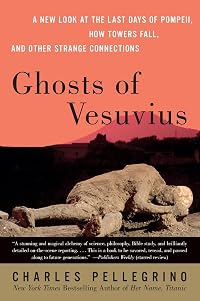
Ghosts of Vesuvius: A New Look at the Last Days of Pompeii, How Towers Fall, and Other Strange Connections
by Charles R. Pellegrino
On This Page
Description
An examination of the disasters at Pompeii and Herculaneum discusses what forensic archaeology and new findings in volcano physics reveal about modern events, including the "collapse column" at the World Trade Center.Tags
Recommendations



















Member Reviews
Brilliant account, equally scientific and emotional, of the Pompeii tragedy, with parallels drawn to the 9/11 attacks on the World Trade Center (the physics of the WTC downblasts resembled a mini volcanic eruption). Some will complain Pellegrino goes on far too many religious and other digressions, though some of these serve to contextualize and get into the heads of those living in 1st century Italy; the spiritual philosophizing also follows from the author's own harrowing coincidences relevant to the story. Without the digressions, the tome would be halved in length and considerably more concise, but Pellegrino is such a fine writer that it all sort of comes together in a worthwhile way.
It is hard to blurb this book. On the one hand it is about Vesuvius and volcanic explosions and disasters both natural and man-made. But it is also a book about the origins of the earth, of the universe, and about how precarious our existence is. How so much of what we are today is dependent on natural events a thousand years ago, or a millennia ago, or so long ago that it is almost pointless to count the time because it is so difficult to grasp those sort of numbers.
It is hard to blurb this book. On the one hand it is about Vesuvius and volcanic explosions and disasters both natural and man-made. But it is also a book about the origins of the earth, of the universe, and about how precarious our existence is. How so much of what we are show more today is dependent on natural events a thousand years ago, or a millennia ago, or so long ago that it is almost pointless to count the time because it is so difficult to grasp those sort of numbers.
I have seen it called a Metalogue and I have to agree with that definition, a text or conversation in which the form resembles the content.
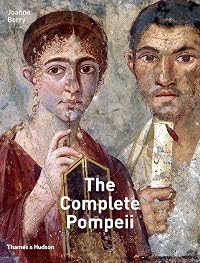
I’m not sure what I expected of this book. I picked up based on the recommendation of someone or other on a library-related work “how to” forum. The cover made me assume it was about Pompeii. But then I read “a new look at the last days of Pompeii, how towers fall, and other strange connections” and I figured that the best thing to do was just start reading and hope it was entertaining.
Well, I’m not sure if entertaining is the right word. When talking about disasters on such a huge scale it seems wrong somehow to describe a book as entertaining. But it was certainly informative. It is a narrative history, with science and religion and philosophy all mixed in there as well. It is extremely well-written, but it has a style all of its own. In a way it is sort of stream of consciousness. And on occasions it is slightly repetitive, but that is a deliberate decision, or at least, that is how it comes across. Some readers might say it rambles all over the place, and it does, but at the same time it has a very important message at its heart. We have very little control over our lives, over the world, and for all our scientific achievement and progress, we are still dependent on the earth’s stability and that cannot be guaranteed, because, over the long-haul the earth is not static. It is a constantly changing, constantly shifting entity.
It is a personal account as well, and for that reason I cannot be too critical of what I found was too much time spent covering individual tales of survival at the World Trade Centre attacks. Some of it was incredibly well told and moving, but reading one story after another in such a manner made these extraordinary events somehow mundane, in my opinion. show less
It is hard to blurb this book. On the one hand it is about Vesuvius and volcanic explosions and disasters both natural and man-made. But it is also a book about the origins of the earth, of the universe, and about how precarious our existence is. How so much of what we are show more today is dependent on natural events a thousand years ago, or a millennia ago, or so long ago that it is almost pointless to count the time because it is so difficult to grasp those sort of numbers.
I have seen it called a Metalogue and I have to agree with that definition, a text or conversation in which the form resembles the content.
I’m not sure what I expected of this book. I picked up based on the recommendation of someone or other on a library-related work “how to” forum. The cover made me assume it was about Pompeii. But then I read “a new look at the last days of Pompeii, how towers fall, and other strange connections” and I figured that the best thing to do was just start reading and hope it was entertaining.
Well, I’m not sure if entertaining is the right word. When talking about disasters on such a huge scale it seems wrong somehow to describe a book as entertaining. But it was certainly informative. It is a narrative history, with science and religion and philosophy all mixed in there as well. It is extremely well-written, but it has a style all of its own. In a way it is sort of stream of consciousness. And on occasions it is slightly repetitive, but that is a deliberate decision, or at least, that is how it comes across. Some readers might say it rambles all over the place, and it does, but at the same time it has a very important message at its heart. We have very little control over our lives, over the world, and for all our scientific achievement and progress, we are still dependent on the earth’s stability and that cannot be guaranteed, because, over the long-haul the earth is not static. It is a constantly changing, constantly shifting entity.
It is a personal account as well, and for that reason I cannot be too critical of what I found was too much time spent covering individual tales of survival at the World Trade Centre attacks. Some of it was incredibly well told and moving, but reading one story after another in such a manner made these extraordinary events somehow mundane, in my opinion. show less
I read this book as part of some ongoing research I am doing regarding the city of Pompeii. By trade Pellegrino is a trained paleo-geologist; in this book however, he ventures into physics, sociology, history and religious studies which combine to create something that is difficult to follow and causes the reader to wander off to read other more straight-forward texts . Yes, more than once I found myself more engrossed in my cereal box and trials of the Trix rabbit versus the correlation between volcanic ash and the 9/11 attacks.
-
I do not want to convey that this book is without merit but its density keeps it at “okay” instead of “good”. There are two general themes of this book. The first is that explosions follow certain show more patterns and if scientists can understand these patterns then there can be strategies for reducing the effect of certain catastrophes. With this one Pellegrino does pretty well. There are plenty of fancy graphs, drawings and data tables regarding different explosions and how they compare to one another - including how the 9/11 attacks were only a small fraction of the destruction power of Mt. St. Helens or Pompeii. That fact alone is pretty remarkable to dwell on.
-
The second theme is an archaeological and geological review of Pompeii as a city. Again, Pellegrino does well and the “Cities in Amber” chapter is the most notable. However it is in this goal that the sub-title of the book: A New Look At the Last Days of Pompeii, How Towers Fall, and Other Strange Connections begins to fall into play. Apparently the phrase “other strange connections” give Pellegrino carte-blanc to write freely about early Christianity in Rome, Spartacus, the tomb of John the Baptist, Jesus and his relationship with Mary Magdalene, the Titanic, the historian Josephus and the Big Dipper. All of these other musings left me annoyed and confused.
-
Lastly, the remainder of the book is devoted to providing a detailed account of individuals who lived and died during the world trade center bombings. Pellegrino may have felt compelled to add a more human element to a very science-heavy book but it came off too poetic for non-fiction and left me slightly frustrated (I didn’t plan to read a memorial text). By the end I felt like I was back in high school being forced to give up a nice summer day for some “required reading”; only this time it was for my job and not sophomore English class.
-
Overall I could recommend sections of this book, but in general I’d go with the Cliff’s Notes version.
————
Grade: C show less
-
I do not want to convey that this book is without merit but its density keeps it at “okay” instead of “good”. There are two general themes of this book. The first is that explosions follow certain show more patterns and if scientists can understand these patterns then there can be strategies for reducing the effect of certain catastrophes. With this one Pellegrino does pretty well. There are plenty of fancy graphs, drawings and data tables regarding different explosions and how they compare to one another - including how the 9/11 attacks were only a small fraction of the destruction power of Mt. St. Helens or Pompeii. That fact alone is pretty remarkable to dwell on.
-
The second theme is an archaeological and geological review of Pompeii as a city. Again, Pellegrino does well and the “Cities in Amber” chapter is the most notable. However it is in this goal that the sub-title of the book: A New Look At the Last Days of Pompeii, How Towers Fall, and Other Strange Connections begins to fall into play. Apparently the phrase “other strange connections” give Pellegrino carte-blanc to write freely about early Christianity in Rome, Spartacus, the tomb of John the Baptist, Jesus and his relationship with Mary Magdalene, the Titanic, the historian Josephus and the Big Dipper. All of these other musings left me annoyed and confused.
-
Lastly, the remainder of the book is devoted to providing a detailed account of individuals who lived and died during the world trade center bombings. Pellegrino may have felt compelled to add a more human element to a very science-heavy book but it came off too poetic for non-fiction and left me slightly frustrated (I didn’t plan to read a memorial text). By the end I felt like I was back in high school being forced to give up a nice summer day for some “required reading”; only this time it was for my job and not sophomore English class.
-
Overall I could recommend sections of this book, but in general I’d go with the Cliff’s Notes version.
————
Grade: C show less
A look at the science of volcanoes, and what it can tell us about the collapse of the Twin Towers and the last days of Pompeii. Not the best disaster book, but a good one about the event.
Ratings
Members
- Recently Added By
Author Information

22+ Works 3,014 Members
Charles Pellegrino has been known to work simultaneously in entomology, forensic physics, paleogenetics, preliminary design of advanced rocket systems, astrobiology, and marine archaeology. The author of eighteen books of fiction and nonfiction. Dr. Pellegrino lives in New York City
Common Knowledge
- Important places
- Mount Vesuvius; Pompeii
- Important events
- Reign of Titus (79-06-23 | 81-09-13); Eruption of Mount Vesuvius (79 AD)
Classifications
- Genres
- Anthropology, History, Nonfiction, General Nonfiction, Science & Nature
- DDC/MDS
- 937.7 — History & geography History of ancient world (to ca. 499) Italian Peninsula to 476 and adjacent territories to 476 Southern Italy: Campania, Samnium, Apulia, etc.
- LCC
- DG70 .P7 .P44 — History of Europe, Asia, Africa and Oceania City History of Italy Ancient Italy. Rome to 476 Local history and description Other cities, towns, etc., A-Z
- BISAC
Statistics
- Members
- 273
- Popularity
- 118,600
- Reviews
- 5
- Rating
- (3.68)
- Languages
- English
- Media
- Paper
- ISBNs
- 3