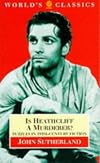
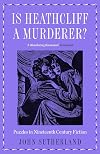
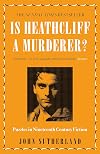
Is Heathcliff a Murderer? Great Puzzles in Nineteenth-Century Fiction
by John Sutherland
Puzzles in Classic Fiction (1)
On This Page
Description
In this quirky and intriguing book, John Sutherland has conveniently gathered together thirty-four nagging little questions, puzzles, errors, and enigmas from some of the best-loved examples of Victorian fiction. Readers often have stumbled upon seeming mysteries in their favorite novels. Why, for example, is the plot of The Woman in White irrevocably flawed? (The timing of the crime is off.) Is the hero of George Eliot's Middlemarch illegitimate? (Probably, although he was later show more legitimized.) Why does the otherwise sensible Jane Eyre give in to a sudden and unexplained outburst of superstition? (Charlotte Bronte, in reality, had a similar experience.) What is the real reason we find The Picture of Dorian Gray so disturbing? (There is an overwhelming emphasis on the sense of smell.) These answers and more can all be found in John Sutherland's entertaining and maddening book. When it comes to literary criticism there's really nothing quite like the joys of close reading and good-natured inquiry. This is the spirit in which Is Heathcliff A Murderer was conceived and executed. Rather than trying to catch great authors in mistakes, Sutherland usually turns up perfectly plausible reasons for the seeming anomalies. Everyone who reads nineteenth-century novels will thoroughly enjoy John Sutherland's exploration of the seemingly unanswered, and each chapter is a direct link to one of Oxford's World's Classics. show lessTags
Recommendations















Member Recommendations
Member Reviews
John Sutherland is Lord Northcliffe Professor Emeritus of Modern English Literature at University College London ("emeritus" being Latin for "scrapheap" and "Northcliffe" journalistic shorthand for "you cannot be serious") according to his profile on The Guardian's website. (Modern includes the 19th century as it's modern relative to the Mediaeval period in this case.)
This little book of essays has set on my bookshelves unread for about 18 months because I was worried it would be dull and, as I hadn't read all of the books Sutherland discusses in his essays, I was worried there would be spoilers for the books I hadn't read. Well, I haven't made great progress in reading through all the Victorian fiction ever written but I decided to show more start reading it anyway and got drawn in.
Each essay is very short, sometimes only a few pages long, and focuses on a particular puzzle in a work of 19th century fiction. Sometimes the puzzles are ones that I think most readers of the book would be aware of, such as the eponymous puzzle surrounding whether Heathcliff was responsible for the death of Hindley Earnshaw in Wuthering Heights. Others, such as Jane Austen mentioning apple blossom in a scene in Emma set in the month of June or Wilkie Collins apparently losing a fortnight in The Woman in White, I think might escape many readers' notice when reading the original work. I hope so anyway, because I read Emma only last month and definitely didn't notice the apple blossom point.
In each case, Sutherland explains what the problems are and digs further into the text, the general social background of the 19th century and what we know of each author to tease out some possible solutions or explanations for each puzzle. In particular, he helps to bring out the very subtle references within the texts to things like pregnancy, menstruation or toilets which the writers couldn't mention outright but to which there are clues which readers of the time would have been able to pick up on.
His aim is certainly not to belittle or pull apart any of the works mentioned; he clearly has a deep love of and respect for Victorian literature. Neither is he being picky or pedantic for the sake of it; I don't think my enjoyment of any of the works he mentions will have been spoilt by reading these essays. Instead, I've found I now want to reread all the books he mentions that I've already read to understand for myself the points he's making as well as read all the books he mentions that I haven't read (the complete works of Anthony Trollope for example). Very entertaining. show less
This little book of essays has set on my bookshelves unread for about 18 months because I was worried it would be dull and, as I hadn't read all of the books Sutherland discusses in his essays, I was worried there would be spoilers for the books I hadn't read. Well, I haven't made great progress in reading through all the Victorian fiction ever written but I decided to show more start reading it anyway and got drawn in.
Each essay is very short, sometimes only a few pages long, and focuses on a particular puzzle in a work of 19th century fiction. Sometimes the puzzles are ones that I think most readers of the book would be aware of, such as the eponymous puzzle surrounding whether Heathcliff was responsible for the death of Hindley Earnshaw in Wuthering Heights. Others, such as Jane Austen mentioning apple blossom in a scene in Emma set in the month of June or Wilkie Collins apparently losing a fortnight in The Woman in White, I think might escape many readers' notice when reading the original work. I hope so anyway, because I read Emma only last month and definitely didn't notice the apple blossom point.
In each case, Sutherland explains what the problems are and digs further into the text, the general social background of the 19th century and what we know of each author to tease out some possible solutions or explanations for each puzzle. In particular, he helps to bring out the very subtle references within the texts to things like pregnancy, menstruation or toilets which the writers couldn't mention outright but to which there are clues which readers of the time would have been able to pick up on.
His aim is certainly not to belittle or pull apart any of the works mentioned; he clearly has a deep love of and respect for Victorian literature. Neither is he being picky or pedantic for the sake of it; I don't think my enjoyment of any of the works he mentions will have been spoilt by reading these essays. Instead, I've found I now want to reread all the books he mentions that I've already read to understand for myself the points he's making as well as read all the books he mentions that I haven't read (the complete works of Anthony Trollope for example). Very entertaining. show less
In this quirky and intriguing book, John Sutherland has conveniently gathered together thirty-four nagging little questions, puzzles, errors, and enigmas from some of the best-loved examples of Victorian fiction. Readers often have stumbled upon seeming mysteries in their favorite novels. Why,
for example, is the plot of The Woman in White irrevocably flawed? (The timing of the crime is off.) Is the hero of George Eliot's Middlemarch illegitimate? (Probably, although he was later legitimised.) Why does the otherwise sensible Jane Eyre give in to a sudden and unexplained outburst of
superstition? (Charlotte Bronte, in reality, had a similar experience.) What is the real reason we find The Picture of Dorian Gray so disturbing? (There is an show more overwhelming emphasis on the sense of smell.) These answers and more can all be found in John Sutherland's entertaining and maddening book.
When it comes to literary criticism there's really nothing quite like the joys of close reading and good-natured inquiry. This is the spirit in which Is Heathcliff A Murderer was conceived and executed. Rather than trying to catch great authors in mistakes, Sutherland usually turns up perfectly
plausible reasons for the seeming anomalies.
Everyone who reads nineteenth-century novels will thoroughly enjoy John Sutherland's exploration of the seemingly unanswered, and each chapter is a direct link to one of Oxford's World's Classics. show less
for example, is the plot of The Woman in White irrevocably flawed? (The timing of the crime is off.) Is the hero of George Eliot's Middlemarch illegitimate? (Probably, although he was later legitimised.) Why does the otherwise sensible Jane Eyre give in to a sudden and unexplained outburst of
superstition? (Charlotte Bronte, in reality, had a similar experience.) What is the real reason we find The Picture of Dorian Gray so disturbing? (There is an show more overwhelming emphasis on the sense of smell.) These answers and more can all be found in John Sutherland's entertaining and maddening book.
When it comes to literary criticism there's really nothing quite like the joys of close reading and good-natured inquiry. This is the spirit in which Is Heathcliff A Murderer was conceived and executed. Rather than trying to catch great authors in mistakes, Sutherland usually turns up perfectly
plausible reasons for the seeming anomalies.
Everyone who reads nineteenth-century novels will thoroughly enjoy John Sutherland's exploration of the seemingly unanswered, and each chapter is a direct link to one of Oxford's World's Classics. show less
In this entertaining book, John Sutherland explores literary puzzles from English literature of the 19th century. It represents the 1st book in a series of four such books.
The 34 individual conundrums that are explored are revealed in the chapter titles. Among them are Wilde’s Picture of Dorian Gray: “Why does this novel disturb us?”; Thomas Hardy’s Tess: “Is Alec a rapist?”; and Rudyard Kipling’s Kim: “How old is Kim?” The eponymous chapter “Is Heathcliff a murderer?” considers whether the vengeful brute is responsible for the death of the master of Wuthering Heights, a question on which careful readers will hold different opinions.
The essays are not confined to historical trivia; to the contrary, they show more occasionally come directly to grips with central issues of past and present concern. For example, the chapter on Jane Austen’s Mansfield Park analyzes commentator Edward Said’s claim that the patriarch Sir Thomas gained his wealth from a slave plantation – showing the claim to be exceedingly weak, politically motivated, and far from justified given what little the novel reveals. The issue is significant because it bears on the question of whether Jane Austen was herself was a willing apologist for slavery. Other chapters draw on contemporary scholarship to reinterpret the works in question. For example, the chapter on Frankenstein titled “How does Victor make his monsters?” draws on an unusual (and controversial) psychosexual approach to its subject based on inferences about Mary Shelley’s own life and attitudes towards sex and childbirth.
Several of the works analyzed will be known to readers of classic fiction. In addition to works cited above are such novels as Jane Eyre; Dr. Jekyll and Mr. Hyde; The Invisible Man (by HG Wells); Emma (Jane Austen); Bleak House (Dickens); and Vanity Fair (Thackeray). However, many are obscure works that will be known chiefly to the most experienced of readers, such as Waverly (Scott); Mary Barton (by Mrs. Gaskell); The Prime Minister(Trollope); and The Tenant of Wildfell Hall (Anne Bronte). Still others are works that readers may have heard of, but haven’t been inclined to read (e.g., Henry James’ Portrait of a Lady; Collins’ Woman in White; Eliot’s Adam Bede).
My overall perspective on this interesting book is that it could have had a wider appeal had more of the chapters focused on literary works known to a wider array of readers. I am pleased to see that John Sutherland’s followups to this book have done just that. show less
The 34 individual conundrums that are explored are revealed in the chapter titles. Among them are Wilde’s Picture of Dorian Gray: “Why does this novel disturb us?”; Thomas Hardy’s Tess: “Is Alec a rapist?”; and Rudyard Kipling’s Kim: “How old is Kim?” The eponymous chapter “Is Heathcliff a murderer?” considers whether the vengeful brute is responsible for the death of the master of Wuthering Heights, a question on which careful readers will hold different opinions.
The essays are not confined to historical trivia; to the contrary, they show more occasionally come directly to grips with central issues of past and present concern. For example, the chapter on Jane Austen’s Mansfield Park analyzes commentator Edward Said’s claim that the patriarch Sir Thomas gained his wealth from a slave plantation – showing the claim to be exceedingly weak, politically motivated, and far from justified given what little the novel reveals. The issue is significant because it bears on the question of whether Jane Austen was herself was a willing apologist for slavery. Other chapters draw on contemporary scholarship to reinterpret the works in question. For example, the chapter on Frankenstein titled “How does Victor make his monsters?” draws on an unusual (and controversial) psychosexual approach to its subject based on inferences about Mary Shelley’s own life and attitudes towards sex and childbirth.
Several of the works analyzed will be known to readers of classic fiction. In addition to works cited above are such novels as Jane Eyre; Dr. Jekyll and Mr. Hyde; The Invisible Man (by HG Wells); Emma (Jane Austen); Bleak House (Dickens); and Vanity Fair (Thackeray). However, many are obscure works that will be known chiefly to the most experienced of readers, such as Waverly (Scott); Mary Barton (by Mrs. Gaskell); The Prime Minister(Trollope); and The Tenant of Wildfell Hall (Anne Bronte). Still others are works that readers may have heard of, but haven’t been inclined to read (e.g., Henry James’ Portrait of a Lady; Collins’ Woman in White; Eliot’s Adam Bede).
My overall perspective on this interesting book is that it could have had a wider appeal had more of the chapters focused on literary works known to a wider array of readers. I am pleased to see that John Sutherland’s followups to this book have done just that. show less
John Sutherland bridges the gap between scholarship and nitpicking in this entertaining set of essays on puzzles in 19th century fiction. The interest is not so much in the answers, which are usually not conclusive, but in the journey to explore what are sometimes quite obscure corners of literature. For instance, the episode where Oliver Twist seems to see Fagin and Monks after he has been rescued is not the best-known part of the book, but that really doesn't matter when Sutherland starts asking if this episode is just a dream. On one point he is in my view incorrect - he asserts that Efffie Deans' pregnancy could not have been missed by those around her, but there are known cases where young women have given birth and no-one had any show more idea that they were expecting a child. However, this can be overlooked when so much of interest is covered. Read it - you too will want to know how Frankenstein constructs his monster, why Jane Austen gets her seasons muddled and if Heathcliff really is a murderer. show less
This is the book that answers questions about some of the mysteries of Victorian fiction. It is a sort of reference work that reminds me of the books I have read yet some of the entries are about books which I have not read. My favorites including Dickens, Hardy and Stevenson are discussed; but there are others including Austen, Trollope, Scott and Stoker. Reading this book almost makes you want to return to each novel and reread them to discover the enigmas for yourself. John Sutherland's exceptional ability at literary detections makes this is one of those books about books that is fun to read a bit at a time.
(#7 in the 2008 book challenge)
Each chapter of this book is devoted to a specific work of 19th century English literature, addressing some burning question that is not answered with complete clarity in the text. In the title essay, for example, the author looks closely at the death of one of the characters in Wuthering Heights -- did Heathcliff have a direct role, or was he merely an observer? Sutherland surveys the critical response in addition to his own insights. Some of the so-called puzzles seem a little more puzzling than others, but I suppose that an uneven field is part and parcel of a collection like this.
Grade: B
Recommended: To people who are very familiar with 19th English lit, presuming it didn't breed contempt in the show more first place. The essays definitely include reveals of key plot points, so if there chapters based on novels you haven't yet read, you might wish to consider before indulging. On the plus side, this book sparked my interest in returning to some classics I haven't picked up since they were required reading in high school. show less
Each chapter of this book is devoted to a specific work of 19th century English literature, addressing some burning question that is not answered with complete clarity in the text. In the title essay, for example, the author looks closely at the death of one of the characters in Wuthering Heights -- did Heathcliff have a direct role, or was he merely an observer? Sutherland surveys the critical response in addition to his own insights. Some of the so-called puzzles seem a little more puzzling than others, but I suppose that an uneven field is part and parcel of a collection like this.
Grade: B
Recommended: To people who are very familiar with 19th English lit, presuming it didn't breed contempt in the show more first place. The essays definitely include reveals of key plot points, so if there chapters based on novels you haven't yet read, you might wish to consider before indulging. On the plus side, this book sparked my interest in returning to some classics I haven't picked up since they were required reading in high school. show less
Of the novels featured, I have read "Vanity Fair" (loved it), "Wuthering Heights" (hated it), "Mansfield Park", "Emma", "Jane Eyre", "Dr Jekyll and Mr Hyde", "The Picture of Dorian Gray", and the Sherlock Holmes story "The Adventure of the Speckled Band". I have also seen or heard others dramatised on TV or radio, but I think I would like to read more of them; Trollope's Palliser novels sound good.
The most interesting chapters were those that discussed the subtle clues about pregnancy and other unmentionable subjects, which Victorian readers would have picked up on, but that modern readers are unlikely to notice.
The most interesting chapters were those that discussed the subtle clues about pregnancy and other unmentionable subjects, which Victorian readers would have picked up on, but that modern readers are unlikely to notice.
Members
- Recently Added By
Lists

Best books about books
209 works; 106 members
Author Information

133+ Works 5,096 Members
John Sutherland was born on October 9, 1938. After graduating from the University of Leicester in 1964, he began his academic career as an assistant lecturer in Edinburgh. He specializes in Victorian fiction, 20th century literature, and the history of publishing. He is Lord Northcliffe Professor Emeritus of Modern English Literature at University show more College, London and is currently teaching at the California Institute of Technology. He writes for The Guardian and is a well-known literary reviewer. He is the author of more than 20 books including Stephen Spender: The Authorized Biography, How to Read a Novel: A User's Guide, The Boy Who Loved Books, Curiosities of Literature, 50 Literature Ideas You Really Need to Know, Lives of the Novelists: A History of Fiction in 294 Lives, and Magic Moments: Life-Changing Encounters with Books, Film, Music. He is also the co-author, with Stephen Fender, of Love, Sex, Death and Words: Tales from a Year in Literature. (Bowker Author Biography) show less
Series

Belongs to Publisher Series
Work Relationships
Common Knowledge
- Canonical title
- Is Heathcliff a Murderer? Great Puzzles in Nineteenth-Century Fiction
- Original publication date
- 1996
- People/Characters
- Heathcliff
- First words
- Personally, I have always thought "how many children had Lady Macbeth?" a perfectly good question.
- Last words
- (Click to show. Warning: May contain spoilers.)How old is Kim? It depends on the angle.
Classifications
Statistics
- Members
- 433
- Popularity
- 71,233
- Reviews
- 9
- Rating
- (3.51)
- Languages
- English
- Media
- Paper, Ebook
- ISBNs
- 5
- ASINs
- 1