
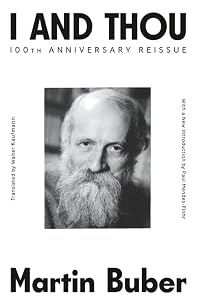
I and Thou
by Martin Buber
On This Page
Description
I AND THOU is one of the most important books of Western Theology. In it, Martin Buber, heavily influenced by the writings of Nietzsche, unites the proto-Existentialist currents of modern German thought with the Judeo-Christian tradition, powerfully updating faith for modern times. Since its first appearance in Germany in 1923, this slender volume has become one of the epoch-making works of our time. This work is the centerpiece of Buber's philosophy. It lays out a view of the world in which show more human beings can enter into relationships using their innermost and whole beings to form true partnerships. This is the original English translation, and it was prepared in the author's presence. show lessTags
Recommendations




















Member Reviews
Though Buber's writing can be quite thick (he himself confessed to not understanding all that he wrote, working from a sense of inspiration), his basic premise is incredibly simple: true life is lived in relationship. By relationship, Buber does not mean experiencing or using others, for then we are treating them as objects. But, when we confront and relate to others, we live in the presence of God, the "eternal You." Buber likewise disdains a view of God that confines Him to religious forms and God-space. God is earthy and active, and we know Him as we live out His revelation in the day to day.
Theology is really not my thing, is what I'm coming around to. I and Thou is one of the masterpieces of 20th century philosophy, written in the aftermath of the modernist slaughter of World War I, and gaining new relevance in decades since. In looping elliptical sentences masterfully translated by Walter Kaufman, Buber describes a transition between an I-It view of the world, one of finite systems and ends, towards an infinite I-Thou conversation with the divine spirit.
It's a gorgeous book, and mostly reinforces my take that you either get spirituality, or you don't. And a lot of people who claim to do, probably don't. It's not really something you can put into words. Buber got it.
I'll close with a story. My grandmother was working at show more the American Jewish Committee in New York when Martin Buber made his first visit to the United States in 1951. Every single one of the rabbinical students was desperate to be his secretary for the visit, which is why the director gave it to my grandmother (22 years old, definitely not going to be rabbi, carried herself as a bit of ditz). All of the boys were furious. And as for the great Jewish theologian, well as my grandmother put, "I never felt like more of an 'it' than when I worked for Martin Buber." show less
It's a gorgeous book, and mostly reinforces my take that you either get spirituality, or you don't. And a lot of people who claim to do, probably don't. It's not really something you can put into words. Buber got it.
I'll close with a story. My grandmother was working at show more the American Jewish Committee in New York when Martin Buber made his first visit to the United States in 1951. Every single one of the rabbinical students was desperate to be his secretary for the visit, which is why the director gave it to my grandmother (22 years old, definitely not going to be rabbi, carried herself as a bit of ditz). All of the boys were furious. And as for the great Jewish theologian, well as my grandmother put, "I never felt like more of an 'it' than when I worked for Martin Buber." show less
As the translator's preface says in this edition, this needs to be read like you would a poem because indeed it is a poem. Hence it must be read more than once. In fact, you could probably read it multiple times over the course of your life and never truly master it. And rightfully so. It is not a text to be mastered by one you enter into relation with. In true Buberian fashion and must have an I-Thou encounter with the text itself. Likewise, words cannot do justice to the contents, message, and spirit of this book. Language is not adequate to express its effects. All I have to say - which isn't saying much - and yet which is saying everything - this book has the potential to change your life.
Buber is one of the greatest Jewish thinkers show more of the 20th century and this work was almost an instant classic. I can see why every major theologian cites "I and Thou" in their work. Whether you agree with all his ideas or not - doesn't matter - read it, and have an encounter. show less
Buber is one of the greatest Jewish thinkers show more of the 20th century and this work was almost an instant classic. I can see why every major theologian cites "I and Thou" in their work. Whether you agree with all his ideas or not - doesn't matter - read it, and have an encounter. show less
“Every real relation with a being or life in the world is exclusive. Its Thou is freed, steps forth, is single, and confronts you. It fills the heavens. This does not mean that nothing else exists; but all else lives in its light. As long as the presence of the relation continues, this its cosmic range is inviolable. But as soon as a Thou becomes It, the cosmic range of the relation appears as an offence to the world, its exclusiveness as an exclusion of the universe.”
Martin Buber's I and Thou is not so much a formal approach to theology as it is a simple answer to "How should I be in the world?" Ethical living is found not in the realm of interiority and constancy, but within dynamic relation to the world. We must respect the show more humanity and complexity of every person sui generis, not only their function in our lives at any particular moment.
This is a very nice introductory ethos. But Buber pushes the extent of the I-Thou relationship further: to the cosmos and to God. And from that position, he also argues that God is in dynamic relation with creation. The model of an omni-max God, almost a force rather than a being, hinders divine relation and makes creation trite. If God is everything already, then the world was created as a bauble and God can only understand us as an It. For creation to be meaningful, God has to grow in relation to it: to be surprised and delighted by our decisions as "created co-creators" (not Buber's term, but I think he would've liked it). We must treat the world and one another in a way that affirms God's presence and presentness, for "the world is not divine sport, it is divine destiny. There is divine meaning in the life of the world, of man, of human persons, of you and of me."
The orthodox alternative, that God is omni-max and unchanging and 'faith' is about what set of beliefs you keep, ends up looking like idolatry in contrast to Buber's theology of compassionate relation. We therefore end up at an empowered existentialism: God didn't create the world teleologically, but instead the meaning of life is dynamic, as the creation uniting God with the world is worked out in mutual and loving relationship. show less
Martin Buber's I and Thou is not so much a formal approach to theology as it is a simple answer to "How should I be in the world?" Ethical living is found not in the realm of interiority and constancy, but within dynamic relation to the world. We must respect the show more humanity and complexity of every person sui generis, not only their function in our lives at any particular moment.
This is a very nice introductory ethos. But Buber pushes the extent of the I-Thou relationship further: to the cosmos and to God. And from that position, he also argues that God is in dynamic relation with creation. The model of an omni-max God, almost a force rather than a being, hinders divine relation and makes creation trite. If God is everything already, then the world was created as a bauble and God can only understand us as an It. For creation to be meaningful, God has to grow in relation to it: to be surprised and delighted by our decisions as "created co-creators" (not Buber's term, but I think he would've liked it). We must treat the world and one another in a way that affirms God's presence and presentness, for "the world is not divine sport, it is divine destiny. There is divine meaning in the life of the world, of man, of human persons, of you and of me."
The orthodox alternative, that God is omni-max and unchanging and 'faith' is about what set of beliefs you keep, ends up looking like idolatry in contrast to Buber's theology of compassionate relation. We therefore end up at an empowered existentialism: God didn't create the world teleologically, but instead the meaning of life is dynamic, as the creation uniting God with the world is worked out in mutual and loving relationship. show less
For me, this was quite a challenge. But definitely worth it.
I and Thou is about relationship. Buber describes entering into relation in its purest form as "saying Thou." He does not consider this relation to be a form of "experience." The I-Thou relation is true relation, but experience is another word for what he calls the I-It relation.
I-Thou, he explains early on, may refer to relation with God, a person, a tree, of an "inanimate object." What distinguishes I-Thou is that in the moment of the relation all external concerns and all experience outside the Thou fall away. When this happens--and Buber makes clear that a human being is not capable of living continuously in this state--no matter whether it is with a partner, a river, or show more God, one is in the presence on the Divine.
Buber mentions the Buddha and Buddhism at one point, and I think it is the contrasts of this Thou philosophy with that tradition that appeal to me the most. Both of these spiritualities appear to lack much practical guidance for day-to-day life. But what distinguishes them to me is the one encourages retreat to the monastery and the other requires intense involvement in the world. One demands total discipline; the other, just pausing to be in the present. One, to me, seems virtually unreachable; the other, I feel is within my capacity at any moment.
It sounds like I'm saying this is the easy way to Enlightenment, but I'm not. Putting Enlightenment on a pedestal just feels wrong to me. At that point it becomes just another kind of "salvation." Finding the Divine in the everyday is good enough for me.
I admire Buber now more than any other spiritual writer I've read (though I admit that is a short list). I will definitely seek out more of his work. show less
I and Thou is about relationship. Buber describes entering into relation in its purest form as "saying Thou." He does not consider this relation to be a form of "experience." The I-Thou relation is true relation, but experience is another word for what he calls the I-It relation.
I-Thou, he explains early on, may refer to relation with God, a person, a tree, of an "inanimate object." What distinguishes I-Thou is that in the moment of the relation all external concerns and all experience outside the Thou fall away. When this happens--and Buber makes clear that a human being is not capable of living continuously in this state--no matter whether it is with a partner, a river, or show more God, one is in the presence on the Divine.
Buber mentions the Buddha and Buddhism at one point, and I think it is the contrasts of this Thou philosophy with that tradition that appeal to me the most. Both of these spiritualities appear to lack much practical guidance for day-to-day life. But what distinguishes them to me is the one encourages retreat to the monastery and the other requires intense involvement in the world. One demands total discipline; the other, just pausing to be in the present. One, to me, seems virtually unreachable; the other, I feel is within my capacity at any moment.
It sounds like I'm saying this is the easy way to Enlightenment, but I'm not. Putting Enlightenment on a pedestal just feels wrong to me. At that point it becomes just another kind of "salvation." Finding the Divine in the everyday is good enough for me.
I admire Buber now more than any other spiritual writer I've read (though I admit that is a short list). I will definitely seek out more of his work. show less
Martin Buber is a wily cat but he's got some great things to say about relationships. Particularly, his notion of the twofold world and the dynamic relationship relationship in different realms of existence. Buber posits the ideal of relationship in genuine meeting of I-Thou but acknowledges that the world of I-It (or object-ish) must exist as well. That's pretty grounded for someone who waxes on about his encounter with a horse! I prefer the Smith translation for the beauty of language, compared to Kaufmann's arguably "clearer" reading of the text.
This was the one sticking point for me:
"Feelings accompany the metaphysical and metapsychical fact of love, but they do not constitute it; and the feelings that accompany it can be very different." (66)
I've always thought that Kant's discussion of the metaphysical is besides the point. Sure, there are forces in the universe that lie outside of human understanding. That does not mean that our "feeling" of these forces, of which love may be one, is not primary.
I am writing this as a layman of philosophy. I've only read bits of "A Critique of Pure Reason" and am piecing together the knowledge I have of the material vs. the metaphysical.
For Buber, verbs are key. One does not "experience" or "use" the other, the You. One "encounters" or show more "stands against" this being.
This is a lovely and dense piece of spiritual and philosophical wrangling. Whether you are an atheist or evangelical, you probably have some experience of the divine. What that means is truly being a part of the world. show less
"Feelings accompany the metaphysical and metapsychical fact of love, but they do not constitute it; and the feelings that accompany it can be very different." (66)
I've always thought that Kant's discussion of the metaphysical is besides the point. Sure, there are forces in the universe that lie outside of human understanding. That does not mean that our "feeling" of these forces, of which love may be one, is not primary.
I am writing this as a layman of philosophy. I've only read bits of "A Critique of Pure Reason" and am piecing together the knowledge I have of the material vs. the metaphysical.
For Buber, verbs are key. One does not "experience" or "use" the other, the You. One "encounters" or show more "stands against" this being.
This is a lovely and dense piece of spiritual and philosophical wrangling. Whether you are an atheist or evangelical, you probably have some experience of the divine. What that means is truly being a part of the world. show less
Members
- Recently Added By
Published Reviews
ThingScore 100
The real reason for the popularity of the Occult Ancient East was pointed out long ago by Kipling: “Ship me somewhere East of Suez . . . where there ain’t no ten commandments . . .” If your religion is just exotic enough, you don’t need to bother about responsibility. You can get away with anything. There is nothing of this in Buber. For him the faith is the faith of his fathers, show more and the highest expression of that faith is its prayer, and prayer is the highest form of responsibility, the ultimately committed dialogue. This is an aesthetic statement, not a religious one, and in the final analysis all of Buber’s major works are works of art. I and Thou is one of the greatest prose poems, an Isaiah, and a Song of Myself. show less
added by SnootyBaronet
Jeg og Du er et kompakt verk, det er på 110 luftige sider. Man skal ikke la seg lure av den manglende ordrikdom. Tiden den tar å lese er ikke lang, men fordøyelsen av den er desto lenger. På mange måter verket lukket, nesten hermetisk, den presenterer oss ikke for et system i tradisjonell forstand, en oppskrift for erkjennelse, men verket er den hele tanke, og den hele tanke er alltid show more vanskelig å gripe, for man må inn i en annen verden, man må møte det på dens egne premisser, følge med. Ikke som med den uferdige tanke, den nesten ufrivillige avstikker fra common sense, fragmentarisk, umiddelbart sterk og overbevisende, som sukkertøy for den blafrende tanke, forståelig, men allikevel nesten allerede glemt. Jeg og Du maler i et annet leie, den lar seg ikke reduseres, fragmenteres og obduseres uten videre, jeg vil la det være. Jeg vil heller fantasere over hans bok, trekke dens innhold urimelig langt, bruke den som en rampe for utflukter inn i kjepphestenes og innfallenes rike.
I Jeg og Du lever stilene side om side, de kryper over i hverandre, viskes ut, fremheves igjen, forsvinner for å igjen dukke opp. Snart systematisk rissende, for så og dreies over i det prøvende. Det åpenbartes manende språk, hamrende, men her likevel mykt, glir over i det poetiske prøvende, videre utover til gysende bilder som nesten er bokstavelig uforståelige, som formidler den språklig sett umulige oppgave; å gripe livet. åpenbaringen blander seg med filosofien på en måte som for mitt utålmodige og ubevandrede blikk er uvant. For vi lever i en tid hvor dette ikke skal skje, skjer det likevel er det med vilje, som en lek, som et program, ikke av nød som formidlingen stiller en overfor. Genreblandingen som programerklæring blir aldri alvor, blir aldri tangering av det mulige, det bare forblir innenfor den trygge tiden. Den blir aldri nødvendig. For Buber har ikke teologien skilt seg fra filosofien, de lever der, ikke side om side men sammen, for ham har ikke metafysikken blitt et skjellsord, et tilstand reservert for prester og demagoger, han lar tanken blande seg med det uetterettelige.
"En sammenligning av den religiøse og den filosofiske antinomi kan tydeliggjøre dette. Kant kan relativisere den filosofiske motsetning mellom nødvendighet og frihet, idet han henviser den ene til fenomenverdenen og den annen til værensverdenen, slik at de to egentlig ikke strider mot hinannen lenger, men forlikes på samme måte som de verdener de er gyldige for. Hvis jeg imidlertid mener nødvendighet og frihet, ikke i tenkte verdener, men i den virkelighet hvor jeg står for Gud, hvis jeg vet: "Jeg er prisgitt," og samtidig vet: "Det kommer an på meg selv", da kan jeg ikke forsøke å slippe unna det paradoks som jeg har å leve, ved å henvise de uforenlige setninger til to adskilte gyldighetsområder. Da kan jeg heller ikke la noe teologisk kunstgrep hjelpe meg til en begrepsmessig forsoning. Jeg må ta det på meg å leve begge i ett, og når de leves, er de ett."
Buber forsøker ikke å unnslippe ved å benytte seg av de rubriserende vendinger, han dukker ikke ned i den vestlige drøm, katalogiseringens drøm, drømmen om å oppnå immunitet mot språkets og verdens tvetydighet. Derved skyter han seg selv ut i mørket, ut av den filosofiske katalog, ut av rekkene med klare kategorier, former og svar. Han blir, som det så idiotisk treffsikkert står på omslaget: "Et meditasjonsobjekt for tenkende moderne mennesker." show less
I Jeg og Du lever stilene side om side, de kryper over i hverandre, viskes ut, fremheves igjen, forsvinner for å igjen dukke opp. Snart systematisk rissende, for så og dreies over i det prøvende. Det åpenbartes manende språk, hamrende, men her likevel mykt, glir over i det poetiske prøvende, videre utover til gysende bilder som nesten er bokstavelig uforståelige, som formidler den språklig sett umulige oppgave; å gripe livet. åpenbaringen blander seg med filosofien på en måte som for mitt utålmodige og ubevandrede blikk er uvant. For vi lever i en tid hvor dette ikke skal skje, skjer det likevel er det med vilje, som en lek, som et program, ikke av nød som formidlingen stiller en overfor. Genreblandingen som programerklæring blir aldri alvor, blir aldri tangering av det mulige, det bare forblir innenfor den trygge tiden. Den blir aldri nødvendig. For Buber har ikke teologien skilt seg fra filosofien, de lever der, ikke side om side men sammen, for ham har ikke metafysikken blitt et skjellsord, et tilstand reservert for prester og demagoger, han lar tanken blande seg med det uetterettelige.
"En sammenligning av den religiøse og den filosofiske antinomi kan tydeliggjøre dette. Kant kan relativisere den filosofiske motsetning mellom nødvendighet og frihet, idet han henviser den ene til fenomenverdenen og den annen til værensverdenen, slik at de to egentlig ikke strider mot hinannen lenger, men forlikes på samme måte som de verdener de er gyldige for. Hvis jeg imidlertid mener nødvendighet og frihet, ikke i tenkte verdener, men i den virkelighet hvor jeg står for Gud, hvis jeg vet: "Jeg er prisgitt," og samtidig vet: "Det kommer an på meg selv", da kan jeg ikke forsøke å slippe unna det paradoks som jeg har å leve, ved å henvise de uforenlige setninger til to adskilte gyldighetsområder. Da kan jeg heller ikke la noe teologisk kunstgrep hjelpe meg til en begrepsmessig forsoning. Jeg må ta det på meg å leve begge i ett, og når de leves, er de ett."
Buber forsøker ikke å unnslippe ved å benytte seg av de rubriserende vendinger, han dukker ikke ned i den vestlige drøm, katalogiseringens drøm, drømmen om å oppnå immunitet mot språkets og verdens tvetydighet. Derved skyter han seg selv ut i mørket, ut av den filosofiske katalog, ut av rekkene med klare kategorier, former og svar. Han blir, som det så idiotisk treffsikkert står på omslaget: "Et meditasjonsobjekt for tenkende moderne mennesker." show less
added by kirstenlund
Lists

Filosofía - Clásicos
217 works; 1 member

Literary Works Read in College
316 works; 15 members

Tonikat reading completed on Librarything journals
329 works; 2 members

Books Referenced by Izetbegovic's Islam Between East and West
233 works; 2 members

Better for Who?
11 works; 1 member
Author Information

248+ Works 12,954 Members
Martin Buber was born in Vienna, the son of Solomon Buber, a scholar of Midrashic and medieval literature. Martin Buber studied at the universities of Vienna, Leipzig, Zurich, and Berlin, under Wilhelm Dilthey and Georg Simmel. As a young student, he joined the Zionist movement, advocating the renewal of Jewish culture as opposed to Theodor show more Herzl's political Zionism. At age 26 he became interested in Hasidic thought and translated the tales of Nahman of Bratslav. Hasidism had a profound impact on Buber's thought. He credited it as being the inspiration for his theories of spirituality, community, and dialogue. Buber is responsible for bringing Hasidism to the attention of young German intellectuals who previously had scorned it as the product of ignorant eastern European Jewish peasants. Buber also wrote about utopian socialism, education, Zionism, and respect for the Palestinian Arabs, and, with Franz Rosenzweig, he translated the Bible. He was appointed to a professorship at the University of Frankfurt in 1925, but, when the Nazis came to power, he received an appointment at the Hebrew University of Jerusalem. Buber died in 1965. (Bowker Author Biography) show less
Some Editions
Awards and Honors
Series
Belongs to Publisher Series
Work Relationships
Has as a reference guide/companion
Common Knowledge
- Canonical title
- I and Thou
- Original title
- Ich und Du
- Original publication date
- 1923; 1937 (English Translation) (English Translation)
- Epigraph
- "So, waiting, I have won from you the end: God's presence in each element." - Goethe
- First words
- To man the world is twofold, in accordance with his twofold attitude.
- Last words
- (Click to show. Warning: May contain spoilers.)But the event that from the side of the world is called turning is called from God's side redemption.
- Original language
- German
- Canonical DDC/MDS
- 181.3
- Canonical LCC
- BM723 .B8313 2000
Classifications
- Genres
- Philosophy, Religion & Spirituality, Nonfiction, General Nonfiction
- DDC/MDS
- 181.3 — Philosophy & psychology Ancient, medieval & eastern philosophy Eastern philosophy Palestine; Israel
- LCC
- BM723 .B8313 — Philosophy, Psychology and Religion Judaism Judaism Practical Judaism Jewish way of life. Spiritual life. Mysticism. Personal
- BISAC
Statistics
- Members
- 4,608
- Popularity
- 3,138
- Reviews
- 38
- Rating
- (3.98)
- Languages
- 17 — Czech, Danish, Dutch, English, Estonian, Finnish, French, German, Hebrew, Hungarian, Italian, Norwegian (Bokmål), Polish, Russian, Spanish, Swedish, Portuguese (Portugal)
- Media
- Paper, Audiobook, Ebook
- ISBNs
- 68
- UPCs
- 2
- ASINs
- 57