
Walter Kaufmann (1921–1980)
Author of Existentialism from Dostoevsky to Sartre
About the Author
Image credit: Walter Kaufmann
Series
Works by Walter Kaufmann
Religions in four dimensions: Existential and aesthetic, historical and comparative (1976) 88 copies, 1 review
Twenty-Five German Poets: A Bilingual Collection (Norton Library (Paperback)) (1975) — Editor — 33 copies, 1 review
What is man?: Photographs and text 2 copies
Homer & the Birth of Tragedy 1 copy
Oedipus Rex 1 copy
Religion und Philosophie 1 copy
Associated Works
Thus Spoke Zarathustra (1883) — Preface, some editions; Translator, some editions — 15,557 copies, 121 reviews
Beyond Good and Evil (1886) — Translator, some editions; Translator, some editions — 11,706 copies, 84 reviews
Goethe's Faust: Part One and Sections from Part Two (1808) — Editor; Translator, some editions; Introduction, some editions — 2,675 copies, 18 reviews
The Will to Power (1901) — Translator, some editions; Editor, some editions — 2,230 copies, 12 reviews
The Birth of Tragedy and The Case of Wagner (1888) — Translator, some editions — 1,123 copies, 1 review
The Hero: A Study in Tradition, Myth and Drama (1975) — Introduction, some editions — 123 copies, 2 reviews
Europe and the Jews: The Pressure of Christendom on the People of Israel for 1,900 Years (1950) — Preface, some editions — 99 copies
Studies in Nietzsche and the Classical Tradition (University of North Carolina Studies in Germanic Languages and Literature (85)) (1977) — Contributor — 10 copies
The Twilight of the Idols. The Anti-Christ. Notes to Zarathustra, and Eternal Recurrence — Translator, some editions — 4 copies
Tagged
Common Knowledge
- Canonical name
- Kaufmann, Walter
- Legal name
- Kaufmann, Walter Arnold
- Birthdate
- 1921-07-01
- Date of death
- 1980-09-04
- Gender
- male
- Education
- Williams College (BA|1941)
Harvard University (MA|1942|PhD|1947) - Occupations
- philosopher
professor
translator
poet
photographer - Organizations
- Princeton University
United States Army Air Forces (WWII) - Relationships
- Arnold Selighson (grandfather)
Julie Kaufmann (grandmother) - Cause of death
- aortic aneurysm
- Nationality
- Germany (birth)
USA (naturalized 1944) - Birthplace
- Freiburg im Breisgau, Germany
- Places of residence
- Princeton, New Jersey, USA
- Place of death
- Princeton, New Jersey, USA
- Associated Place (for map)
- Princeton, New Jersey, USA
Members
Reviews
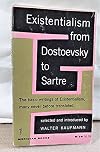
Later: OK, very glad I pushed passed the block of Jaspers. An overall great collection, and it's pretty funny in itself to find Heidegger and Sartre, who follow J, a wondrous relief of comparatively easy understanding.
Everything was going well until I snagged on the LONG, LONG excerpt from Karl Jaspers's Existenzphilosophie. I finally broke out in laughter yesterday at what seems like a manic parody of mid-20th-century European philosophers. The only way I'll get through this section is if I show more view it as unintentional comedy. show less
Everything was going well until I snagged on the LONG, LONG excerpt from Karl Jaspers's Existenzphilosophie. I finally broke out in laughter yesterday at what seems like a manic parody of mid-20th-century European philosophers. The only way I'll get through this section is if I show more view it as unintentional comedy. show less

This wasn't exactly what I'd had in mind when I asked my wife for a bilingual anthology of German poetry for Christmas. I had imagined something more modern and dashing, dotted with obscure works of genius. Kaufmann turns out to be an idiosyncratic editor-translator, sometimes swashbuckling and never neutral in his short introductions to each poet. His selection runs from 17th-century Silesius through to about the mid-20th, stopping short of Celan. The translation, which might be expected to show more be workaday in a parallel text edition, is actually quite characterful and often inspired, not shying away from englishing the rhyme and metre while remaining quite faithful to the feel of the original.
The diversity of Goethe's work was the first revelation for me, and I loved his rowdy Venetian Epigrams. There is a lot by Schiller and only three by Hölderlin, which I found odd. I liked the Heine very much. The selection of Rilke is broad and deep. I was very impressed by the expressionists Trakl and Benn, both of whom I will read more of. I was surprised at the omission of Georg Heym, who I was reading separately at the same time.
The editor is an immense fan of Nietzsche, referencing him in his introductions whenever appropriate and often when not, and including a baker's dozen of FN's frankly second-rate poems, as well as verses dedicated to him by George and Morgenstern. Other than the Nietzsche fetish, this is a really good introduction to German poetry and overview of its development. show less
The diversity of Goethe's work was the first revelation for me, and I loved his rowdy Venetian Epigrams. There is a lot by Schiller and only three by Hölderlin, which I found odd. I liked the Heine very much. The selection of Rilke is broad and deep. I was very impressed by the expressionists Trakl and Benn, both of whom I will read more of. I was surprised at the omission of Georg Heym, who I was reading separately at the same time.
The editor is an immense fan of Nietzsche, referencing him in his introductions whenever appropriate and often when not, and including a baker's dozen of FN's frankly second-rate poems, as well as verses dedicated to him by George and Morgenstern. Other than the Nietzsche fetish, this is a really good introduction to German poetry and overview of its development. show less

I read this book in my late teens. It concisely expressed much of my own thinking at the time. It laid down a gauntlet, so to speak, offered me a challenge. What is justice? Does it have any meaning?
I think it does, and I think Kaufmann is wrong here, wrong especially in not looking at justice as one virtue among many that gained its meaning as a means to reduce conflict in a world where conflict was king, but co-operation always possible.
These are the ideas I grappled with before I settled show more on my political beliefs. (I found the key to resolving Kaufmann’s anti-justice position while reading the works of Ludwig von Mises.) But this book solidified my commitment to taking seriously value diversity and the nature of conflict of interest - indeed, looking at “interest” in a skeptical way.
I gave away my copy, alas, so I cannot now readily quote from it. It’s worth noting that philosopher Walter Kaufmann has written a philosophical work in the form of a self-help book. It’s an odd achievement, and quite admirable.
His defense of alienation struck me, in the late days of my youth, as spot on, pitch perfect. And every leftist and alleged admirer of po-mo post-Marxian claptrap should read it. show less
I think it does, and I think Kaufmann is wrong here, wrong especially in not looking at justice as one virtue among many that gained its meaning as a means to reduce conflict in a world where conflict was king, but co-operation always possible.
These are the ideas I grappled with before I settled show more on my political beliefs. (I found the key to resolving Kaufmann’s anti-justice position while reading the works of Ludwig von Mises.) But this book solidified my commitment to taking seriously value diversity and the nature of conflict of interest - indeed, looking at “interest” in a skeptical way.
I gave away my copy, alas, so I cannot now readily quote from it. It’s worth noting that philosopher Walter Kaufmann has written a philosophical work in the form of a self-help book. It’s an odd achievement, and quite admirable.
His defense of alienation struck me, in the late days of my youth, as spot on, pitch perfect. And every leftist and alleged admirer of po-mo post-Marxian claptrap should read it. show less
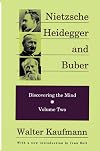
I especially enjoyed the chapter on Martin Heidegger, which gives a devastatingly simple yet undeniable critique of Heidegger's entire philosophical project. I had been previously reading Heidegger sympathetically, but this chapter brought the dishonesty of Heidegger's main ideas to my attention. Kaufmann is emphatic that we not therefore disregard Heidegger as unimportant nor is he suggesting that we ignore Heidegger. He is only suggesting that Heidegger was guilty of covering up the show more problems he set himself to dissolving by needlessly impeding his readers with inconsistent language, failing to honestly identify the intellectual lineage of his contentions, employing a language of "ontology" to disguise his fundamentally anthropological enterprise, and subscribing to a Manichæan opposition of inauthenticity/authenticity. There is more to the critique than just this, but these were the points that most pressingly stood out to me. show less
Lists
Awards

You May Also Like


Associated Authors
Statistics
- Works
- 50
- Also by
- 20
- Members
- 7,265
- Popularity
- #3,367
- Rating
- 3.9
- Reviews
- 40
- ISBNs
- 155
- Languages
- 3
- Favorited
- 10

