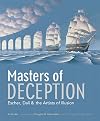
Masters of Deception: Escher, Dalí & the Artists of Optical Illusion
by Al Seckel
On This Page
Description
Astonishing creations by masters of the art, such as Escher, Dali, and Archimbolo; amazing visual trickery; and an illuminating foreword by the Pulitzer Prize--winning author Douglas R. Hofstadter make this 320-page, breathtaking collection the definitive book of optical illusions. Rings of seahorses that seem to rotate on the page. Butterflies that transform right before your eyes into two warriors with their horses. A mosaic portrait of oceanographer Jacques Cousteau made from seashells. show more These dazzling and often playful artistic creations manipulate perspective so cleverly that they simply outwit our brains: we can't just take a quick glance and turn away. They compel us to look once, twice, and over and over again, as we try to figure out exactly how the delightful trickery manages to fool our perceptions so completely. Of course, first and foremost, every piece is beautiful on the surface, but each one offers us so much more. Some, including Sandro del Prete's charming "Window Gazing," construct illusionary worlds where normal conceptions of up, down, forward, and back simply have no meaning anymore. Others, such as Jos De Mey's sly "Ceci n'est pas un Magritte," create visual puns on earlier work. From Escher's famous and elaborate "Waterfall" to Shigeo Fukuda's "Mary Poppins," where a heap of bottles, glasses, shakers, and openers somehow turn into the image of a Belle Epoque woman when the spotlight hits them, these works of genius will provide endless enjoyment and food for thought. Rings of seahorses seem to rotate and butterflies seems to transform into warriors right on the page. Astonishing creations of visual trickery by masters of the art, such as Escher, Dali, and Archimbolo make this breathtaking collection the definitive book of optical illusions. show lessTags
Recommendations























Member Reviews
When I was a kid, we had a set of books from Childcraft, each volume of which focused on a different topic in the sciences or the humanities in a kid-friendly fashion. I loved those books immensely, but the one on art and art history I found less interesting than most of the others, with one notable exception: the chapter featuring M. C. Escher and Salvador Dali. I remember starting at those pictures for what seemed like hours, then coming back repeatedly and staring at them again. And the longer I looked, the more I seemed to see, and the more fascinated I was. Well, my tastes in art might possibly have matured slightly since I was eight, but they really don't seem to have changed that much. Unsurprisingly, then, I really enjoyed this show more book showcasing the work of Escher, Dali, and eighteen other artists. They vary quite widely in technique, style, and medium, but all of them enjoy playing with human perceptions in various clever ways, so it's full of visual paradoxes and ambiguities. There are illusions, impossible perspectives, images that look different from different angles or at different scales, shapes that morph and change their meaning , and all manner of other trickery, ranging from the purely technical to the indisputably artistic. Some of the illusions employed here were familiar enough to me that I no longer find them terribly interesting, but other images made me laugh or gasp as their hidden secrets suddenly popped out at me, which is rather wonderful. I think I've also discovered an instant new favorite artist in Rob Gonsalves, whose work can be seen gracing the front cover.
As well as lots and lots of pictures, the book also features a few pages of text on each artist, including a brief biography and description of their work, usually along with a few quotes from them. These are generally well done, I think, telling us just enough to enhance the experience of viewing the pictures, but not enough that it becomes tedious. Unfortunately, there seems to have been some kind of formatting or editing issue, at least with the copy I have, and a few pages scattered through the book are missing a line of text at the bottom, which is an annoying blemish on an otherwise extremely well-produced book. show less
As well as lots and lots of pictures, the book also features a few pages of text on each artist, including a brief biography and description of their work, usually along with a few quotes from them. These are generally well done, I think, telling us just enough to enhance the experience of viewing the pictures, but not enough that it becomes tedious. Unfortunately, there seems to have been some kind of formatting or editing issue, at least with the copy I have, and a few pages scattered through the book are missing a line of text at the bottom, which is an annoying blemish on an otherwise extremely well-produced book. show less
We lost our original copy of this to a fire in 2013 and I have had it on my short list for the past eight years of those (of the 5,800 we lost) that I wanted to replace. When I was looking for a different book some months back, I saw this and checked it off that list. Wonderful collection of artists and selected works of some of the best illusory imaginings out there. I savored this reading, stretching it out over two months because... well it's pretty cool.
I borrowed this book from my library on a Saturday, read the foreword, introduction and first chapter, stopped and returned it monday morning. Because on Sunday I tracked this book down and bought it. Every chapter focuses on a different artist who uses some sort of illusion in their work, not just painters but sculpters as well. Every artist is distinct, but all are equally brilliant. Even the foreword is interesting. But don't take my word for it, find it and read it yourself (or just look at the pictures). Go!
Beautiful coffee-table book full of the promised optical illusions of many stripes (and forks and staircases). Generally visual artists talking about their art are not very interesting, and this book’s descriptions of them do not veer from that, but there is a large selection of works from almost every one of the (all male) artists represented so it’s a good volume anyway.
This is an enjoyable book with all of the usual suspects in visual illusions and mathematical optics such as Escher and Dali. It also has a very good collection of newer artists that you may not have ever heard of. The reproductions are high quality and the sizes of most of the images are good.
Masters of Deception is a math book with a heavy emphasis on art. The chapters are full of paintings that are almost illusion-like. This book portrays the powers number and patterns have and can provide an interest of stem into the art-inclined students. While the text in the book is sparse, the beautiful, almost puzzling art makes this book a great addition to any classroom, and could be used as the basis for many projects!
A beautiful collection of art based on optical illusions. Includes more contemporary than classical work (though Escher is covered). Not all the artists have been able to go beyond Escher or find an independent path, but most of the artwork in this book is quite stunning.
Members
- Recently Added By
Author Information

22+ Works 1,821 Members
Al Seckel is currently working on a comprehensive academic treatise on illusions for Massachusetts Institute of Technology and working in the Division of Computational and Neuronal Systems at Cal Tech in Pasadena. He lives in Pasadena, California.
All Editions
Some Editions
Common Knowledge
- Canonical title
- Masters of Deception: Escher, Dalí & the Artists of Optical Illusion
- Original publication date
- 2004
- People/Characters
- M. C. Escher; Salvador Dalí
- First words
- Sixteenth-century Italian artist Guiseppe Arcimboldo is without doubt one of the most bizarre ad distinctive painters i the history of western art.
- Last words
- (Click to show. Warning: May contain spoilers.)Before his untimely death, he had achieved some considerable fame for his illustrations of Jonathan Swift's Gulliver's Travels and Hans Christian Andersen's fairy tales.
Classifications
Statistics
- Members
- 633
- Popularity
- 46,188
- Reviews
- 12
- Rating
- (4.26)
- Languages
- English, German
- Media
- Paper
- ISBNs
- 5
- UPCs
- 1
- ASINs
- 1