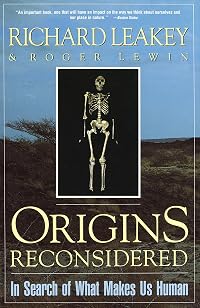
Origins Reconsidered
by Richard E. Leakey, Roger Lewin
On This Page
Description
In Origins Reconsidered, Richard Leakey, one of the most respected and influential scientists of our time, takes us on a brilliant and provocative journey through human history. Beginning with his landmark discoveries at Lake Turkana, and including his fascinating reassessment of how we became "human"--And what, after all, being human really means - Leakey concludes with a glimpse of what our evolutionary future may hold. In 1984, Richard Leakey and his "Hominid Gang" of fossil hunters show more discovered fragments of a boy's skull that were more than 1.5 million years old. They soon unearthed virtually the entire skeleton of what was dubbed the "Turkana Boy" and recognized as one of the most significant paleoanthropological discoveries of all time. But while his Turkana Boy caused a sensation in the media and throughout the world of science, Leakey himself was restless. Yes, the existing fossil record of our prehistory was impressive. But there were more elusive matters to consider. For Richard Leakey the most compelling question is no longer "How did we physically evolve?" It is, instead, "How did we become human?" For this world-renowned paleoanthropologist it is a humbling reminder that no matter how complete the skeleton, how perfect the fossil, there is a gap in our knowledge. Our ancestors evolved from two-legged scavengers into creatures that create. They learned to make stone tools, to communicate, to build shelters, and to hunt for food. This realization sparked Leakey to return to his earlier work - especially his 1977 book, Origins - to poke holes in his previous beliefs and to reflect anew on what makes us who we are. As he gently admits, considerations like these are usually left to philosophers, not scientists. But again and again, he is faced with his own guiding principle: "The past is the key to our future." In this seminal work, Leakey incorporates ideas from philosophy, anthropology, molecular biology, and even linguistics, to investigate not only how we evolved anatomically, but how we acquired the qualities that make us human - consciousness, creativity, and culture. show lessTags
Recommendations



















Member Reviews
Richard Leakey is the famous anthropologist who, back in 1984, discovered the no less famous 'Turkana Boy'; a nearly complete skeleton of a young Homo erectus having lived about 1.5 millions years ago. Using this fossil as a starting point, Richard Leakey delivers here a fascinating book of popular science, opening up a window upon palaeontology -its successes, its meanderings, its challenges. Himself coming from a prestigious family of palaeontologists (he is the son of Louis and Mary Leakey), in love with his job (of which he gives us to see, not without a certain sense of humour, both the highs and the lows) by focusing first on 'Turkana Boy' he goes back in fact to the roots of what make us human.
Homo erectus was indeed a turning show more point in our evolution, 'the messenger carrying our humanity'. As he puts it: ''to understand the origins of mankind, one has to understand Homo erectus, its anatomy, biology, behaviours.' That's precisely, then, what he purports to do in here, using the remains of 'Turkana Boy' to gather hypotheses from its way of life to its cognitive and intellectual abilities. You bet, the open and contradictory interpretations, the controversies coming with such endeavour (genetics vs anthropology...) are obviously tumultuous! Having said that, once consensus have been reached the questions being raised turn out to be crucial so as to better understand who we are. Homo erectus might have been an hominid for sure; however, he wasn't human. Chapters about consciousness, culture and language are here deeply engrossing. They, above all, open new trails that may never cease to astonish us when it comes to find out what, exactly, distinguish us from these other hominids now extinct, or, nowadays, our cousins the other great apes.
Fascinating and informative, Richard Leakey tames here the quarrels between experts knowing full well that, nevertheless, we ought to stay humble enough to admit to our own past mistakes and the extend of our current ignorance. A very good read! show less
Homo erectus was indeed a turning show more point in our evolution, 'the messenger carrying our humanity'. As he puts it: ''to understand the origins of mankind, one has to understand Homo erectus, its anatomy, biology, behaviours.' That's precisely, then, what he purports to do in here, using the remains of 'Turkana Boy' to gather hypotheses from its way of life to its cognitive and intellectual abilities. You bet, the open and contradictory interpretations, the controversies coming with such endeavour (genetics vs anthropology...) are obviously tumultuous! Having said that, once consensus have been reached the questions being raised turn out to be crucial so as to better understand who we are. Homo erectus might have been an hominid for sure; however, he wasn't human. Chapters about consciousness, culture and language are here deeply engrossing. They, above all, open new trails that may never cease to astonish us when it comes to find out what, exactly, distinguish us from these other hominids now extinct, or, nowadays, our cousins the other great apes.
Fascinating and informative, Richard Leakey tames here the quarrels between experts knowing full well that, nevertheless, we ought to stay humble enough to admit to our own past mistakes and the extend of our current ignorance. A very good read! show less
During the early days of my re-discovery of books, I became quite interested in human origins. I fondly remember this one by Richard Leakey. Very well-written.
I picked this book up at used bookstore on trade in. I once saw Leakey's father at a lecture with my father.
Overzicht van de recentste bevindingen van de paleontologie, waarbij hij ruim put uit eigen ervaringen. Schets van de vele vragen die nog overblijven. Het slot trekt verregaande conclusies, ondermeer in verband met de ecologische ramp die ons staat te wachten.
Jul 23, 2010Dutch
Ratings
Members
- Recently Added By
Lists

Falling for Science
56 works; 3 members
Author Information

25+ Works 3,717 Members

23+ Works 3,679 Members
Roger Lewin is an associate of the Peabody Museum at Harvard University.
Some Editions
Awards and Honors
Notable Lists
Work Relationships
Is abridged in
Common Knowledge
- Canonical title
- Origins Reconsidered
- Original title
- Origins Reconsidered: In Search of What Makes Us Human
- Alternate titles*
- Onze oorsprong : een speurtocht naar het ontstaan van de mensheid
- Original publication date
- 1992
- Dedication
- For Meave and Gail
- First words
- Chapter 1
To West Turkana
They had set out early, this band of six purposeful individuals, striding across rolling, grassy terrain punctuated here and there by flat-topped acacia trees. - Last words
- (Click to show. Warning: May contain spoilers.)The journey of discovery has taken me to new territories, territories from where the place of Homo sapiens in the universe of things is more clearly perceived. I have learned that our future is here, now. We are already living it.
- Original language*
- Engels
*Some information comes from Common Knowledge in other languages. Click "Edit" for more information.
Classifications
- Genres
- Anthropology, Science & Nature, Nonfiction, General Nonfiction
- DDC/MDS
- 573.2 — Natural sciences & mathematics Biology Specific physiological systems in animals, regional histology and physiology in animals Origin of man
- LCC
- GN31.2 .L4 — Geography, Anthropology and Recreation Anthropology Anthropology
- BISAC
Statistics
- Members
- 634
- Popularity
- 45,784
- Reviews
- 4
- Rating
- (3.65)
- Languages
- 6 — Dutch, English, Finnish, German, Spanish, Swedish
- Media
- Paper
- ISBNs
- 14
- ASINs
- 4