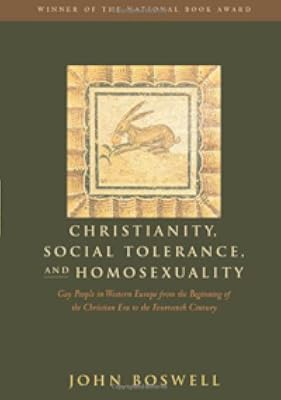
Christianity, Social Tolerance, and Homosexuality: Gay People in Western Europe from the Beginning of the Christian Era to the Fourteenth Century
by John Boswell
On This Page
Description
John Boswell's National Book Award-winning study of the history of attitudes toward homosexuality in the early Christian West was a groundbreaking work that challenged preconceptions about the Church's past relationship to its gay members-among them priests, bishops, and even saints-when it was first published thirty-five years ago. The historical breadth of Boswell's research (from the Greeks to Aquinas) and the variety of sources consulted make this one of the most extensive treatments of show more any single aspect of Western social history.Now in this thirty-fifth anniversary edition with a new foreword by leading queer and religious studies scholar Mark D. Jordan, Christianity, Social Tolerance, and Homosexuality is still fiercely relevant. This landmark book helped form the disciplines of gay and gender studies, and it continues to illuminate the origins and operations of intolerance as a social force. show lessTags
Recommendations













Member Reviews
In his conclusion to Christianity, Social Tolerance and Homosexuality, John Boswell states that as such little work had been done on this topic before—which, at the time of this book's publication was certainly true—"the writer on this subject cannot hope to avoid leading his readers down many wrong paths or, occasionally, coming to a dead end", and begs the reader's forbearance in the hopes that future scholars will build on his work. From the perspective of several decades later, both Boswell's hopes and fears have been realised, to varying extents.
Many younger scholars were inspired by his writings, and much work has been produced on the history of gender and sexuality since Boswell's death. Yet a lot of that scholarship has show more pushed back against CSTH, critiquing his analytical categories and terminology and his use of source material. They're criticisms which I share—the idea of a longue durée gay and/or homosexual cultural identity which he presents here is problematic, US-centric and presentist, women are almost entirely absent (and no, his statement that there simply aren't the sources doesn't really hold water any more), and at times Boswell's use of sources is highly frustrating. Often he seems to read them in the way which bests supports his thesis, and as Boswell was an out gay man who was also a devout convert to Catholicism and wished to both argue for the validity of his sexual orientation and of his place within the church, this requires a lot of inconsistency and contortions on his part. Still, it would be churlish to deny the enormity of Boswell's achievement in helping to pioneer a new area of study, the importance of some of the things he points to here, or the bravery it took to be so open about his sexuality. For that CSTH is still worth reading. show less
Many younger scholars were inspired by his writings, and much work has been produced on the history of gender and sexuality since Boswell's death. Yet a lot of that scholarship has show more pushed back against CSTH, critiquing his analytical categories and terminology and his use of source material. They're criticisms which I share—the idea of a longue durée gay and/or homosexual cultural identity which he presents here is problematic, US-centric and presentist, women are almost entirely absent (and no, his statement that there simply aren't the sources doesn't really hold water any more), and at times Boswell's use of sources is highly frustrating. Often he seems to read them in the way which bests supports his thesis, and as Boswell was an out gay man who was also a devout convert to Catholicism and wished to both argue for the validity of his sexual orientation and of his place within the church, this requires a lot of inconsistency and contortions on his part. Still, it would be churlish to deny the enormity of Boswell's achievement in helping to pioneer a new area of study, the importance of some of the things he points to here, or the bravery it took to be so open about his sexuality. For that CSTH is still worth reading. show less
The conclusions of this book are now controversial, but when I read it, it opened up a whole new world to me. Before reading this book, I had thought of cultures as being fairly uniform and ideas changing only over time. This made me aware that people in different circumstances can think about things very differently and that your willingness to be tolerant might have to do with your social circumstances. This informed much of my reading from then on.
Interesting historical analysis claiming that recent religious intolerant attitudes towards homosexuality are only a recent invention and that the prevailing attitude, even among the early Catholic church itself, was one of tacit tolerance, following with Roman attitudes of the time.
A must read for anyone who wants to know the history behind the relationship between Christianity and homosexuality. If you're someone who's confused about the subject or believes that homosexuality is a sin, take a read from this scholar who dives into the original languages and histories to clear things up for you. Worth a read for anyone who takes the Bible seriously, yet has issues with the subject.
Impressive and comprehensive. Perhaps a little weak in terms of biblical interpretation - but the history is fascinating and compelling.
Impressive scholarship and depth of erudition. Highly commended to those Evangelicals who believe liberal scholarship lacks intellectual rigour.
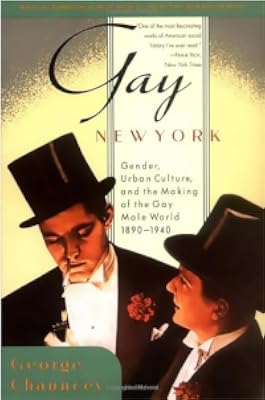
Only one review? I believe this was his doctoral dissertation at Yale remade into a book. It's a scholarly work, and belongs on a continuum beginning here and ending somewhere near "Gay New York" (Chauncey), "And the Band Played On" (Shilts), "The Mayor of Castro Street" (also Shilts) and finally "Gay L.A." (Federman and Timmons). For additional reviews, jump over to amazon.com and see what better reviewers than I have to say. My point: to understand homosexuality as it exists today, a reader needs to start somewhere in the history of Western Europe and North America. Greece, Rome, and the First Nations of North America are too culturally diverse. Christianity and its fellow "book" religions are what formed the West, and Boswell is a show more good place to go.
He's easier than Proust, by the way, and only one volume. show less
He's easier than Proust, by the way, and only one volume. show less
Members
- Recently Added By
Lists

Christianity Books You've Read
179 works; 19 members

The Best LGBTQ Nonfiction
222 works; 73 members

Works Cited in From Shame to Sin by Kyle Harper
219 works; 1 member
Author Information

8+ Works 2,704 Members
John Boswell (1947-94) was the A. Whitney Griswold Professor of History at Yale University and the author of The Royal Treasure, The Kindness of Strangers, and Same-Sex Unions in Premodern Europe.
Awards and Honors
Awards
Distinctions
Work Relationships
Has as a commentary on the text
Common Knowledge
- Canonical title
- Christianity, Social Tolerance, and Homosexuality: Gay People in Western Europe from the Beginning of the Christian Era to the Fourteenth Century
- Original publication date
- 1980
Classifications
- Genres
- Religion & Spirituality, Nonfiction, LGBTQ+, History, General Nonfiction, Sexuality and Gender Studies
- DDC/MDS
- 306.76 — Society, government, & culture Social sciences, sociology & anthropology Social Behavior - Dating, Marriage, Divorce Sexual relations Sexual orientation, transgender identity, intersexuality
- LCC
- HQ76.3 .E8 .B67 — Social sciences The family. Marriage, Women and Sexuality The Family. Marriage. Women Sexual life Homosexuality. Lesbianism
- BISAC
Statistics
- Members
- 1,203
- Popularity
- 20,773
- Reviews
- 10
- Rating
- (4.36)
- Languages
- English, French, Italian, Spanish
- Media
- Paper, Ebook
- ISBNs
- 9
- ASINs
- 9