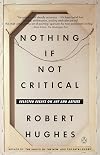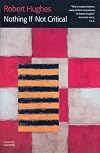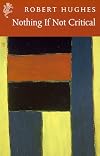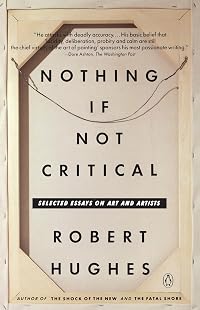
Nothing If Not Critical: Selected Essays on Art and Artists
by Robert Hughes
On This Page
Description
A generous selection of forthright essays on art and artists. Hughes tackles the lives and works of over 80 artists, from the old masters to our contemporaries, exploring their achievement (or lack of it) and how they altered the history of art for better or worse.Tags
Recommendations










Member Reviews
Outstanding collection of nearly one hundred essays written in the 1980s, mostly for Time Magazine, on art and artists from Holbein, Goya, Degas, Whistler, van Gogh right up to the big names of the 50s, 60s, 70s and 80s, by the leading art critic at the time in America, outspoken, rough-and-ready tough-guy Robert Hughes (1938-2012).
If you are familiar with his 1970s documentary The Shock of the New, you know he has a hyper-perceptive eye for art as well as a thorough command of art history and cultural currents. If not, then these essays will introduce you to one of the freshest and liveliest voices ever to enter the house of art.
To provide a good strong taste of Robert Hughes’ style, below are quotes from his spirited essay on Andy show more Warhol, one of the few artists included in this collection that he really didn’t like.
Robert Hughes on Andy Warhol’s using everyday objects like soup cans, Brillo boxes or photos of Marilyn Monroe: “The tension this set up depended on the assumption, still in force in the sixties, that there was a qualitative difference between the perceptions of high art and the million daily diversions and instructions issued by popular culture. Since then, Warhol has probably done more than any other living artist to wear that distinction down, but while doing so, he has worn away the edge of his work.”
On Andy’s quest for celebrity: “Inspired by the example of Truman Capote, he went after publicity with the voracious singlemindedness of a feeding bluefish. And he got it in abundance, because the sixties in New York reshuffled and stacked the social deck: press and television, in their pervasiveness, constructed a kind of parallel universe in which the hierarchical orders of American society – vestiges, it was thought, but strong ones, and based on inherited wealth –were replaced by the new tyranny of the “interesting.” Its rule had to do with the rapid shift of style and image, with the assumption that all civilized life was discontinuous and worth only a short attention span: better to be Baby Jane Holzer than the Duchesse de Guermantes.”
On Andy and television: “Above all, the working-class kid who had spent so many thousands of hours gazing into the blue, anesthetizing glare of the TV screen, like Narcissus into his pool, realized that the cultural moment of the mid-sixties favored a walking void. Television was producing an affectless culture.”
On Andy’s mass produced art: “Thus his paintings, tremendously stylish in their rough silk-screening, full of slips, mimicked the dissociation of gaze and empathy induced by the mass media: the banal punch of tabloid newsprint, the visual jabber and bright sleazy color of TV, the sense of glut and anesthesia caused by both. Three dozen Elvises are better than one.”
On Andy as THE artist of the Ronald Reagan years: “How can one doubt that Warhol was delivered by Fate to be the Rubens of this administration, to play Bernini to Reagan’s Urban VIII? On the one hand, the shrewd old movie actor, void of ideas but expert at manipulation, projected into high office by the insuperable power of mass imagery and secondhand perception. On the other, the shallow painter who understood more about the mechanisms of celebrity than any of his colleagues, whose entire sense of reality was shaped, like Reagan’s sense of power, by the television tube. Each, in his way, coming on like Huck Finn; both obsessed with serving the interests of privilege. Together, they signify a new moment: the age of supply-side aesthetics.”
I read this Robert Hughes essay on Andy Warhol back when it was first published in 1982. Loved every word and really was on Hughes’ vibe since I recoil from anything smacking of mass culture, things like television, celebrity, glamour or glitz.
But then one spring afternoon in 1990 I had a shocking experience - I walked into a downtown New York City gallery and saw for the very first time original Andy Warhol silkscreens, one of Hermann Hesse and the other of Mickey Mouse.
I could almost not believe my eyes: the art was so stunningly beautiful and brimming over with vitality, it almost put me on my knees. Incredible. I couldn’t take my eyes off these silkscreens; I was riveted to the spot for a good long while.
For me, this experience underscored how the visual arts are ultimately a personal experience of standing before the original and using and trusting our eyes. Sure, art critics, even the great art critics, can speak about cultural and historical context, about the artist’s biography and the artist’s influences and intent, even offering comments and insights on specific works, but we are best putting theories and criticism aside when we engage with the work one-on-one. Who knows what magic may take place? show less
Such an outstanding collection of nearly 100 essays written in the 1980s, mostly for Time Magazine, on art and artists from Holbein, Goya, Degas, Whistler, van Gogh right up to the big names of the 50s, 60s, 70s and 80s, by the leading art critic at the time in America, outspoken, rough-and-ready tough-guy Robert Hughes (1938-2012). If you are familiar with his 1970s documentary “The Shock of the New” you know he has a hyper-perceptive eye for art as well as a thorough command of art history and cultural currents. If not, then these essays will introduce you to one of the freshest and liveliest voices ever to enter the house of art.
To provide a good strong taste of Robert Hughes’ style, below are quotes from his spirited essay on show more Andy Warhol, one of the few artists included in this collection that he really didn’t like.
Robert Hughes on Andy Warhol’s using everyday objects like soup cans, Brillo boxes or photos of Marilyn Monroe: “The tension this set up depended on the assumption, still in force in the sixties, that there was a qualitative difference between the perceptions of high art and the million daily diversions and instructions issued by popular culture. Since then, Warhol has probably done more than any other living artist to wear that distinction down, but while doing so, he has worn away the edge of his work.”
On Andy’s quest for celebrity: “Inspired by the example of Truman Capote, he went after publicity with the voracious singlemindedness of a feeding bluefish. And he got it in abundance, because the sixties in New York reshuffled and stacked the social deck: press and television, in their pervasiveness, constructed a kind of parallel universe in which the hierarchical orders of American society – vestiges, it was thought, but strong ones, and based on inherited wealth –were replaced by the new tyranny of the “interesting.” Its rule had to do with the rapid shift of style and image, with the assumption that all civilized life was discontinuous and worth only a short attention span: better to be Baby Jane Holzer than the Duchesse de Guermantes.”
On Andy and television: “Above all, the working-class kid who had spent so many thousands of hours gazing into the blue, anesthetizing glare of the TV screen, like Narcissus into his pool, realized that the cultural moment of the mid-sixties favored a walking void. Television was producing an affectless culture.”
On Andy’s mass produced art: “Thus his paintings, tremendously stylish in their rough silk-screening, full of slips, mimicked the dissociation of gaze and empathy induced by the mass media: the banal punch of tabloid newsprint, the visual jabber and bright sleazy color of TV, the sense of glut and anesthesia caused by both. Three dozen Elvises are better than one.”
On Andy as THE artist of the Ronald Reagan years: “How can one doubt that Warhol was delivered by Fate to be the Rubens of this administration, to play Bernini to Reagan’s Urban VIII? On the one hand, the shrewd old movie actor, void of ideas but expert at manipulation, projected into high office by the insuperable power of mass imagery and secondhand perception. On the other, the shallow painter who understood more about the mechanisms of celebrity than any of his colleagues, whose entire sense of reality was shaped, like Reagan’s sense of power, by the television tube. Each, in his way, coming on like Huck Finn; both obsessed with serving the interests of privilege. Together, they signify a new moment: the age of supply-side aesthetics.”
Coda: I read this Robert Hughes essay on Andy Warhol back when it was first published in 1982. Loved every word and really was on Hughes’ vibe since I recoil from anything smacking of mass culture, things like television, celebrity, glamour or glitz. But then one spring afternoon in 1990 I had a shocking experience -- I walked into a downtown New York City gallery and saw for the very first time original Andy Warhol silkscreens, one of Hermann Hesse and the other of Mickey Mouse. I could almost not believe my eyes: the art was so stunningly beautiful and brimming over with vitality, it almost put me on my knees. Incredible. I couldn’t take my eyes off these silkscreens; I was riveted to the spot for a good long while. For me, this experience underscored how the visual arts are ultimately a personal experience of standing before the original and using and trusting our eyes. Sure, art critics, even the great art critics, can speak about cultural and historical context, about the artist’s biography and the artist’s influences and intent, even offering comments and insights on specific works, but we are best putting theories and criticism aside when we engage with the work one-on-one. Who knows what magic may take place?
show less
Robert Hughes must be one of the finest users of language at work in the field of art criticism. His comments, whether you agree with them or not, are always a joy to read.
Ratings
Members
- Recently Added By
Lists

Fake Top 100 Nonfiction
79 works; 3 members
Author Information

53+ Works 11,271 Members
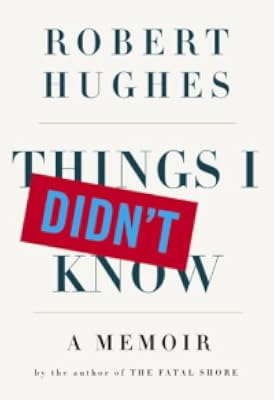
Robert Hughes was born in Sydney, Australia on July 28, 1938. He studied art and architecture at the University of Sydney. He pursued art criticism mostly as a sideline while painting, writing poetry and serving as a cartoonist for the weekly intellectual journal The Observer. He left Australia and spent time in Italy before settling in London, show more where he became a well-known critical voice and wrote for several newspapers. He was chief art critic for Time magazine for over 30 years. He wrote several books including The Fatal Shore, American Visions: The Epic History of Art in America, Culture of Complaint: The Fraying of America, Things I Didn't Know, and Rome. He also hosted an eight-part documentary about the development of modernism from the Impressionists through Warhol entitled The Shock of the New. It was seen by more than 25 million viewers when it ran first on BBC and then on PBS. He also wrote a book by the same name about the series. He died after a long illness on August 6, 2012 at the age of 74. (Bowker Author Biography) show less
Some Editions
Series
Belongs to Publisher Series
Harvill (84)
Classifications
Statistics
- Members
- 544
- Popularity
- 54,995
- Reviews
- 3
- Rating
- (4.09)
- Languages
- Dutch, English, German, Spanish
- Media
- Paper, Ebook
- ISBNs
- 13
- ASINs
- 7