On This Page
Description
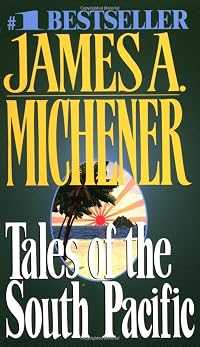
Eighteen sketches of the island-hopping warfare in the South Pacific during World War II.Tags
Recommendations


























Member Reviews
I first read this in high school, some 40 years ago. When I found myself referencing it recently in a review for another book (McKenna's "The Sand Pebbles"), I knew I had to reread it. Reading it with older eyes only enhanced the luster.
It's all here: history, anthropology, war journalism, vignettes of life and waiting and death. It's strengths are the limits Michener gives it: it's about some people on some islands in part of the South Pacific during part of World War II, and their limited hopes, fears, and experiences. It's as good a novel about war and people in war as you can find, really clearly evoking the tone, language, and culture of the 1940s. Blurbs about this book play up romance, but it's really about trying to hold on show more against loss, and that very loss.
As the caretaker says near the end, "Dey's only so many good men, and if you uses 'em up, where you gonna git de others?" show less
It's all here: history, anthropology, war journalism, vignettes of life and waiting and death. It's strengths are the limits Michener gives it: it's about some people on some islands in part of the South Pacific during part of World War II, and their limited hopes, fears, and experiences. It's as good a novel about war and people in war as you can find, really clearly evoking the tone, language, and culture of the 1940s. Blurbs about this book play up romance, but it's really about trying to hold on show more against loss, and that very loss.
As the caretaker says near the end, "Dey's only so many good men, and if you uses 'em up, where you gonna git de others?" show less
I could probably recite the entire musical by heart, but I'd never read the book. A great group of stories about the Pacific War, fictional (I assume) but based on Michener's observations in the South Seas during WWII. Michener has a wonderful way with a story, but the best thing about these stories is that they aren't just about war, but about people in the war. There is much more of a sense of these being ordinary men and women thrown into something they had no idea about, and although there are battle stories, it's the human part of the stories that make them so readable. My favorite? The very last, "A Cemetery on Hoga Point." Puts a lot in perspective. Fabulous book. If you've never read it, you should.
Many of you will know Michener from his popular 1,000-page novels, books that were enormously well-liked (at least in the US) by readers and often bestsellers but most of which were either disdained or ridiculed by critics.
Tales of the South Pacific is different…at least for me. Michener served in the South Pacific for the U.S. Navy in World War Two. He was a “paper pusher,” not a fighting soldier, and in his spare time he began writing “some stories that disturbed me.” Over and over, Michener shows in simple, understated language the courage and bravery of so many of these ordinary people—the pilots, the seamen, the nurses, the coastwatchers—people whose stories would otherwise go unremarked and unremembered. There are show more plenty of books about the admirals and the generals, about the large overview of the war in the Pacific. There are piles of books about individual battles or tactics or strategy.
All of the tales here are based on fact and all of them include enough real names and places to make the stories vivid and affecting. These are the stories are about the men and women who followed the orders and fought the battles, not the ones giving orders or creating grand strategy. They tell about the long stretches of time when nothing happened. The brief explosive moments of combat. The extraordinary time and obsessive detail that went into planning for invasions or other campaigns. What it was like to be in a strange world, thousands of miles from home. Most of these stories can be read as entertainment, told for their own sake. Most of them are easy to read. Some are funny, some are informative, some are heart-breaking. Most are easily enjoyed. In fact, the reading is so easy that Michener can lull the reader into stopping at the surface. You can read this book easily without digging deeper. And I am under no illusions: it is not great literature. But every tale, it seems, tells timeless truths. Lurking just beneath the entertainment and the laughs are tears—of pain, of sadness, of fear, and of understanding. I believe that many (if not most) of the stories invite (or perhaps even expect) you to probe and ponder the issues that they raise.
I have read this book many times and every time I read it, it affects me deeply. Many in my family served in World War Two, including a cousin of my mother’s whose Navy ship was sunk by a kamikaze pilot in April 1945, three weeks before the end of the war in Europe. He suffered horrific burns and died a few days later. I re-read the book from time to time as a way of paying homage to those who took part in the war by simply remembering them. Of course, what Michener highlights is true of every war, not just World War Two. But many of the people and places and things he writes about resonate for me because of those in my family or the stories my father told me.
Michener ends the first story—just an introduction, really—with language that has always haunted me because it makes clear how much of who we are and what we know depends on people, on individuals and their own stories. And that, after all, is why we read anything, not just war stories.
"They will live a long time, these men of the South Pacific. They had an American quality. They, like their victories, will be remembered as long as our generation lives. After that, like the men of the Confederacy, they will become strangers. Longer and longer shadows will obscure them, until their Guadalcanal sounds distant on the ear like Shiloh and Valley Forge [two iconic battles in U.S. history]."
“As long as our generation lives.” The older I get, the more this phrase affects me. We will soon lose all first-hand memory of World War Two, as we have with every war that preceded it. There are fewer veterans of that war alive every day. It will become just another piece of history, territory explored only by historians. My father’s memory will live as long as I do. What I know of him and his service and his life disappears when I die. No one will ever know about him afterwards except in general, impersonal ways.
It has always been like this. It was true of those who fought at Troy or Kurukshetra, of those who fought at Agincourt or Gawakuke, Stalingrad or Itaparica. Which is precisely what makes the stories in Tales of the South Pacific so moving and so timeless. I have read many excellent “war novels”: Norman Mailer’s Naked and the Dead; Karl Marlantes’s Matterhorn (Vietnam); Vasily Grossman’s Life and Fate; Uwe Timm’s Morenga (German Southwest Africa); Atiq Rahimi’s Earth and Ashes (Afghanistan). The list is far too long and it starts with the [Iliad] and the [Mahabharata] only because that’s where the written record starts. Each is brilliant in its own way. And each tells the same story…a different aspect perhaps, but the same story.
Ulysses. Arjuna. Tony Fry and Joe Cable. My father. They are all and they are none of them heroes. Each one who has gone to war knows the same story—in a very personal and profound way—a story that the rest of us will never really know. show less
Tales of the South Pacific is different…at least for me. Michener served in the South Pacific for the U.S. Navy in World War Two. He was a “paper pusher,” not a fighting soldier, and in his spare time he began writing “some stories that disturbed me.” Over and over, Michener shows in simple, understated language the courage and bravery of so many of these ordinary people—the pilots, the seamen, the nurses, the coastwatchers—people whose stories would otherwise go unremarked and unremembered. There are show more plenty of books about the admirals and the generals, about the large overview of the war in the Pacific. There are piles of books about individual battles or tactics or strategy.
All of the tales here are based on fact and all of them include enough real names and places to make the stories vivid and affecting. These are the stories are about the men and women who followed the orders and fought the battles, not the ones giving orders or creating grand strategy. They tell about the long stretches of time when nothing happened. The brief explosive moments of combat. The extraordinary time and obsessive detail that went into planning for invasions or other campaigns. What it was like to be in a strange world, thousands of miles from home. Most of these stories can be read as entertainment, told for their own sake. Most of them are easy to read. Some are funny, some are informative, some are heart-breaking. Most are easily enjoyed. In fact, the reading is so easy that Michener can lull the reader into stopping at the surface. You can read this book easily without digging deeper. And I am under no illusions: it is not great literature. But every tale, it seems, tells timeless truths. Lurking just beneath the entertainment and the laughs are tears—of pain, of sadness, of fear, and of understanding. I believe that many (if not most) of the stories invite (or perhaps even expect) you to probe and ponder the issues that they raise.
I have read this book many times and every time I read it, it affects me deeply. Many in my family served in World War Two, including a cousin of my mother’s whose Navy ship was sunk by a kamikaze pilot in April 1945, three weeks before the end of the war in Europe. He suffered horrific burns and died a few days later. I re-read the book from time to time as a way of paying homage to those who took part in the war by simply remembering them. Of course, what Michener highlights is true of every war, not just World War Two. But many of the people and places and things he writes about resonate for me because of those in my family or the stories my father told me.
Michener ends the first story—just an introduction, really—with language that has always haunted me because it makes clear how much of who we are and what we know depends on people, on individuals and their own stories. And that, after all, is why we read anything, not just war stories.
"They will live a long time, these men of the South Pacific. They had an American quality. They, like their victories, will be remembered as long as our generation lives. After that, like the men of the Confederacy, they will become strangers. Longer and longer shadows will obscure them, until their Guadalcanal sounds distant on the ear like Shiloh and Valley Forge [two iconic battles in U.S. history]."
“As long as our generation lives.” The older I get, the more this phrase affects me. We will soon lose all first-hand memory of World War Two, as we have with every war that preceded it. There are fewer veterans of that war alive every day. It will become just another piece of history, territory explored only by historians. My father’s memory will live as long as I do. What I know of him and his service and his life disappears when I die. No one will ever know about him afterwards except in general, impersonal ways.
It has always been like this. It was true of those who fought at Troy or Kurukshetra, of those who fought at Agincourt or Gawakuke, Stalingrad or Itaparica. Which is precisely what makes the stories in Tales of the South Pacific so moving and so timeless. I have read many excellent “war novels”: Norman Mailer’s Naked and the Dead; Karl Marlantes’s Matterhorn (Vietnam); Vasily Grossman’s Life and Fate; Uwe Timm’s Morenga (German Southwest Africa); Atiq Rahimi’s Earth and Ashes (Afghanistan). The list is far too long and it starts with the [Iliad] and the [Mahabharata] only because that’s where the written record starts. Each is brilliant in its own way. And each tells the same story…a different aspect perhaps, but the same story.
Ulysses. Arjuna. Tony Fry and Joe Cable. My father. They are all and they are none of them heroes. Each one who has gone to war knows the same story—in a very personal and profound way—a story that the rest of us will never really know. show less
"I wish I could tell you about the South Pacific. The way it actually was. The endless ocean. The infinite specks of coral we called islands. Coconut palms nodding gracefully toward the ocean. . . . I wish I could tell you about the sweating jungle, the full moon rising behind the volcanoes, and the waiting. The timeless, repetitive waiting." Thus opens James A. Michener's Tales of the South Pacific, a beginning that could so easily be repeated at the end.
As a lifetime fan of the 1958 film South Pacific, I was wrong to think I already knew these stories. In barely more than 300 pages, Michener's 1948 Pulitzer Prize winner opens the door to understanding war from the inside. He wrote this fictionalized memoir of his World War II service show more while memories of his service were still fresh. A young officer, hobnobbing with the big brass, he was involved with planning and providing war supplies: cots, bandages, meals, body bags, even the construction of air strips. Just as in the film (and the Broadway musical by the same name), there are dramatic battle scenes against a backdrop of romance and humor in the hurry-up-and-wait lives of men waiting to be called to action. But what I've never seen or heard before are the behind-the-scenes plans for waging battles --- and I'm not talking about men in uniforms standing around a large table, pushing battleships around a model ocean. Planning a siege includes estimating the number of troops who will lose their lives in order to have ready sufficient supplies for things like building coffins and erecting hospital buildings, and (if the siege is long) locating a cemetery location --- everything except the names of those who will survive and those who won't. That's what stunned me. Guessing how many soldiers would be killed and how many would be wounded so that necessary staff and supplies could be made ready, so that commanding officers would have enough stationery, pens, and ink to write letters to families of the fallen. Naively, it never occurred to me that being prepared for loss of life involved so many cold-blooded mundane details. Hopefully, we're evolving into societies that find other ways to be heroic than planning the slaughter of one another. show less
As a lifetime fan of the 1958 film South Pacific, I was wrong to think I already knew these stories. In barely more than 300 pages, Michener's 1948 Pulitzer Prize winner opens the door to understanding war from the inside. He wrote this fictionalized memoir of his World War II service show more while memories of his service were still fresh. A young officer, hobnobbing with the big brass, he was involved with planning and providing war supplies: cots, bandages, meals, body bags, even the construction of air strips. Just as in the film (and the Broadway musical by the same name), there are dramatic battle scenes against a backdrop of romance and humor in the hurry-up-and-wait lives of men waiting to be called to action. But what I've never seen or heard before are the behind-the-scenes plans for waging battles --- and I'm not talking about men in uniforms standing around a large table, pushing battleships around a model ocean. Planning a siege includes estimating the number of troops who will lose their lives in order to have ready sufficient supplies for things like building coffins and erecting hospital buildings, and (if the siege is long) locating a cemetery location --- everything except the names of those who will survive and those who won't. That's what stunned me. Guessing how many soldiers would be killed and how many would be wounded so that necessary staff and supplies could be made ready, so that commanding officers would have enough stationery, pens, and ink to write letters to families of the fallen. Naively, it never occurred to me that being prepared for loss of life involved so many cold-blooded mundane details. Hopefully, we're evolving into societies that find other ways to be heroic than planning the slaughter of one another. show less
A series of short stories set in the South Pacific during World War II. James A Michener lays it all bare, like a bleached-out beach, baking in the island sun. The stories tell of unbearably hot days and frigid nights, of relentless mosquitoes and horrible diseases. And not just physical disease, but the mental illnesses that accompanies war. Not surprisingly for the 1940’s, the book is full of solders displaying racism and misogyny. Female native women of child-bearing ages had to evacuated from islands to prevent rape by American military men. Nurses had to be constantly chaperoned to avoid the same. Yes, it’s set during war, and while you’ll get a glimpse of the horrors of battle, you’ll spend more time, like many of the show more military did, waiting and preparing for battle. Mitchener is at his best describing the unique characters and events in between the military action. When days turn into months, and months into years, soldiers eventually realize they are not just fighting a war, they are living their lives.
“I wish I could tell you about the sweating jungle, the full moon rising behind the volcanoes, and the waiting. The waiting. The timeless repetitive waiting.”
There is such a juxtaposition between the tranquil beauty of the South Pacific and the ugliness in wartime and in men’s hearts. Michener describes moment of bravery, empathy, and even love and then alternates to moments of bigotry, violence, and death. He lovingly describes the beauty of natives and scenes of tropical paradise, then a few pages later he reveals the confusion and insanity of combat.
Five stars for compelling storytelling that brings to life the locations, characters, and events of World War II in the South Pacific. Deserving of its Pulitzer Prize for the honest writing of the weakness and strengths in humanity that war exposes. show less
“I wish I could tell you about the sweating jungle, the full moon rising behind the volcanoes, and the waiting. The waiting. The timeless repetitive waiting.”
There is such a juxtaposition between the tranquil beauty of the South Pacific and the ugliness in wartime and in men’s hearts. Michener describes moment of bravery, empathy, and even love and then alternates to moments of bigotry, violence, and death. He lovingly describes the beauty of natives and scenes of tropical paradise, then a few pages later he reveals the confusion and insanity of combat.
Five stars for compelling storytelling that brings to life the locations, characters, and events of World War II in the South Pacific. Deserving of its Pulitzer Prize for the honest writing of the weakness and strengths in humanity that war exposes. show less
Like many people, I've seen and enjoyed the musical South Pacific. However, I had no idea that the musical was for the most part based on two of the short stories ("Our Heroine" and "Fo' Dollah") in this collection, which won a Pulitzer Prize. It takes a while for the collection to build up momentum, but Michener builds a continuity between the stories that ends up being very moving, the alternation of funny bits and serious stories generating a strong emotional rhythm. A good comparison might be Catch-22, but this work isn't quite as overtly comic; in fact the more serious and straightforward narrative style makes this work seem more truthful even if most of the stories are just as fictional as in Heller's novel. It's been a while show more since I've seen the musical, so I was surprised at how forward the theme of anti-racism was, but even if you've seen the musical more recently than I have you'll still be impressed at how progressive Michener was in 1946. Aside from the "big themes", this is a great collection of war stories, with lots of good military humor and some great writing. show less
I read this in preparation of seeing the current touring production of "South Pacific" this Sunday. The book is much better than I was even anticipating. It's unexpectedly haunting and quite moving. Essentially a collection of short stories with a few recurring characters laced throughout it really provides a panoramic exploration of life for American soldiers in the Pacific waiting for World War II to get started. The strongest stories are reserved for the center of the book, like "Our Heroine," "Dry Rot," and of course "Fo' Dolla'." The stories on the outskirts of this middle section I found to be a tad dull and unexciting comparatively, but the book still kept my attention and I wanted to keep reading. It was also refreshing to read show more something about the war written shortly after it happened. These are the words of Michener himself, who served in the Pacific. The people in the stories have very different views on race, gender and social conduct which haven't been glossed over and sanitized by history books. It feels like a genuine artifact of that time, and therefore makes it priceless as a time capsule. Highly recommended. show less
Members
- Recently Added By
Lists

The Guardian's 1000 Novels Everyone Must Read
1,005 works; 547 members

Pulitzer Prize Winners for Fiction
102 works; 54 members

Watched the Movie, Probably Won't Read the Book
185 works; 34 members

Books about World War II
241 works; 22 members

Allie's Favourite 150 Books
145 works; 3 members

Books Set on Islands
190 works; 24 members

My favourite books
96 works; 3 members

Books With the Most Memorable Titles
478 works; 158 members

THE WAR ROOM
813 works; 24 members

Books With Place Names in the Title
215 works; 10 members
Author Information

208+ Works 49,341 Members
James A. Michener, 1907 - 1997 James Albert Michener was born on February 3, 1907 in Doylestown, Pa. He earned an A.B. from Swarthmore College, an A.M. from Colorado State College of Education, and an M.A. from Harvard University. He taught for many years and was an editor for Macmillan Publishing Company. His first book, "Tales of the South show more Pacific," derived from Michener's service in the Pacific in World War II, won the 1947 Pulitzer Prize for Fiction and was the basis for the Rodgers and Hammerstein Broadway musical South Pacific, which won the 1950 Pulitzer Prize for Drama. Michener completed close to 40 novels. Some other epic works include "Hawaii," "Centennial," "Space," and "Caribbean." He also wrote a significant amount of nonfiction including his autobiography "The World Is My Home." Among his many other honors, James Michener received the Presidential Medal of Freedom in 1977. He was married to Patti Koon in 1935; they divorced in 1948. He married Vange Nord in 1948 (divorced 1955) and Mari Yoriko Sabusawa in 1955 (deceased 1994). He died in 1997 in Austin, Texas. (Bowker Author Biography) show less
Awards and Honors
Awards
Notable Lists
Series

Belongs to Publisher Series
Work Relationships
Is contained in
Has the adaptation
Is abridged in
Inspired
Has as a supplement
Has as a student's study guide
Common Knowledge
- Canonical title
- Tales of the South Pacific
- Original title
- Tales of the South Pacific
- Original publication date
- 1946
- Important places
- Pacific Ocean; South Pacific Ocean; Solomon Islands; Norfolk Island
- Important events
- World War II (1939 | 1945); World War II, Pacific Theater (1941-12-07 | 1945-09-02); Battle of the Coral Sea (1942-05-04 | 1942-05-08)
- Related movies
- South Pacific (1958 | IMDb); South Pacific (2001 | IMDb); Great Performances:'South Pacific' in Concert from Carnegie Hall (2006 | s34e3 | IMDb)
- First words
- I wish I could tell you about the South Pacific.
- Quotations
- The men who would make up the difference between the expected dead and the actual dead would never know that they were the lucky ones. But all the world would be richer for their having lived.
- Last words
- (Click to show. Warning: May contain spoilers.)"Sometime he run off at da mouf'."
Classifications
Statistics
- Members
- 2,069
- Popularity
- 10,006
- Reviews
- 36
- Rating
- (3.76)
- Languages
- 7 — Danish, Dutch, English, German, Italian, Norwegian (Bokmål), Swedish
- Media
- Paper, Audiobook, Ebook
- ISBNs
- 31
- ASINs
- 63