On This Page
Description
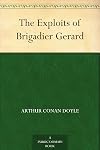
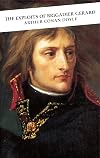
Love humor writing? Can't get enough of classic adventure tales? Get the best of both worlds with The Exploits of Brigadier Gerard, a series of short stories in which mystery master Arthur Conan Doyle dishes up action and hilarity in equal measures. The stories follow the adventures of the eponymous brigadier, a Frenchman who is puzzled by British mores and manners but is always at the ready to defend his own or another's honor, either by word or by the sword..
Tags
Recommendations





















Member Reviews
What do you get if you take Flashman, remove the streak of yellow from his back and make at least some of the adventures ones entered into knowingly by the participant? Why, you get Brigadier Etienne Gerard, of course! Gerard is a creation of Arthur Conan Doyle, sadly languishing in the shadows with all of his other characters not called "Sherlock Holmes". He is a dashing hussar in Napoleon's Grande Armée who, in his old age, is recalling to the reader the adventures of his youth. The comparison to Flashman is an instructive one, especially in that while Flashman is committed to strictly telling the truth he ultimately becomes more and more a bounder and cad in our eyes, while Gerard (well I certainly won’t call him a liar, but show more let’s just say he has a spotty memory at best and isn’t the most observant fellow) is a somewhat less than objective reporter, and yet each tale shows him to be a goodhearted man of high ideals.
These are tales filled with derring-do, close escapes and not a few romantic entanglements...I think I see where George MacDonald Fraser got at least part of his inspiration from. Gerard is a very likeable character and narrator for all that he is so full of himself that it's a wonder the hot air doesn't make him float away. His voice is urbane and charming and all of his adventures are rousing good tales. At the beginning of each adventure one almost sees the sunlit café table at which we sit and can almost taste the cognac in our coffee as we listen to the Brigadier reminisce. He really is a charming old campaigner, though not exactly the sharpest knife in the drawer. Still, for loyalty and sheer bravado one could do worse than having a Brigadier Gerard in one’s army, for while he “has the thickest head he has also the stoutest heart” of all of Napoleon’s men.
I was actually a bit surprised at the very real violence and horror of war hinted at occasionally in these stories. Despite being adventure stories of the Victorian era they don't necessarily shy away from some of the less palatable aspects of their subject matter, even if Gerard tells of them with a very wry nonchalance. I was, for example, a bit surprised by the horrific death of one of Gerard's soldiers, buried alive, as related to him by a bandit chieftain, or the recounting by Gerard of a military tribunal of French POWs who punish a traitor in their midst such that "In the morning, when [the English] came for their man with papers for his release, there was not as much of him left as you could put upon your thumb-nail."
When I started this book in tandem with Doyle’s _The Adventures of Sherlock Holmes_ I was asked which I liked better. I had immediately given the nod to Sherlock Holmes, if only for his iconic and fascinating character, but now I’m not so sure. Holmes is great, but Gerard is very charming indeed and there is not a dud amongst his tales. Doyle has really impressed me with his range in these two creations alone and I look forward to the further adventures of both characters, not to mention a look at some of Doyle’s other fiction. I highly recommend the Gerard stories to anyone interested in historical fiction and adventure, especially when it is tinged with good humour. show less
These are tales filled with derring-do, close escapes and not a few romantic entanglements...I think I see where George MacDonald Fraser got at least part of his inspiration from. Gerard is a very likeable character and narrator for all that he is so full of himself that it's a wonder the hot air doesn't make him float away. His voice is urbane and charming and all of his adventures are rousing good tales. At the beginning of each adventure one almost sees the sunlit café table at which we sit and can almost taste the cognac in our coffee as we listen to the Brigadier reminisce. He really is a charming old campaigner, though not exactly the sharpest knife in the drawer. Still, for loyalty and sheer bravado one could do worse than having a Brigadier Gerard in one’s army, for while he “has the thickest head he has also the stoutest heart” of all of Napoleon’s men.
I was actually a bit surprised at the very real violence and horror of war hinted at occasionally in these stories. Despite being adventure stories of the Victorian era they don't necessarily shy away from some of the less palatable aspects of their subject matter, even if Gerard tells of them with a very wry nonchalance. I was, for example, a bit surprised by the horrific death of one of Gerard's soldiers, buried alive, as related to him by a bandit chieftain, or the recounting by Gerard of a military tribunal of French POWs who punish a traitor in their midst such that "In the morning, when [the English] came for their man with papers for his release, there was not as much of him left as you could put upon your thumb-nail."
When I started this book in tandem with Doyle’s _The Adventures of Sherlock Holmes_ I was asked which I liked better. I had immediately given the nod to Sherlock Holmes, if only for his iconic and fascinating character, but now I’m not so sure. Holmes is great, but Gerard is very charming indeed and there is not a dud amongst his tales. Doyle has really impressed me with his range in these two creations alone and I look forward to the further adventures of both characters, not to mention a look at some of Doyle’s other fiction. I highly recommend the Gerard stories to anyone interested in historical fiction and adventure, especially when it is tinged with good humour. show less
Eight interrelated short stories featuring protagonist Brigadier Etiennne Gerard, an officer in the French Army during the Napoleonic Wars. He narrates tales of his escapades looking back on them many years later. Gerard is quite the hero – just ask him!
The Brigadier is a great character. He is vain and a little pompous. I would not be surprised if he were exaggerating some of his exploits. He knows the Emperor and has several tales that feature Napoleon himself. His more serious escapades are interspersed with comic interludes. I had read several of Conan Doyle’s Sherlock Holmes novels but was previously unaware of this book. I found it in my local library and picked it up on a whim. It is full of delightful adventures, and I show more quite enjoyed it. show less
The Brigadier is a great character. He is vain and a little pompous. I would not be surprised if he were exaggerating some of his exploits. He knows the Emperor and has several tales that feature Napoleon himself. His more serious escapades are interspersed with comic interludes. I had read several of Conan Doyle’s Sherlock Holmes novels but was previously unaware of this book. I found it in my local library and picked it up on a whim. It is full of delightful adventures, and I show more quite enjoyed it. show less
Eight interrelated short stories featuring protagonist Brigadier Etiennne Gerard, an officer in the French Army during the Napoleonic Wars. He narrates tales of his escapades looking back on them many years later. Gerard is quite the hero – just ask him!
The Brigadier is a great character. He is vain and a little pompous. I would not be surprised if he were exaggerating some of his exploits. He knows the Emperor and has several tales that feature Napoleon himself. His more serious escapades are interspersed with comic interludes. I had read several of Conan Doyle’s Sherlock Holmes novels but was previously unaware of this book. I found it in my local library and picked it up on a whim. It is full of delightful adventures, and I show more quite enjoyed it. show less
The Brigadier is a great character. He is vain and a little pompous. I would not be surprised if he were exaggerating some of his exploits. He knows the Emperor and has several tales that feature Napoleon himself. His more serious escapades are interspersed with comic interludes. I had read several of Conan Doyle’s Sherlock Holmes novels but was previously unaware of this book. I found it in my local library and picked it up on a whim. It is full of delightful adventures, and I show more quite enjoyed it. show less
These eight stories concern the humorous (but also sometimes quite horrific) exploits of the Brigadier in the French army under Napoleon. Gerard is intensely loyal to his master to the last, but overestimates his own bravery and intelligence, with results often very funny to the reader. The stories are closely linked and really form a loose novel-like sequence, not really feeling like individual stories. Good stuff.
Was Brigadier Gerard the original of Inspector Clousseau?Very vivid, action-packed and amusing.
Fun adventures of Gerard. He is the greatest swordsman, as he will gladly tell you. He is completely devoted to Napoleon. Things don't quite work out the way he expects.
A very nice rediscovery, Superbly narrated by Rupert Degas
Members
- Recently Added By
Author Information

3,999+ Works 169,712 Members
The most famous fictional detective in the world is Arthur Conan Doyle's Sherlock Holmes. However, Doyle was, at best, ambivalent about his immensely successful literary creation and, at worst, resentful that his more "serious" fiction was relatively ignored. Born in Edinburgh, Doyle studied medicine from 1876 to 1881 and received his M.D. in show more 1885. He worked as a military physician in South Africa during the Boer War and was knighted in 1902 for his exceptional service. Doyle was drawn to writing at an early age. Although he attempted to enter private practice in Southsea, Portsmouth, in 1882, he soon turned to writing in his spare time; it eventually became his profession. As a Liberal Unionist, Doyle ran, unsuccessfully, for Parliament in 1903. During his later years, Doyle became an avowed spiritualist. Doyle sold his first story, "The Mystery of the Sasassa Valley," to Chambers' Journal in 1879. When Doyle published the novel, A Study in Scarlet in 1887, Sherlock Holmes was introduced to an avid public. Doyle is reputed to have used one of his medical professors, Dr. Joseph Bell, as a model for Holmes's character. Eventually, Doyle wrote three additional Holmes novels and five collections of Holmes short stories. A brilliant, though somewhat eccentric, detective, Holmes employs scientific methods of observation and deduction to solve the mysteries that he investigates. Although an "amateur" private detective, he is frequently called upon by Scotland Yard for assistance. Holmes's assistant, the faithful Dr. Watson, provides a striking contrast to Holmes's brilliant intellect and, in Doyle's day at least, serves as a character with whom the reader can readily identify. Having tired of Holmes's popularity, Doyle even tried to kill the great detective in "The Final Problem" but was forced by an outraged public to resurrect him in 1903. Although Holmes remained Doyle's most popular literary creation, Doyle wrote prolifically in other genres, including historical adventure, science fiction, and supernatural fiction. Despite Doyle's sometimes careless writing, he was a superb storyteller. His great skill as a popular author lay in his technique of involving readers in his highly entertaining adventures. (Bowker Author Biography) show less

Arthur Conan Doyle has a Legacy Library. Legacy libraries are the personal libraries of famous readers, entered by LibraryThing members from the Legacy Libraries group.
Some Editions
Awards and Honors
Series

Work Relationships
Common Knowledge
- Canonical title
- The Exploits of Brigadier Gerard
- Original title
- The exploits of Brigadier Gerard
- Original publication date
- 1896
- People/Characters
- Brigadier Etienne Gerard; Napoleon Bonaparte
- Important places
- Paris, France; Dartmoor Prison, Devon, England, UK
- Important events
- Napoleonic Wars (1793 | 1815)
- Blurbers
- Chabon, Michael; Symons, Julian; Longford, Elizabeth
- Disambiguation notice
- Please do not combine this with collections including both the Exploits and the Adventures of Gerard.
Classifications
Statistics
- Members
- 199
- Popularity
- 164,381
- Reviews
- 7
- Rating
- (3.82)
- Languages
- 8 — English, Finnish, French, German, Portuguese, Russian, Spanish, Swedish
- Media
- Paper, Audiobook, Ebook
- ISBNs
- 92
- ASINs
- 23