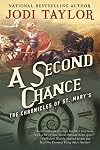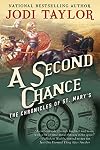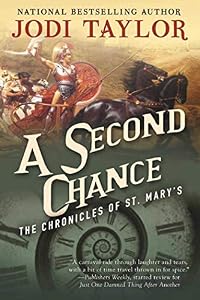
A Second Chance
by Jodi Taylor
The Chronicles of St Mary's (03), The Chronicles of St Mary's {Chronological Order} (3)
On This Page
Description
The third book in the bestselling Chronicles of St Mary's series which follows a group of tea-soaked disaster magnets as they hurtle their way around History..
Tags
Recommendations



















Member Reviews
The Historians at St.Mary’s have a straightforward approach to discovering what really happened at an historical event, they get in a POD, travel back in time and take a shufftie at what’s going on.
Of course, that means that they risk getting abducted, maimed or killed by the locals or simply by their own clumsiness, but they are a plucky lot who are willing to take their chances and get on with things in their own anarchic way.
The lead Historian, Madeleine Maxwell, “Max”, is the embodiment of what a St. Mary’s Historian should be: insatiably curious, unthinkingly courageous, capable of great compassion but implacable in dealing with those she sees as evil.
She’s come a long way from her rookie days in the first book, “Just show more One Damned Thing After Another” when she had “damaged misfit” written all the way through her like “Brighton” in a bar of rock.
She is a leader: doing the detailed planning, wrangling the St. Mary’s mob into almost acting as a team, winning the respect and even the love of her people. She’s getting her personal life together after a series of disasters.
Of course, in a Jodi Taylor novel, where every silver lining has a cloud, this degree of happiness and accomplishment can only mean that Max is doomed. Which indeed she is, though I won’t disclose her fate here.
The St. Mary’s books really are chronicles, describing events in the order that they happened, although, with time travel involved, the timeline can still have twists and turns in it. In “A Second Chance”, we follow the intrepid Max to Sir Issac Newton’s London, the fall of Troy and the battle of Agincourt. There are also a few unexpected side trips that you’ll have to read the book to find out about.
Troy has been a long-term obsession for Max. She wants to know if Greek soldiers really hid in the belly of a wooden horse and how they stayed hidden and how they got out and whether Helen’s face really launched a thousand ships, and hundreds of other things, so going there is a big deal and is described at length. What I enjoyed most about this part of the book was that, while original, plausible, surprising answers are given to all these questions, their importance fades as the scale of human suffering becomes clear. Max and her team spend months in Troy before the siege, sharing the way of life of the people only to it strangled by the siege and shattered by the assault on the city. The killing, rape, enslavement and greed-driven destruction hits home hard. This is not some Homeric glorification of war, but a description of the human cost of the phrase: “Troy fell.”
Towards the end of the book, after Agincourt, Max’s life takes a strange, world-changing, series-altering turn that finally explains the title, “A Second Chance.” This twist makes me certain that the next St. Mary’s book will be different from its predecessors. I’m looking forward to seeing what Jodi Taylor does with it.
I recently found out that Jodi Taylor self-published her first St. Mary’s book, “Just One Damned Thing After Another” after repeatedly being rejected by publishers. If you’re interested in how she did that, read this INTERVIEW show less
Of course, that means that they risk getting abducted, maimed or killed by the locals or simply by their own clumsiness, but they are a plucky lot who are willing to take their chances and get on with things in their own anarchic way.
The lead Historian, Madeleine Maxwell, “Max”, is the embodiment of what a St. Mary’s Historian should be: insatiably curious, unthinkingly courageous, capable of great compassion but implacable in dealing with those she sees as evil.
She’s come a long way from her rookie days in the first book, “Just show more One Damned Thing After Another” when she had “damaged misfit” written all the way through her like “Brighton” in a bar of rock.
She is a leader: doing the detailed planning, wrangling the St. Mary’s mob into almost acting as a team, winning the respect and even the love of her people. She’s getting her personal life together after a series of disasters.
Of course, in a Jodi Taylor novel, where every silver lining has a cloud, this degree of happiness and accomplishment can only mean that Max is doomed. Which indeed she is, though I won’t disclose her fate here.
The St. Mary’s books really are chronicles, describing events in the order that they happened, although, with time travel involved, the timeline can still have twists and turns in it. In “A Second Chance”, we follow the intrepid Max to Sir Issac Newton’s London, the fall of Troy and the battle of Agincourt. There are also a few unexpected side trips that you’ll have to read the book to find out about.
Troy has been a long-term obsession for Max. She wants to know if Greek soldiers really hid in the belly of a wooden horse and how they stayed hidden and how they got out and whether Helen’s face really launched a thousand ships, and hundreds of other things, so going there is a big deal and is described at length. What I enjoyed most about this part of the book was that, while original, plausible, surprising answers are given to all these questions, their importance fades as the scale of human suffering becomes clear. Max and her team spend months in Troy before the siege, sharing the way of life of the people only to it strangled by the siege and shattered by the assault on the city. The killing, rape, enslavement and greed-driven destruction hits home hard. This is not some Homeric glorification of war, but a description of the human cost of the phrase: “Troy fell.”
Towards the end of the book, after Agincourt, Max’s life takes a strange, world-changing, series-altering turn that finally explains the title, “A Second Chance.” This twist makes me certain that the next St. Mary’s book will be different from its predecessors. I’m looking forward to seeing what Jodi Taylor does with it.
I recently found out that Jodi Taylor self-published her first St. Mary’s book, “Just One Damned Thing After Another” after repeatedly being rejected by publishers. If you’re interested in how she did that, read this INTERVIEW show less
There's so much I love about this and a lot that kind of rubbed me the wrong way. I feel like I've got a strong grasp on what kind of person Leon (the central love interest) is, but every time something goes wrong in that romance, it's like he turns into a completely different character, and it pretty much shatters the illusion that these are real people. Now this isn't one of those stories where the narrator (and thus the reader) seem to just be blind to a character's faults until they show their true colors. It feels like Taylor wanted to give him a little bit of a dangerous edge because that would make him sexier, but it didn't work on me at all. This sort of thing happens to some extent in some of the earlier books, but I think I show more just hit my limit in this book. There's also an unfortunate no-means-yes scene which actually kind of pissed me off.
I'm also getting tired of time-travel stories where supposedly professional organizations who have been working with time travel for decades still don't seem to understand how time travel works. You'd think they'd have figured out long before now whether or not time travelers could actually change the past and what form that would take if they could. I sometimes don't mind when stories play fast and loose with this sort of thing... Except when it becomes an issue of central importance in major moral dilemmas that the characters are faced with.
But I still enjoy a good time travel tale, especially one with good closed time-loop hooks, and there are a few nice ones here. The story is often funny, sometimes exciting, and occasionally touching. But I'm not quite sure if I want to keep reading the series or not. show less
I'm also getting tired of time-travel stories where supposedly professional organizations who have been working with time travel for decades still don't seem to understand how time travel works. You'd think they'd have figured out long before now whether or not time travelers could actually change the past and what form that would take if they could. I sometimes don't mind when stories play fast and loose with this sort of thing... Except when it becomes an issue of central importance in major moral dilemmas that the characters are faced with.
But I still enjoy a good time travel tale, especially one with good closed time-loop hooks, and there are a few nice ones here. The story is often funny, sometimes exciting, and occasionally touching. But I'm not quite sure if I want to keep reading the series or not. show less
After a short trip to seventeenth-century Cambridge that nearly goes disastrously wrong, Max fulfils her long-held dreams of visiting first the siege of Troy and then the Battle of Agincourt. But despite their best intentions to simply record and observe, Peterson and Max end up in the middle of the fighting. The title of the book gives an indication of how that plays out ...
More so than in previous novels, I felt that comedy and tragedy were walking hand in hand here, with a dark core running beneath the usual good-natured banter and humour. Jodi Taylor makes it clear that history is not about dates, but about the people caught up in events that are often beyond their control. I loved it: I laughed and I cried when reading what my show more favourite historians got up to this time. Somehow the characters always get under my skin. I thought the descriptions of the siege and the fighting at Agincourt were exceptionally well done and brought home the violence and slaughter of each historical event. I'm not entirely sure about the latest twist (hence the slightly lower rating), but then I remember writing this in my review of the first novel, Just One Damned Thing after Another, after finding out who Mrs Partridge really is. So far this hasn't detracted from my enjoyment of reading the novels at all.
I can't wait to start on the next instalment, A Trail through Time. show less
More so than in previous novels, I felt that comedy and tragedy were walking hand in hand here, with a dark core running beneath the usual good-natured banter and humour. Jodi Taylor makes it clear that history is not about dates, but about the people caught up in events that are often beyond their control. I loved it: I laughed and I cried when reading what my show more favourite historians got up to this time. Somehow the characters always get under my skin. I thought the descriptions of the siege and the fighting at Agincourt were exceptionally well done and brought home the violence and slaughter of each historical event. I'm not entirely sure about the latest twist (hence the slightly lower rating), but then I remember writing this in my review of the first novel, Just One Damned Thing after Another, after finding out who Mrs Partridge really is. So far this hasn't detracted from my enjoyment of reading the novels at all.
I can't wait to start on the next instalment, A Trail through Time. show less
Rating: 4* of five
The Publisher Says: St Mary’s is back and nothing is going right for Max. Once again, it’s just one damned thing after another.
The action jumps from an encounter with a mirror-stealing Isaac Newton to the bloody battlefield at Agincourt. Discover how a simple fact-finding assignment to witness the ancient and murderous cheese-rolling fertility ceremony in Gloucester can result in CBC – concussion by cheese. The long awaited jump to Bronze Age Troy ends in personal catastrophe for Max and just when it seems things couldn’t get any worse – it’s back to the Cretaceous Period again to confront an old enemy who has nothing to lose.
So, make the tea, grab the chocolate biscuits, settle back and discover exactly show more why the entire history department has painted itself blue …
My Review: History slaps Max and St Mary's around a good bit. Kleio seems to favor the rough love school of affection. She really rides Max and the entire Institute hard this time out.
This is not the final installment of the series, at least it's not if La Taylor has any idea of what's good for her career, and yet this book is about aging, about slowing down, and not least...not at all least...about closure and releasing all that has come before as a means of surviving and also living fully, finally living fully, after carrying and shouldering and dragging the past everywhere one goes.
Max, our PoV character, isn't as young as her paper age suggests. All those months-long missions in the past have racked up the miles and the relative years. This mission, the main one of the book, is the dream of her lifetime: Return to Troy, scope it out, and watch it fall. Now, as we're accustomed to in the previous entries in the series, Max and team are not going to go by the book. We know they're on a major and incalculably valuable mission, but we also know that this is St Mary's and there will be surprises.
Yes indeed there are. Throughout the previous books, we've seen the team break the supposedly inviolable rule about interfering in the course of history, and not get squashed flat by History's revenge. Permaybehaps, then, Kleio is aiming them at certain moments to make alterations? It's a thought...but Max, who discovered a HUGE loophole in the theory of history's inviolability in book one, isn't a trusting soul and prefers her trips not to end in death where avoidable. She will not countenance terrifyingly major infractions of the rules. She pays her worst possible price for this uncharacteristic obedience.
But there is always a compensation for caution, aging people's most frequent urging on the young. Her compensation takes the series in a very surprising and new direction.
Now as book four isn't out yet (sob), let me pause here to bitch about a few things. Kalinda Black is first on my list. She's built up as Max's best friend and we see so little of her as to make her invisible. The least she could do is have a few lines here and there! She's only referred to in books two and three. I think that's very mingy.
The redoubtable Mrs Partridge, deployed strategically throughout the series, has a sister in the first book, Mrs De Winter. She vanishes. Given the sisters' ummm ancestry, there isn't *anything* the author could imagine for her to do in other contexts?
The theme I'm developing is one I suspect has led many an author down the path to Book Bloat. These novels are concise. They are lean. Nothing, and I do mean nothing, is overworded in here. Permaybehaps a wee tidge too much conciseness...there is room, while staying on story-line, to give more time to the second-billed cast. The world Taylor is creating is deliciously dotty, so let's see more of it. The serious points Taylor is making aren't going to suffer. I'm not suggesting she Robert-Jordanize the books! Just give us more side views. After all, Max is head of a department, and can reasonably be expected to need to read reports and interview returning staff...can't we eavesdrop?
The technology issues...recording devices that seem way too bulky and cumbersome not least of them...are actually, I think, handwaved away by the ending of this book. But I'll state a bit of it here: In a time-travel-verse that suggests machines simply won't travel if there is an anomaly present in the device, how do high-tech recorders make it back and forth? There have never been lost recorders? They're hand-held! Since all of this travel is to pre-computer eras, why not have something like Google Glass (only without the frames) emitting microwave signals to the pod's hard drive? No worries about competing signals...a wearable hard drive in case they're unable to make contact (though why that would be is unclear to me)...but hand-held recorders in the kind of violent worlds they're visiting seem to me to be very clunky.
These are all cavils. In the main, by the end of this book, I was so sad to see St Mary's in my rear-view mirror (which reminds me, MORE EDDIE!!) that I shed a few more tears than were actually required. The ending will wring tears from you. As hopeful as beginnings always are, they require endings, and those aren't always easy.
And as a side note, does anyone know someone in the development department of the BBC? Or ITV? This is a *perfect* TV show. Like Sliders only smart.
This work is licensed under a Creative Commons Attribution-NonCommercial-ShareAlike 3.0 Unported License. show less
The Publisher Says: St Mary’s is back and nothing is going right for Max. Once again, it’s just one damned thing after another.
The action jumps from an encounter with a mirror-stealing Isaac Newton to the bloody battlefield at Agincourt. Discover how a simple fact-finding assignment to witness the ancient and murderous cheese-rolling fertility ceremony in Gloucester can result in CBC – concussion by cheese. The long awaited jump to Bronze Age Troy ends in personal catastrophe for Max and just when it seems things couldn’t get any worse – it’s back to the Cretaceous Period again to confront an old enemy who has nothing to lose.
So, make the tea, grab the chocolate biscuits, settle back and discover exactly show more why the entire history department has painted itself blue …
My Review: History slaps Max and St Mary's around a good bit. Kleio seems to favor the rough love school of affection. She really rides Max and the entire Institute hard this time out.
This is not the final installment of the series, at least it's not if La Taylor has any idea of what's good for her career, and yet this book is about aging, about slowing down, and not least...not at all least...about closure and releasing all that has come before as a means of surviving and also living fully, finally living fully, after carrying and shouldering and dragging the past everywhere one goes.
Max, our PoV character, isn't as young as her paper age suggests. All those months-long missions in the past have racked up the miles and the relative years. This mission, the main one of the book, is the dream of her lifetime: Return to Troy, scope it out, and watch it fall. Now, as we're accustomed to in the previous entries in the series, Max and team are not going to go by the book. We know they're on a major and incalculably valuable mission, but we also know that this is St Mary's and there will be surprises.
Yes indeed there are. Throughout the previous books, we've seen the team break the supposedly inviolable rule about interfering in the course of history, and not get squashed flat by History's revenge. Permaybehaps, then, Kleio is aiming them at certain moments to make alterations? It's a thought...but Max, who discovered a HUGE loophole in the theory of history's inviolability in book one, isn't a trusting soul and prefers her trips not to end in death where avoidable. She will not countenance terrifyingly major infractions of the rules. She pays her worst possible price for this uncharacteristic obedience.
But there is always a compensation for caution, aging people's most frequent urging on the young. Her compensation takes the series in a very surprising and new direction.
Now as book four isn't out yet (sob), let me pause here to bitch about a few things. Kalinda Black is first on my list. She's built up as Max's best friend and we see so little of her as to make her invisible. The least she could do is have a few lines here and there! She's only referred to in books two and three. I think that's very mingy.
The redoubtable Mrs Partridge, deployed strategically throughout the series, has a sister in the first book, Mrs De Winter. She vanishes. Given the sisters' ummm ancestry, there isn't *anything* the author could imagine for her to do in other contexts?
The theme I'm developing is one I suspect has led many an author down the path to Book Bloat. These novels are concise. They are lean. Nothing, and I do mean nothing, is overworded in here. Permaybehaps a wee tidge too much conciseness...there is room, while staying on story-line, to give more time to the second-billed cast. The world Taylor is creating is deliciously dotty, so let's see more of it. The serious points Taylor is making aren't going to suffer. I'm not suggesting she Robert-Jordanize the books! Just give us more side views. After all, Max is head of a department, and can reasonably be expected to need to read reports and interview returning staff...can't we eavesdrop?
The technology issues...recording devices that seem way too bulky and cumbersome not least of them...are actually, I think, handwaved away by the ending of this book. But I'll state a bit of it here: In a time-travel-verse that suggests machines simply won't travel if there is an anomaly present in the device, how do high-tech recorders make it back and forth? There have never been lost recorders? They're hand-held! Since all of this travel is to pre-computer eras, why not have something like Google Glass (only without the frames) emitting microwave signals to the pod's hard drive? No worries about competing signals...a wearable hard drive in case they're unable to make contact (though why that would be is unclear to me)...but hand-held recorders in the kind of violent worlds they're visiting seem to me to be very clunky.
These are all cavils. In the main, by the end of this book, I was so sad to see St Mary's in my rear-view mirror (which reminds me, MORE EDDIE!!) that I shed a few more tears than were actually required. The ending will wring tears from you. As hopeful as beginnings always are, they require endings, and those aren't always easy.
And as a side note, does anyone know someone in the development department of the BBC? Or ITV? This is a *perfect* TV show. Like Sliders only smart.
This work is licensed under a Creative Commons Attribution-NonCommercial-ShareAlike 3.0 Unported License. show less
Oh my lord, this series is kicking my ass.
I mean, sure, there's tons of truly hilarious events going on, just one after another, and I love it. Plus the time-travel simply plays second fiddle to the historical accuracy displayed, but here's the real kicker: the emotional impact.
It's always bad enough to see people die that you didn't know very well, and then this series keeps on throwing people we're beginning to love under the bus. And then. I mean, shit!
Fine, Troy burns. Women and children suffer. All amounts of grotesque horrors occur... but this? This?
And if that wasn't enough, the fact of time travel throws us for a loop, literally, and then we get an almost Whovian twist, but alas, it's a very St. Mary twist.
Do I make sense? show more Well, if not, then it's only because the novel has gotten under my skin and again I'm not quite certain whether I like that or not. It's one thing to shut down emotionally and it's quite another thing to open up again in the right situation, but the fact that it's all happening so naturally has it killing me. ; ; Good stuff. Right in the feels.
And if that wasn't enough, the books still makes me laugh. What a ride! show less
I mean, sure, there's tons of truly hilarious events going on, just one after another, and I love it. Plus the time-travel simply plays second fiddle to the historical accuracy displayed, but here's the real kicker: the emotional impact.
It's always bad enough to see people die that you didn't know very well, and then this series keeps on throwing people we're beginning to love under the bus. And then. I mean, shit!
Fine, Troy burns. Women and children suffer. All amounts of grotesque horrors occur... but this? This?
And if that wasn't enough, the fact of time travel throws us for a loop, literally, and then we get an almost Whovian twist, but alas, it's a very St. Mary twist.
Do I make sense? show more Well, if not, then it's only because the novel has gotten under my skin and again I'm not quite certain whether I like that or not. It's one thing to shut down emotionally and it's quite another thing to open up again in the right situation, but the fact that it's all happening so naturally has it killing me. ; ; Good stuff. Right in the feels.
And if that wasn't enough, the books still makes me laugh. What a ride! show less
Great writecraft, fun character writing, and as the series goes along the world gets more and more developed. The original villain begins to fade out by book three--a smart move, given that their mode of villainy means there'd be no end to them. A risk of repeats. The series looked to twist at that point, but...
I couldn't do it. I couldn't get past book 3. This, despite that I found myself invested in the characters and the story, as well as the world building. Sure, the author made The Corset Mistake, but hey, that's common. It's a funny, well-established myth, just like the Victorian's ankle fetish.
...
What drops this book for me is the author relies on abuse for shock value.
[Spoilers Ahead]
Not only does a MC's backstory involve his show more spouse cheating on him, he loses wife and both children to an unnamed plague, but only after discovering the children were illegitimate before everyone died.
Only one of those things needed to happen for it to be tragic. All three, or four (depending on count) pushes it into the realm of shockwriting and towards surrealism. Then there is the physical/sexual abuse, that goes beyond "realism" in terms of how women were treated and into shockwriting.
For a while, it seemed as though every villain, and every major history travel, seemed to involve a sexual assault attempt of the MC. Or, emotional abuse: For example, when the MC loses a child there's a whole set of her partner being emotionally abusive towards her, despite her near-death and extended suffering.
Mind, there's other tragedies in the series that don't get as much pagetime.
If the later books have less shock, I'd love to continue. The writing otherwise was great, the characters good, and the rest an excellent romp. However, it's probably also the shock that makes the book for many (thinking Game of Thrones, here). show less
I couldn't do it. I couldn't get past book 3. This, despite that I found myself invested in the characters and the story, as well as the world building. Sure, the author made The Corset Mistake, but hey, that's common. It's a funny, well-established myth, just like the Victorian's ankle fetish.
...
What drops this book for me is the author relies on abuse for shock value.
[Spoilers Ahead]
Not only does a MC's backstory involve his show more spouse cheating on him, he loses wife and both children to an unnamed plague, but only after discovering the children were illegitimate before everyone died.
Only one of those things needed to happen for it to be tragic. All three, or four (depending on count) pushes it into the realm of shockwriting and towards surrealism. Then there is the physical/sexual abuse, that goes beyond "realism" in terms of how women were treated and into shockwriting.
For a while, it seemed as though every villain, and every major history travel, seemed to involve a sexual assault attempt of the MC. Or, emotional abuse: For example, when the MC loses a child there's a whole set of her partner being emotionally abusive towards her, despite her near-death and extended suffering.
Mind, there's other tragedies in the series that don't get as much pagetime.
If the later books have less shock, I'd love to continue. The writing otherwise was great, the characters good, and the rest an excellent romp. However, it's probably also the shock that makes the book for many (thinking Game of Thrones, here). show less
Taylor, Jodi. A Second Chance. Chronicles of St. Mary’s No. 3. Accent Press, 2014.
Our merry band of less-than-intrepid historians is back, muddling themselves up in dangerous events like the battle of Agincourt, the sack of Troy, and most dangerous of all, a nineteenth-century cheese rolling in Gloucester. Back at home, the entire history faculty dyes itself blue. Why not? This breezy, very English series always makes me laugh, cry, and shake my head. A nice evening’s entertainment. Hey, better that than Travelers on Netflix.
Our merry band of less-than-intrepid historians is back, muddling themselves up in dangerous events like the battle of Agincourt, the sack of Troy, and most dangerous of all, a nineteenth-century cheese rolling in Gloucester. Back at home, the entire history faculty dyes itself blue. Why not? This breezy, very English series always makes me laugh, cry, and shake my head. A nice evening’s entertainment. Hey, better that than Travelers on Netflix.
Members
- Recently Added By
Author Information

77+ Works 15,415 Members
Some Editions
Awards and Honors
Awards
Series


Work Relationships
Is contained in
A Symphony of Echoes | A Trail Through Time | A Second Chance | What Could Possibly Go Wrong? by Jodi Taylor
Common Knowledge
- Canonical title
- A Second Chance
- Original title
- A Second Chance
- Original publication date
- 2014-02-11
- People/Characters
- Madeleine Maxwell (Chief Operations Officer); Leon Farrell (Chief Technical Officer); Cleo Partridge (Muse and personal assistant); Clive Ronan (Rogue historian); Rosie Lee [St. Mary's] (PA to Chief Operations Officer); Edward Bairstow (Director | St. Mary's Institute)
- Important places
- St. Mary's Institute, England, UK; Cambridge, Cambridgeshire, England, UK; Azincourt, Hauts-de-France, France (as Agincourt); Gloucester, Gloucestershire, England, UK; Troy
- Important events
- Battle of Agincourt; Trojan War
- First words
- Troy fell. (Prologue)
Before that, however, there was this ... - Quotations
- When you've really screwed something up, the secret is to jump in with both feet and make it worse. It's called The Maxwell Way.
Asked once what was the ideal quality in a husband, I'd replied: 'Absence.' No one ever asked again.
"As Joan of Arc probably said: 'Build a girl a fire and she's warm for a few minutes. Set a girl on fire and she's warm for the rest of her life.'"
'Joan of Arc should have known better than to misquote Terry Pratchett.'
'You've had control over everything that happened in your life. But now, your life is about to happen to you.'
All gods are the same. They're big on the worshipping and the ceremonies and the imposing buildings, but when you really need them -- they're never there.
DNA evidence is quite clear. There was only ever one successful migration out of Africa and every one of us -- every single person outside of Africa -- is descended from one of the people who made that one crossing. Estimates... (show all) put the number at around two hundred to two hundred and fifty people.
I turned back to him, clutched at his greens, shook him slightly and said harshly, 'Listen to me, Leon. Listen to me now, because this is the most important thing you will ever hear. I will always come for you. No matter how ... (show all)bad things seem, I always come for you. Remember that.
Newton says that Time is like an arrow, and can never deviate from its path. Einstein says Time is like a river and meanders, running fast and slow. Maxwell -- when she's been up all night thinking too much, says Time is like... (show all) a circle and ripples in a pool spread out in all directions. Including back into the past. - Last words
- (Click to show. Warning: May contain spoilers.)'Leon. Get out. They're here. Run!'
- Original language
- English UK
Classifications
Statistics
- Members
- 838
- Popularity
- 32,588
- Reviews
- 47
- Rating
- (4.03)
- Languages
- English, French, German
- Media
- Paper, Audiobook, Ebook
- ISBNs
- 17
- ASINs
- 10