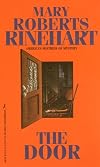
The Door
by Mary Roberts Rinehart
On This Page
Description
In a quiet old mansion, an aging spinster contemplates questions of murder Elizabeth Bell runs a quiet household, with no family and no more than the usual number of servants. She passes her time thinking about crime and working on her biography of a relative. When a young cousin comes to stay, life in the house becomes uncharacteristically lively. First, cousin Judy burns a hole in Miss Bell's desk. Next, they spy a burglar on the staircase-a shadowy figure who vanishes without a trace. And show more finally, Sarah, the nurse, takes the dogs for a walk and never returns. She is found savagely murdered, and she will not be the last to die. At first, Miss Bell stays calm, but when the police determine that the killer was one of her household, she begins to panic. If one of her servants is the killer, what is an old woman to do? show lessTags
Recommendations















Member Reviews
SPOILER ALERT: This is the mystery novel that began the genre of "The Butler Did It." Of course, while that is a complete spoiler alert, I must add that the book is skillfully written, and until the end, I kept wondering how the author was going to pull it off.....
A classic of the "had-I-but-known" school of mystery, invented by Rinehart, in which the narrator relates the tale as a reminiscence, commenting throughout on the oversights of the characters. The voice is pure Rinehart -- that wry, breezy, conversational tone of the strong older woman who is shocked but resolute as her world disintegrates around her.
This book is also held responsible for a favorite mystery cliché, but you'll have to Google that, lest it spoil someone's reading...
This book is also held responsible for a favorite mystery cliché, but you'll have to Google that, lest it spoil someone's reading...
After reading Man in the Lower Ten I researched the life of Mary Roberts Rinehart as I thought I had read some of her novels when I was in high school but couldn't remember any of the titles and wanted to know more about the author. Learning Rinehart was "an American writer, often called the American Agatha Christie, although her first mystery novel was published 14 years before Christie's first novel in 1920" was extraordinary. "Rinehart is also considered to have invented the 'Had-I-But-Known' school of mystery writing, with the publication of The Circular Staircase (1908)" so that had to be my next selection to read by this author. At the same time I learned that "Rinehart is considered the source of the phrase "The butler did it" show more from her novel The Door (1930), although the novel does not use the exact phrase” but in many ways the information didn't truly register with me.
I started reading The Door and became quite absorbed in the twists and turns and as I was still trying to “solve” the first murder, it was quickly followed by another, and then another, and well you get the idea. I had many suspicions along the way only to turn to the last page and be totally wrong.
I'm so happy that I rediscovered the mysteries by Mary Roberts Rinehart. I can't wait to read more of her novels. show less
I started reading The Door and became quite absorbed in the twists and turns and as I was still trying to “solve” the first murder, it was quickly followed by another, and then another, and well you get the idea. I had many suspicions along the way only to turn to the last page and be totally wrong.
I'm so happy that I rediscovered the mysteries by Mary Roberts Rinehart. I can't wait to read more of her novels. show less
September 18, 2000
The Door
Mary Roberts Rhinehart
Sarah Gittings, Elizabeth Bell's family nurse, has just been brutally murdered. But all thoughts of a homicidal maniac running amok are banished when the evidence reveals that Sarah actually knew and trusted her murderer. Now, Elizabeth Bell is about to discover that her staid and orderly household harbors more than one suspect with a motive--and unfortunately, more than one victim.
Though I occasionally need a break from MRR, there are times when I’m so addicted to her excellent stories that I just can’t get enough. I know they’re all similar. Different plots, but always the same characters (with different names). I don’t care, though. I love the wonderful sense of foreboding I show more always feel when reading one of her books, and the rather unique way of building suspense that she has – you know something terrible has happened, because she tells you “if only she had known what would happen that day, things would have been different”, and at that point you can’t help but read on. It’s a talent of hers, this method. show less
The Door
Mary Roberts Rhinehart
Sarah Gittings, Elizabeth Bell's family nurse, has just been brutally murdered. But all thoughts of a homicidal maniac running amok are banished when the evidence reveals that Sarah actually knew and trusted her murderer. Now, Elizabeth Bell is about to discover that her staid and orderly household harbors more than one suspect with a motive--and unfortunately, more than one victim.
Though I occasionally need a break from MRR, there are times when I’m so addicted to her excellent stories that I just can’t get enough. I know they’re all similar. Different plots, but always the same characters (with different names). I don’t care, though. I love the wonderful sense of foreboding I show more always feel when reading one of her books, and the rather unique way of building suspense that she has – you know something terrible has happened, because she tells you “if only she had known what would happen that day, things would have been different”, and at that point you can’t help but read on. It’s a talent of hers, this method. show less
A century after Mary Roberts Rinehart first put pen to paper, her novels remain as thrilling as ever. In The Door, set in Upstate New York in 1927, practical spinster Elizabeth Jane Bell sees her household troubled by the death of Sarah Gittings, a woman who had served as nurse to her family for 20 years. Who could have killed the unemotional Sarah? It turns out that it is someone with a very good handle on the household’s layout and routine. Soon Elizabeth’s family are all suspecting one another.
I was lucky enough to listen to The Door on Audible; Liza Ross did a fabulous job as narrator.
I was lucky enough to listen to The Door on Audible; Liza Ross did a fabulous job as narrator.
96. The Door by Mary Roberts Rinehart (read 1942) I was in eighth grade when I read this book and know that I really liked it.
Ratings
Members
- Recently Added By
Lists

Isle Royale
18 works; 1 member

Publisher's Weekly Bestsellers Part I - 1895-1939
399 works; 8 members
Author Information

142+ Works 8,184 Members
Mary Roberts Rinehart was born in the City of Allegheny, Pennsylvania on August 12, 1876. While attending Allegheny High School, she received $1 each for three short stories from a Pittsburgh newspaper. After receiving inspiration from a town doctor who happened to be a woman, she developed a curiosity for medicine. She went on to study nursing at show more the Pittsburgh Training School for Nurses at Homeopathic Hospital. After graduating in 1896, she began her writing career. The first of her many mystery stories, The Circular Staircase (1908), established her as a leading writer of the genre; Rinehart and Avery Hopwood successfully dramatized the novel as The Bat (1920). Her other mystery novels include The Man in Lower Ten (1909), The Case of Jennie Brice (1914), The Red Lamp (1925), The Door (1930), The Yellow Room (1945), and The Swimming Pool (1952). Stories about Tish, a self-reliant spinster, first appeared in the Saturday Evening Post and were collected into The Best of Tish (1955). She wrote more than 50 books, eight plays, hundreds of short stories, poems, travelogues and special articles. Three of her plays were running on Broadway at one time. During World War I, she was the first woman war correspondent at the Belgian front. She died September 22, 1958 at the age of 82. (Bowker Author Biography) show less
Awards and Honors
Distinctions
Series
Belongs to Publisher Series
Work Relationships
Is contained in
Common Knowledge
- Original publication date
- 1930
- Related movies
- The Bat (1959 | IMDb)
- First words
- I have wrenched my knee, and for the past two weeks my days have consisted of three trays, two of them here in the library, a nurse at ten o'clock each morning with a device of infernal origin, which is supposed to bake the p... (show all)ain out of my leg, and my thoughts for company.
- Quotations
- The butler did it
- Last words
- (Click to show. Warning: May contain spoilers.)And with that I believe that I fainted.
Classifications
Statistics
- Members
- 263
- Popularity
- 123,182
- Reviews
- 6
- Rating
- (3.89)
- Languages
- English, Italian
- Media
- Paper, Audiobook, Ebook
- ISBNs
- 15
- UPCs
- 1
- ASINs
- 24