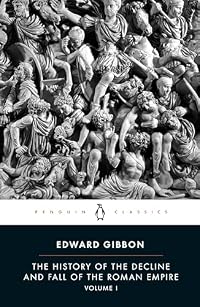
The History of the Decline and Fall of the Roman Empire, Vol. 1 [Penguin Classics]
by Edward Gibbon
The Decline and Fall - Womersley (1)
On This Page
Description
The pre-eminent historian of his day, Edward Gibbon (1737-94) produced his magnum opus in six volumes between 1776 and 1788. Reissued here is the authoritative seven-volume edition prepared by J.B. Bury (1861-1927) between 1896 and 1900. Immediately and widely acclaimed, Gibbon's work remains justly famous for its magisterial account of Roman imperialism and Christianity from the first century CE through to the fall of Constantinople and beyond. Innovative in its use of primary sources and show more notable for its tone of religious scepticism, this epic narrative stands as a masterpiece of English literature and historical scholarship. Volume 1 commences with the early emperors and a survey of the empire's extent and expansion. Examining Roman culture, law, government, slavery and agriculture, Gibbon guides the reader through three centuries to Constantine's emergence as sole emperor in 324. show lessTags
Recommendations





Member Reviews
Volume I
It is a testament to the breadth of Gibbon's passion that his Decline and Fall, widely regarded as a literary monument, on reading appears merely to expatiate on some salient thoughts. The charm of Gibbon resides in his unashamed partiality, notwithstanding his wise words on the responsibility of historians to extract truth from exaggeration and understatement alike.
Gibbon, in the mould of his beloved Tacitus, is not for the faint-hearted, nor for the politically correct, religiously devout or feminist. Histories of a similar scale have been successfully abridged, but it would be sacrilegious to attempt the same with Gibbon. The careful editor may capture the essence but will inevitably lose the rich turn of phrase for which the show more Decline and Fall is so fondly read. For some reason, I never tire of the rapine, licentiousness, degeneracy, effeminacy, corruption and avarice which so liberally pepper Volume I.
Before I provide some extracts of Gibbon's wonderful prose, on some particular topics which attracted my interest, it is worthwhile to comment on the title itself. Of course, it is a tautology. An empire cannot be in constant decline for well over a thousand years. But it points to the author's purpose, which is to extract the relation of each event to the eventual fate of the empire. In his quest, Gibbon was meticulous in researching and documenting primary and secondary sources; this in itself has left a profound influence.
I. The meanderings of barbarians, whether from Caledonia or Gaul, provide some humorous insights. Naturally, Gibbon is dismissive of the uncivilised or unlearned.
On the Caledonians (of Scottish extraction):-
"The masters of the fairest and most wealthy climates of the globe turned with contempt from gloomy hills assailed by the winter tempest, from lakes concealed in a blue mist, and from cold and lonely heaths, over which the deer of the forest were chased by a troop of naked barbarians."
On the Germans:-
"Fully to apprehend this important truth, let us attempt, in an improved society, to calculate the immense distance between the man of learning and the illiterate peasant. The former, by reading and reflection, multiplies his own experience, and lives in distant ages and remote countries; whilst the latter, rooted to a single spot, and confined to a few years of existence, surpasses but very little his fellow-labourer the ox in the exercise of his mental faculties."
II. Organised religion, accompanied by its propagation or persecution at the whims of emperors or on dubious philosophical grounds, is ridiculed. But Gibbon did not omit from his account the apparent harmony which pervaded pre-Christian religion:-
"The various modes of worship which prevailed in the Roman world were all considered by the people as equally true; by the philosopher as equally false; and by the magistrate as equally useful. And thus toleration produced not only mutual indulgence, but even religious concord."
Christianity is by no means singularly treated. Here Gibbon comments on the Greek philosopher Apollonius of Tyana:-
"His life (that of the former) is related in so fabulous a manner by his disciples, that we are at a loss to discover whether he was a sage, an impostor, or a fanatic."
Gibbon is scathing in his criticism of early Christian fanaticism:-
"Credulity performed the office of faith; fanaticism was permitted to assume the language of inspiration, and the effects of accident or contrivance were ascribed to supernatural causes."
"It is this deep impression of supernatural truths which has been so much celebrated under the name of faith; a state of mind described as the surest pledge of the divine favour and of future felicity, and recommended as the first or perhaps the only merit of a Christian."
But it is the apologists who are most comprehensively vilified:-
"The total disregard of truth and probability in the representation of these primitive martyrdoms was occasioned by a very natural mistake. The ecclesiastical writers of the fourth or fifth centuries ascribed to the magistrates of Rome the same degree of implacable and unrelenting zeal which filled their own breasts against the heretics or the idolaters of their own times."
"A convenient distance of time or place gave an ample scope to the progress of fiction; and the frequent instances which might be alleged of holy martyrs, whose wounds had been instantly healed, whose strength had been renewed, and whose lost members had miraculously been restored, were extremely convenient for the purpose of removing every difficulty and of silencing every objection."
"We shall conclude this chapter by a melancholy truth which obtrudes itself on the reluctant mind; that even admitting, without hesitation or inquiry, all that history has recorded, or devotion has feigned, on the subject of martyrdoms, it must still be acknowledged that the Christians, in the course of their intestine dissensions, have inflicted far greater severities on each other than they had experienced from the zeal of infidels."
III. The descent of the famed Roman army is attributed to excessive payment to soldiers and their succumbing to luxury and licentiousness.
"But in proportion as the public freedom was lost in extent of conquest, war was gradually improved into an art, and degraded into a trade."
"Their personal valour remained, but they no longer possessed that public courage which is nourished by the love of independence, the sense of national honour, the presence of danger, and the habit of command."
The generosity of the emperor Severus to his soldiers is condemned:-
"Had the emperor pursued the train of reflection, he would have discovered that the primary cause of this general corruption might be ascribed, not indeed to the example, but to the pernicious indulgence, however, of the commander-in-chief."
In a similar vein, Gibbon praises the severity of Aurelian:-
"One of the soldiers had seduced the wife of his host. The guilty wretch was fastened to two trees forcibly drawn towards each other, and his limbs were torn asunder by their sudden separation. A few such examples impressed a salutary consternation."
Typical of Gibbon's wit, a comment on developments in modern warfare:-
"There is no surer proof of the military skill of the Romans, than their first surmounting the idle terror, and afterwards disdaining the dangerous use, of elephants in war."
IV. The fall of the Roman empire is accompanied by, either as precursor or result, a degradation in human knowledge and learning.
"The name of Poet was almost forgotten; that of Orator was usurped by the sophists. A cloud of critics, of compilers, of commentators, darkened the face of learning, and the decline of genius was soon followed by the corruption of taste."
Knowledge is substituted by superstition:-
"When Cæsar subdued the Gauls, that great nation was already divided into three orders of men; the clergy, the nobility, and the common people. The first governed by superstition, the second by arms, but the third and last was not of any weight or account in their public councils."
"The guardians of these ancient oracles were as well versed in the arts of this world, as they were ignorant of the secrets of fate; and they returned him a very prudent answer, which might adapt itself to the event, and secure their reputation whatever should be the chance of arms."
V. Gibbon's wit pervades every aspect of human life. Here he provides a simple explanation for global warming:-
"The modern improvements sufficiently explain the causes of the diminution of the cold. These immense woods have been gradually cleared, which intercepted from the earth the rays of the sun. The morasses have been drained, and, in proportion as the soil has been cultivated, the air has become more temperate."
But he will find difficulty in impressing today's feminist:-
"Female courage, however it may be raised by fanaticism, or confirmed by habit, can be only a faint and imperfect imitation of the manly valour that distinguishes the age or country in which it may be found."
Nor can he disdain from mocking the early Christian:-
"It was with the utmost difficulty that ancient Rome could support the institution of six vestals; but the primitive church was filled with a great number of persons of either sex who had devoted themselves to the profession of perpetual chastity."
Or the apologists:-
"The adoption of fraud and sophistry in the defence of revelation too often reminds us of the injudicious conduct of those poets who load their invulnerable heroes with a useless weight of cumbersome and brittle armour."
While, at least judging from Volume I, one can hardly call Gibbon faultless, perfectly weighted prose and exquisite irony makes reading Decline and Fall a pleasure. show less
It is a testament to the breadth of Gibbon's passion that his Decline and Fall, widely regarded as a literary monument, on reading appears merely to expatiate on some salient thoughts. The charm of Gibbon resides in his unashamed partiality, notwithstanding his wise words on the responsibility of historians to extract truth from exaggeration and understatement alike.
Gibbon, in the mould of his beloved Tacitus, is not for the faint-hearted, nor for the politically correct, religiously devout or feminist. Histories of a similar scale have been successfully abridged, but it would be sacrilegious to attempt the same with Gibbon. The careful editor may capture the essence but will inevitably lose the rich turn of phrase for which the show more Decline and Fall is so fondly read. For some reason, I never tire of the rapine, licentiousness, degeneracy, effeminacy, corruption and avarice which so liberally pepper Volume I.
Before I provide some extracts of Gibbon's wonderful prose, on some particular topics which attracted my interest, it is worthwhile to comment on the title itself. Of course, it is a tautology. An empire cannot be in constant decline for well over a thousand years. But it points to the author's purpose, which is to extract the relation of each event to the eventual fate of the empire. In his quest, Gibbon was meticulous in researching and documenting primary and secondary sources; this in itself has left a profound influence.
I. The meanderings of barbarians, whether from Caledonia or Gaul, provide some humorous insights. Naturally, Gibbon is dismissive of the uncivilised or unlearned.
On the Caledonians (of Scottish extraction):-
"The masters of the fairest and most wealthy climates of the globe turned with contempt from gloomy hills assailed by the winter tempest, from lakes concealed in a blue mist, and from cold and lonely heaths, over which the deer of the forest were chased by a troop of naked barbarians."
On the Germans:-
"Fully to apprehend this important truth, let us attempt, in an improved society, to calculate the immense distance between the man of learning and the illiterate peasant. The former, by reading and reflection, multiplies his own experience, and lives in distant ages and remote countries; whilst the latter, rooted to a single spot, and confined to a few years of existence, surpasses but very little his fellow-labourer the ox in the exercise of his mental faculties."
II. Organised religion, accompanied by its propagation or persecution at the whims of emperors or on dubious philosophical grounds, is ridiculed. But Gibbon did not omit from his account the apparent harmony which pervaded pre-Christian religion:-
"The various modes of worship which prevailed in the Roman world were all considered by the people as equally true; by the philosopher as equally false; and by the magistrate as equally useful. And thus toleration produced not only mutual indulgence, but even religious concord."
Christianity is by no means singularly treated. Here Gibbon comments on the Greek philosopher Apollonius of Tyana:-
"His life (that of the former) is related in so fabulous a manner by his disciples, that we are at a loss to discover whether he was a sage, an impostor, or a fanatic."
Gibbon is scathing in his criticism of early Christian fanaticism:-
"Credulity performed the office of faith; fanaticism was permitted to assume the language of inspiration, and the effects of accident or contrivance were ascribed to supernatural causes."
"It is this deep impression of supernatural truths which has been so much celebrated under the name of faith; a state of mind described as the surest pledge of the divine favour and of future felicity, and recommended as the first or perhaps the only merit of a Christian."
But it is the apologists who are most comprehensively vilified:-
"The total disregard of truth and probability in the representation of these primitive martyrdoms was occasioned by a very natural mistake. The ecclesiastical writers of the fourth or fifth centuries ascribed to the magistrates of Rome the same degree of implacable and unrelenting zeal which filled their own breasts against the heretics or the idolaters of their own times."
"A convenient distance of time or place gave an ample scope to the progress of fiction; and the frequent instances which might be alleged of holy martyrs, whose wounds had been instantly healed, whose strength had been renewed, and whose lost members had miraculously been restored, were extremely convenient for the purpose of removing every difficulty and of silencing every objection."
"We shall conclude this chapter by a melancholy truth which obtrudes itself on the reluctant mind; that even admitting, without hesitation or inquiry, all that history has recorded, or devotion has feigned, on the subject of martyrdoms, it must still be acknowledged that the Christians, in the course of their intestine dissensions, have inflicted far greater severities on each other than they had experienced from the zeal of infidels."
III. The descent of the famed Roman army is attributed to excessive payment to soldiers and their succumbing to luxury and licentiousness.
"But in proportion as the public freedom was lost in extent of conquest, war was gradually improved into an art, and degraded into a trade."
"Their personal valour remained, but they no longer possessed that public courage which is nourished by the love of independence, the sense of national honour, the presence of danger, and the habit of command."
The generosity of the emperor Severus to his soldiers is condemned:-
"Had the emperor pursued the train of reflection, he would have discovered that the primary cause of this general corruption might be ascribed, not indeed to the example, but to the pernicious indulgence, however, of the commander-in-chief."
In a similar vein, Gibbon praises the severity of Aurelian:-
"One of the soldiers had seduced the wife of his host. The guilty wretch was fastened to two trees forcibly drawn towards each other, and his limbs were torn asunder by their sudden separation. A few such examples impressed a salutary consternation."
Typical of Gibbon's wit, a comment on developments in modern warfare:-
"There is no surer proof of the military skill of the Romans, than their first surmounting the idle terror, and afterwards disdaining the dangerous use, of elephants in war."
IV. The fall of the Roman empire is accompanied by, either as precursor or result, a degradation in human knowledge and learning.
"The name of Poet was almost forgotten; that of Orator was usurped by the sophists. A cloud of critics, of compilers, of commentators, darkened the face of learning, and the decline of genius was soon followed by the corruption of taste."
Knowledge is substituted by superstition:-
"When Cæsar subdued the Gauls, that great nation was already divided into three orders of men; the clergy, the nobility, and the common people. The first governed by superstition, the second by arms, but the third and last was not of any weight or account in their public councils."
"The guardians of these ancient oracles were as well versed in the arts of this world, as they were ignorant of the secrets of fate; and they returned him a very prudent answer, which might adapt itself to the event, and secure their reputation whatever should be the chance of arms."
V. Gibbon's wit pervades every aspect of human life. Here he provides a simple explanation for global warming:-
"The modern improvements sufficiently explain the causes of the diminution of the cold. These immense woods have been gradually cleared, which intercepted from the earth the rays of the sun. The morasses have been drained, and, in proportion as the soil has been cultivated, the air has become more temperate."
But he will find difficulty in impressing today's feminist:-
"Female courage, however it may be raised by fanaticism, or confirmed by habit, can be only a faint and imperfect imitation of the manly valour that distinguishes the age or country in which it may be found."
Nor can he disdain from mocking the early Christian:-
"It was with the utmost difficulty that ancient Rome could support the institution of six vestals; but the primitive church was filled with a great number of persons of either sex who had devoted themselves to the profession of perpetual chastity."
Or the apologists:-
"The adoption of fraud and sophistry in the defence of revelation too often reminds us of the injudicious conduct of those poets who load their invulnerable heroes with a useless weight of cumbersome and brittle armour."
While, at least judging from Volume I, one can hardly call Gibbon faultless, perfectly weighted prose and exquisite irony makes reading Decline and Fall a pleasure. show less
Let's be very clear about one thing: if you write English prose, and if you read a lot and care about English prose, you should read Gibbon. His sentences are perfect. Each is carefully weighted, pulling the reader through like a kind of perpetual motion machine; the syntax and the content are perfectly matched. Certainly some constructions seem a little dated, but generally that makes me think that contemporary prose is impoverished, rather than that Gibbon's is overly difficult. Just as all Western intellectual life feeds into Dante, so all Western prose feeds into Gibbon: Tacitus' compression, Swift's clarity, Voltaire's irony, and doubtless plenty of people I've never read, too.
Here's a sentence more or less chosen at random: "The show more general respect with which these deputies were received, and the zeal of Italy and the provinces in favour of the senate, sufficiently prove that the subjects of Maximin were reduced to that uncommon distress in which the body of the people has more to fear from oppression than from resistance." This single thought--that the conditions of the early clauses prove that the people were so oppressed that revolution became inevitable--would take a paragraph of clauseless, muddy Hemingwayed nouns.
Add to this Gibbon's possession of most seventeenth century virtues--clarity, unwillingness to hide his contradictory thoughts, judgments made according to morality rather than form--and his work becomes all the more remarkable. Of course, he also has the greatest seventeenth century vices, which he has to have if he's going to display his contradictory thoughts. He's a supreme enlightenment thinker, obsessed with natural laws (hence, he should be universalist) who's also strangely bigoted. The barbarians are uncultured, the Romans effeminate, the Byzantines weak and so on. The Jews, who bizarrely insist on worshiping only their own national God, are villains, as are the Christians who take over this insistence on the unity of the deity.
David Womersley's introduction is excellent, too; it makes very clear the contradictions between Gibbon's overarching argument (supposedly, that Christianity is the 'cause' of the D&F) and what he actually writes. He's fascinated by the accidents of history ("Cleopatra's nose"), and he lays out in great detail the many, many social trends that would eventually lead to the fall of the West. Although the book is organized as if Christianity is the primary cause (the first volume ends with two chapters on the new religion; the second begins with Constantine), Gibbon himself must have recognized that his book had become something much more than another philosophe-like attack on early modern religion. Of course, he also gets in some great jabs at ancient Christianity.
Also tied to his general plan: every section ends with a lament for the continuing decline of the empire, even as the empire stubbornly continues to exist. This has surely shaped Western attitudes to Rome for the worse. Constantinople stood into the fifteenth century; Constantinople was Roman. But too many writers, particularly conservatives, like to say that Rome fell due to x, which is exactly what Obama is giving us. That's fatuous. Rome lasted for two thousand years: would you say the United States fell because the capital was moved from D. C. to Portland, and then D.C. was taken by Mexico? No, you would not.
But if there's a real flaw to the work, it's simply that Gibbon couldn't help attacking ancient historians, particularly ecclesiastical historians. They deserve attack, and if I'd spent dozens of years reading about so and so's miracles and the genius of such and such, I'd be on the offensive as well. But only rarely does this make for good reading.
He also tends towards moralizing generalities: outside of the major figures (Julian, Constantine etc...), he too often writes that this usurper was bad, without explaining how or why. That might be a problem with his sources, of course, but again, a little boring.
I don't imagine many people will get through the six volumes of this work. There's too much of everything, so whatever you dislike, you'll find it here. Personally, I was rarely riveted by his explanations of battles and wars. So and so set up by the mountains; so and so in the valley... I'm asleep. Others will be tortured by his discussions of early Christian heresies. On the other hand, if you can get into Game of Thrones, you can get into this. It's the original fantasy novel.
So, in sum, it's not perfect. What a damning indictment. show less
Here's a sentence more or less chosen at random: "The show more general respect with which these deputies were received, and the zeal of Italy and the provinces in favour of the senate, sufficiently prove that the subjects of Maximin were reduced to that uncommon distress in which the body of the people has more to fear from oppression than from resistance." This single thought--that the conditions of the early clauses prove that the people were so oppressed that revolution became inevitable--would take a paragraph of clauseless, muddy Hemingwayed nouns.
Add to this Gibbon's possession of most seventeenth century virtues--clarity, unwillingness to hide his contradictory thoughts, judgments made according to morality rather than form--and his work becomes all the more remarkable. Of course, he also has the greatest seventeenth century vices, which he has to have if he's going to display his contradictory thoughts. He's a supreme enlightenment thinker, obsessed with natural laws (hence, he should be universalist) who's also strangely bigoted. The barbarians are uncultured, the Romans effeminate, the Byzantines weak and so on. The Jews, who bizarrely insist on worshiping only their own national God, are villains, as are the Christians who take over this insistence on the unity of the deity.
David Womersley's introduction is excellent, too; it makes very clear the contradictions between Gibbon's overarching argument (supposedly, that Christianity is the 'cause' of the D&F) and what he actually writes. He's fascinated by the accidents of history ("Cleopatra's nose"), and he lays out in great detail the many, many social trends that would eventually lead to the fall of the West. Although the book is organized as if Christianity is the primary cause (the first volume ends with two chapters on the new religion; the second begins with Constantine), Gibbon himself must have recognized that his book had become something much more than another philosophe-like attack on early modern religion. Of course, he also gets in some great jabs at ancient Christianity.
Also tied to his general plan: every section ends with a lament for the continuing decline of the empire, even as the empire stubbornly continues to exist. This has surely shaped Western attitudes to Rome for the worse. Constantinople stood into the fifteenth century; Constantinople was Roman. But too many writers, particularly conservatives, like to say that Rome fell due to x, which is exactly what Obama is giving us. That's fatuous. Rome lasted for two thousand years: would you say the United States fell because the capital was moved from D. C. to Portland, and then D.C. was taken by Mexico? No, you would not.
But if there's a real flaw to the work, it's simply that Gibbon couldn't help attacking ancient historians, particularly ecclesiastical historians. They deserve attack, and if I'd spent dozens of years reading about so and so's miracles and the genius of such and such, I'd be on the offensive as well. But only rarely does this make for good reading.
He also tends towards moralizing generalities: outside of the major figures (Julian, Constantine etc...), he too often writes that this usurper was bad, without explaining how or why. That might be a problem with his sources, of course, but again, a little boring.
I don't imagine many people will get through the six volumes of this work. There's too much of everything, so whatever you dislike, you'll find it here. Personally, I was rarely riveted by his explanations of battles and wars. So and so set up by the mountains; so and so in the valley... I'm asleep. Others will be tortured by his discussions of early Christian heresies. On the other hand, if you can get into Game of Thrones, you can get into this. It's the original fantasy novel.
So, in sum, it's not perfect. What a damning indictment. show less
Más de 250 años de historia, desde Marco Antonio (~ año 100) a la invasion de los hunos (~ año 375).
Este libro aunque se llama Vol 1, realmente contiene los volumenes 1 y 2 originales que fueron publicados en 1776 and 1781.
Este libro es bastante largo con más de 1000 páginas pero se hace muy ameno.
Es una larga sucesion de traiciones, asesinatos, guerras civiles, guerras externas, internas, politicas, conjuras familiares, etc. En un momento, la propia abuela del emperador se conjura para que le asesinen y poner a su primo.
Una especie de juego de tronos pero esto es historia autentica.
El lenguaje del libro es a la vez sencillo pero bello. Ameno y bien explicado
La unica pega que le encuentro son esos capitulos sobre el cristianismo show more que no mantienen el nivel de tension del resto del libro. Tambien parece que el ritmo se esta ralentizando. La mitad del libro es la explicación de los ultimos 75 años de este periodo mientras que la primera mitad explica los otros 200 años. show less
Este libro aunque se llama Vol 1, realmente contiene los volumenes 1 y 2 originales que fueron publicados en 1776 and 1781.
Este libro es bastante largo con más de 1000 páginas pero se hace muy ameno.
Es una larga sucesion de traiciones, asesinatos, guerras civiles, guerras externas, internas, politicas, conjuras familiares, etc. En un momento, la propia abuela del emperador se conjura para que le asesinen y poner a su primo.
Una especie de juego de tronos pero esto es historia autentica.
El lenguaje del libro es a la vez sencillo pero bello. Ameno y bien explicado
La unica pega que le encuentro son esos capitulos sobre el cristianismo show more que no mantienen el nivel de tension del resto del libro. Tambien parece que el ritmo se esta ralentizando. La mitad del libro es la explicación de los ultimos 75 años de este periodo mientras que la primera mitad explica los otros 200 años. show less
Outstanding! Beware the reader will be captivated from the first paragraph.
Gibbon's style is so wonderful and his knowledge so easy that one can forget to question some of his opinions and conclusions. Being written in the 18th century, Gibbon gives you his view of matters on the page. While his use of footnotes is eccentric @ best, he does make good use of primary material and the reader will want a pen @ hand to underline scores of passages.
Gibbon's style is so wonderful and his knowledge so easy that one can forget to question some of his opinions and conclusions. Being written in the 18th century, Gibbon gives you his view of matters on the page. While his use of footnotes is eccentric @ best, he does make good use of primary material and the reader will want a pen @ hand to underline scores of passages.
Preface
Chapter I
Chapter II: Of the Union and Internal Prosperity of the Roman Empire in the Age of the Antonines
Chapter III: Of the Constitution of the Roman Empire in the Age of the Antonines
Chapter IV: The cruelty, follies and murder of Commodus [with added Pertinax]
Chapter V: mostly about Septimius Severus
Chapter VI: Septimius Severus, Caracalla, Macrinus, Elagabalus and Alexander Severus; and taxation
Chapter VII: The Year of Six Emperors, and Philip the Arab
Chapter VIII: Of the state of Persia after the restoration of the monarchy by Artaxerxes
Chapter IX: The state of Germany till the invasion of the Barbarians
Chapter X: mostly about the Goths
Chapter XI: mostly about Aurelian
Chapter XII: Tacitus, Probus, Carus, and the rise of show more Diocletian
Chapter XIII: Diocletian
Chapter XIV: The Rise of Constantine
Chapter XV: Early Christianity
Chapter XVI: Early Christianity and the Emperors
Chapter XVII: Constantinople and Constantine's system of government
Chapter XVIII: Constantine and his successors
Chapter XIX: Constantius, Gallus and Julian
Chapter XX: The conversion of Constantine and the establishment of Christianity
Chapter XXI: Heresy and paganism
Chapter XXII: The Rise of Julian the Apostate
Chapter XXIII: Julian and his Apostasy
Chapter XXIV: Julian's Persian campaign, and his death
Chapter XXV: Jovian, Valentinian, Valens, Valentinian's sons & the final division of the empire
Chapter XXVI: The Goths infiltrate show less
Chapter I
Chapter II: Of the Union and Internal Prosperity of the Roman Empire in the Age of the Antonines
Chapter III: Of the Constitution of the Roman Empire in the Age of the Antonines
Chapter IV: The cruelty, follies and murder of Commodus [with added Pertinax]
Chapter V: mostly about Septimius Severus
Chapter VI: Septimius Severus, Caracalla, Macrinus, Elagabalus and Alexander Severus; and taxation
Chapter VII: The Year of Six Emperors, and Philip the Arab
Chapter VIII: Of the state of Persia after the restoration of the monarchy by Artaxerxes
Chapter IX: The state of Germany till the invasion of the Barbarians
Chapter X: mostly about the Goths
Chapter XI: mostly about Aurelian
Chapter XII: Tacitus, Probus, Carus, and the rise of show more Diocletian
Chapter XIII: Diocletian
Chapter XIV: The Rise of Constantine
Chapter XV: Early Christianity
Chapter XVI: Early Christianity and the Emperors
Chapter XVII: Constantinople and Constantine's system of government
Chapter XVIII: Constantine and his successors
Chapter XIX: Constantius, Gallus and Julian
Chapter XX: The conversion of Constantine and the establishment of Christianity
Chapter XXI: Heresy and paganism
Chapter XXII: The Rise of Julian the Apostate
Chapter XXIII: Julian and his Apostasy
Chapter XXIV: Julian's Persian campaign, and his death
Chapter XXV: Jovian, Valentinian, Valens, Valentinian's sons & the final division of the empire
Chapter XXVI: The Goths infiltrate show less
Very interesting so far. Of course, this is only volume 1 of 6.
La opinión de Jorge Luis Borges sobre este libro es muy superior a la mia. Así que mejor copiar y pegar:
Las propias deficiencias, o, si se quiere, abstenciones de Gibbon, son favorables a la obra. Si ésta hubiera sido escrita en función de tal o cual teoría, la aprobación o desaprobación del lector dependerían del juicio que la tesis pudiera merecerle. Tal no es, ciertamente, el caso de Gibbon. Fuera de aquella prevención contra el sentimiento religioso en general y contra la fe cristiana en particular que declara en ciertos famosos capítulos, Gibbon parece abandonarse a los hechos que narra y los refleja con una divina inconsciencia que lo asemeja al ciego destino, al propio curso de la historia.
El buen sentido y la ironía show more son costumbres de Gibbon. Tácito alaba la reverencia de los germanos, que no encerraron a sus dioses entre paredes y que no se atrevieron a figurarlos en madera o en mármol; Gibbon se limita a observar que mal podían tener templos o estatuas quienes apenas tenían chozas. En lugar de escribir que no hay confirmación alguna de los milagros que divulga la Biblia, Gibbon censura la imperdonable distracción de aquellos paganos que, en sus largos catálogos de prodigios, nada nos dicen de la luna y del sol, que detuvieron todo un día su curso, o del eclipse y del terremoto que acompañaron la muerte de Jesús.
...La obra de Gibbon sigue incólume y es verosímil conjeturar que no la tocarán las vicisitudes del porvenir. Dos causas colaboran en esta perduración. La primera y quizá la más importante, es de orden estético; estriba en el encanto, que, según Stevenson, es la imprescindible y esencial virtud de la literatura. La otra razón estribaría en el hecho, acaso melancólico, de que al cabo del tiempo, el historiador se convierte en historia y no sólo nos importa saber cómo era el campamento de Atila sino cómo podía imaginárselo un caballero inglés del siglo XVIII. show less
Las propias deficiencias, o, si se quiere, abstenciones de Gibbon, son favorables a la obra. Si ésta hubiera sido escrita en función de tal o cual teoría, la aprobación o desaprobación del lector dependerían del juicio que la tesis pudiera merecerle. Tal no es, ciertamente, el caso de Gibbon. Fuera de aquella prevención contra el sentimiento religioso en general y contra la fe cristiana en particular que declara en ciertos famosos capítulos, Gibbon parece abandonarse a los hechos que narra y los refleja con una divina inconsciencia que lo asemeja al ciego destino, al propio curso de la historia.
El buen sentido y la ironía show more son costumbres de Gibbon. Tácito alaba la reverencia de los germanos, que no encerraron a sus dioses entre paredes y que no se atrevieron a figurarlos en madera o en mármol; Gibbon se limita a observar que mal podían tener templos o estatuas quienes apenas tenían chozas. En lugar de escribir que no hay confirmación alguna de los milagros que divulga la Biblia, Gibbon censura la imperdonable distracción de aquellos paganos que, en sus largos catálogos de prodigios, nada nos dicen de la luna y del sol, que detuvieron todo un día su curso, o del eclipse y del terremoto que acompañaron la muerte de Jesús.
...La obra de Gibbon sigue incólume y es verosímil conjeturar que no la tocarán las vicisitudes del porvenir. Dos causas colaboran en esta perduración. La primera y quizá la más importante, es de orden estético; estriba en el encanto, que, según Stevenson, es la imprescindible y esencial virtud de la literatura. La otra razón estribaría en el hecho, acaso melancólico, de que al cabo del tiempo, el historiador se convierte en historia y no sólo nos importa saber cómo era el campamento de Atila sino cómo podía imaginárselo un caballero inglés del siglo XVIII. show less
Members
- Recently Added By
Lists

Bibliography of How the Old World Ended by Jonathan Scott
308 works; 1 member
Author Information

418+ Works 16,928 Members
All Editions
Some Editions
Series

Belongs to Publisher Series
Common Knowledge
- Canonical title
- The History of the Decline and Fall of the Roman Empire, Vol. 1 [Penguin Classics]
- Alternate titles
- The History of the Decline and Fall of the Roman Empire: Edward Gibbon: 1
Classifications
- Genres
- History, Nonfiction, General Nonfiction
- DDC/MDS
- 937.06 — History & geography History of ancient world (to ca. 499) Italian Peninsula to 476 and adjacent territories to 476 Empire 31 B.C.-476 A.D.
- LCC
- DG311 .G5 — History of Europe, Asia, Africa and Oceania City History of Italy Ancient Italy. Rome to 476 History By period Empire, 27 B.C. - 476 A.D. 284-476. Decline and fall
- BISAC
Statistics
- Members
- 566
- Popularity
- 51,894
- Reviews
- 8
- Rating
- (4.26)
- Languages
- English, German
- Media
- Paper, Ebook
- ISBNs
- 7
- UPCs
- 1