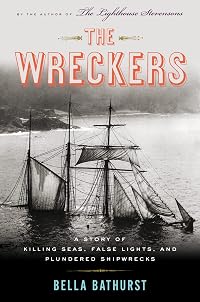
The Wreckers
by Bella Bathurst
On This Page
Description
Bella Bathurst's first book, the acclaimed The Lighthouse Stevensons,told the story of Scottish lighthouse construction by the ancestors of Robert Louis Stevenson. Now she returns to the sea to search out the darker side of those lights, detailing the secret history of shipwrecks and the predatory scavengers who live off the spoils. Even today, Britain's coastline remains a dangerous place. An island soaked by four separate seas, with shifting sand banks to the east, veiled reefs to the show more west, powerful currents above, and the world's busiest shipping channel below, the country's offshore waters are strewn with shipwrecks. For villagers scratching out an existence along Britain's shores, those wrecks have been more than simply an act of God; in many cases, they have been the difference between living well and just getting by. Though Daphne Du Maurier made Cornwall Britain's most notorious region for wrecking, many other coastal communities regarded the "sea's bounty" as an impromptu way of providing themselves with everything from grapefruits to grand pianos. Some plunderers were held to be so skilled that they could strip a ship from stem to stern before the Coast Guard had even left port, some were rumored to lure ships onto the rocks with false lights, and some simply waited for winter gales to do their work. From all around Britain, Bathurst has uncovered the hidden history of ships and shipwreck victims, from shoreline orgies so Dionysian that few participants survived the morning to humble homes fitted with silver candelabra, from coastlines rigged like stage sets to villages where everyone owns identical tennis shoes. Spanning three hundred years of history, The Wreckers examines the myths, the realities, and the superstitions of shipwrecks and uncovers the darker side of life on Britain's shores. show lessTags
Recommendations












Member Recommendations
The Map that Changed the World: The Tale of William Smith and the Birth of a Science by Simon Winchester
MinaKelly narrative non-fiction that gives a great picture of UK some centuries ago
Member Reviews
The title of this grand survey of nautical true crime presents an ambiguity right up front. Are wreckers people who cause shipwrecks in order to profit from them, or only people who passively take advantage of such shipwrecks as occur? In a sense, the entire book is devoted to teasing out the implications of that question. Bella Bathurst takes us round (literally) the island of Britain in this "Story of Killing Seas and Plundered Shipwrecks, from the Eighteenth Century to the Present Day," and in the process we meet not only wreckers under both definitions, but representatives of many other related "breeds": hovellers, salvors, pilots, lifesavers, lighthouse keepers, smugglers, and beachmen. (The Thames River has its own even more show more colorfully named types: river pirates, day and night plunderers, mudlarks, rat-catchers, and scuffle-hunters.) Many of these, no matter what skullduggery they engaged in, were (and needed to be) exceptional seamen.
Bathurst investigates, tours, and conducts interviews in seven wrecking zones:
The Goodwin Sands off Kent in the English Channel
The Pentland Firth in the north of Scotland
The Scilly Isles
The Hebrides on the West Coast of Scotland
The Thames
Cornwall
The East Coast of England (specifically the Norfolk / Suffolk / Essex area)
The geographical detail is delightful. The treacherous Goodwin Sands come and go with the tides.
The island of Stroma in the Pentland Firth, once modestly populated and kind of a Wrecker Central, is now abandoned to the elements.
The "garden isles" of Scilly are guarded by the forbidding Western Rocks.
Off the Scottish island of Mull, a boating George Orwell once nearly went down in the infamous Corryvreckan Whirlpool.
Wrecking has its strongest public associations in Cornwall and in the Scillies, where several generations of photographing Gibsons made beautiful images of disaster.
The chapter on always-picturesque Cornwall in The Wreckers is one of Bathurst's most amusing, as the Cornish persistently try to capitalize economically and touristically on their heritage of wrecking, while simultaneously denying that most of it ever happened. Fact and fiction become hard to disentangle here, as much of Cornwall's reputation for deliberate wrecking (putting out "false lights" and such) is derived second-hand from Daphne Du Maurier's popular 1936 novel Jamaica Inn, and the 1939 Alfred Hitchcock film based on it.
The real Jamaica Inn still exists on Bodmin Moor in Cornwall, and is understandably popular with visitors.
Another piece of popular culture that shaped perceptions of wrecking is Compton Mackenzie's 1947 novel Whisky Galore, along with Alexander Mackendrick's 1949 film adaptation. This story is based on a real incident, the grounding of the cargo ship SS Politician in the Hebrides in 1941. From the wreckers' standpoint, general cargo ships are usually the best prizes, carrying as they do all manner of useful, valuable, and just plain interesting goods. Given that there was a whisky shortage in Scotland in 1941 owing to World War II, the fact that the Politician was carrying several hundred thousand bottles of superb whisky bound for export to the United States was one of those once-in-a-lifetime pieces of good fortune that you just don't argue with.
Wrecking may not be what it once was, but Bathurst points out that it will continue to exist as long as there are ships at sea, and Great Britain still boasts a public official with the nifty title of "Receiver of Wreck." All salvage is supposed to be reported, and this has been the case for a very long time, but the problem has always been getting people to report, and most officials have ultimately looked the other way rather than pressing the point. Although, as Bathurst points out, "There is not a single line in the laws of England or Scotland which supports the notion of 'finders keepers'," the idea is deeply ingrained in the populace and will never disappear.
There is a continuum between casual beachcombing and the sort of actively malicious wrecking that involves false signaling, leaving wreck victims to die while retrieving their goods, and cutting fingers or biting ears off corpses in order to retrieve jewelry. At some point on that continuum, understandable high spirits give way to unforgivable criminality, but identifying the exact spot where the crossing-over takes place is not easy by the lights of law, philosophy, or even common sense. That's part of what makes wrecking a great subject. Bella Bathurst has done full justice to it. show less
Bathurst investigates, tours, and conducts interviews in seven wrecking zones:
The Goodwin Sands off Kent in the English Channel
The Pentland Firth in the north of Scotland
The Scilly Isles
The Hebrides on the West Coast of Scotland
The Thames
Cornwall
The East Coast of England (specifically the Norfolk / Suffolk / Essex area)
The geographical detail is delightful. The treacherous Goodwin Sands come and go with the tides.
The island of Stroma in the Pentland Firth, once modestly populated and kind of a Wrecker Central, is now abandoned to the elements.
The "garden isles" of Scilly are guarded by the forbidding Western Rocks.
Off the Scottish island of Mull, a boating George Orwell once nearly went down in the infamous Corryvreckan Whirlpool.
Wrecking has its strongest public associations in Cornwall and in the Scillies, where several generations of photographing Gibsons made beautiful images of disaster.
The chapter on always-picturesque Cornwall in The Wreckers is one of Bathurst's most amusing, as the Cornish persistently try to capitalize economically and touristically on their heritage of wrecking, while simultaneously denying that most of it ever happened. Fact and fiction become hard to disentangle here, as much of Cornwall's reputation for deliberate wrecking (putting out "false lights" and such) is derived second-hand from Daphne Du Maurier's popular 1936 novel Jamaica Inn, and the 1939 Alfred Hitchcock film based on it.
The real Jamaica Inn still exists on Bodmin Moor in Cornwall, and is understandably popular with visitors.
Another piece of popular culture that shaped perceptions of wrecking is Compton Mackenzie's 1947 novel Whisky Galore, along with Alexander Mackendrick's 1949 film adaptation. This story is based on a real incident, the grounding of the cargo ship SS Politician in the Hebrides in 1941. From the wreckers' standpoint, general cargo ships are usually the best prizes, carrying as they do all manner of useful, valuable, and just plain interesting goods. Given that there was a whisky shortage in Scotland in 1941 owing to World War II, the fact that the Politician was carrying several hundred thousand bottles of superb whisky bound for export to the United States was one of those once-in-a-lifetime pieces of good fortune that you just don't argue with.
Wrecking may not be what it once was, but Bathurst points out that it will continue to exist as long as there are ships at sea, and Great Britain still boasts a public official with the nifty title of "Receiver of Wreck." All salvage is supposed to be reported, and this has been the case for a very long time, but the problem has always been getting people to report, and most officials have ultimately looked the other way rather than pressing the point. Although, as Bathurst points out, "There is not a single line in the laws of England or Scotland which supports the notion of 'finders keepers'," the idea is deeply ingrained in the populace and will never disappear.
There is a continuum between casual beachcombing and the sort of actively malicious wrecking that involves false signaling, leaving wreck victims to die while retrieving their goods, and cutting fingers or biting ears off corpses in order to retrieve jewelry. At some point on that continuum, understandable high spirits give way to unforgivable criminality, but identifying the exact spot where the crossing-over takes place is not easy by the lights of law, philosophy, or even common sense. That's part of what makes wrecking a great subject. Bella Bathurst has done full justice to it. show less
From Jamaica Inn to Poldark to Whiskey Galore I, like others, have seen the 'fictional' take on wreckers in the British Isles but never really knew what was fact and what was fiction.
Secretly I was hoping that this book would be crammed with tales of luring unwary ships onto the rocks and stories of Cornishmen fleeing from the redcoats over the cliffs and to a degree it was, but, it was so much more.
Whilst the wrecking tales where what brought me to this book it delivered so much more with descriptions of the key wrecking areas and the people who inhabited them. It also branched out to cover lesser know areas classified as wrecking like Whales and other cretaceous relations.
I found that the history of the locations and organisations show more involved in the prevention of wrecking including the RNLI which significantly had its roots in wrecking before the poachers turned gamekeeper were fascinating.
Some may argue that parts of the book wandered too far from its core directive but it is this departure from the wrecking stories that make this a joy to read.
I'm off to track down Bella's previous book about the Stevenson Lighthouses show less
Secretly I was hoping that this book would be crammed with tales of luring unwary ships onto the rocks and stories of Cornishmen fleeing from the redcoats over the cliffs and to a degree it was, but, it was so much more.
Whilst the wrecking tales where what brought me to this book it delivered so much more with descriptions of the key wrecking areas and the people who inhabited them. It also branched out to cover lesser know areas classified as wrecking like Whales and other cretaceous relations.
I found that the history of the locations and organisations show more involved in the prevention of wrecking including the RNLI which significantly had its roots in wrecking before the poachers turned gamekeeper were fascinating.
Some may argue that parts of the book wandered too far from its core directive but it is this departure from the wrecking stories that make this a joy to read.
I'm off to track down Bella's previous book about the Stevenson Lighthouses show less
A very readable romp around Britain's maritime history. Well referenced, though maybe not for the historian; instead, it's a deeply enjoyable exploration of the myths and facts surrounding our treacherous coasts and their inhabitants.
Ratings
Members
- Recently Added By
Lists

Huxley's Reading Log 2018
37 works; 1 member
Author Information

Awards and Honors
Common Knowledge
- Canonical title
- The Wreckers
- Original publication date
- 2005
- Important places
- Cornwall, England, UK; Isles of Scilly, England, UK; St Kilda, Na h-Eileanan Siar, Scotland, UK; Norfolk, England, UK; London, England, UK; Goodwin Sands, Kent, England, UK (show all 7); Pentland Firth, Scotland, UK
Classifications
- Genres
- History, Nonfiction, General Nonfiction
- DDC/MDS
- 909.096336 — History & geography History World history Other Geographic Classifications Air And Water
- LCC
- DA90 .B334 — History of Europe, Asia, Africa and Oceania Great Britain History of Great Britain England History Antiquities. Social life and customs. Ethnography
- BISAC
Statistics
- Members
- 206
- Popularity
- 158,781
- Reviews
- 3
- Rating
- (3.83)
- Languages
- English
- Media
- Paper, Audiobook, Ebook
- ISBNs
- 6
- UPCs
- 1
- ASINs
- 2