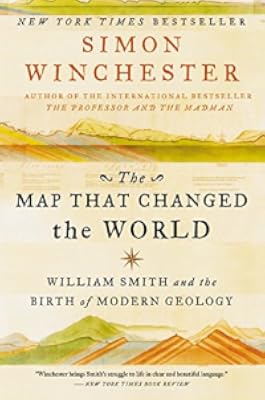
The Map that Changed the World: The Tale of William Smith and the Birth of a Science
by Simon Winchester
On This Page
Description
In 1793, a canal digger named William Smith made a startling discovery. He found that by tracing the placement of fossils, which he uncovered in his excavations, one could follow layers of rocks as they dipped and rose and fell-clear across England and, indeed, clear across the world-making it possible, for the first time ever, to draw a chart of the hidden underside of the earth. Smith spent twenty-two years piecing together the fragments of this unseen universe to create an epochal and show more remarkably beautiful hand-painted map. But instead of receiving accolades and honors, he ended up in debtors' prison, the victim of plagiarism, and virtually homeless for ten years more. The Map That Changed the World is a very human tale of endurance and achievement, of one man's dedication in the face of ruin. With a keen eye and thoughtful detail, Simon Winchester unfolds the poignant sacrifice behind this world-changing discovery. show lessTags
Recommendations





Member Recommendations
Member Reviews
Hagiographical? Frankly, I don't care. I luxuriated in this book.
Call me old-fashioned, but this is the style of writing that hits all the right buttons with me. It put me in mind of Michael Innes, a writer of detective fiction from the middle of the 20th century who wrote in a very formal way: his prose was beautiful, and Simon Winchester's style is very similar. I contrast it with the output of Hal Duncan - the writer of "Vellum" - which is that of someone who's experimenting ... and failing.
It's taken me a while to finish the book, so it's not the sort that sucks you in. To an extent, the subject matter is a bit sparse: there is a slight feeling of padding, such as the insertion of a semi-autobiographical chapter in the middle of show more the book in which Winchester recounts anecdotes which trace his interest in geology and the subject of the book: William Smith - "The Father of English Geology".
Smith plied his trade of surveying; draining land; and giving advice to landowners on the likelihood of coal lying under their property in the early 19th century. He came from humble beginnings, but quickly made a name for himself, while working in Somerset, such that he was employed throughout the land. His early jobs in coal mines gave him the opportunity to notice the layers of rock within which the coal-bearing seams lay, and he used this knowledge to relate the surface rocks to the underlying structure of the earth. His travels across the country allowed him to extend this knowledge to provide a picture of the geological make-up of England and Wales which formed the basis for surveys for individual counties, and for the country as a whole. In particular, the occurrence of fossils in particular strata (he came to be known as 'Strata Smith') gave him the idea that the layers of rock were ordered by age, and that the age of rocks was very great. This conflicted with the prevailing religious idea of the biblical formation of the Earth, but the mood of the times meant that liberal interpretations were becoming more prevalent. These ideas presaged Darwin's work that was to follow.
Smith's life was pretty up and down: he rubbed shoulders with the landed classes who employed him, and established a presence in London, but he always seemed to feel that he couldn't shake off his humble beginnings and be recognised for his contributions to the brand new science of geology. He was thrown into debtors' prison for a while, and this seemed to break his spirit and caused him to retreat from London. This was around the time that the map of the title had been published, but which failed to be the making of his reputation. He settled down to a reasonably quiet life, but recognition came to him in his retirement.
This book places Simon Winchester as a "must buy" author for me, but I can certainly see that some may find his style too florid. I'd still recommend this book for everyone, as a portrait of the changing times in the first half of the 1800s, and it's a vital purchase for anyone who is interested in geology. show less
Call me old-fashioned, but this is the style of writing that hits all the right buttons with me. It put me in mind of Michael Innes, a writer of detective fiction from the middle of the 20th century who wrote in a very formal way: his prose was beautiful, and Simon Winchester's style is very similar. I contrast it with the output of Hal Duncan - the writer of "Vellum" - which is that of someone who's experimenting ... and failing.
It's taken me a while to finish the book, so it's not the sort that sucks you in. To an extent, the subject matter is a bit sparse: there is a slight feeling of padding, such as the insertion of a semi-autobiographical chapter in the middle of show more the book in which Winchester recounts anecdotes which trace his interest in geology and the subject of the book: William Smith - "The Father of English Geology".
Smith plied his trade of surveying; draining land; and giving advice to landowners on the likelihood of coal lying under their property in the early 19th century. He came from humble beginnings, but quickly made a name for himself, while working in Somerset, such that he was employed throughout the land. His early jobs in coal mines gave him the opportunity to notice the layers of rock within which the coal-bearing seams lay, and he used this knowledge to relate the surface rocks to the underlying structure of the earth. His travels across the country allowed him to extend this knowledge to provide a picture of the geological make-up of England and Wales which formed the basis for surveys for individual counties, and for the country as a whole. In particular, the occurrence of fossils in particular strata (he came to be known as 'Strata Smith') gave him the idea that the layers of rock were ordered by age, and that the age of rocks was very great. This conflicted with the prevailing religious idea of the biblical formation of the Earth, but the mood of the times meant that liberal interpretations were becoming more prevalent. These ideas presaged Darwin's work that was to follow.
Smith's life was pretty up and down: he rubbed shoulders with the landed classes who employed him, and established a presence in London, but he always seemed to feel that he couldn't shake off his humble beginnings and be recognised for his contributions to the brand new science of geology. He was thrown into debtors' prison for a while, and this seemed to break his spirit and caused him to retreat from London. This was around the time that the map of the title had been published, but which failed to be the making of his reputation. He settled down to a reasonably quiet life, but recognition came to him in his retirement.
This book places Simon Winchester as a "must buy" author for me, but I can certainly see that some may find his style too florid. I'd still recommend this book for everyone, as a portrait of the changing times in the first half of the 1800s, and it's a vital purchase for anyone who is interested in geology. show less
On first appearance, I wouldn't imagine many would find a book about the origins of modern geology to be high on their pleasure reading lists, but I'm glad I finally took this one off the shelf because it provided brain food of a diverse and pleasurable kind. If any popular historian can make the fumbling origins of geology interesting, it is Simon Winchester. Although Winchester can be a bit dramatic and tends towards hagiography at times, I still found the book quite rewarding.
The Map That Changed the World is more a biography than a popular science book, but delivers on both accounts in an enlightening and compelling way. However, a word of warning to all who may be enticed to read this book by simply reading the book flap alone: the show more intriguing tid-bit about Smith's wife being a nymphomaniac, should be disregarded as nothing but an editor's ploy to get the more naughty minds to crack the book open looking for tantalizing kinky anecdotes. Sadly, for those of us interested in saucy 1800's nymphomania, the word nymphomania is found only once in the entire book. The details surrounding Smith's wife's affliction are sparse and limited to a single paragraph more than half way through. I do not fault Winchester's editors for stooping to such tactics in hopes of luring more readers into his book. It was a good ploy that seemed to work for our book club and in the end I didn't really care because the story of William Smith was very rewarding and helped expand my mental image of early 1800's scientific England by quite a bit.
For the book collector and admirer of trivial biblio-gimmicks, try to pick up a hardback edition of this text if you can. The dust jacket, actually folds out to be a miniaturized version of the very map that much of the book is about. It is quite helpful to reference while reading the book, something I did quite a few times. show less
The Map That Changed the World is more a biography than a popular science book, but delivers on both accounts in an enlightening and compelling way. However, a word of warning to all who may be enticed to read this book by simply reading the book flap alone: the show more intriguing tid-bit about Smith's wife being a nymphomaniac, should be disregarded as nothing but an editor's ploy to get the more naughty minds to crack the book open looking for tantalizing kinky anecdotes. Sadly, for those of us interested in saucy 1800's nymphomania, the word nymphomania is found only once in the entire book. The details surrounding Smith's wife's affliction are sparse and limited to a single paragraph more than half way through. I do not fault Winchester's editors for stooping to such tactics in hopes of luring more readers into his book. It was a good ploy that seemed to work for our book club and in the end I didn't really care because the story of William Smith was very rewarding and helped expand my mental image of early 1800's scientific England by quite a bit.
For the book collector and admirer of trivial biblio-gimmicks, try to pick up a hardback edition of this text if you can. The dust jacket, actually folds out to be a miniaturized version of the very map that much of the book is about. It is quite helpful to reference while reading the book, something I did quite a few times. show less
This is the first book by Winchester that I have ever read and it is a treat. Winchester writes well and it read quickly, I finished it in two lazy days. Winchester's biography of a now little-known light of science, the "founder" of geology William Smith, is a bit hagiographic, but nonetheless interesting, informative and entertaining. Perhaps Winchester highlights the class conflict between Smith and those high-born in the fledgling science a bit too much. But this must be forgiven, as our friends across the sea are still class conscious to a fault, and tend to see oppression where it might not be. ("Help! I'm being repressed here..." from Monty Python and the Holy Grail is coming to mind.) Smith comes across, even veiled in show more Winchester's glowing light, as a bit of a bore, a procrastinator, and heady dreamer. There are books and maps left unfinished, jobs left undone, etc. Imagine how many toes he stepped on? But that is just a minor problem I have in an overall excellent work of biography. I would like to have seen more pictures, photographs, etc., although the line drawings were nice. The hardcover dustjacket that folds out into "the map" is a nice touch. Kudos to the designer Roberto De Vico De Cumptich. And, of course, William Smith. show less
If the name "Simon Winchester" sounds familiar, it is probably because of his recent bestseller, "The Professor and the Madman", the history of how the Oxford English Dictionary was originally compiled. It is supposed to be very good, but I haven't had a chance to read it myself yet. However, my experience with "The Map..." strongly inclines me toward reading that other one as well. Mr. Winchester does an excellent job of bringing to life not only the obsession of William Smith to publish a lifetime of work in the first geological map of England, but also the milieu in which he worked. Perhaps Winchester slightly exaggerates the singularity of his main character, and gives him a bit more credit than he deserves, for putting together show more ideas that had been going through the minds of others of the time. But there is no minimizing his painstaking effort to gather the data that would constitute his opus. This is a book that makes the relatively slow-moving science of geology come to life. show less
This is a nice pacy factual book that kept me occupied during 2 flights (no easy thing - not a happy flyer). It's one of those classic 18th century tales where there's science, religion, class, prejudice money and, out of the mess and shambles comes something that is really mind blowing. William Smith produced the first geological survey of the UK. All by himself. And a small version is reproduced on the inside front cover and it's a real thing of beauty - the colour, shading and texture is fabulous, as well as being remarkably similar to the British Geological Survey's edition of the 1990s that graces the rear cover.
It's set during that great upheaval in science, when Britain finally moved from being a medieval belief led society to show more one that valued science, facts, precision, deduction and started wanting to ask questions of the natural world. this is one example. It was driven by his being involved in the coal mining industry, then in the routing and digging of a canal through Somerset. What he'd seen by the vertical descent into the ground of the mines was reinforced by what he'd seen in the cut made across miles of Somerset - the rocks beneath our feet are different, but predictably different in different places.
It's got it's fair share of trials and tribulations, and the class system comes in for a fair old (and entirely justified) bashing, but Smith doesn't always seem to be the most astute of individuals. Even so, it's nice to see that he did finally get the recognition he deserved in his lifetime - even if he seems to have been largely forgotten since. Simon Winchester does write a good story, as well as managing to get some facts to stick in your brain at the same time. I thought this was a good read. show less
It's set during that great upheaval in science, when Britain finally moved from being a medieval belief led society to show more one that valued science, facts, precision, deduction and started wanting to ask questions of the natural world. this is one example. It was driven by his being involved in the coal mining industry, then in the routing and digging of a canal through Somerset. What he'd seen by the vertical descent into the ground of the mines was reinforced by what he'd seen in the cut made across miles of Somerset - the rocks beneath our feet are different, but predictably different in different places.
It's got it's fair share of trials and tribulations, and the class system comes in for a fair old (and entirely justified) bashing, but Smith doesn't always seem to be the most astute of individuals. Even so, it's nice to see that he did finally get the recognition he deserved in his lifetime - even if he seems to have been largely forgotten since. Simon Winchester does write a good story, as well as managing to get some facts to stick in your brain at the same time. I thought this was a good read. show less
it took me three tries to actually be able to listen to this, but this time something finally clicked for me. at least mostly. there is some really interesting history here (about william smith but more so about the history of geology and the way that knowledge and science contradicted the religious assumptions of the time), but this definitely won't appeal to everyone.
The world is an ever-shifting, ever-changing place. Millions upon millions of years of plate tectonics, volcanic eruptions, and eroding forces have brought to the earth its current form. Only recently have we been able to figure out just how it happened. In many ways, we owe a lot of our current geological knowledge to a coal mine surveyor from Oxfordshire, William Smith. Simon Winchester’s The Map That Changed the World is look into a the life and work of a man whose debts landed him in jail, but whose work has left us indebted to him.
William Smith, born in 1769, was a bright boy and quickly became a land surveyor, working for estate holders and canal companies. One day, while working for a coal company, he came upon the realization show more that certain rock strata existed in the same places all throughout the country. And if you inspected closer, you would find the fossils from a certain rock layer in that same layer on the other side of the country. He collected fossils and rock samples from all over Britain in an effort to support his hypothesis. In 1815, he published a vibrant, perfect 8.5-foot by 6-foot map of the country, showing all the geological features and rock strata. Unfortunately for him, he was neither a gentleman nor a member of the Geological Society, so his work was seen as amateur and consequently plagiarized and profited from by those who had the means to do so. Luckily, a rich benefactor, Sir John Johnstone, recognized his scientific worth and championed his cause and by 1831 he was admitted into the Geological Society of London and awarded the first Wollaston Medal, becoming the father of English geology.
There are some who are not partial to Simon Winchester’s flowery prose and decidedly British approach to scholarship and history, but not me. He could write about the history of paint drying techniques and I would give him the benefit of the doubt. He pulls together the scant details of Smith’s life with gusto and panache. To flesh out some of the sparser bits, Winchester goes on an expedition around Britain to experience the geology for himself. The work of William Smith deserves to be honored and now the Geological Society gives out an award in his name every year. I really enjoyed this one and hope more people discover the scientists who have toiled throughout history. Without them, the world would indeed be a much different place. A pleasant read. show less
William Smith, born in 1769, was a bright boy and quickly became a land surveyor, working for estate holders and canal companies. One day, while working for a coal company, he came upon the realization show more that certain rock strata existed in the same places all throughout the country. And if you inspected closer, you would find the fossils from a certain rock layer in that same layer on the other side of the country. He collected fossils and rock samples from all over Britain in an effort to support his hypothesis. In 1815, he published a vibrant, perfect 8.5-foot by 6-foot map of the country, showing all the geological features and rock strata. Unfortunately for him, he was neither a gentleman nor a member of the Geological Society, so his work was seen as amateur and consequently plagiarized and profited from by those who had the means to do so. Luckily, a rich benefactor, Sir John Johnstone, recognized his scientific worth and championed his cause and by 1831 he was admitted into the Geological Society of London and awarded the first Wollaston Medal, becoming the father of English geology.
There are some who are not partial to Simon Winchester’s flowery prose and decidedly British approach to scholarship and history, but not me. He could write about the history of paint drying techniques and I would give him the benefit of the doubt. He pulls together the scant details of Smith’s life with gusto and panache. To flesh out some of the sparser bits, Winchester goes on an expedition around Britain to experience the geology for himself. The work of William Smith deserves to be honored and now the Geological Society gives out an award in his name every year. I really enjoyed this one and hope more people discover the scientists who have toiled throughout history. Without them, the world would indeed be a much different place. A pleasant read. show less
Members
- Recently Added By
Published Reviews
ThingScore 75
Smith was ultimately successful because his ideas were immediately useful, and his map was beautiful as well as reasonably accurate for its era. It taught us to begin to look beneath the surface and see the history of our planet. The publisher of ''The Map That Changed the World'' pays tribute to Smith in the ingenious dust jacket of this book, which unfolds to form a striking reproduction of show more Smith's map. show less
added by danielx
True, the reader must put aside a familiarity with Smith's discoveries, which have long since become textbook information, and travel back in time to the days when the earth was literally terra incognita. But for those willing to suspend previous knowledge and great expectations, Mr. Winchester tries hard to make this story worth the trip.
added by jlelliott
The genre of scientific biography has gone rather stale over the last year or so, but Winchester's book may well prompt a revival.
added by John_Vaughan
Lists

Best General History Books
50 works; 20 members

For Science!
39 works; 5 members

Unread books
1,063 works; 82 members

History of Geology
6 works; 1 member

BingoDOG - Language in Fiction
35 works; 12 members

The r/AskScience Reading List
159 works; 3 members

Books We Discovered On LibraryThing
530 works; 130 members

In Our Time books
4,934 works; 2 members
Author Information

Simon Winchester was born in London, England on September 28, 1944. He read geology at St. Catherine's College, Oxford. After graduation in 1966, he joined a Canadian mining company and worked as field geologist in Uganda. The following year he decided to become a journalist. His first reporting job was for The Journal, Newcastle upon Tyne. In show more 1969, he joined The Guardian and was named Britain's Journalist of the Year in 1971. He also worked for the Daily Mail and the Sunday Times before becoming a freelancer. He is the author of numerous books including In Holy Terror, The River at the Center of the World, The Alice Behind Wonderland, The Professor and the Madman: A Tale of Murder, Insanity, the Making of the Oxford English Dictionary, and.Exactly: How Precision Engineers Created the Modern World. In 2006, he was made an Officer of the Order of the British Empire for services to journalism and literature. (Bowker Author Biography) show less
All Editions
Some Editions
Awards and Honors
Distinctions
Work Relationships
Common Knowledge
- Canonical title
- The Map that Changed the World: The Tale of William Smith and the Birth of a Science
- Original title
- The Map That Changed the World: William Smith and the Birth of Modern Geology
- Alternate titles
- The Map that Changed the World: A Tale of Rocks, Ruin and Redemption
- Original publication date
- 2001
- People/Characters
- William Smith; Joseph Banks (Sir); John Cary; John Farey; George Bellas Greenough; John Phillips (show all 9); Benjamin Richardson (Reverend); Joseph Townsend (Reverend); William Buckland (Dean)
- Important places
- Churchill, Oxfordshire, England, UK; High Littleton, Somerset, England, UK; Midford, Somerset, England, UK; Somerset, England, UK; Bath, Somerset, England, UK; London, England, UK (show all 9); Scarborough, North Yorkshire, England, UK; England, UK; Wales, UK
- Epigraph
- In days of old, old William Smith,
While making a canal, Sir,
Found out how the strata dipped to the east
With a very gentle fall, Sir,
First New Red Sand and marl a-top,
With Lias on its border,
Then the Oo... (show all)lite and the Chalk so white
All stratified in order.
Sing, cockle-shells and oyster banks,
Sing, thunder-bolts and screw-stones,
To Father Smith we owe our thanks
For the history of a few stones.
Anniversary dinner, A. C. Ramsay, 1854. - Dedication
- For Harold Reading
- First words
- Incorporated in eighteen of the nineteen chapter headings that follow will be found small line drawings of Jurassic ammonites - long-extinct marine animals that were so named because their coiled and chambered shells resemble... (show all)d nothing so much as the horns of the ancient Egyptian ram-god, Ammon.
About the chapter heading illustrations.
Above one of the many grand marble staircases within the east wing of Burlington House, the great Palladian mansion on the north side of London's Piccadilly, hangs a pair of huge sky blue velvet curtains, twisted and tasseled... (show all) silk ropes beside them.
Prologue.
The last day of August 1819, a Tuesday, dawned gray, showery, and refreshingly cool in London, promising a welcome end to a weeklong spell of close and muggy weather that seemed to have put all the capital's citizens in a net... (show all)tlesome, liverish mood.
1. Escape on the northbound stage. - Last words
- (Click to show. Warning: May contain spoilers.)The Father of English Geology was at last able to rest on his laurels, and begin the final chapter of his life as a revered elder statesman, at last accorded his due, and given the respect that his hitherto unsung achievements deserved.
(Click to show. Warning: May contain spoilers.)The hundreds who pass by each day seldom glance up at it - and even if they do, few of them ever ask to see it, and fewer still ever stop to wonder who created it, and why, and exactly how.
Epilogue. - Original language
- English
Classifications
Statistics
- Members
- 4,256
- Popularity
- 3,563
- Reviews
- 89
- Rating
- (3.61)
- Languages
- 6 — Czech, Dutch, English, French, German, Italian
- Media
- Paper, Audiobook, Ebook
- ISBNs
- 35
- ASINs
- 21