On This Page
Description
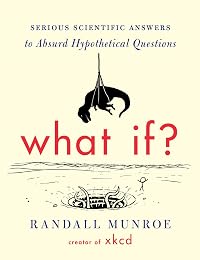
"Millions of people visit xkcd.com each week to read Randall Munroe's iconic webcomic. His stick-figure drawings about science, technology, language, and love have a large and passionate following. Fans of xkcd ask Munroe a lot of strange questions. What if you tried to hit a baseball pitched at 90 percent the speed of light? How fast can you hit a speed bump while driving and live? If there was a robot apocalypse, how long would humanity last? In pursuit of answers, Munroe runs computer show more simulations, pores over stacks of declassified military research memos, solves differential equations, and consults with nuclear reactor operators. His responses are masterpieces of clarity and hilarity, complemented by signature xkcd comics. They often predict the complete annihilation of humankind, or at least a really big explosion. The book features new and never-before-answered questions, along with updated and expanded versions of the most popular answers from the xkcd website. What If? will be required reading for xkcd fans and anyone who loves to ponder the hypothetical. "-- show lessTags
Recommendations

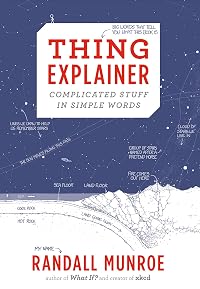






Member Recommendations
dClauzel Discussions amusantes sur la science. Des questions hypothétiques, des expérimentations qui n’auraient jamais eu lieu d’être, et surtout l’envie de partager.
Physics of the Impossible: A Scientific Exploration Into the World of Phasers, Force Fields, Teleportation, and Time Travel by Michio Kaku
CGlanovsky Rigorous scientific descriptions of ridiculous things
Member Reviews
This book contains the sentence: "Aroldis Chapman could probably throw a golf ball about sixteen giraffes high." That alone makes it worth reading. The creator of the webcomic xkcd, Randall Munroe uses math and science to investigate cornball questions from his readers. If you've ever wondered what would happen if a baseball were pitched at the speed of light, what would happen if every person in the world jumped at the same place at the same time (say, Rhode Island), or what place on earth would allow for the longest free fall, this book is for you. In addition to Munroe's humorous, but mathematically explicit, explanations there are plenty of whimsical illustrations. There are also a series of questions too weird and worrying for even show more Munroe to answer.
Favorite Passages:
Favorite Passages:
Our plastic will become shredded and buried, and perhaps some microbes will learn to digest it, but in all likelihood, a million years from now, an out-of-place layer of processed hydrocarbons—transformed fragments of our shampoo bottles and shopping bags—will serve as a chemical monument to civilization.
If humans escape the solar system and outlive the Sun, our descendants may someday live on one of these planets. Atoms from Times Square, cycled through the heart of the Sun, will form our new bodies. One day, either we will all be dead, or we will all be New Yorkers.
So we shouldn’t worry too much about when computers will catch up with us in complexity. After all, we’ve caught up to ants, and they don’t seem too concerned. Sure, we seem like we’ve taken over the planet, but if I had to bet on which one of us would still be around in a million years—primates, computers, or ants—I know who I’d pick.show less
if an astronaut on the ISS listens to “I’m Gonna Be,” in the time between the first beat of the song and the final lines . . . . . . they will have traveled just about exactly 1000 miles.
Rule of thumb: One person per square meter is a light crowd, four people per square meter is a mosh pit.
Al Worden, the Apollo 15 command module pilot, even enjoyed the experience. There’s a thing about being alone and there’s a thing about being lonely, and they’re two different things. I was alone but I was not lonely. My background was as a fighter pilot in the air force, then as a test pilot—and that was mostly in fighter airplanes—so I was very used to being by myself. I thoroughly enjoyed it. I didn’t have to talk to Dave and Jim any more . . . On the backside of the Moon, I didn’t even have to talk to Houston and that was the best part of the flight. Introverts understand; the loneliest human in history was just happy to have a few minutes of peace and quiet.
This is just fab. It made me laugh out loud several times. Also science, lots of lovely science with nice twists. Well I say nice, but really evil twists. That's what makes it funny and interesting.
Randall Munroe is best known for the xkcd comics (and if you haven't read them then you really must). 'What if?' comes from an offshoot of the popularity of xkcd and typifies the sort of scary thoughts we have. People have been sending Randall their what if? questions and Randall has been off to do some research to answer them. The answers all follow impeccable scientific logic, yet they are written with some hilarious assumptions (on the right side of plausible, think of chemistry played for explosions, fires and spectacular effects rather show more than safety).
Some of the questions that get answered include
what if you flew an airplane on all the planets in the solar system?
what if you put a wormhole at the bottom of the deepest part of the ocean to drain the water?
what if you dropped a steak from orbit, would it cook?
There are dozens of these questions, and I laughed at the consequences of almost all of them. There were an amazing number of innocent sounding 'what if?' questions that lead to catastrophe. As well as all of those there are bits in the middle where some of the dodgier 'what if?' questions get listed, mainly of the 'asking for a friend' variety. Many of these get illustrated with xkcd style cartoons. This just adds to the enjoyment of it all.
Seriously, you need to read this book, especially if you aren't a scientist. It's entertaining and a little educational, but all fun. Definitely my best book for quite a while. show less
Randall Munroe is best known for the xkcd comics (and if you haven't read them then you really must). 'What if?' comes from an offshoot of the popularity of xkcd and typifies the sort of scary thoughts we have. People have been sending Randall their what if? questions and Randall has been off to do some research to answer them. The answers all follow impeccable scientific logic, yet they are written with some hilarious assumptions (on the right side of plausible, think of chemistry played for explosions, fires and spectacular effects rather show more than safety).
Some of the questions that get answered include
what if you flew an airplane on all the planets in the solar system?
what if you put a wormhole at the bottom of the deepest part of the ocean to drain the water?
what if you dropped a steak from orbit, would it cook?
There are dozens of these questions, and I laughed at the consequences of almost all of them. There were an amazing number of innocent sounding 'what if?' questions that lead to catastrophe. As well as all of those there are bits in the middle where some of the dodgier 'what if?' questions get listed, mainly of the 'asking for a friend' variety. Many of these get illustrated with xkcd style cartoons. This just adds to the enjoyment of it all.
Seriously, you need to read this book, especially if you aren't a scientist. It's entertaining and a little educational, but all fun. Definitely my best book for quite a while. show less
I can't help feeling that the real question to be posed here is "How long could civilisation last on a planet where a scientist can make a better living drawing stick-figures on the web than by doing actual science?" — Randall Munroe is of course the creator of xkcd, and this book is a compilation of entries from his "What if...?" blog, where people pose silly questions and Munroe does his best to research scientifically coherent answers to them (contrary to what they teach you in training seminars, there are silly questions, and this book contains more than enough evidence to show that...).
This is fun, if you're the sort of person who can enjoy a coffee-break conversation between scientists and engineers. Possibly not if you aren't, show more though: you need a certain amount of capacity to suspend disbelief. Munroe looks at how a baseball would behave if it could be thrown at relativistic velocity, what would happen if the earth started growing or if someone pulled the plug out of the oceans, how a bullet-sized piece of neutron-star material would behave on the surface of the earth, how much of the periodic table you could stack up as bricks, on which other bodies in the solar system you could fly a Cessna, whether it makes sense to extract energy from thunderstorms, etc.
Usually the answer is some variant on "NO", "very bad things", or "a small nuclear explosion", but he has fun getting there, explains a few interesting scientific principles, and includes a few of his always-funny drawings. In between the chapters there are selections of the questions he's not even going to start answering, which provide very disturbing insights into the darker side of the (presumably mostly male-adolescent) human mind... show less
This is fun, if you're the sort of person who can enjoy a coffee-break conversation between scientists and engineers. Possibly not if you aren't, show more though: you need a certain amount of capacity to suspend disbelief. Munroe looks at how a baseball would behave if it could be thrown at relativistic velocity, what would happen if the earth started growing or if someone pulled the plug out of the oceans, how a bullet-sized piece of neutron-star material would behave on the surface of the earth, how much of the periodic table you could stack up as bricks, on which other bodies in the solar system you could fly a Cessna, whether it makes sense to extract energy from thunderstorms, etc.
Usually the answer is some variant on "NO", "very bad things", or "a small nuclear explosion", but he has fun getting there, explains a few interesting scientific principles, and includes a few of his always-funny drawings. In between the chapters there are selections of the questions he's not even going to start answering, which provide very disturbing insights into the darker side of the (presumably mostly male-adolescent) human mind... show less
Using questions and answers from his popular webcomic xkcd, former NASA roboticist Randall Munroe takes some of the outlandish questions he's received, including several that hadn't been answered on the website, and answers them with science & math, aplomb and some fairly humorous references to pop (or nerd) culture.
The answers are entertaining, often including stick figure cartoon drawings illustrating what he's talking about. The questions themselves are entertaining, anything from "How fast do you have to drop steak to cook it?" to "Could you make a Lego bridge from New York to London?" (And in that one he definitely has fun with the spelling of LEGO). Some of it was way over my head, but I could enjoy the premise if not entirely show more follow his reasoning and equations. His answers sometimes tend to the ridiculous, but, well, that's kind of what you sign up for with the entire book! If you listen to the audio, Wil Wheaton gives an excellent performance but you do miss a little something of the visuals, so I found myself going back and forth between formats a lot. show less
The answers are entertaining, often including stick figure cartoon drawings illustrating what he's talking about. The questions themselves are entertaining, anything from "How fast do you have to drop steak to cook it?" to "Could you make a Lego bridge from New York to London?" (And in that one he definitely has fun with the spelling of LEGO). Some of it was way over my head, but I could enjoy the premise if not entirely show more follow his reasoning and equations. His answers sometimes tend to the ridiculous, but, well, that's kind of what you sign up for with the entire book! If you listen to the audio, Wil Wheaton gives an excellent performance but you do miss a little something of the visuals, so I found myself going back and forth between formats a lot. show less
Randall Munroe is best known for the webcomic xkcd, which may be one of the best things on the internet. But he also has a blog called What If?, where, as the title of this book says, he provides "serious scientific answers to absurd hypothetical questions." The book version collects many questions and answers that have previously appeared on the blog, along with some brand new ones. A few examples: "What would happen if you tried to hit a baseball pitched at 90 percent of the speed of light?", "Is it possible to build a jet pack out of downward-firing machine guns?", and "What if a rainstorm dropped all its water in a single giant drop?"
OK, a few of the questions are a bit more, uh, normal-sounding than that (like, "How high can a show more human throw something?"), but most of them are wonderfully bizarre or even downright insane. (And that's not even counting the "Weird (and Worrying) Questions from the What If? Inbox" sections, which mostly feature questions he doesn't even attempt to answer, and which are disturbingly hilarious.) No matter how odd the question may be, though, the answers are carefully thought out and based in real math and science. They're also very, very funny, and illustrated with Munroe's distinctive stick-figure drawings. (Seeing those pictures on the printed page was a weird experience for me, though. I kept wanting to tap them to bring up the hovertext.) Munroe's also a bit like the Mythbusters, in that if the answer he gets isn't terribly interesting, he'll usually keep poking at it and adding new wrinkles until it results in something nifty and absurd. A surprising number of these scenarios end in global cataclysm, but it's all good, clean, nerdy fun.
Rating: 4.5/5, although I admit that's probably me rating the website as much as it is the book. Still, it's a fun and very well-put-together book. Be sure to look inside the dust jacket for an illustration of what would happen if Earth's oceans were allowed to drain out through an inter-dimensional plughole! show less
OK, a few of the questions are a bit more, uh, normal-sounding than that (like, "How high can a show more human throw something?"), but most of them are wonderfully bizarre or even downright insane. (And that's not even counting the "Weird (and Worrying) Questions from the What If? Inbox" sections, which mostly feature questions he doesn't even attempt to answer, and which are disturbingly hilarious.) No matter how odd the question may be, though, the answers are carefully thought out and based in real math and science. They're also very, very funny, and illustrated with Munroe's distinctive stick-figure drawings. (Seeing those pictures on the printed page was a weird experience for me, though. I kept wanting to tap them to bring up the hovertext.) Munroe's also a bit like the Mythbusters, in that if the answer he gets isn't terribly interesting, he'll usually keep poking at it and adding new wrinkles until it results in something nifty and absurd. A surprising number of these scenarios end in global cataclysm, but it's all good, clean, nerdy fun.
Rating: 4.5/5, although I admit that's probably me rating the website as much as it is the book. Still, it's a fun and very well-put-together book. Be sure to look inside the dust jacket for an illustration of what would happen if Earth's oceans were allowed to drain out through an inter-dimensional plughole! show less
The creator of xkcd.com provides “Serious scientific answers to absurd hypothetical questions.” Yes, serious in intelligence -- Munroe is an incredibly smart guy with an incredibly smart group of math/science collaborators -- but playful in execution as they think waaay outside the box and ramp up nerdy questions to full-on exaggeration. It’s surprising, very fun and quite informative, e.g. with reminders that, above a certain altitude, “your blood oxygen content would plummet {because} there’s so little oxygen in the air that your veins lose oxygen to the air instead of gaining it.” And that, with cable/etc. now instead of huge broadcast antennas, we’re no longer releasing all of our TV/radio signals out into the universe show more (to be stumbled upon by intelligent life).
It’s hard to choose favorites from the ~50 Q&As but here are three:
• “If every human somehow simply disappeared from the face of the Earth, how long would it be before the last artificial light source would go out?” -- turns into an overview of all of our power-generating technologies and ends up centuries into the future, with the light from nuclear waste.
• “What is the farthest one human being has ever been from every other living person? Were they lonely?” -- puts early explorers in the running, but then settles on “the six Apollo command module pilots who stayed in lunar orbit {...alone while the} other astronauts landed on the moon” -- about 3585 km apart. And no, since the pilots tended to be introverts, they felt solitude not loneliness.
• “What if a Richter magnitude 15 earthquake were to hit America at, let’s say, New York City? What about a Richter 20? 25?” After answering that a 15 would blow up the planet, Munroe turns instead to low-magnitude events, from Magnitude -1 (“A single football player running into a tree in your yard”) and moving entertainingly downward to Magnitude -15 (“A drifting mote of dust coming to rest on a table”). show less
It’s hard to choose favorites from the ~50 Q&As but here are three:
• “If every human somehow simply disappeared from the face of the Earth, how long would it be before the last artificial light source would go out?” -- turns into an overview of all of our power-generating technologies and ends up centuries into the future, with the light from nuclear waste.
• “What is the farthest one human being has ever been from every other living person? Were they lonely?” -- puts early explorers in the running, but then settles on “the six Apollo command module pilots who stayed in lunar orbit {...alone while the} other astronauts landed on the moon” -- about 3585 km apart. And no, since the pilots tended to be introverts, they felt solitude not loneliness.
• “What if a Richter magnitude 15 earthquake were to hit America at, let’s say, New York City? What about a Richter 20? 25?” After answering that a 15 would blow up the planet, Munroe turns instead to low-magnitude events, from Magnitude -1 (“A single football player running into a tree in your yard”) and moving entertainingly downward to Magnitude -15 (“A drifting mote of dust coming to rest on a table”). show less
What If? Serious Scientific Answers to Absurd Hypothetical Questions is simply a collection of the questions posed on Randall Munroe’s website. However, he manages to bring the collection together in such a way that not only emphasizes the absurdity of the questions but also the seriousness of the answers. For, no matter how unusual or extreme the question, Munroe approaches each answer with logic, math, and science as his arsenal. He may do so in a light-hearted fashion, but the resulting explosions or world-ending catastrophes all have a scientific basis behind them.
As an audiobook, one loses the visual elements of the comics, but listeners will find that they are not necessary to capture the essence of the book. Most will be able show more to grasp the concepts Munroe applies to each of his answers. As a fair warning, however, there is some fairly advanced math and scientific theory at work throughout the collection. While Munroe tries to make each concept understandable, the fact that he discusses complex laws of physics with the same casualness that others discuss the weather means this is not the type of book towards which the casual reader would gravitate.
That being said, for the right audience, this is a wickedly clever collection of the most outlandish hypothetical situations. Munroe makes science and math fun with the questions he chooses to answer and with the sarcastic approach he takes with each answer. He offsets the zaniness with a detailed explanation of the theorems and laws of nature at play so that behind each wacky answer lies substance. Best listened to or read in short bursts to allow a reader adequate time to process the details and come to an understanding of what he is saying, What If? is a fun way to tease your brain every day. show less
As an audiobook, one loses the visual elements of the comics, but listeners will find that they are not necessary to capture the essence of the book. Most will be able show more to grasp the concepts Munroe applies to each of his answers. As a fair warning, however, there is some fairly advanced math and scientific theory at work throughout the collection. While Munroe tries to make each concept understandable, the fact that he discusses complex laws of physics with the same casualness that others discuss the weather means this is not the type of book towards which the casual reader would gravitate.
That being said, for the right audience, this is a wickedly clever collection of the most outlandish hypothetical situations. Munroe makes science and math fun with the questions he chooses to answer and with the sarcastic approach he takes with each answer. He offsets the zaniness with a detailed explanation of the theorems and laws of nature at play so that behind each wacky answer lies substance. Best listened to or read in short bursts to allow a reader adequate time to process the details and come to an understanding of what he is saying, What If? is a fun way to tease your brain every day. show less
Members
- Recently Added By
Lists

Best Laugh Out Loud Books
143 works; 49 members

Recommend the 20 best books you've read in the last five years
2,168 works; 606 members

Top Five Books of 2014
1,064 works; 397 members

Non-Fiction Worth Reading
1,015 works; 254 members

Top Five Books of 2020
982 works; 350 members

Top Five Books of 2022
736 works; 272 members

Phi Beta Kappa reading list
260 works; 8 members

Top Five Books of 2015
811 works; 241 members

Books Read in 2016
110 works; 1 member

Non-Fiction
68 works; 1 member

Most Frequently Tagged "Read in 2015"
70 works; 1 member

Best Audiobooks
240 works; 114 members

Audio Books
29 works; 3 members

Books Read in 2014
2,343 works; 89 members

Five star books
1,767 works; 110 members
To Read
617 works; 7 members

Books Read in 2020
4,379 works; 124 members

Books Read in 2015
3,299 works; 126 members

2016 Book Club Choices
52 works; 7 members

Books Read in 2019
4,052 works; 108 members

Houghton Mifflin Harcourt
45 works; 1 member
Books Read in 2016
4,666 works; 197 members

Research/Inquiry - questions and wondering
43 works; 3 members

Vlogbrothers Book Recommendations
307 works; 4 members
Talk Discussions
Past Discussions
What if?-type thought experiments, physics, NF in Name that Book (August 2015)
Author Information

12+ Works 15,924 Members
Randall Munroe was born in Easton, Pennsylvania on October 17, 1984. He received a degree in physics from Christopher Newport University. He got a job building robots at NASA Langley Research Center. In 2006, he left NASA to draw comics on the internet full-time. He is the author of the popular webcomic xkcd, the science question-and-answer blog show more What If, and the New York Times bestseller What If?: Serious Scientific Answers to Absurd Hypothetical Questions. (Bowker Author Biography) show less
Some Editions
Awards and Honors
Awards
Distinctions
Notable Lists
Series

Belongs to Publisher Series
Work Relationships
Common Knowledge
- Canonical title
- What If? Serious Scientific Answers to Absurd Hypothetical Questions
- Original title
- What If? Serious Scientific Answers to Absurd Hypothetical Questions
- Alternate titles
- What If?
- Original publication date
- 2014-09-02
- Epigraph
- DISCLAIMER
Do not try any of this at home. The author of this book is an Internet cartoonist, not a health or safety expert. He likes it when things catch fire or explode, which means he does not have your best interests i... (show all)n mind. The publisher and the author disclaim responsibility for any adverse effects resulting, directly or indirectly, from information contained in this book. - First words
- This book is a collection of answers to hypothetical questions. -Introduction
Global Windstorm
What would happen if the Earth and all terrestrial objects suddenly stopped spinning but the atmosphere retained its velocity? - Quotations
- They say there are no stupid questions. That's obviously wrong. [...] But it turns out that trying to thoroughly answer a stupid question can take you to some pretty interesting places.
- Last words
- (Click to show. Warning: May contain spoilers.)Sometimes it's nice not to destroy the world for a change.
- Publisher's editor
- Young, Courtney
- Blurbers
- Goldacre, Ben; Harford, Tim; le Saux, Graeme
- Original language
- English
- Canonical DDC/MDS
- 502.07
- Canonical LCC
- Q173 .M965
Classifications
- Genres
- Science & Nature, General Nonfiction, Nonfiction
- DDC/MDS
- 502.07 — Natural sciences & mathematics Science Miscellany
- LCC
- Q173 .M965 — Science Science (General) General
- BISAC
Statistics
- Members
- 8,409
- Popularity
- 1,315
- Reviews
- 237
- Rating
- (4.15)
- Languages
- 21 — Czech, Danish, Dutch, English, Estonian, Finnish, French, German, Greek, Hungarian, Italian, Japanese, Korean, Norwegian (Bokmål), Polish, Portuguese, Spanish, Swedish, Turkish, Chinese, traditional, Chinese, simplified
- Media
- Paper, Audiobook, Ebook
- ISBNs
- 77
- ASINs
- 18