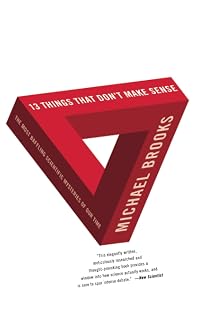
13 Things That Don't Make Sense: The Most Baffling Scientific Mysteries of Our Time
by Michael Brooks
On This Page
Description
Science starts to get interesting when things don't make sense.Science's best-kept secret is this: even today, there are experimental results and reliable data that the most brilliant scientists can neither explain nor dismiss. In the past, similar "anomalies" have revolutionized our world, like in the sixteenth century, when a set of celestial anomalies led Copernicus to realize that the earth goes around the sun and not the reverse, and in the 1770s, when two chemists discovered oxygen show more because of experimental results that defied all the theories of the day. So if history is any precedent, we should look to today's inexplicable results to forecast the future of science.
In 13 Things That Don't Make Sense, Michael Brooks heads to the scientific frontier to meet thirteen modern-day anomalies and discover tomorrow's breakthroughs. Why are some NASA satellites speeding up as they get farther from the sun? Why has the placebo effect become a pillar of modern medicine when doctors can't agree whether it even exists? Is ninety-six percent of the universe missing? Is a 1977 signal from outer space a transmission from an alien civilization? Might giant viruses explain how life began? Taking readers on an entertaining tour d'horizon of the strangest of scientific findings—involving everything from our lack of free will to Martian methane that offers new evidence of life on the planet—Michael Brooks argues that the things we don't understand are the key to what we are about to discover. Spanning disciplines from biology to cosmology, chemistry to psychology to physics, Brooks thrillingly captures the excitement, messiness, and controversy of the battle over where science is headed.
. show less
Tags
Recommendations









Member Recommendations

Member Reviews
Michael Brooks' survey of anomalies in contemporary science (2009 - UK Edition) might be regarded as a riposte to the 'end of science' thesis promoted by John Horgan in the mid-1990s. He makes a very good case although one has the suspicion that it is not that there is nothing else to know (which this book shows would be an absurd proposition) but perhaps that there are things that, because of the limitations of ourselves as human observers, we may never know.
Brooks adopts a systematic approach, taking us from anomalies in cosmology and physics through those in biology thence to evolutionary studies, neuroscience and medicine. However, it might be better here to separate out the one-off nagging anomalies, which may or may not be show more important. They may, of course, be of considerable importance IF proven but the broader sets of anomaly that frustrate scientists in their fields and indicate the potential (no more) for a major 'Kuhnian' paradigm shift, equivalent to that from the Ptolemaic to the Copernican astronomical system, are much more interesting. Such paradigm shifts can have significant associated cultural and political effects whereas the one-off anomalies have (largely) yet to be settled even as anomalies and imply rather than state major paradigm change.
Let's dispose quickly of these 'one-offs' - cold fusion, a navigational anomaly with the Pioneer spacecraft, disputed evidence for life on Mars and the freak alleged 'ET' signal received in 1977. These are fascinating but inconclusive. We are just going to have to admit that, as of today, we don't know whether cold fusion is possible, whether there is life on Mars or there are signalling aliens - not until more experiments can be mounted (at considerable public cost), possibly not even then.
The anomalies that imply paradigm shifts fall into two general areas - the nature of physics and of the universe and the nature of life and of matters affecting the relationship of mind and body. Perhaps the anomalies in the first zone (which relate to serious problems with the current consensus derived from Einstein's revision of Newtonian mechanics) might impact on the latter, but, at this point in history, such a leap would be so speculative as to be scientifically meaningless.
This book is mostly an easy read by a science journalist and consultant with considerable skill in explaining complex matters to the lay reader but, be warned, you will have to keep your wits about you. The general reader is going to have to take many claims for granted. Nevertheless, he feels reliable and the only 'wobbly' section is that on free will which we will come to in a moment.
The cosmology and physics anomalies are interesting but hard to make relevant to daily life. Our model of the universe works near to us but does not quite stack up the further that you move away from our immediate locality - issues of dark energy, dark matter, possible unknown gravitational forces and 'varying constants' suggest that some of the finest mathematical minds and some significant astronomical resources are going to be puzzling away at these issues for a good time to come.
What may be more relevant to us as persons on this planet is the complex of debates surrounding some very basic questions about human existence that have hitherto been left to philosophers but into which scientists are now intruding:
* what exactly is life? - to which there still appears to be no clear answer
* what is the role of the virus in evolution?
* why death? and why sexual rather than asexual repoduction?
* whether we have free will?
* and how the placebo effect and homeopathy work (or don't work) in medicine?
Brooks is effective in outlining, without (except in one case - free will) prejudice, the contrasting scientific theories and the inconclusive evidence in each case and he is not shy of making a subsidiary point of considerable importance about the flaws in scientists rather than in scientific method.
Scientists themselves are not objective machines but are human beings dependent on their own perception, expectations (both group and their own) and prejudices and (my opinion and not his) on measurement and analytical tools created by humans for humans. Even peer review can be unreliable, although the track record of scientific method in uncovering reliable facts remains, on balance, a good and effective one - if a lot more long-winded and cumbersome (and so expensive) than some lay people think.
Towards the end of the book, Brooks get a little less sure-footed. His account of the free will debate is not very convincing. In this area, many scientists are missing the point about free will and the human condition - or rather about the impossibility of measuring 'intent in the field'. One might concede that, for most of the time and in most conditions (especially under conditions of both stability or extreme emergency), the human mind is much more on auto-pilot than we like to think. Free will is possibly meaningless insofar as actions undertaken on auto-pilot involve a suspension of will and a body and mind losing themselves to cause and effect. It is this phenomenon that the scientists are clearly recording.
However, it is an unscientific and dangerous assumption to believe that a mind is not capable of setting the autopilot in the first place or of taking charge and making decisions, including positive decisions to reconform the mind to meet internal needs. Whether this proposition is true or false, it is also untestable for all the reasons noted by the philosopher Heidegger and others that each instant of consciousness is unique for each person - no instant can be held down and quantified without the fact of it being studied becoming part of the equation. Once observed in ways that meet the needs of scientific method, the 'will' may well disappear in the very decision to concede to the process. The answer to the riddle may be that the binary absolute of free will/determinism is absurd in itself - much of the time we are on autopilot but we have developed a consciousness capable of exerting will which most do not use very often but some do. The quality of free will is its uniqueness. Scientific method is not good with highly contingent or random effects and consciousness deals in complexity, the contingent and the randomness of external inputs.
The danger here (given that the case is not proven either way) is that experimental evidence will create, much as early Darwinism did, an inappropriate model of human behaviour that might meet the paradigm of what can be observed but cannot embrace what cannot be observed (a similar problem to that of cosmology). A sufficient to academic or commercial purpose 'working model' of the mind, based on autopilot behaviour, might become integrated into cultural and political policy and so into social and economic regulation - the path to a state- or community-directed 'soft' tyranny. History has a precedent - the use of evolutionary studies in Rassenpolitik in the first half of the last century.
We might see new attempts at social control which seem scientifically appropriate but which become massive perversions of the human condition as they are integrated into ideological presuppositions about human nature. However, before being too harsh on the neuro-scientists' potential political naivete, the research has one good side benefit - the destruction, even amongst scientists themselves, of any pretensions by humanity to ultra-rationalism or objectivity. The book could be seen as a running commentary on the lack of full rationalism in scientific treatment of anomalies but the point is a much bigger one and raised by Brooks himself - rational decision-making is an illusion. However, this does not tell the whole story.
Decision-making is not rational by any external standard (such as that of scientific positivism) but it is perfectly rational from the point of view of the organism itself (which fact irritates many rationalists). It is just that an outsider does not understand the base assumptions of the person making the decision - what appears irrational to an outsider is not to the insider. The issue then comes down to assessing why particular individuals have a 'will' to accept 'incorrect' assessments of their environment (from the point of socially constructed reality) that lead to (apparently) irrational responses and why this may have survival benefits (or not). For example, if you are a victim of external power but cannot change things for the better, a decision to take up magic or religion might be a rational act (a sort of social placebo effect amongst other things) in order to avoid despair, to aid survival and to build community cohesion that offers survival advantages.
This apparent irrationality is perfectly rational and may even be 'willed' - Sartre's famous case of the waiter who 'becomes' a waiter rather than a person is the type of all strategies of survival through inauthenticity. But it does not mean that persons are not capable of being authentic. It may also mean that neuroscientists are only investigating inauthenticity - some subjects decide not to be investigated and these may be the very persons who need to be investigated to make any progress in understanding free will (say). Scientists, indeed all rationalists, have had real difficulty understanding these practical points of living in the world. It is good to see psychologists and neuroscientists beginning a journey towards understanding the counter-productiveness of pure 'objective' rationality even if (unlike us 'existentialists') they still have a way to go yet and may blunder into politics along the way.
Very different problems arise with the placebo effect (where 'not-knowing' is part of the effect) and with homeopathy. In both cases, there seem to be real effects. Yet the difficulty of proving or disproving these effects divides scientists into sceptics and those who are more open-minded in debates that can get increasingly bitter. One solution for some scientists in understanding the first effect is to allow doctors to turn into shamans and keep patients in the dark for their own good. Another in relation to homeopathy is to postulate that water has structural qualities that permit the phenomenon and that, one day, homeopathy might indeed be 'tamed' and introduced back into allopathic (conventional) medicine. The common denominators here (sociologically) are the desire of the 'expert' positivist-minded scientific community to accrue power to itself and to systematise any effects into what is acceptable on positivists' own terms.
However, just as with the problem of free will, it may be that science is reaching the limit of its ability to know and is seeking to create boundaries beyond which there can be only 'magic' (with magic's negative connotations). In fact, true scientists (and there are many magnificent examples in this book) remain open-minded about all anomalies at all times and remain determined to push scientific method to its limits. They know what they do not know.
It may be that the human mind will not be able to know or grasp the true nature of the universe for a number of technical perceptual and measurement reasons and that the modelling will have to move from science to art - or rather to the art of increasingly sophisticated but ultimately untestable mathematical modelling that may pull cosmology back to the domain of belief i.e. belief in the most cogent mathematical model where the components may not be tested, in fact, against real conditions in the world. At this level, science really does revert to religion but the religion of the 'most reasonable belief in the circumstances', certainly not as experimentally verified truth.
A similar process may be happening at the 'mind' level too but under conditions which may be more dangerous for human social development and survival. Experimentally, it is impossible to know all actions or thoughts or all responses and feelings within a conscious human community but neuroscience and medecine may try to do precisely this - creating 'laws' that enter into consciousness and become self-fulfilling as socially constructed reality rather than as true representations of what is the case.
This is important. A physical or cosmological law does not (unless you believe in magic) change the conditions of the universe through enunciation but a psychological or social 'law' changes the conditions of society when people with power decide to take it on and impose it throughout a culture. The power of 'incantation' is understood in the context of the placebo effect and probably applies to many more social conditions than health provision. Social Darwinism came to include racist nonsense but its acceptance by elites resulted in the masses adopting and believing in racial science as if it were true and many (though not all by any means) then became racists with conceptions of inferiority and superiority that may have been technologically true but were biologically idiotic (regardless of morality).
Given that scientists do not KNOW how either the placebo effect or homeopathy works (or otherwise), they should continue to work in good faith and with a bit of humility to establish the mechanisms (whether psychological or physical) for the phenomena but they should not allow politicians and bureaucrats to purloin these studies at the expense of human freedom - nor state as law that something is not so when persons clearly experience it as so. Though Brooks would undoubtedly not agree (given his status within the scientific community as one of its interpreters), it might be argued that, just as free will can never be known not to not exist in a human community amounting to several billion, so the public has a right not to trust scientists absolutely and to demand the right to homeopathic treatment even if it should be 'proved' to be wholly placebo in effect. If it works, don't knock it!
Similarly, if a placebo works in many cases, as it clearly does in pain relief, then this fact should permit the public to accept guidance from people who are not in white coats but can also provide relief and comfort - even real shamans if necessary. What Brooks points out is the real danger that over-enthusiasm for placebo effects will result in a drift away from rational medicine to quackery that causes real damage to persons with severe and very real organic illnesses. He is absolutely right and the way forward is probably an easy tolerance of the self-healing within the mind (thanks to a bit of TLC) in order to ensure that patients continue to get checked up and take white coat advice where it matters. Whether free will, placebo or homeopathy, the men in white coats should continue to investigate and theorise but should not deny phenomena too eagerly from what amounts to ideological distaste or class self-interest.
Where we may get to is a bad scenario or a good scenario. The bad scenario is where the new consensus is that we do not know our own minds and others must take care of us, perhaps by lying (placebo effect) or by controlling and limiting grey area therapies through massive regulation and integration into the mainstream. This is where some would have us go and I suggest that this derives from a personality type that is attracted into bureaucracy and politics.
The second scenario is the good one. It allows persons to make choices as if they had free will all things being equal (even if some neuroscientists might argue against it), is open and transparent about techniques (including the dangerous new zone of neuro-marketing and political 'nudge') and allows, where not harmful, the public to find their own structures of coping that make may use of science and belief, even what positivists might dismiss as magic. In the meantime, if society wants rational behaviour, it can do its part by creating a society of equals with access to full information, power over their environment and sufficient resources.
This review has gone off at a tangent because the book does not raise these questions directly itself. It stops at the science and avoids philosophy - and certainly politics. Whether we understand or do not understand the nature of the universe is unlikely to affect us directly (unless resolution of anomalies such as cold fusion or new particles gives us new energy sources or weapons of war) but any scientific theory about our minds has enormous import for the turn of our culture and our society.
This book is worth reading if you are scientifically curious but it is also worth reading if you like to think of yourself as an educated citizen. You will learn two big things amongst the many small things - that science is far more complex than the establishment of simple truths (a fact worth bearing in mind in accepting any standard view of climate change) and that important work is going on now on anomalies related to consciousness that we, as free individuals, must get a grip on lest others with power take them up and adapt them to purposes that end our freedoms with cataclysmic speed. Educate yourself or others will educate you to their requirements.
[For an associated comment, making use of the cold fusion case study in the book - http://asithappens.tppr.info/journal/2009/12/21/climate-change-cold-fusion.html ] show less
Brooks adopts a systematic approach, taking us from anomalies in cosmology and physics through those in biology thence to evolutionary studies, neuroscience and medicine. However, it might be better here to separate out the one-off nagging anomalies, which may or may not be show more important. They may, of course, be of considerable importance IF proven but the broader sets of anomaly that frustrate scientists in their fields and indicate the potential (no more) for a major 'Kuhnian' paradigm shift, equivalent to that from the Ptolemaic to the Copernican astronomical system, are much more interesting. Such paradigm shifts can have significant associated cultural and political effects whereas the one-off anomalies have (largely) yet to be settled even as anomalies and imply rather than state major paradigm change.
Let's dispose quickly of these 'one-offs' - cold fusion, a navigational anomaly with the Pioneer spacecraft, disputed evidence for life on Mars and the freak alleged 'ET' signal received in 1977. These are fascinating but inconclusive. We are just going to have to admit that, as of today, we don't know whether cold fusion is possible, whether there is life on Mars or there are signalling aliens - not until more experiments can be mounted (at considerable public cost), possibly not even then.
The anomalies that imply paradigm shifts fall into two general areas - the nature of physics and of the universe and the nature of life and of matters affecting the relationship of mind and body. Perhaps the anomalies in the first zone (which relate to serious problems with the current consensus derived from Einstein's revision of Newtonian mechanics) might impact on the latter, but, at this point in history, such a leap would be so speculative as to be scientifically meaningless.
This book is mostly an easy read by a science journalist and consultant with considerable skill in explaining complex matters to the lay reader but, be warned, you will have to keep your wits about you. The general reader is going to have to take many claims for granted. Nevertheless, he feels reliable and the only 'wobbly' section is that on free will which we will come to in a moment.
The cosmology and physics anomalies are interesting but hard to make relevant to daily life. Our model of the universe works near to us but does not quite stack up the further that you move away from our immediate locality - issues of dark energy, dark matter, possible unknown gravitational forces and 'varying constants' suggest that some of the finest mathematical minds and some significant astronomical resources are going to be puzzling away at these issues for a good time to come.
What may be more relevant to us as persons on this planet is the complex of debates surrounding some very basic questions about human existence that have hitherto been left to philosophers but into which scientists are now intruding:
* what exactly is life? - to which there still appears to be no clear answer
* what is the role of the virus in evolution?
* why death? and why sexual rather than asexual repoduction?
* whether we have free will?
* and how the placebo effect and homeopathy work (or don't work) in medicine?
Brooks is effective in outlining, without (except in one case - free will) prejudice, the contrasting scientific theories and the inconclusive evidence in each case and he is not shy of making a subsidiary point of considerable importance about the flaws in scientists rather than in scientific method.
Scientists themselves are not objective machines but are human beings dependent on their own perception, expectations (both group and their own) and prejudices and (my opinion and not his) on measurement and analytical tools created by humans for humans. Even peer review can be unreliable, although the track record of scientific method in uncovering reliable facts remains, on balance, a good and effective one - if a lot more long-winded and cumbersome (and so expensive) than some lay people think.
Towards the end of the book, Brooks get a little less sure-footed. His account of the free will debate is not very convincing. In this area, many scientists are missing the point about free will and the human condition - or rather about the impossibility of measuring 'intent in the field'. One might concede that, for most of the time and in most conditions (especially under conditions of both stability or extreme emergency), the human mind is much more on auto-pilot than we like to think. Free will is possibly meaningless insofar as actions undertaken on auto-pilot involve a suspension of will and a body and mind losing themselves to cause and effect. It is this phenomenon that the scientists are clearly recording.
However, it is an unscientific and dangerous assumption to believe that a mind is not capable of setting the autopilot in the first place or of taking charge and making decisions, including positive decisions to reconform the mind to meet internal needs. Whether this proposition is true or false, it is also untestable for all the reasons noted by the philosopher Heidegger and others that each instant of consciousness is unique for each person - no instant can be held down and quantified without the fact of it being studied becoming part of the equation. Once observed in ways that meet the needs of scientific method, the 'will' may well disappear in the very decision to concede to the process. The answer to the riddle may be that the binary absolute of free will/determinism is absurd in itself - much of the time we are on autopilot but we have developed a consciousness capable of exerting will which most do not use very often but some do. The quality of free will is its uniqueness. Scientific method is not good with highly contingent or random effects and consciousness deals in complexity, the contingent and the randomness of external inputs.
The danger here (given that the case is not proven either way) is that experimental evidence will create, much as early Darwinism did, an inappropriate model of human behaviour that might meet the paradigm of what can be observed but cannot embrace what cannot be observed (a similar problem to that of cosmology). A sufficient to academic or commercial purpose 'working model' of the mind, based on autopilot behaviour, might become integrated into cultural and political policy and so into social and economic regulation - the path to a state- or community-directed 'soft' tyranny. History has a precedent - the use of evolutionary studies in Rassenpolitik in the first half of the last century.
We might see new attempts at social control which seem scientifically appropriate but which become massive perversions of the human condition as they are integrated into ideological presuppositions about human nature. However, before being too harsh on the neuro-scientists' potential political naivete, the research has one good side benefit - the destruction, even amongst scientists themselves, of any pretensions by humanity to ultra-rationalism or objectivity. The book could be seen as a running commentary on the lack of full rationalism in scientific treatment of anomalies but the point is a much bigger one and raised by Brooks himself - rational decision-making is an illusion. However, this does not tell the whole story.
Decision-making is not rational by any external standard (such as that of scientific positivism) but it is perfectly rational from the point of view of the organism itself (which fact irritates many rationalists). It is just that an outsider does not understand the base assumptions of the person making the decision - what appears irrational to an outsider is not to the insider. The issue then comes down to assessing why particular individuals have a 'will' to accept 'incorrect' assessments of their environment (from the point of socially constructed reality) that lead to (apparently) irrational responses and why this may have survival benefits (or not). For example, if you are a victim of external power but cannot change things for the better, a decision to take up magic or religion might be a rational act (a sort of social placebo effect amongst other things) in order to avoid despair, to aid survival and to build community cohesion that offers survival advantages.
This apparent irrationality is perfectly rational and may even be 'willed' - Sartre's famous case of the waiter who 'becomes' a waiter rather than a person is the type of all strategies of survival through inauthenticity. But it does not mean that persons are not capable of being authentic. It may also mean that neuroscientists are only investigating inauthenticity - some subjects decide not to be investigated and these may be the very persons who need to be investigated to make any progress in understanding free will (say). Scientists, indeed all rationalists, have had real difficulty understanding these practical points of living in the world. It is good to see psychologists and neuroscientists beginning a journey towards understanding the counter-productiveness of pure 'objective' rationality even if (unlike us 'existentialists') they still have a way to go yet and may blunder into politics along the way.
Very different problems arise with the placebo effect (where 'not-knowing' is part of the effect) and with homeopathy. In both cases, there seem to be real effects. Yet the difficulty of proving or disproving these effects divides scientists into sceptics and those who are more open-minded in debates that can get increasingly bitter. One solution for some scientists in understanding the first effect is to allow doctors to turn into shamans and keep patients in the dark for their own good. Another in relation to homeopathy is to postulate that water has structural qualities that permit the phenomenon and that, one day, homeopathy might indeed be 'tamed' and introduced back into allopathic (conventional) medicine. The common denominators here (sociologically) are the desire of the 'expert' positivist-minded scientific community to accrue power to itself and to systematise any effects into what is acceptable on positivists' own terms.
However, just as with the problem of free will, it may be that science is reaching the limit of its ability to know and is seeking to create boundaries beyond which there can be only 'magic' (with magic's negative connotations). In fact, true scientists (and there are many magnificent examples in this book) remain open-minded about all anomalies at all times and remain determined to push scientific method to its limits. They know what they do not know.
It may be that the human mind will not be able to know or grasp the true nature of the universe for a number of technical perceptual and measurement reasons and that the modelling will have to move from science to art - or rather to the art of increasingly sophisticated but ultimately untestable mathematical modelling that may pull cosmology back to the domain of belief i.e. belief in the most cogent mathematical model where the components may not be tested, in fact, against real conditions in the world. At this level, science really does revert to religion but the religion of the 'most reasonable belief in the circumstances', certainly not as experimentally verified truth.
A similar process may be happening at the 'mind' level too but under conditions which may be more dangerous for human social development and survival. Experimentally, it is impossible to know all actions or thoughts or all responses and feelings within a conscious human community but neuroscience and medecine may try to do precisely this - creating 'laws' that enter into consciousness and become self-fulfilling as socially constructed reality rather than as true representations of what is the case.
This is important. A physical or cosmological law does not (unless you believe in magic) change the conditions of the universe through enunciation but a psychological or social 'law' changes the conditions of society when people with power decide to take it on and impose it throughout a culture. The power of 'incantation' is understood in the context of the placebo effect and probably applies to many more social conditions than health provision. Social Darwinism came to include racist nonsense but its acceptance by elites resulted in the masses adopting and believing in racial science as if it were true and many (though not all by any means) then became racists with conceptions of inferiority and superiority that may have been technologically true but were biologically idiotic (regardless of morality).
Given that scientists do not KNOW how either the placebo effect or homeopathy works (or otherwise), they should continue to work in good faith and with a bit of humility to establish the mechanisms (whether psychological or physical) for the phenomena but they should not allow politicians and bureaucrats to purloin these studies at the expense of human freedom - nor state as law that something is not so when persons clearly experience it as so. Though Brooks would undoubtedly not agree (given his status within the scientific community as one of its interpreters), it might be argued that, just as free will can never be known not to not exist in a human community amounting to several billion, so the public has a right not to trust scientists absolutely and to demand the right to homeopathic treatment even if it should be 'proved' to be wholly placebo in effect. If it works, don't knock it!
Similarly, if a placebo works in many cases, as it clearly does in pain relief, then this fact should permit the public to accept guidance from people who are not in white coats but can also provide relief and comfort - even real shamans if necessary. What Brooks points out is the real danger that over-enthusiasm for placebo effects will result in a drift away from rational medicine to quackery that causes real damage to persons with severe and very real organic illnesses. He is absolutely right and the way forward is probably an easy tolerance of the self-healing within the mind (thanks to a bit of TLC) in order to ensure that patients continue to get checked up and take white coat advice where it matters. Whether free will, placebo or homeopathy, the men in white coats should continue to investigate and theorise but should not deny phenomena too eagerly from what amounts to ideological distaste or class self-interest.
Where we may get to is a bad scenario or a good scenario. The bad scenario is where the new consensus is that we do not know our own minds and others must take care of us, perhaps by lying (placebo effect) or by controlling and limiting grey area therapies through massive regulation and integration into the mainstream. This is where some would have us go and I suggest that this derives from a personality type that is attracted into bureaucracy and politics.
The second scenario is the good one. It allows persons to make choices as if they had free will all things being equal (even if some neuroscientists might argue against it), is open and transparent about techniques (including the dangerous new zone of neuro-marketing and political 'nudge') and allows, where not harmful, the public to find their own structures of coping that make may use of science and belief, even what positivists might dismiss as magic. In the meantime, if society wants rational behaviour, it can do its part by creating a society of equals with access to full information, power over their environment and sufficient resources.
This review has gone off at a tangent because the book does not raise these questions directly itself. It stops at the science and avoids philosophy - and certainly politics. Whether we understand or do not understand the nature of the universe is unlikely to affect us directly (unless resolution of anomalies such as cold fusion or new particles gives us new energy sources or weapons of war) but any scientific theory about our minds has enormous import for the turn of our culture and our society.
This book is worth reading if you are scientifically curious but it is also worth reading if you like to think of yourself as an educated citizen. You will learn two big things amongst the many small things - that science is far more complex than the establishment of simple truths (a fact worth bearing in mind in accepting any standard view of climate change) and that important work is going on now on anomalies related to consciousness that we, as free individuals, must get a grip on lest others with power take them up and adapt them to purposes that end our freedoms with cataclysmic speed. Educate yourself or others will educate you to their requirements.
[For an associated comment, making use of the cold fusion case study in the book - http://asithappens.tppr.info/journal/2009/12/21/climate-change-cold-fusion.html ] show less
A well written look on the current state of science. This book tackles some of the big questions that baffle scientists in an accessible manner that does not dumb it down. Brooks is a better story teller than most science writers.
Though some have objected to the inclusion of homeopathy in the book, Brooks by no means endorses or even leans towards supporting homeopathy, but use that chapter to show how human attitudes, such as the extreme views of some homeopaths that treating water with music can cure diseases, to the other end that rejects even examining the biochemistry of some seemingly effective homeopathic substances. Brooks' main point is the view of homeopathy as magic has negated any possible scientific gains, and some of the show more fault is with the way science is practiced. show less
Though some have objected to the inclusion of homeopathy in the book, Brooks by no means endorses or even leans towards supporting homeopathy, but use that chapter to show how human attitudes, such as the extreme views of some homeopaths that treating water with music can cure diseases, to the other end that rejects even examining the biochemistry of some seemingly effective homeopathic substances. Brooks' main point is the view of homeopathy as magic has negated any possible scientific gains, and some of the show more fault is with the way science is practiced. show less
Brooks' exploration of science's current condundrums is provocative and at times satisfyingly eerie, examining the deadlocks we've reached, and positing that maybe these stumpers mean that we're on the brink of a revolution. 13 of today's bafflers, from dark energy to the placebo effect, are explained.
Brooks starts out in one of my favorite realms to consider: cosmology, with the hint of quantum. These areas are wonderful playthings for the dilletante. I like to skip the math, education, logic and levelheadedness and go straight for the wacky and fun. And Brooks lets me do that, lets me revisit my favorite pop pet theories. The first few chapters are the most fun, covering those big, fun, universe-sized physics topics.
The later show more paradoxes in the books, the ones involving biology and chemistry, lack the luster of these first topics. Somehow the inexplicable success of homeopathy's quackery and a perplexing giant virus don't stand up to the hair-raising queerness of the Viking crafts' extra-solarsystem trajectory oddities, nor the notion that our fundamental constants may be inaccurate on cosmic scales or simply not constant at all. Shortly, it's clear that Brooks is a physicist, and that's where he shines.
A clear and entertaining read, unobtrusively constructed and well-researched. show less
Brooks starts out in one of my favorite realms to consider: cosmology, with the hint of quantum. These areas are wonderful playthings for the dilletante. I like to skip the math, education, logic and levelheadedness and go straight for the wacky and fun. And Brooks lets me do that, lets me revisit my favorite pop pet theories. The first few chapters are the most fun, covering those big, fun, universe-sized physics topics.
The later show more paradoxes in the books, the ones involving biology and chemistry, lack the luster of these first topics. Somehow the inexplicable success of homeopathy's quackery and a perplexing giant virus don't stand up to the hair-raising queerness of the Viking crafts' extra-solarsystem trajectory oddities, nor the notion that our fundamental constants may be inaccurate on cosmic scales or simply not constant at all. Shortly, it's clear that Brooks is a physicist, and that's where he shines.
A clear and entertaining read, unobtrusively constructed and well-researched. show less
Michael Brooks introduces thirteen scientific mysteries that have the experts baffled: there's the missing universe, two errant spacecrafts, varying physics constants, cold fusion, life on Earth, a possible signal from outer space, a giant virus, death, sex, free will, the placebo effect and homeopathy (yes, really!). I was glad to see that he didn't solely concentrate on cosmology, but offered an intriguing and interesting excursion through biology, medicine and psychology. Michael Brooks writes well, in a very engaging style that draws the reader in and invites them to think for themselves, to join in the discussion. The enthusiasm for his subject is obvious, and this is transferred to his readership. At times the science left me show more behind, but it is not always necessary to follow his dissemination of the present evidence to the letter, and the gist is enough to start a meaningful discussion. At times I felt the matter at hand was slightly oversimplified (the chapter on free will being the prime example), but on the whole he is content to let the contradictory scientific facts speak for themselves. I feel that with his chapter on homeopathy he was being deliberately controversial, but maybe it would have been wiser to choose a different scientific anomaly with which to end the book. What is certainly clear is that the scientists will still have their hands full for the foreseeable future, as there's still plenty of things left to be discovered. Highly entertaining and sure to provide material for silent reflection and lively debate during those long winter nights. show less
I'm a big fan of NewScientist magazine, and was a faithful subscriber before moving to AU. So when I read about this book, 13 Things That Don't Make Sense: The Most Baffling Scientific Mysteries of Our Time, and that it's author was a NewScientist contributor, I quickly ordered it.
Almost all (if not all) of these mysteries are Weighty Stuff. The author does a pretty decent job of writing about them without overwhelming the everyday reader with too much terminology, but it leans a bit towards the dry in tone.
Brooks does a very, very good job of talking about these issues, their historical origins, the direction research is going with each; but he's not Bill Bryson - this isn't a chatty book about the coolness of science and it's show more mysteries. These chapters read like a very well researched article. Each is, in it's own way, controversial and some of them are hot button topics: cold fusion, free will, homeopathy. I personally found myself all het up about the free will chapter; I think he oversimplifies the idea of free will.
I'd suggest this book to anyone who bridges the gap between "I don't know anything about science, but it's cool!" and "I did my thesis work at MIT". It's chapters are intriguing, informative and thought provoking. show less
Almost all (if not all) of these mysteries are Weighty Stuff. The author does a pretty decent job of writing about them without overwhelming the everyday reader with too much terminology, but it leans a bit towards the dry in tone.
Brooks does a very, very good job of talking about these issues, their historical origins, the direction research is going with each; but he's not Bill Bryson - this isn't a chatty book about the coolness of science and it's show more mysteries. These chapters read like a very well researched article. Each is, in it's own way, controversial and some of them are hot button topics: cold fusion, free will, homeopathy. I personally found myself all het up about the free will chapter; I think he oversimplifies the idea of free will.
I'd suggest this book to anyone who bridges the gap between "I don't know anything about science, but it's cool!" and "I did my thesis work at MIT". It's chapters are intriguing, informative and thought provoking. show less
This book is something anyone who has an inkling of an interest in science should read. It grabs your attention from the beginning, and doesn't let go until the last bit. Even the epilogue keeps your attention! And it's little things tossed in like the phrase "sperm is cheap and plentiful" or referring to young bucks as "little fuckers" that keeps you laughing - totally unexpected from a scientific book.
When it comes to popular science writing, homeopathy is a shibboleth. I therefore flicked straight to that chapter and these words jumped out at me:
"...they too had failed to prove homeopathy's inefficacy. Yet again. This all seems implausible. Given more than two centuries, science has failed to show that homeopathy is bunkum." [p194].
You'd think that a "PhD in quantum physics" would at least give one some grasp of the scientific method, including where the burden of proof lies and the 'argument from ignorance' fallacy. This chapter gives no evidence of this (though maybe it's confirmation bias on my part). This is such a fundamental flaw (cognitive or editorial, it matters not) that I have no reason to read the rest of the book or, show more indeed, any of his other stuff. show less
"...they too had failed to prove homeopathy's inefficacy. Yet again. This all seems implausible. Given more than two centuries, science has failed to show that homeopathy is bunkum." [p194].
You'd think that a "PhD in quantum physics" would at least give one some grasp of the scientific method, including where the burden of proof lies and the 'argument from ignorance' fallacy. This chapter gives no evidence of this (though maybe it's confirmation bias on my part). This is such a fundamental flaw (cognitive or editorial, it matters not) that I have no reason to read the rest of the book or, show more indeed, any of his other stuff. show less
Members
- Recently Added By
Published Reviews
De auteur, een Britse wetenschapsjournalist, probeert met dit boek een opsomming en uitleg te geven van dertien bijzondere wetenschappelijke mysteries die nog steeds niet volledig zijn opgelost. Onderwerpen zoals koude kernfusie, homeopathie, het heelal en ons leven passeren de revue. Aan de hand van diverse bestaande theorieën op het gebied van de (natuur)wetenschappen en verwijzingen naar show more grote geleerden uit de geschiedenis wordt aangetoond dat er nog geen eenduidige verklaringen zijn voor bepaalde experimenten en waarnemingen van de wereld om ons heen. Hebben wij mensen überhaupt wel een vrije wil? Wat is precies 'donkere energie'? En is er nu wel of geen overtuigend bewijs dat er 'ooit' leven was op Mars? Deze en vele andere vragen worden beantwoord in dit intrigerende boek. De auteur neemt de lezer mee in een bijzondere reis langs tot op heden onverklaarde raadsels van onze wereld. Hoewel het boek vol staat met specialistische termen, leest het prettig. Je raakt gefascineerd. Het is dan ook een aanrader voor lezers met belangstelling voor de natuurwetenschappen. show less
added by karnoefel
Lists

Top Five Books of 2013
1,562 works; 721 members
Author Information

13+ Works 1,809 Members
Michael Brooks holds a PhD in quantum physics and is the bestselling author of Free Radicals (also available from Overlook) and 13 Things that Don't Make Sense. He is a consultant at New Scientist and has a biweekly column for New Statesman.
Some Editions
Awards and Honors
Common Knowledge
- Original title
- 13 Things That Don´t Make Sense
- Alternate titles*
- Das Licht war früher auch mal schneller. 13 ungelöste Rätsel der Wissenschaft
- Original publication date
- 2009
- Epigraph
- The most exciting phrase to hear in science, the one that heralds the most discoveries, is not "Eureka!," but "That's funny..." - Isaac Asimov
- Dedication
- To Mr. Sumner, for lasting inspiration and fascination. I hope this repays some of my debt.
Also to Philippa, Millie, and Zachary for inspiration every day. - First words
- I am standing in the magnificent lobby of the Hotel Metropole in Brussels, watching three Nobel laureates struggle with the elevator.
- Last words
- (Click to show. Warning: May contain spoilers.)"The answer to this question is not only one of the tasks but the task of science."
*Some information comes from Common Knowledge in other languages. Click "Edit" for more information.
Classifications
Statistics
- Members
- 1,055
- Popularity
- 24,403
- Reviews
- 41
- Rating
- (3.65)
- Languages
- 8 — Dutch, English, German, Hungarian, Italian, Lithuanian, Russian, Spanish
- Media
- Paper, Audiobook, Ebook
- ISBNs
- 24
- ASINs
- 12