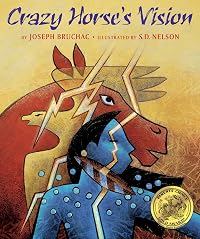
Crazy Horse's Vision
by Joseph Bruchac
On This Page
Description
A story based on the life of the dedicated young Lakota boy who grew up to be one of the bravest defenders of his people.Tags
Recommendations


Member Reviews
"The outer work will never be puny if the inner work is great." Meister Eckhart's quote is the awe-inspiring depiction of Crazy Horse and his vision which can be almost as illuminating as his very own enlightenment. This self-actualization brought Crazy Horse, once called Curly as a child, an aura of wisdom. His modesty, compassion, and generosity, made him known by many. With every page the reader is drawn in with both story and illustration. Each aesthetically stunning with detail to help bring the past to life. When the unthinkable happens and one's way of life is hastily seized; what cannot be taken is the freedom to choose. Crazy Horse knew this as he always chose his words mindfully. A perfect read as a reminder of the deep wisdom show more that lived on the lands in America long before white settlers impetuously plowed their way through. show less
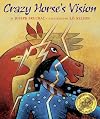
I believe that this myth does do a good job reflecting the culture of the Lakota's and other Native American tribes. Native Americans are very spiritual and believe in the visions that come from their gods or the elders that have passed on. They believe that they can speak to them in various ways and tell of how to better themselves and their tribal communities. Many of these rites are still practiced today. The author and the illustrator both come from Native American backgrounds and therefore do a very good job of portraying what daily life was like, what fears they had, and their spiritual beliefs. The illustrator used colors that have different symbolic meanings. For instance, he painted Crazy Horse blue because blue symbolizes the show more sky and the connection with the spirit world. show less
Written by an Abenaki Indian and illustrated by a Standing Rock Sioux (their own identity claims). It's an engaging and inspirational exploration of one part of a great man's life. More biographical details are in the author's notes. The illustrator's note is also interesting. A great read for November, or for any time of year.
This story is beautifully illustrated. I originally looked at it because I thought it was illustrated by Kadir Nelson, but learned otherwise. It was illustrated by S.D. Nelson who is a member of the Standing Rock Sioux Tribe. This story tells of Crazy Horse's life and his prophetic vision, "keep nothing for yourself." It describes how he got his name from his father, and became a great leader. I would definitely recommend this for any classroom.
Joseph Bruchac, whose prolific output as a children's author seems to span every conceivable genre, here turns his attention to the tale of Crazy Horse, the famous Lakota leader. Focusing on his childhood, this picture-book "biography" relates the story of young Curly, a quiet Lakota boy who decides to seek a vision after he witnesses the murder of Conquering Bear by U.S. soldiers.
The winner of the "Parents' Choice Gold Award," Crazy Horse's Vision pairs Bruchac's skillful narrative with S.D. Nelson's fabulous illustrations. Inspired by the ledger book style of painting created by Lakota artists of the 19th century, Nelson's colorful palette and stylized forms are a breathtaking complement to the story. Well worth the time of any young show more reader interested in American history, or the story of the Lakota people. show less
The winner of the "Parents' Choice Gold Award," Crazy Horse's Vision pairs Bruchac's skillful narrative with S.D. Nelson's fabulous illustrations. Inspired by the ledger book style of painting created by Lakota artists of the 19th century, Nelson's colorful palette and stylized forms are a breathtaking complement to the story. Well worth the time of any young show more reader interested in American history, or the story of the Lakota people. show less
I really loved this book. First, I like how this book represents the Lakota or Sioux people. Although the story is fiction, it is based on a person and actual Native American traditions and culture. In the back of the book there is an author's note with some more information regarding Crazy Horse and his people which is very informative and interesting. Second, I love the illustrations. They are vibrant and bright. There is an illustrator's note in the back too. The illustrations demonstrate perspective, color, and texture. There is also symbolism in the drawings, "I painted Crazy Horse blue because blue represents the sky and a connection with the spirit world." Finally, I liked the characters. The reader gets to see Curly develop from show more a small boy to a brave man called Crazy Horse. He is a brave character and he is also wise. I think the theme of this book is to be courageous and bold in difficult times. show less
This book recounts the story of how the Lakota chief Crazy Horse received his name, as told in Lakota legends. The story is well written and authentic to the legend if not necessarily the historical facts. S.D. Nelson's illustrations are extremely vibrant and eye-catching, and he is an award-winning author and artist in his own right, in addition to illustrating this book. This book is worth it for the artwork alone, and it makes a nice addition to any kind of mythology or folklore set for younger readers.
Members
- Recently Added By
Author Information

196+ Works 28,885 Members
Joseph Bruchac, author of more than seventy books for children and adults, is also an acclaimed storyteller and poet. He has received many prestigious literary awards, including the American Book Award, the PEN Syndicated Fiction Award, and the Lifetime Achievement Award from the Native Writers' Circle of The Americas
All Editions
Awards and Honors
Awards
Distinctions
Common Knowledge
- People/Characters
- Crazy Horse; Tashunka Witco; High Backbone; Chief Conquering Bear
- Dedication
- Wli dogo wõngan. For all my relations in our many nations --J.B.
In memory of those star-filled nights when the Northern Lights danced for a little boy above the Dakota prairies --S.D.N. - First words
- Crazy Horse, they say, was always different.
- Last words
- (Click to show. Warning: May contain spoilers.)They would know Crazy Horse.
Classifications
Statistics
- Members
- 325
- Popularity
- 97,618
- Reviews
- 27
- Rating
- (4.19)
- Languages
- English
- Media
- Paper, Audiobook, Ebook
- ISBNs
- 15
- ASINs
- 5