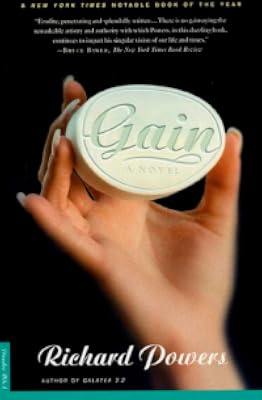
Gain
by Richard Powers
On This Page
Description
From Pulitzer Prize-winning and New York Times bestselling author of The Overstory, Richard Powers's Gain braids together two stories on very different scales. In one, Laura Body, divorced mother of two and a real-estate agent in the small town of Lacewood, Illinois, plunges into a new existence when she learns that she has ovarian cancer. In the other, Clare & Company, a soap manufacturer begun by three brothers in nineteenth-century Boston, grows over the course of a century and a half show more into an international consumer products conglomerate based in Laura's hometown. Clare's stunning growth reflects the kaleidoscopic history of America; Laura Body's life is changed forever by Clare. Gain's stunning conclusion reveals the countless invisible connections between the largest enterprises and the smallest lives. show lessTags
Recommendations






















Member Reviews
I have a complicated relationship with contemporary American fiction. Actually, I flat-out despise most of it. Give me a period novel about Edwardian English gentlemen, Second Empire French coalminers, post-Petrine Russian nobles, or even Depression-era California fruit pickers, and I will be happy, but it seems like I loathe anything set in the modern United States. Why does the life of a person in the recent past seem so full compared to the bland epigones who populate our shelves? Such small characters, such vitiated lives, such small epiphanies. Charles Portis was right: "We're weaker than our fathers, Dupree. We don't even look like them." At the helm of the mightiest empire the world has ever seen, ordinary Americans are the least show more interesting people on Earth, yet the most willing to over-document their sluggish swirls through the stagnant pond that they call home. It's either self-indulgence or a simple absence of anything real to talk about.
Another reason I get annoyed is that a lot of those kinds of novels make "consumerism" a theme, which I find incredibly boring. What is interesting at all about people consuming goods, talking about consuming goods, or thinking about talking about consuming goods? Nothing. How many novels have we been subjected to where authors try to make "points" about consumerism by including all of those things, lulling the reader into an ostentatiously branded coma so that no one catches on to the complete absence of any action or humanity that would interest a normal person with full control of their faculties? What in the name of God are you trying to SAY? Yet somehow Gain takes both of those themes that otherwise bore me and makes them great. It's two interrelated stories: one, the gradual growth amidst all the turbulence of American history of a small colonial-era soap-making factory called Jephthah Clare & Sons into Clare Inc., a Johnson & Johnson-esque corporate behemoth; and two, Laura Bodey's struggle against ovarian cancer in the modern-day town of Lacewood, IL, where Clare has a factory.
As a big economic history nerd, I confess that I found the first story far more interesting for the most part. In long stretches of sometimes-overwrought prose, Powers has concocted probably the most engrossing life story of a fictional corporation you'll ever read (which may not be a crowded field). Parts of it were easily on the level with a real corporate history like Marc Levinson's superb The Great A&P, or a magisterial economic history like William Cronon's Nature's Metropolis, which Powers clearly alludes to in the part set just prior to the 1893 World's Columbian Exposition. Watching the fledgling soap company make its first deals, improve its production process, and slowly expand into other markets to eventually become a titan of industry is honestly enthralling; you can almost see Adam Smith nodding approvingly during the sections on how the various Clare family members improve their firm's ability to truck and barter. There are also plenty of great parts about the chemistry of soap (no really).
Clare is intended to be both a parody of "better living through chemistry"-type companies, particularly as its story moves into the present-day, and also a serious study of how companies become both legal people and also "good corporate citizens", and enmesh themselves in our lives. Think of the sinister Bland corporation in Gravity's Rainbow, or Ambrose Bierce's definition of a corporation as "An ingenious device for obtaining individual profit without individual responsibility", or Milton Friedman's infamous arguments in "The Social Responsibility of Business is to Increase its Profits" that companies have zero responsibilities to society beyond enhancing shareholder value. While Clare is presented as a fairly benevolent company, taking early Progressive-era steps to bring their workers on board with the company and prevent the labor troubles so typical of the era, it slowly begins to seem like Just Another Company, especially when the narrative gets to the 80s. What starts out as a hagiography subtly becomes a much more nuanced picture.
This is made a little less abstract by Laura's story. She's a divorced mother of 2 kids who's seeing a married guy in her spare time. I expected to be bored stiff by her life, and initially I was, since she spends a lot of the beginning doing mundane ordinary complaining or snarking about consumer products, but Powers eventually won me over by giving her cancer, a time-tested method of increasing reader sympathy dating back at least to Charles Dickens. I've never had or known anyone close to me who had cancer so I don't know how accurate his depiction of it was, but it seemed pretty real and engrossing to me. While a lot of her story was used to present the reader with some Themes (e.g., the growth of Clare is implicitly analogized to the metastasis of cancer cells, the company's efforts to disavow any link between the chemical outputs of the Lacewood factory and the illnesses of the townfolk are contrasted with their equally assiduous efforts to seem like they Care About the Community), the changes in her relationships with her kids and ex-husband came off as genuine and moving. Powers also namedrops Crossing Brooklyn Ferry, a cool Walt Whitman poem.
Overall I liked the book, especially the capitalist cheerleading parts, which I would definitely read more of. While the modern characters occasionally threaten to become as boringly loathsome as their counterparts in a Jonathan Franzen novel, Powers does about the right amount of tearjerking to make them relatable and sympathetic. show less
Another reason I get annoyed is that a lot of those kinds of novels make "consumerism" a theme, which I find incredibly boring. What is interesting at all about people consuming goods, talking about consuming goods, or thinking about talking about consuming goods? Nothing. How many novels have we been subjected to where authors try to make "points" about consumerism by including all of those things, lulling the reader into an ostentatiously branded coma so that no one catches on to the complete absence of any action or humanity that would interest a normal person with full control of their faculties? What in the name of God are you trying to SAY? Yet somehow Gain takes both of those themes that otherwise bore me and makes them great. It's two interrelated stories: one, the gradual growth amidst all the turbulence of American history of a small colonial-era soap-making factory called Jephthah Clare & Sons into Clare Inc., a Johnson & Johnson-esque corporate behemoth; and two, Laura Bodey's struggle against ovarian cancer in the modern-day town of Lacewood, IL, where Clare has a factory.
As a big economic history nerd, I confess that I found the first story far more interesting for the most part. In long stretches of sometimes-overwrought prose, Powers has concocted probably the most engrossing life story of a fictional corporation you'll ever read (which may not be a crowded field). Parts of it were easily on the level with a real corporate history like Marc Levinson's superb The Great A&P, or a magisterial economic history like William Cronon's Nature's Metropolis, which Powers clearly alludes to in the part set just prior to the 1893 World's Columbian Exposition. Watching the fledgling soap company make its first deals, improve its production process, and slowly expand into other markets to eventually become a titan of industry is honestly enthralling; you can almost see Adam Smith nodding approvingly during the sections on how the various Clare family members improve their firm's ability to truck and barter. There are also plenty of great parts about the chemistry of soap (no really).
Clare is intended to be both a parody of "better living through chemistry"-type companies, particularly as its story moves into the present-day, and also a serious study of how companies become both legal people and also "good corporate citizens", and enmesh themselves in our lives. Think of the sinister Bland corporation in Gravity's Rainbow, or Ambrose Bierce's definition of a corporation as "An ingenious device for obtaining individual profit without individual responsibility", or Milton Friedman's infamous arguments in "The Social Responsibility of Business is to Increase its Profits" that companies have zero responsibilities to society beyond enhancing shareholder value. While Clare is presented as a fairly benevolent company, taking early Progressive-era steps to bring their workers on board with the company and prevent the labor troubles so typical of the era, it slowly begins to seem like Just Another Company, especially when the narrative gets to the 80s. What starts out as a hagiography subtly becomes a much more nuanced picture.
This is made a little less abstract by Laura's story. She's a divorced mother of 2 kids who's seeing a married guy in her spare time. I expected to be bored stiff by her life, and initially I was, since she spends a lot of the beginning doing mundane ordinary complaining or snarking about consumer products, but Powers eventually won me over by giving her cancer, a time-tested method of increasing reader sympathy dating back at least to Charles Dickens. I've never had or known anyone close to me who had cancer so I don't know how accurate his depiction of it was, but it seemed pretty real and engrossing to me. While a lot of her story was used to present the reader with some Themes (e.g., the growth of Clare is implicitly analogized to the metastasis of cancer cells, the company's efforts to disavow any link between the chemical outputs of the Lacewood factory and the illnesses of the townfolk are contrasted with their equally assiduous efforts to seem like they Care About the Community), the changes in her relationships with her kids and ex-husband came off as genuine and moving. Powers also namedrops Crossing Brooklyn Ferry, a cool Walt Whitman poem.
Overall I liked the book, especially the capitalist cheerleading parts, which I would definitely read more of. While the modern characters occasionally threaten to become as boringly loathsome as their counterparts in a Jonathan Franzen novel, Powers does about the right amount of tearjerking to make them relatable and sympathetic. show less
Richard Power's 'Gain' justaposes the history of a modern multi-national corporation against a small town woman dying of ovarian cancer--a victim of the chemicals that that corporation has been seeding into the local ecology of her town for years.
From it's founding as a soap and candle making manufactory in Boston Massachusetts in the early 19th Century--the Clare corporation is shown as it grows over the next century and a half + through science and also innovation and through the ruthless dog eat dog ideology that pushes it over the top of its competition--swallowing up those competitors which has it adding and diversifying its product lines. As the country grows westward following the newly built rail lines the Clare company will show more set up in small town Lacewoold Illinois centrally located between Chicago, Kansas City and Indianapolis and become immediately the most essential part of that town's economy. Over the years its residents will depend on the Clare corporation for their livelihoods and it will act as not only that town's main benefactor but as a symbol of their small town values of good citizenship.
But there is the darker story that Powers describe following one of Lacewood's residents Laura Bodey who as it happens does not and has not worked for Clare but has been poisoned by some of Clare's pollution which has gotten into the local ecology. She as we find out is not the only victim and there is a class action suit against the company being waged in court and many of the plaintiffs work for Clare. The behemoth company of course is fighting them every step of the way. It points to its good citizenship--the local hospital for instance is a gift to the community from them. Laura's ex-husband Don wants her to join in the lawsuit against the company--sometimes arguing bitterly with her. Their children seem caught somewhere between numbness and incomprehension.
It's an interesting story that Powers tells well. His description of the cancer treatments that Laura recieves--whether Chemo or radiation are particularly gripping and are realistically drawn. The book is worth reading just for them. Overall however there are some lapses. In mostly short passages he chronilogically updates the companies history offsetting it in likewise short passages running side by side with that history he details Laura's life, illness and eventual death connecting both in time at the end. Sadly this does not require a rather large leap of the imagination as a story such as corporate neglect of the enviroment leading to devastating effects on nearby localities have been all to frequent in the last century or so. Not all that many books about it though.
As a writer I think Powers is much too creative to the point where he is incapable of writing a bad book. This may not be his best effort but it is certainly good and has enough intensity and imagination to carry the reader to the end. How that reader may look back at this one afterwards may have as much to do with their personal ideology than anything else. The attack on the corporate structures holding up America's economic well being are understated but they are still there. This novel is as much about people disappearing into a void at the expense of a consumption driven culture bent on kowtowing to wealth, power and ambition on the one end and the obsessive drive of consumers to realize themselves on the other. show less
From it's founding as a soap and candle making manufactory in Boston Massachusetts in the early 19th Century--the Clare corporation is shown as it grows over the next century and a half + through science and also innovation and through the ruthless dog eat dog ideology that pushes it over the top of its competition--swallowing up those competitors which has it adding and diversifying its product lines. As the country grows westward following the newly built rail lines the Clare company will show more set up in small town Lacewoold Illinois centrally located between Chicago, Kansas City and Indianapolis and become immediately the most essential part of that town's economy. Over the years its residents will depend on the Clare corporation for their livelihoods and it will act as not only that town's main benefactor but as a symbol of their small town values of good citizenship.
But there is the darker story that Powers describe following one of Lacewood's residents Laura Bodey who as it happens does not and has not worked for Clare but has been poisoned by some of Clare's pollution which has gotten into the local ecology. She as we find out is not the only victim and there is a class action suit against the company being waged in court and many of the plaintiffs work for Clare. The behemoth company of course is fighting them every step of the way. It points to its good citizenship--the local hospital for instance is a gift to the community from them. Laura's ex-husband Don wants her to join in the lawsuit against the company--sometimes arguing bitterly with her. Their children seem caught somewhere between numbness and incomprehension.
It's an interesting story that Powers tells well. His description of the cancer treatments that Laura recieves--whether Chemo or radiation are particularly gripping and are realistically drawn. The book is worth reading just for them. Overall however there are some lapses. In mostly short passages he chronilogically updates the companies history offsetting it in likewise short passages running side by side with that history he details Laura's life, illness and eventual death connecting both in time at the end. Sadly this does not require a rather large leap of the imagination as a story such as corporate neglect of the enviroment leading to devastating effects on nearby localities have been all to frequent in the last century or so. Not all that many books about it though.
As a writer I think Powers is much too creative to the point where he is incapable of writing a bad book. This may not be his best effort but it is certainly good and has enough intensity and imagination to carry the reader to the end. How that reader may look back at this one afterwards may have as much to do with their personal ideology than anything else. The attack on the corporate structures holding up America's economic well being are understated but they are still there. This novel is as much about people disappearing into a void at the expense of a consumption driven culture bent on kowtowing to wealth, power and ambition on the one end and the obsessive drive of consumers to realize themselves on the other. show less
Richard Powers is probably the smartest writer you're either not reading or never even heard of. In his novel Gain, he takes two incredibly simple, almost paradigmatic, narratives and weaves them together in a fairly straightforward allegory. But this book is not what you're expecting, because at almost all turns, it manages to upend the obvious in increasingly fascinating ways.
The novel opens in Lacewood, IN, a small town that houses major factories for Clare Soap & Chemical. Laura Bodey, a realtor and divorced single mom, lives in Lacewood with her somewhat eccentric family. All seems well until Laura is diagnosed with ovarian cancer. As she progresses through various treatments, Powers interweaves the narrative of Clare's development show more -- from its humble beginnings as a small Boston store run by three brothers to the multinational conglomerate it has become in the present.
The novel's accessibility comes from this relatively simplistic approach: eschewing chapters, Powers instead alternates short passages of ten or fewer pages from each narrative before breaking off to rejoin the other story. Ultimately, there's a predictability to the plot: Clare's "gain" and Laura's "loss" happen on relatively equal though opposite valences, and the concept of excess and overgrowth is unsurprising given the novel's thematic focus on cancer. Nevertheless, Powers navigates each portion of his tale brilliantly, the emotional wear-and-tear of Laura's life contrasting brilliantly with the technical discussions of chemical compounds, medical treatments, and business expansion. The result is a novel that is as erudite as it is affecting.
If there's a weakness to the work, it's that the novel itself is an exhausting mental exercise. Though "only" 355 pages in length, Powers's style is so dense that he encapsulates large concepts into brief thoughts and paragraphs, resulting in a work that reads incredibly slowly. As the inevitability of the story sinks in, Powers consequently overwhelms the reader with detail and observation, painstakingly pointing out each portion of the plot's progress. It's fascinating if taxing on the brain, and almost assuredly will result in the reader taking frequent breaks, no matter how engrossed he may be in the story.
Despite its challenges, Gain nevertheless proves to be an unquestionably valuable read. It is challenging, thought-provoking, and inspiring in ways that few novels in recent memory have been. It offers no easy answers, but revels in giving the reader everything he needs to form whichever solutions he'd like. If you've never heard of Richard Powers, or never considering reading Gain, it's undoubtedly your loss. show less
The novel opens in Lacewood, IN, a small town that houses major factories for Clare Soap & Chemical. Laura Bodey, a realtor and divorced single mom, lives in Lacewood with her somewhat eccentric family. All seems well until Laura is diagnosed with ovarian cancer. As she progresses through various treatments, Powers interweaves the narrative of Clare's development show more -- from its humble beginnings as a small Boston store run by three brothers to the multinational conglomerate it has become in the present.
The novel's accessibility comes from this relatively simplistic approach: eschewing chapters, Powers instead alternates short passages of ten or fewer pages from each narrative before breaking off to rejoin the other story. Ultimately, there's a predictability to the plot: Clare's "gain" and Laura's "loss" happen on relatively equal though opposite valences, and the concept of excess and overgrowth is unsurprising given the novel's thematic focus on cancer. Nevertheless, Powers navigates each portion of his tale brilliantly, the emotional wear-and-tear of Laura's life contrasting brilliantly with the technical discussions of chemical compounds, medical treatments, and business expansion. The result is a novel that is as erudite as it is affecting.
If there's a weakness to the work, it's that the novel itself is an exhausting mental exercise. Though "only" 355 pages in length, Powers's style is so dense that he encapsulates large concepts into brief thoughts and paragraphs, resulting in a work that reads incredibly slowly. As the inevitability of the story sinks in, Powers consequently overwhelms the reader with detail and observation, painstakingly pointing out each portion of the plot's progress. It's fascinating if taxing on the brain, and almost assuredly will result in the reader taking frequent breaks, no matter how engrossed he may be in the story.
Despite its challenges, Gain nevertheless proves to be an unquestionably valuable read. It is challenging, thought-provoking, and inspiring in ways that few novels in recent memory have been. It offers no easy answers, but revels in giving the reader everything he needs to form whichever solutions he'd like. If you've never heard of Richard Powers, or never considering reading Gain, it's undoubtedly your loss. show less
Gain, Richard Power’s amazing sixth novel (originally published in 1998), takes one of the most difficult issues of our time and humanizes it. The issue is corporate culpability. We all know that “better living through chemistry” has its price and its consequences, but who is to pay?
Not Clare, the transnational corporation whose history is charted across three generations in this saga of a novel. The company makes soap — a cleaning product that offers the homemaker so much to gain. And the company, of course, has gained, prodigiously, over the years: it has profited immensely.
Clare manufacturers its products in Lacewood, Illinois, where Laura Bodey is an estate agent. Laura has ovarian cancer. Her story – of her illness and show more how, as she disintegrates, her family reunites around her – is intertwined with the story of Clare International.
Long before the novel makes the facts plain, we’ve already drawn connections: our chemistry is killing us. The brilliant Powers draws parallels and cycles in abundance but, to his credit, he never once hits over the head with any moralizing message.
Perennial plants flower and die, and so do people and industries, he implies. It’s the way of the world. We can change things, perhaps and, after reading Gain, we may well join one crusade or another, seeking justice for victims of industries focused on nothing but gain or, contrarily, seeking to eliminate the tort system that is, at this point, the victim’s only source of recompense and punishment for the polluters who make us sick. Either way, or no way, that’ll be what you got out of the novel, not what’s there.Gain is a history of a cancer, then, but also a history of the American corporation — a frightening parallel, but also apropos. Clare starts out as just a few people but, because they are incorporated, they have all the rights of individuals but none of the responsibilities. In our lust to profit and consume in an environment unfettered by regulation or consequence, we too quickly forget this strange contortion of the Fourteenth Amendment. Written to declare the personhood of those held as slaves and thus set them free, it quickly came to be wielded as a blunt instrument in the creation of corporate personhood.
Corporations attained the rights of individuals (without the responsibilities – that is, they cannot easily and directly be held responsible of their actions) through a reading, an interpretation of the word “person,” in the U.S. constitution. So Powers is riffing on a cycle of healing and sickness: in the hands of a great writer, reading is curative. In the hands of lawyers, though, interpretative powers can be perverted and make us sick.
Gain is, in short, a brilliant, exhilarating novel that, like all Powers’ novels, deserves and rewards our closest reading. Richard Powers is without a doubt one of the two or three best living writers working in the English language. With Gain, he flexed his considerable muscles, letting us see ourselves through both the wide-angle lens of history and the microscope of the cancerous body. Gain is a major achievement, a novel of conscience for a largely unconscious culture. And he didn’t stop with Gain. Soon after came novels about terrorism, the environment, race and, most recently, a return to science in a novel about the creativity of genetic engineering (and the engineering of creative writing).
If you care about ideas and their power in the world, you should be reading Richard Powers.
Originally published on Curled Up With A Good Book at www.curledup.com. © Brian Charles Clark, 2010 show less
Not Clare, the transnational corporation whose history is charted across three generations in this saga of a novel. The company makes soap — a cleaning product that offers the homemaker so much to gain. And the company, of course, has gained, prodigiously, over the years: it has profited immensely.
Clare manufacturers its products in Lacewood, Illinois, where Laura Bodey is an estate agent. Laura has ovarian cancer. Her story – of her illness and show more how, as she disintegrates, her family reunites around her – is intertwined with the story of Clare International.
Long before the novel makes the facts plain, we’ve already drawn connections: our chemistry is killing us. The brilliant Powers draws parallels and cycles in abundance but, to his credit, he never once hits over the head with any moralizing message.
Perennial plants flower and die, and so do people and industries, he implies. It’s the way of the world. We can change things, perhaps and, after reading Gain, we may well join one crusade or another, seeking justice for victims of industries focused on nothing but gain or, contrarily, seeking to eliminate the tort system that is, at this point, the victim’s only source of recompense and punishment for the polluters who make us sick. Either way, or no way, that’ll be what you got out of the novel, not what’s there.Gain is a history of a cancer, then, but also a history of the American corporation — a frightening parallel, but also apropos. Clare starts out as just a few people but, because they are incorporated, they have all the rights of individuals but none of the responsibilities. In our lust to profit and consume in an environment unfettered by regulation or consequence, we too quickly forget this strange contortion of the Fourteenth Amendment. Written to declare the personhood of those held as slaves and thus set them free, it quickly came to be wielded as a blunt instrument in the creation of corporate personhood.
Corporations attained the rights of individuals (without the responsibilities – that is, they cannot easily and directly be held responsible of their actions) through a reading, an interpretation of the word “person,” in the U.S. constitution. So Powers is riffing on a cycle of healing and sickness: in the hands of a great writer, reading is curative. In the hands of lawyers, though, interpretative powers can be perverted and make us sick.
Gain is, in short, a brilliant, exhilarating novel that, like all Powers’ novels, deserves and rewards our closest reading. Richard Powers is without a doubt one of the two or three best living writers working in the English language. With Gain, he flexed his considerable muscles, letting us see ourselves through both the wide-angle lens of history and the microscope of the cancerous body. Gain is a major achievement, a novel of conscience for a largely unconscious culture. And he didn’t stop with Gain. Soon after came novels about terrorism, the environment, race and, most recently, a return to science in a novel about the creativity of genetic engineering (and the engineering of creative writing).
If you care about ideas and their power in the world, you should be reading Richard Powers.
Originally published on Curled Up With A Good Book at www.curledup.com. © Brian Charles Clark, 2010 show less
Laura Bodey is a 42-year old divorced mother of two teenaged kids who is struggling to make ends meet as a real estate broker in the small Midwestern town of Lacewood, Illinois. She manages just fine most days, but when she contracts ovarian cancer everything in her life starts to spiral downward in a hurry. Clare International Inc. is a major multinational corporation that is headquartered in Boston but has located its agricultural chemicals division in Lacewood. The firm has been a model citizen for as long as anyone can remember, but recently there have been reports that Clare is responsible for the spread of toxic pollutants that may have contaminated the land and water around town. Is the company responsible for Laura’s illness show more and, if so, what should be the remedy?
In Gain, Richard Powers continues his on-going exploration of the trends and events that have shaped modern American society. In fact, in the tradition of the sort of promotional campaign used by companies like Clare, the author gives the reader a two-for-one deal in story-telling: the rise of a major corporation from its origins as a family soap-maker in the early 1800s to its modern-day status as a major industrial conglomerate is intertwined with Laura’s heart-breaking personal tale of physical decline. In an interesting literary device, the novel is structured without chapter divisions by alternating between the two story lines—each more or less linear in its own time frame—until they converge in the present day.
I enjoyed reading Gain and I learned a lot in the process, just as I have with every one of Powers’ other novels. Surprisingly, though, Laura’s sad plight did not quite resonate with me, perhaps because there was not enough time spent developing her background before she became ill. On the other hand, the way that the author animated the corporation as a fully realized character in its own right was nothing short of amazing, particularly for all the research and imagination it required to fit the details of Clare’s fictional existence into the historical circumstances that actually occurred over the 170-year arc of the tale. For the most part, this is an even-handed and realistic portrait of what is both good and potentially bad about the corporate form of business organization and that alone should make this novel well worth reading. show less
In Gain, Richard Powers continues his on-going exploration of the trends and events that have shaped modern American society. In fact, in the tradition of the sort of promotional campaign used by companies like Clare, the author gives the reader a two-for-one deal in story-telling: the rise of a major corporation from its origins as a family soap-maker in the early 1800s to its modern-day status as a major industrial conglomerate is intertwined with Laura’s heart-breaking personal tale of physical decline. In an interesting literary device, the novel is structured without chapter divisions by alternating between the two story lines—each more or less linear in its own time frame—until they converge in the present day.
I enjoyed reading Gain and I learned a lot in the process, just as I have with every one of Powers’ other novels. Surprisingly, though, Laura’s sad plight did not quite resonate with me, perhaps because there was not enough time spent developing her background before she became ill. On the other hand, the way that the author animated the corporation as a fully realized character in its own right was nothing short of amazing, particularly for all the research and imagination it required to fit the details of Clare’s fictional existence into the historical circumstances that actually occurred over the 170-year arc of the tale. For the most part, this is an even-handed and realistic portrait of what is both good and potentially bad about the corporate form of business organization and that alone should make this novel well worth reading. show less
Though I applauded Powers’ 2006 National Book Award win for Echo Maker, this is still my favorite novel by one of my favorite authors. Corporations have long been treated like individuals under the law and in this book, Powers has done the literary equivalent--a corporation as a living breathing character. One plot line follows the corporation from its humble beginnings in 19th century Boston to a multinational conglomerate, and the other plot line is the painful story of Laura Bodey who is facing a terminal illness. You know how the stories will collide from the beginning, but you enjoy every second of the journey. The history of this fictional corporation is the history of this country, from cute jingles to advertising savvy, from show more family ownership to shareholder control, and the consequence of the shifts of American capitalism are written horribly on Laura’s life. show less
As a reader, I'm sometimes not sure if "Gain" is reporting or fictionalizing history. So much of the narrative appears to recount actual history--the influence of specific corporations, for example--or a summation of technological processes--like the explication of what's involved in developing a disposable camera. On the other hand, the characters are fictional and there is a plot and there is action and there are all the other elements we associate with "story." The approach does remind me of Michener, though--thoroughly researched realism. I am fascinated by "Gain's" accumulation of detail. I've never had ovarian cancer (or any other kind of cancer, for that matter), but, having read this novel, it seems that I understand, or at show more least am sensitive to, what people go through in chemotherapy. show less
Members
- Recently Added By
Published Reviews
ThingScore 63
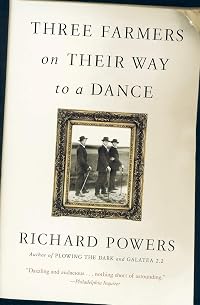
AT the beginning of Richard Powers's first novel, published in 1985, an unnamed visitor to a
Detroit museum becomes captivated by a photograph of three Prussian farmers heading for a
dance. The year of the picture -- 1914 -- is crucial to its fascination for him. ''The date,'' he
explains, ''sufficed to show they were not going to their expected dance. I was not going to my
expected dance. We show more would all be taken blindfolded into a field somewhere in this tortured
century and made to dance until we'd had enough. Dance until we dropped.'' The novel goes on
to imagine the three farmers' wartime experiences and to describe how the strangely arresting
photograph impels both the Detroit museumgoer and a writer in Boston to investigate and
ponder the history surrounding it. Along the way, in passages that would not seem out of place
in a philosophy journal, Powers contemplates the annihilation by World War I of the 19thcentury
''doctrine of perfectibility'' and the repercussions of the ''geometrically accelerating
culture'' of our own ''tortured century,'' which, in his view, creates an illusion of progress and
prosperity amid rampant brutality and dehumanization.
''Three Farmers on Their Way to a Dance,'' which appeared when Powers had not yet turned 30,
was nothing less than enthralling in its ambition and promise. In the 13 years since then, he has
published four other novels -- ''Prisoner's Dilemma,'' ''The Gold Bug Variations,'' ''Operation
Wandering Soul'' and ''Galatea 2.2'' -- in which he has continued to explore some of the darker
ironies, absurdities and tragedies of life in the American century. Dense, challenging, aphoristic
and swarming with recondite allusions and puns, these novels display an authoritative grasp of
a breathtaking range of subjects, from architectural history and medieval theology to quantum
physics and popular culture. But while Powers never seems out to impress or obfuscate, his
conspicuous intelligence and virtuosity have also won him a reputation as difficult, even
inaccessible.
His sixth novel, ''Gain,'' seems designed to change all that. Like his earlier books, it is erudite,
penetrating and splendidly written; alongside them, though, it seems positively straightforward.
Powers cuts back and forth between two narratives. One relates the history of a small family
soap-and-candle business, Jephthah Clare & Sons of Boston, which over the course of the 19th
and 20th centuries grows into a giant worldwide conglomerate called Clare International. The
other story, set in the present day, concerns Laura Bodey, a divorced 42-year-old real estate
saleswoman who lives with her son and daughter in Lacewood, Ill., the headquarters of Clare's
North American Agricultural Products Division.
Not long after Laura develops ovarian cancer, she discovers that chemicals from the Clare plant
-- or the Clare-produced fertilizers and weedkillers that she uses in her garden -- may be
responsible. From early on, it's clear what Powers is getting at -- the history of a company like
Clare may add up to a classic American success story, but among the casualties of that supposed
success are the health and happiness of some of its customers and neighbors. The pointed
association of business growth with tumor growth, of a corporation's robust health with a
woman's agonizing infirmity, is deliberate: for Powers, there is a direct link between the rise of
corporations and the decline of the individual, of humane values and of human well-being
generally. The title's irony is hardly subtle: have we gained the whole world, Powers wants to
know, only to lose our souls?
Neither of the novel's parallel narratives contains so much as a single surprising plot
development. Yet the book holds one's interest anyway, mainly because Powers, in the
corporate-history passages, makes a compelling tale out of the evolution of American business
practices over nearly two centuries. The story of Clare, like that of many a real-life American
company, proves to be one of survival and expansion made possible by its management's ability
to adapt to -- or even anticipate -- such changes as the invention of the corporation, the
introduction of packaging and promotion and the advent of multinationals and vertical
integration. Powers's account of how Clare's management acquires a concept of the corporate
image and then consciously strives to establish the corporation as ''a person'' not only ''in the
eyes of the law'' but ''in the minds of its customers'' is perceptive and valuable. Has any novelist
been more successful at bringing the history of American business to life?
And yet, for all his gifts, Powers proves somewhat less successful at animating his characters.
This is true especially of the men and women -- most of them named Clare -- who figure in the
nearly dialogue-free corporate history, but it is also the case with Laura Bodey and her family.
By far the most distinctive attribute of the rather affectless Laura is her bemused, quizzical take
on daily life in millennial America, but her reflections always make her sound less like a middleaged,
Middle American real estate saleswoman than an egghead novelist. If at times this cancerridden
mom and her brand-name-ridden life seem almost to have stepped out of a 1980's short
story by David Leavitt or some other practitioner of Brat Pack minimalism (a subgenre that has
always appeared to be at the opposite end of the literary spectrum from Powers), some of the
digs at modern consumer society that Powers puts in her mouth bring to mind Don DeLillo at
his most facile. (''Remind me again,'' Laura asks her daughter at one point. ''Which is stronger:
Mega, Super or Ultra?'')
Illness only makes Laura more implausible. Though she declines from a vigorous, independent
woman into an utterly debilitated, pain-racked invalid, the tone of her thoughts, as reported by
Powers, remains unwaveringly crisp, clever and sardonic. (Which is, of course, another way of
saying that she continues to function principally as an authorial mouthpiece.) It doesn't add up
to a terribly credible or affecting portrait of a soul in extremis. Powers, alas, seems to have
trouble resisting the urge to reduce people to his ideas about them -- a surprising flaw in a
novelist whose chief theme is the dehumanization of Americans by corporations.
Yet this novel's merits far outweigh its failings. Though the dark underside of American
enterprise and the American dream of material fulfillment have long been standard literary
themes, what Powers has attempted -- and carried off -- here is something quite special. One
can have a pretty fair knowledge of the history of the United States and still experience ''Gain''
almost as a revelation. For to read Powers's story of the shaping of today's commercial culture is
to feel as if one has never before seen that culture quite so clearly or acquired such a vivid
understanding of the dynamic, generations-long process that brought it into being.
THE book abounds in memorable statements summing up the significance of various historical
developments. (With the invention of the telegraph, for example, ''time was dead; things could
be known in the moment they happened.'') And how many writers could, at considerable length,
describe everything that goes into the creation and packaging of a single-use camera and leave a
reader at once awe-struck at the complexity of the process, dismayed that so much should go
into the manufacture of an item designed for almost instant obsolescence and haunted by our
culture's baffling admixture of the miraculous and the banal, of technological sophistication and
moral and spiritual coarseness?
Moreover, Powers so effectively ties chemistry to cancer -- tapping adroitly into Americans'
latent paranoia about the ubiquity of carcinogens -- that by the novel's end many readers may
well find themselves staring in terror at the chemical names on the labels of their household
products. And he so powerfully communicates his sense of the corporate world's tyranny over
the 20th-century American soul that one may almost forget the century's far more monstrous
tyrannies -- which were, of course, vanquished through the efforts and example of the capitalist
democracies. Yet if one may reasonably dispute the novel's implicit politics, there is no
gainsaying the remarkable artistry and authority with which Powers, in this dazzling book,
continues to impart his singular vision of our life and times. show less
Detroit museum becomes captivated by a photograph of three Prussian farmers heading for a
dance. The year of the picture -- 1914 -- is crucial to its fascination for him. ''The date,'' he
explains, ''sufficed to show they were not going to their expected dance. I was not going to my
expected dance. We show more would all be taken blindfolded into a field somewhere in this tortured
century and made to dance until we'd had enough. Dance until we dropped.'' The novel goes on
to imagine the three farmers' wartime experiences and to describe how the strangely arresting
photograph impels both the Detroit museumgoer and a writer in Boston to investigate and
ponder the history surrounding it. Along the way, in passages that would not seem out of place
in a philosophy journal, Powers contemplates the annihilation by World War I of the 19thcentury
''doctrine of perfectibility'' and the repercussions of the ''geometrically accelerating
culture'' of our own ''tortured century,'' which, in his view, creates an illusion of progress and
prosperity amid rampant brutality and dehumanization.
''Three Farmers on Their Way to a Dance,'' which appeared when Powers had not yet turned 30,
was nothing less than enthralling in its ambition and promise. In the 13 years since then, he has
published four other novels -- ''Prisoner's Dilemma,'' ''The Gold Bug Variations,'' ''Operation
Wandering Soul'' and ''Galatea 2.2'' -- in which he has continued to explore some of the darker
ironies, absurdities and tragedies of life in the American century. Dense, challenging, aphoristic
and swarming with recondite allusions and puns, these novels display an authoritative grasp of
a breathtaking range of subjects, from architectural history and medieval theology to quantum
physics and popular culture. But while Powers never seems out to impress or obfuscate, his
conspicuous intelligence and virtuosity have also won him a reputation as difficult, even
inaccessible.
His sixth novel, ''Gain,'' seems designed to change all that. Like his earlier books, it is erudite,
penetrating and splendidly written; alongside them, though, it seems positively straightforward.
Powers cuts back and forth between two narratives. One relates the history of a small family
soap-and-candle business, Jephthah Clare & Sons of Boston, which over the course of the 19th
and 20th centuries grows into a giant worldwide conglomerate called Clare International. The
other story, set in the present day, concerns Laura Bodey, a divorced 42-year-old real estate
saleswoman who lives with her son and daughter in Lacewood, Ill., the headquarters of Clare's
North American Agricultural Products Division.
Not long after Laura develops ovarian cancer, she discovers that chemicals from the Clare plant
-- or the Clare-produced fertilizers and weedkillers that she uses in her garden -- may be
responsible. From early on, it's clear what Powers is getting at -- the history of a company like
Clare may add up to a classic American success story, but among the casualties of that supposed
success are the health and happiness of some of its customers and neighbors. The pointed
association of business growth with tumor growth, of a corporation's robust health with a
woman's agonizing infirmity, is deliberate: for Powers, there is a direct link between the rise of
corporations and the decline of the individual, of humane values and of human well-being
generally. The title's irony is hardly subtle: have we gained the whole world, Powers wants to
know, only to lose our souls?
Neither of the novel's parallel narratives contains so much as a single surprising plot
development. Yet the book holds one's interest anyway, mainly because Powers, in the
corporate-history passages, makes a compelling tale out of the evolution of American business
practices over nearly two centuries. The story of Clare, like that of many a real-life American
company, proves to be one of survival and expansion made possible by its management's ability
to adapt to -- or even anticipate -- such changes as the invention of the corporation, the
introduction of packaging and promotion and the advent of multinationals and vertical
integration. Powers's account of how Clare's management acquires a concept of the corporate
image and then consciously strives to establish the corporation as ''a person'' not only ''in the
eyes of the law'' but ''in the minds of its customers'' is perceptive and valuable. Has any novelist
been more successful at bringing the history of American business to life?
And yet, for all his gifts, Powers proves somewhat less successful at animating his characters.
This is true especially of the men and women -- most of them named Clare -- who figure in the
nearly dialogue-free corporate history, but it is also the case with Laura Bodey and her family.
By far the most distinctive attribute of the rather affectless Laura is her bemused, quizzical take
on daily life in millennial America, but her reflections always make her sound less like a middleaged,
Middle American real estate saleswoman than an egghead novelist. If at times this cancerridden
mom and her brand-name-ridden life seem almost to have stepped out of a 1980's short
story by David Leavitt or some other practitioner of Brat Pack minimalism (a subgenre that has
always appeared to be at the opposite end of the literary spectrum from Powers), some of the
digs at modern consumer society that Powers puts in her mouth bring to mind Don DeLillo at
his most facile. (''Remind me again,'' Laura asks her daughter at one point. ''Which is stronger:
Mega, Super or Ultra?'')
Illness only makes Laura more implausible. Though she declines from a vigorous, independent
woman into an utterly debilitated, pain-racked invalid, the tone of her thoughts, as reported by
Powers, remains unwaveringly crisp, clever and sardonic. (Which is, of course, another way of
saying that she continues to function principally as an authorial mouthpiece.) It doesn't add up
to a terribly credible or affecting portrait of a soul in extremis. Powers, alas, seems to have
trouble resisting the urge to reduce people to his ideas about them -- a surprising flaw in a
novelist whose chief theme is the dehumanization of Americans by corporations.
Yet this novel's merits far outweigh its failings. Though the dark underside of American
enterprise and the American dream of material fulfillment have long been standard literary
themes, what Powers has attempted -- and carried off -- here is something quite special. One
can have a pretty fair knowledge of the history of the United States and still experience ''Gain''
almost as a revelation. For to read Powers's story of the shaping of today's commercial culture is
to feel as if one has never before seen that culture quite so clearly or acquired such a vivid
understanding of the dynamic, generations-long process that brought it into being.
THE book abounds in memorable statements summing up the significance of various historical
developments. (With the invention of the telegraph, for example, ''time was dead; things could
be known in the moment they happened.'') And how many writers could, at considerable length,
describe everything that goes into the creation and packaging of a single-use camera and leave a
reader at once awe-struck at the complexity of the process, dismayed that so much should go
into the manufacture of an item designed for almost instant obsolescence and haunted by our
culture's baffling admixture of the miraculous and the banal, of technological sophistication and
moral and spiritual coarseness?
Moreover, Powers so effectively ties chemistry to cancer -- tapping adroitly into Americans'
latent paranoia about the ubiquity of carcinogens -- that by the novel's end many readers may
well find themselves staring in terror at the chemical names on the labels of their household
products. And he so powerfully communicates his sense of the corporate world's tyranny over
the 20th-century American soul that one may almost forget the century's far more monstrous
tyrannies -- which were, of course, vanquished through the efforts and example of the capitalist
democracies. Yet if one may reasonably dispute the novel's implicit politics, there is no
gainsaying the remarkable artistry and authority with which Powers, in this dazzling book,
continues to impart his singular vision of our life and times. show less
added by browner56
Never one to tread lightly or think small, Powers (Galatea 2.2, 1995, etc.) here tackles 170 years of US capitalism as embodied by a single corporation, binding it to the struggle of a midwestern mom to a cancer most likely caused by the same company’s malfeasance. The candle-and-soap outfit begun in Boston in the 1830s by the three Clare brothers first built a reputation on its medicinal show more soap, the secret ingredient of which came from a root given the youngest Clare on a surveying expedition to the South Seas. Prosperity came when the brothers were chosen as a soap supplier to the Army, and diversity followed as the ever-expanding company moved into home, industrial, and agricultural commodities. At the turn of the century, Clare Soap and Chemical chose the sleepy town of Lacewood, Illinois, as the site of its Agricultural Products group. Since then, the fate of the town has been tied tightly to the fate of the multinational corporation. None of this matters to Laura Bodey, a competent, plant-loving single mother of two teenagers whose only links to Clare, Inc., are the homebuyers brought into her realty office as a result of the company’s booming business. After being diagnosed with ovarian cancer, however, she begins to become aware of reports concerning widespread industrial pollution by Lacewood’s corporate benefactor. Surgery and chemotherapy fail to keep the monstrous cancer at bay, but even as she grows weaker Laura resists joining a class-action suit against Clare, refusing to believe that any of the company’s products could have done this to her--until confronted by evidence from her beloved garden. The personal story is wrenching in its detail, and the larger point is amply made, but interest in the corporate history itself, which is not only weighty but a tad dull in the balance, proves harder to sustain. Yet anothttp://www.librarything.com/work/1486091#her unconventional work from Powers, a novelist who never does the same thing twice, but not his strongest. show less
added by browner56
Lists

Top Five Books of 2013
1,562 works; 721 members

Top Five Books of 2014
1,064 works; 398 members
Author Information

21+ Works 22,459 Members
Richard Powers was born on June 18, 1957 in Evanston, Illinois. He received bachelor's and master's degrees in English from the University of Illinois at Urbana-Champaign. After graduation, he moved to Boston, Massachusetts and worked as a computer programmer and freelance data processor. One day he saw August Sander's 1914 black-and-white show more photograph of three Westerwald farm boys heading to a dance at the Museum of Fine Arts. This photograph inspired Powers to quit his job and try writing a novel. Three Farmers on Their Way to a Dance was published in 1985. His other works include Prisoner's Dilemma, The Gold Bug Variations, Operation Wandering Soul, Galatea 2.2, Plowing the Dark, The Time of Our Singing, and Generosity: An Enhancement. He received numerous awards including the James Fenimore Cooper Prize for Best Historical Fiction for Gain, the National Book Award for The Echo Maker, and Pulitzer Prize in fiction for The Overstory: A Novel. (Bowker Author Biography) show less
Some Editions
Awards and Honors
Common Knowledge
- Canonical title*
- Gains
- Original title
- Gain
- Original publication date
- 1999
- First words
- Day had a way of shaking Lacewood awake.
- Last words
- (Click to show. Warning: May contain spoilers.)And softly, Tim suggested that it might be time for the little group of them to incorporate.
- Canonical DDC/MDS
- 813.54; 813.6
- Canonical LCC
- PS3566.O92
*Some information comes from Common Knowledge in other languages. Click "Edit" for more information.
Classifications
Statistics
- Members
- 652
- Popularity
- 44,230
- Reviews
- 22
- Rating
- (3.79)
- Languages
- 5 — Dutch, English, French, Italian, Spanish
- Media
- Paper, Ebook
- ISBNs
- 18
- ASINs
- 5