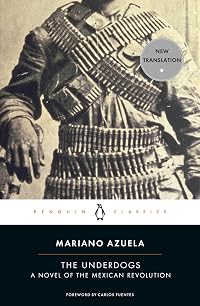
The Underdogs
by Mariano Azuela
On This Page
Description
Originally published in serialized form in a border-town newspaper, Mariano Azuela's The Underdogs is a gripping tale that recounts the personal and political havoc that surrounded the Mexican Revolution. Equal parts action-packed war novel and philosophical meditation on the costs of conflict, The Underdogs is a must-read for fans of historical fiction or Hispanic literature buffs..
Tags
Recommendations


















Member Reviews
“I love the revolution like a volcano in eruption; I love the volcano because it’s a volcano, the revolution because it’s the revolution! What do I care about the stones left above or below after the cataclysm? What are they to me?”
Set in 1910-1915, this story follows protagonist Demetrio Macías, a peasant who becomes involved in the Mexican Revolution after a disagreement with a local landowner. He forms and leads a band of outcasts as they travel the country, committing random acts of violence in support of the cause. They do not seem to understand exactly what or for whom they are fighting. Pancho Villa and other historic figures are mentioned but are not the focus.
My favorite part is the way the author portrays the mental show more and behavioral changes exhibited by the outcasts. It portrays how the oppressed become the oppressors. The novel feels rather fragmented, which could be due to the translation. Published in 1916, it is short and worth reading solely for the historical context and the fact that the author experienced the Mexican Revolution first-hand. show less
Set in 1910-1915, this story follows protagonist Demetrio Macías, a peasant who becomes involved in the Mexican Revolution after a disagreement with a local landowner. He forms and leads a band of outcasts as they travel the country, committing random acts of violence in support of the cause. They do not seem to understand exactly what or for whom they are fighting. Pancho Villa and other historic figures are mentioned but are not the focus.
My favorite part is the way the author portrays the mental show more and behavioral changes exhibited by the outcasts. It portrays how the oppressed become the oppressors. The novel feels rather fragmented, which could be due to the translation. Published in 1916, it is short and worth reading solely for the historical context and the fact that the author experienced the Mexican Revolution first-hand. show less
If this didn’t influence Cormac McCarthy’s Border Trilogy, I’d be surprised. Azuela’s sparse prose and depiction of individuals caught up in events and landscape that they have little control over gives us a raw novel inspired by events the author witnessed.
The narration begins with the peasant Demetrio as he starts to participate in what would become the Mexican Revolutionary War. He barely understands what he is doing as events carry him along with an array of characters who eventually form his army.
While there are moments when Demetrio and his compatriots believe they know what they are fighting for, the novel ends in disillusionment and confusion. Throughout, Azuela writes with irony if not outright satire to give us a view show more of revolution that is realistic and therefore shorn of any ideologies or heroes.
For that, it’s important. The fact that it’s written in Latin America makes it all the more important: noone does revolutionary ideology or heroism like our fellow Latinos. To show that this particular emperor wears no clothes was daring and as one of the first Latin American novels to be published in English, it was very influential. show less
The narration begins with the peasant Demetrio as he starts to participate in what would become the Mexican Revolutionary War. He barely understands what he is doing as events carry him along with an array of characters who eventually form his army.
While there are moments when Demetrio and his compatriots believe they know what they are fighting for, the novel ends in disillusionment and confusion. Throughout, Azuela writes with irony if not outright satire to give us a view show more of revolution that is realistic and therefore shorn of any ideologies or heroes.
For that, it’s important. The fact that it’s written in Latin America makes it all the more important: noone does revolutionary ideology or heroism like our fellow Latinos. To show that this particular emperor wears no clothes was daring and as one of the first Latin American novels to be published in English, it was very influential. show less
Me sorprendió. Azuela es un tremendo novelista. No glorifica ni justifica a nadie, la Revolución como un baño de sangre en el que, muchas veces, nadie sabía de qué lado peleaba. El triunfo de cualquiera de los bandos resultaba en la adicción al poder de sus dirigentes. Y el círculo de violencia sigue hasta nuestros días...
An interesting novel that isn't completely novel-like, this would be such an interesting book to read in a class on Mexican history or literature.
Demetrio Macias, who becomes a general amongst the rebels, really joined because he had to. He would rather be at home on his farm with his wife and child. But he turns out to be a decent military leader. But with continual losses among the rebels, the constantly changing leadership, to looting of even the poor by his ill-disciplined troops (men just like him, for the most part), and the female hangers-on (often essentially kidnapped by the men)--he is losing control, and losing patience, and wondering what they are really hoping to accomplish.
Demetrio Macias, who becomes a general amongst the rebels, really joined because he had to. He would rather be at home on his farm with his wife and child. But he turns out to be a decent military leader. But with continual losses among the rebels, the constantly changing leadership, to looting of even the poor by his ill-disciplined troops (men just like him, for the most part), and the female hangers-on (often essentially kidnapped by the men)--he is losing control, and losing patience, and wondering what they are really hoping to accomplish.
I can’t remember if I first read Los de abajo (The Underdogs) in high school or in college, but I definitely read it in English. I saw a cheap Cátedra edition online the other day, and decided it was time to read it again. I work with quite a few Mexicans, and when I told them I liked to read in Spanish, they told me I should read Los de abajo, because it’s one of the most famous Mexican novels. I imagine that it’s a much better read in Spanish, because the use of “Mexicanisms” is prevalent throughout and serves to define the characters’ backgrounds and social status. The book could be grouped in with a lot of other regional classics like Don Segundo Sombra, Doña Bárbara, and La vorágine, because it is a novel that is show more inseparable from the specific places in Mexico that it describes. More importantly, it’s inseparable from the Mexican revolution and the historical events that it depicts from the perspective of Demetrio Macías and his men. That’s what I find most fascinating about the book: it’s famous, millions of Mexican people have read it, and it has become so completely and intimately linked to the history of Mexico that its characters are almost more real than the actual people who fought the war. It was interesting to hear my coworkers talk about their ancestors’ roles in the war: one of them said that his grandfather fought for both sides, federales and revolucionarios, and that he went with the side that allowed him to take the best advantage of the situation for his personal benefit. As he was telling me about his grandfather, I wondered how much of what he was saying was about the actual man, and how much was about the characters in the book that he read as a kid, and which perhaps occupies a place in his memory alongside the stories of his grandfather.
I like the wide variety of characters that Azuela introduces in a relatively short book. Demetrio Macías, a rural citizen who takes up arms against the federal forces, serves as the central axis around whom the rest of the men and women orbit. I also like the trajectory of the story, from the men’s initial enthusiasm and pride in their role in the revolution (supported by their positive interactions with the poor, rural people who give them food and shelter) to their later greed, brutality and lack of consideration for human life, as right and wrong become less clear and the different factions wonder whom and what they are actually fighting for. I especially enjoyed an absolutely hellish twenty or thirty page section in the beginning of the second part of the story, where the men indulge in the spoils of victory and drunkenly revel in their impunity as they sack the rich estates they have forcibly occupied. They don’t pause to consider the ugliness of their actions (Demetrio shows ambivalence at times, but seems in a way to understand that the war and the reasons for what is happening are beyond his control), and Azuela narrates the scenes as they occur, without delving into the moral repercussions of the men’s acts. There’s no “voice of reason” saying what a shame it all is, and I like that. As a chronicle of a revolution and what happens when there’s no clear end result or goal that the revolutionaries are fighting for, I think the story and the men and women in it are as ugly as they should be.
O, si quiere, en español:
Hacía mucho que tenía pensado leer este libro en español, pues lo leí hace seis o siete años en inglés para una clase de historia latinoamericana (creo), y quería revisitarlo ahora que sé leer en español. Compré una edición Cátedra por tres o cuatro dólares y me puse a leerlo el otro día, y al terminarlo hoy, creo que recibí tanto placer de él como pensaba. Es un libro sencillo y relata la historia de Demetrio Macías (un personaje ficticio) y sus tropas de forma directa, contando de sus andanzas en la revolución mexicana entre los años 1912 y 1914. Cuenta el entusiasmo inicial de los revolucionarios y el buen acogido que reciben de la gente de la sierra; después cuenta de los robos, las matanzas, y los demás horrores de una guerra que se vuelve más y más incomprensible para las personas que la pelean, y hasta para los generales que mandan las tropas luchando por Villa, Carranza y las demás figuras caudillescas que reemplazan los mismos caudillos contra los cuales se rebelaron los primeros revolucionarios. Macías queda como el único héroe posible, el buen soldado que lucha sin preguntar por qué causa estará luchando, y exhibe emociones mixtas con respecto a los robos y otros actos violentos a que se consagran los demás. En torno de él orbitan varios caracteres (como el “curro” Luis Cervantes y el “malo” Margarito) que se corrompen como prosigue la guerra, sacando los más despojos que puedan de una guerra que no tiene sentido, buscando con el oro, el dinero, las mujeres y las joyas darse el gusto de sentirse por lo menos enriquecidos por sus esfuerzos.
Trabajo con algunos mexicanos, y cuando les dije que estaba leyendo el libro de Azuela, se pusieron de acuerdo de que Los de abajo es “el libro de la revolución mexicana.” Todos lo habían leído (o si no, no lo admitieron), y es fascinante pensar que tantas millones de personas hayan leído este libro de niño o de joven, en la escuela o en el colegio, y que haya proveído a mucha gente la imagen más nítida de la revolución que tenga. No llego a encontrar una comparación en la historia de mi país, de un libro que haya llegado a representar una guerra entera de forma parecida a Los de abajo. The Red Badge of Courage, quizá. Para mí, ahí queda la importancia de este libro: a pesar de ser una obra de ficción, funciona como un libro de historia, y los personajes que habitan sus páginas son de alguna manera más reales que las mismas figuras históricas. Si alguien me pidiera que le recomendara un libro sobre la revolución mexicana, le diría que leyera este libro. Quizá no cuente las ocurrencias exactamente como pasaron, pero da una idea muy fuerte de cómo era la vida en México durante la guerra.
Y como libro de guerra, es muy bueno. Como dije, es sencillo y no va mucho más allá que las ocurrencias y las emociones de las personas que lucharon en la guerra. Presenta una imagen de los horrores de aquella guerra, y es muy fácil pensar en otras guerras y otras revoluciones y encontrar similitudes entre ellas y la revolución mexicana que está mostrada aquí. Traza una trayectoria de idealismo y entusiasmo inicial seguido por un descenso a un infierno de crueldad y menosprecio de la vida, y es fácil pensar en Rusia, Cuba, Iraq, Afganistán, o donde sea, e imaginar que el mismo proceso haya ocurrido en lo que pasa de los inicios a los finales de cualquiera revolución o guerra.
Recomiendo que cualquiera que se interese por la historia de México lea este libro. El lenguaje, los personajes y los lugares de este libro te ponen en el México de la revolución, y te dan una idea de la vida en México durante los horrores de la guerra. show less
I like the wide variety of characters that Azuela introduces in a relatively short book. Demetrio Macías, a rural citizen who takes up arms against the federal forces, serves as the central axis around whom the rest of the men and women orbit. I also like the trajectory of the story, from the men’s initial enthusiasm and pride in their role in the revolution (supported by their positive interactions with the poor, rural people who give them food and shelter) to their later greed, brutality and lack of consideration for human life, as right and wrong become less clear and the different factions wonder whom and what they are actually fighting for. I especially enjoyed an absolutely hellish twenty or thirty page section in the beginning of the second part of the story, where the men indulge in the spoils of victory and drunkenly revel in their impunity as they sack the rich estates they have forcibly occupied. They don’t pause to consider the ugliness of their actions (Demetrio shows ambivalence at times, but seems in a way to understand that the war and the reasons for what is happening are beyond his control), and Azuela narrates the scenes as they occur, without delving into the moral repercussions of the men’s acts. There’s no “voice of reason” saying what a shame it all is, and I like that. As a chronicle of a revolution and what happens when there’s no clear end result or goal that the revolutionaries are fighting for, I think the story and the men and women in it are as ugly as they should be.
O, si quiere, en español:
Hacía mucho que tenía pensado leer este libro en español, pues lo leí hace seis o siete años en inglés para una clase de historia latinoamericana (creo), y quería revisitarlo ahora que sé leer en español. Compré una edición Cátedra por tres o cuatro dólares y me puse a leerlo el otro día, y al terminarlo hoy, creo que recibí tanto placer de él como pensaba. Es un libro sencillo y relata la historia de Demetrio Macías (un personaje ficticio) y sus tropas de forma directa, contando de sus andanzas en la revolución mexicana entre los años 1912 y 1914. Cuenta el entusiasmo inicial de los revolucionarios y el buen acogido que reciben de la gente de la sierra; después cuenta de los robos, las matanzas, y los demás horrores de una guerra que se vuelve más y más incomprensible para las personas que la pelean, y hasta para los generales que mandan las tropas luchando por Villa, Carranza y las demás figuras caudillescas que reemplazan los mismos caudillos contra los cuales se rebelaron los primeros revolucionarios. Macías queda como el único héroe posible, el buen soldado que lucha sin preguntar por qué causa estará luchando, y exhibe emociones mixtas con respecto a los robos y otros actos violentos a que se consagran los demás. En torno de él orbitan varios caracteres (como el “curro” Luis Cervantes y el “malo” Margarito) que se corrompen como prosigue la guerra, sacando los más despojos que puedan de una guerra que no tiene sentido, buscando con el oro, el dinero, las mujeres y las joyas darse el gusto de sentirse por lo menos enriquecidos por sus esfuerzos.
Trabajo con algunos mexicanos, y cuando les dije que estaba leyendo el libro de Azuela, se pusieron de acuerdo de que Los de abajo es “el libro de la revolución mexicana.” Todos lo habían leído (o si no, no lo admitieron), y es fascinante pensar que tantas millones de personas hayan leído este libro de niño o de joven, en la escuela o en el colegio, y que haya proveído a mucha gente la imagen más nítida de la revolución que tenga. No llego a encontrar una comparación en la historia de mi país, de un libro que haya llegado a representar una guerra entera de forma parecida a Los de abajo. The Red Badge of Courage, quizá. Para mí, ahí queda la importancia de este libro: a pesar de ser una obra de ficción, funciona como un libro de historia, y los personajes que habitan sus páginas son de alguna manera más reales que las mismas figuras históricas. Si alguien me pidiera que le recomendara un libro sobre la revolución mexicana, le diría que leyera este libro. Quizá no cuente las ocurrencias exactamente como pasaron, pero da una idea muy fuerte de cómo era la vida en México durante la guerra.
Y como libro de guerra, es muy bueno. Como dije, es sencillo y no va mucho más allá que las ocurrencias y las emociones de las personas que lucharon en la guerra. Presenta una imagen de los horrores de aquella guerra, y es muy fácil pensar en otras guerras y otras revoluciones y encontrar similitudes entre ellas y la revolución mexicana que está mostrada aquí. Traza una trayectoria de idealismo y entusiasmo inicial seguido por un descenso a un infierno de crueldad y menosprecio de la vida, y es fácil pensar en Rusia, Cuba, Iraq, Afganistán, o donde sea, e imaginar que el mismo proceso haya ocurrido en lo que pasa de los inicios a los finales de cualquiera revolución o guerra.
Recomiendo que cualquiera que se interese por la historia de México lea este libro. El lenguaje, los personajes y los lugares de este libro te ponen en el México de la revolución, y te dan una idea de la vida en México durante los horrores de la guerra. show less
Anyone who has learned anything about the Mexican Revolution knows that it was a complicated era in that nation’s history that just seemed to continue without end. The Underdogs was the first novel about the conflict even as it continued to grind on and written by a former participant Mariano Azuela.
The majority of the narrative follows Demetrio Macias, who finds himself on the bad side of the local chief and is burned out of his home before feeling to the mountains. Gathering his friends, Macias begins battling the Federales becoming a local then regional military leader. Joining with a growing Villista army around Zacatecas, Macias and his men achieve a remarkable feat during the battle that leads to victory and a promotion of show more Macias to general. The main reason Macias journeys to Zacatecas is an idealistic Federales deserter, Luis Cervantes, who conveniences the leader to join the growing Villista force. But after the battle, both men become disillusioned with the overall Revolution leading to simply leaving—Cervantes—for the United States or just keep fighting until the odds become too much—Macias.
This relatively short, well-written, yet seemingly disjointed narrative is considered the greatest novel of the Mexican Revolution because of this final aspect. Although this was Azuela’s first novel, it reads very well—in translation—and gives someone not interested in history a little knowledge about the defining moment in Mexican history if only in a brief glimpse. show less
The majority of the narrative follows Demetrio Macias, who finds himself on the bad side of the local chief and is burned out of his home before feeling to the mountains. Gathering his friends, Macias begins battling the Federales becoming a local then regional military leader. Joining with a growing Villista army around Zacatecas, Macias and his men achieve a remarkable feat during the battle that leads to victory and a promotion of show more Macias to general. The main reason Macias journeys to Zacatecas is an idealistic Federales deserter, Luis Cervantes, who conveniences the leader to join the growing Villista force. But after the battle, both men become disillusioned with the overall Revolution leading to simply leaving—Cervantes—for the United States or just keep fighting until the odds become too much—Macias.
This relatively short, well-written, yet seemingly disjointed narrative is considered the greatest novel of the Mexican Revolution because of this final aspect. Although this was Azuela’s first novel, it reads very well—in translation—and gives someone not interested in history a little knowledge about the defining moment in Mexican history if only in a brief glimpse. show less
This interesting novel about the Mexican Revolution is cynical toward everyone concerned. The main characters are peasants who become rebels. There are a lot of funny bits. The most depressing part is how the women are treated like garbage by everyone. You get the impression that the people of Mexico will get the shaft, no matter who wins.
Members
- Recently Added By
Lists

1001 Books You Must Read Before You Die
1,448 works; 1,134 members

Recommend the 20 best books you've read in the last five years
2,168 works; 606 members

Philip Ward's Lifetime Reading Plan
592 works; 22 members

First published in 1915
87 works; 11 members
Lamont's Hundred Best Novels (1947)
100 works; 4 members

Books Read in 2015
3,299 works; 129 members
Books Read in 2016
4,666 works; 199 members

For Further Reading: A List of 160 Novels from 15 Literatures
160 works; 4 members

Las 100 mejores novelas de la literatura hispanoamericana
96 works; 1 member

My TBR
371 works; 3 members
Las 100 mejores novelas de la literatura hispanoamericana (cicutadry)
100 works; 1 member
Author Information

52+ Works 1,839 Members
Mariano Azuela is a Mexican writer born in 1873. After receiving a degree in medicine, he returned to poor districts in his home state to practice madicine, a manifestation of his lifelong concern for the pueblo of Mexico. During the Mexican Revolution, Azuela joined the forces of Francisco Villa and became director of public education in Jalisco show more under the Villa government. When that government fell, he served as doctor to Villa's men during their retreat northward. From Azuela's war experiences came his novel The Underdogs, which he published in installments in a newspaper after fleeing to Texas in 1915. The novel Torres-Rioseco which has been called an epic poem in prose of the Mexican Revolution deals with the revolution from the point of view of the humble soldiers, examining the circumstances that keep them in poverty, the brutality of the fighting, and the opportunism and betrayal of the revolution. An admirer of Emile Zola, Azuela stressed the effect of environment on character in many of his novels. (Bowker Author Biography) show less
Some Editions
Awards and Honors
Series
Belongs to Publisher Series
Common Knowledge
- Canonical title
- The Underdogs
- Original title
- Los de abajo
- Alternate titles
- The Underdogs: A Novel of the Mexican Revolution
- Original publication date
- 1915
- People/Characters
- Demetrio Macías
- Important places
- Mexico; Admiral Benbow Inn
- Important events
- Mexican Revolution
- Related movies*
- Los de abajo (1940 | IMDb); Los de abajo (1978 | IMDb)
- First words
- "I'm telling you that's no animal. Listen to how Palomo is barking...That must be a man."
"Revolutions begin fighting tyranny and end fighting themselves." (Foreword)
The Underdogs is the most important novel of the Mexican Revolution. (Introduction)
—Te digo que no es un animal... Oye cómo ladra el Palomo... Debe ser algún cristiano... - Last words
- (Click to show. Warning: May contain spoilers.)At the foot of a hollow - enormous and magnificent as the portico of an old cathedral - Demetrio Macías, his eyes fixed forever, continues to aim with the barrel of his rifle...
(Click to show. Warning: May contain spoilers.)And it is this wonderful sense of surprise that gives Los de abajo its lasting wonder. (Foreword)
(Click to show. Warning: May contain spoilers.)What follows is my attempt to re-create this classic in a new version in English. (Introduction)
(Click to show. Warning: May contain spoilers.)Y al pie de una resquebrajadura enorme y suntuosa, como pórtico de vieja catedral, Demetrio Macías,
con los ojos fijos para siempre, sigue apuntando con el cañón de su fusil... - Original language
- Spanish
*Some information comes from Common Knowledge in other languages. Click "Edit" for more information.
Classifications
- Genres
- Fiction and Literature, General Fiction, Historical Fiction
- DDC/MDS
- 863.62 — Literature & rhetoric Spanish Literature Spanish fiction 20th Century 1900-1945
- LCC
- PQ7297 .A9 .L6 — Language and Literature French, Italian, Spanish and Portuguese literatures Spanish literature Provincial, local, colonial, etc. Spanish America
- BISAC
Statistics
- Members
- 1,639
- Popularity
- 13,744
- Reviews
- 34
- Rating
- (3.45)
- Languages
- 7 — Dutch, English, Finnish, French, German, Italian, Spanish
- Media
- Paper, Audiobook, Ebook
- ISBNs
- 122
- UPCs
- 1
- ASINs
- 32