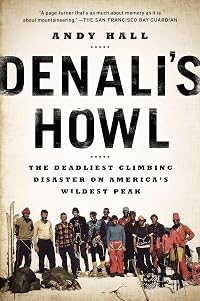
Denali's Howl: The Deadliest Climbing Disaster on America's Wildest Peak
by Andy Hall
On This Page
Description
"Denali's Howl is the white-knuckle account of one of the most deadly climbing disasters of all time. In 1967, twelve young men attempted to climb Alaska's Mount McKinley-known to the locals as Denali-one of the most popular and deadly mountaineering destinations in the world. Only five survived. Journalist Andy Hall, son of the park superintendent at the time, investigates the tragedy. He spent years tracking down survivors, lost documents, and recordings of radio communications. In show more Denali's Howl, Hall reveals the full story of an expedition facing conditions conclusively established here for the first time: At an elevation of nearly 20,000 feet, these young men endured an "arctic super blizzard," with howling winds of up to 300 miles an hour and wind chill that freezes flesh solid in minutes. All this without the high-tech gear and equipment climbers use today. As well as the story of the men caught inside the storm, Denali's Howl is the story of those caught outside it trying to save them-Hall's father among them. The book gives readers a detailed look at the culture of climbing then and now and raises uncomfortable questions about each player in this tragedy. Was enough done to rescue the climbers, or were their fates sealed when they ascended into the path of this unprecedented storm?"-- show lessTags
Recommendations


















Member Recommendations

Member Reviews
I am an adventure-adrenaline junkie. Okay, let's amend that: I am an adventure-adrenaline junkie....from the comfort of my couch. In other words, I love true adventure books. Especially ones about mountain climbing. I have no idea where this love came from given that I've never climbed a mountain in my life, nor do I intend to. I've even been known to avoid small inclines while taking a stroll around the neighborhood. Reading about these adventurous souls who tackle the world's most dangerous peaks, however, stirs something in my soul. Probably a little smugness that I'm not the one who fell down an icy crevasse in sub-zero temperatures and ended up a frozen mummy abandoned on a mountain side.
Whatever the reason, a well-written show more climbing story will always find it's way onto my bookshelves. This summer, the book I couldn't resist was Andy Hall's Denali's Howl, the riveting story of the ill-fated 1967 Wilcox Expedition on North America's tallest peak, Denali.
Formerly known as Mt. McKinley, Denali dominates the Alaska Range. At 20,237 feet high, Denali isn't the highest peak in the world, but the climb from the base of the mountain to the peak is 18,000 feet and that is the largest of any in the world.
In July of 1967, twelve young men set off to conquer Denali. Most of them had enough climbing experience that it should have been a routine ascent. They had planned and conditioned themselves for this climb for months and months. What they hadn't planned for was an unforecast super-storm that bore down on the mountain just as the Wilcox Expedition was approaching the summit, trapping them in far-below freezing temperatures and hurricane force winds in the matter of minutes, conditions that continued for ten days.
Of the twelve men who left the base of Denali, only five were to return. What happened up on the summit of that mountain has been shrouded in mystery for over forty years. Reluctant and conflicting accounts from the survivors over the years have only added to the confusion as survivors and those who watched from afar passed around accusations and blame.
Alaskan author Andy Hall's account of that fateful expedition is masterful. Despite his obvious meticulous research he never once allows the narrative to bog down with onerous details. Facts are presented where known and where they aren't, Hall provides plausible scenarios based on the evidence that is known. He provides first-rate biographical background on each member of the expedition, making it easy for the reader to keep track of each team member as the doomed party makes their way unknowingly towards disaster. Throughout the fast-moving narration, he also intersperses an excellent geological history of the imposing mountain as well as the fascinating climbing history over the past one hundred years.
Overall, Denali's Howl is so well-written it certainly rivals Jon Krakauer's blockbuster climbing hit Into Thin Air. If you enjoyed the one, you'll certainly appreciate the other. show less
Whatever the reason, a well-written show more climbing story will always find it's way onto my bookshelves. This summer, the book I couldn't resist was Andy Hall's Denali's Howl, the riveting story of the ill-fated 1967 Wilcox Expedition on North America's tallest peak, Denali.
Formerly known as Mt. McKinley, Denali dominates the Alaska Range. At 20,237 feet high, Denali isn't the highest peak in the world, but the climb from the base of the mountain to the peak is 18,000 feet and that is the largest of any in the world.
In July of 1967, twelve young men set off to conquer Denali. Most of them had enough climbing experience that it should have been a routine ascent. They had planned and conditioned themselves for this climb for months and months. What they hadn't planned for was an unforecast super-storm that bore down on the mountain just as the Wilcox Expedition was approaching the summit, trapping them in far-below freezing temperatures and hurricane force winds in the matter of minutes, conditions that continued for ten days.
Of the twelve men who left the base of Denali, only five were to return. What happened up on the summit of that mountain has been shrouded in mystery for over forty years. Reluctant and conflicting accounts from the survivors over the years have only added to the confusion as survivors and those who watched from afar passed around accusations and blame.
Alaskan author Andy Hall's account of that fateful expedition is masterful. Despite his obvious meticulous research he never once allows the narrative to bog down with onerous details. Facts are presented where known and where they aren't, Hall provides plausible scenarios based on the evidence that is known. He provides first-rate biographical background on each member of the expedition, making it easy for the reader to keep track of each team member as the doomed party makes their way unknowingly towards disaster. Throughout the fast-moving narration, he also intersperses an excellent geological history of the imposing mountain as well as the fascinating climbing history over the past one hundred years.
Overall, Denali's Howl is so well-written it certainly rivals Jon Krakauer's blockbuster climbing hit Into Thin Air. If you enjoyed the one, you'll certainly appreciate the other. show less
True story of the ill-fated Wilcox Expedition that climbed to the summit of Denali in 1967. Twelve climbers set out; five returned. The author, Andy Hall, has a personal connection to the tragedy. He was five years old at the time, and his father was the park superintendent. The author has done a good job of assembling the puzzle pieces to suggest what happened to the climbers during the mega-storm that blew hurricane force winds over the high peaks. He tells the story in a journalistic manner and throws in interesting peripheral information about mountain climbing, meteorology, and what has changed in the past almost 50 years to make climbing safer. He also includes a touching tribute to his father.
Hall pulls together research and show more interviews into a compelling account. He comments on the transience of human memory, as many of the accounts differ as to the specifics of what happened. I felt the author sifted through all the information to come as close as possible to figuring out what happened. My primary issue with it is that the audio sounds like a dull droning documentary. The narration improves toward the end and includes more voice inflection, but I feel I would have appreciated it even more if I had read rather than listened to it. Content warnings include descriptions of bodies, explanations of the many ways death can occur in conditions of extreme cold and altitude, and a bit of profanity. Recommended for readers interested in mountaineering and its history. show less
Hall pulls together research and show more interviews into a compelling account. He comments on the transience of human memory, as many of the accounts differ as to the specifics of what happened. I felt the author sifted through all the information to come as close as possible to figuring out what happened. My primary issue with it is that the audio sounds like a dull droning documentary. The narration improves toward the end and includes more voice inflection, but I feel I would have appreciated it even more if I had read rather than listened to it. Content warnings include descriptions of bodies, explanations of the many ways death can occur in conditions of extreme cold and altitude, and a bit of profanity. Recommended for readers interested in mountaineering and its history. show less
Despite, or maybe because of my hysterical fear of heights (it's difficult for me to even climb a few steps up the ladder to change light bulbs), I love reading about mountain climbing disasters. A lot of people will be comparing this to [b:Into Thin Air: A Personal Account of the Mt. Everest Disaster|1898|Into Thin Air A Personal Account of the Mt. Everest Disaster|Jon Krakauer|https://d.gr-assets.com/books/1403184587s/1898.jpg|1816662], and that's understandable. Both are about a mountain climbing disaster. But that's about all they have in common, and that's ok. While Andy was present at Denali at the time of the disaster, he was only 5 years old. So his recounting of the event is based upon historical documents, notes and interviews show more with survivors and rescuers. His personal relationship to the park superintendent (his father) and others bring a more personal feel to this account. With a 12-man expedition, plus other individuals that got invovled later, there's a lot of people to keep track of. That was one weakness. Also, since I'm not familiar with Denali, it's geography and such, maps detailing the route the parties took and where the bodies were located would have been a big help.* Still a great read!
* I later discovered that at the very end of the book - after the Notes and Index, there was indeed a map, as well as pictures. Wish these would have been placed earlier so I could have referred to them while I was reading. (I was reading the Kindle version.) show less
* I later discovered that at the very end of the book - after the Notes and Index, there was indeed a map, as well as pictures. Wish these would have been placed earlier so I could have referred to them while I was reading. (I was reading the Kindle version.) show less
3.5 stars
In 1967, twelve people climbed Alaska’s (also North America’s) highest mountain, Denali (aka Mt. McKinley). The group was actually two groups “stitched” together before the climb, so many didn’t know each other, or didn’t know each other well, nor were really prepared to work (well) together. Only five survived. The author’s father worked for the park service at the time and was involved in the search afterward. This covers what is known of the climb, the aftermath, and speculation about what may have happened to the seven who never made it back.
I listened to the audio and it’s another where I sometimes lost interest. But the portions I paid attention to were interesting. Of course, in the 1960s, the hiking show more gear was not as advanced, nor was communication, so it was harder to know if there was really something wrong if you didn’t hear from someone via radio when you were supposed to. This book has made me interested to possibly look up some of the other books on the same mountaineering disaster on Denali. show less
In 1967, twelve people climbed Alaska’s (also North America’s) highest mountain, Denali (aka Mt. McKinley). The group was actually two groups “stitched” together before the climb, so many didn’t know each other, or didn’t know each other well, nor were really prepared to work (well) together. Only five survived. The author’s father worked for the park service at the time and was involved in the search afterward. This covers what is known of the climb, the aftermath, and speculation about what may have happened to the seven who never made it back.
I listened to the audio and it’s another where I sometimes lost interest. But the portions I paid attention to were interesting. Of course, in the 1960s, the hiking show more gear was not as advanced, nor was communication, so it was harder to know if there was really something wrong if you didn’t hear from someone via radio when you were supposed to. This book has made me interested to possibly look up some of the other books on the same mountaineering disaster on Denali. show less
Denali’s Howl is the white-knuckle account of one of the most deadly climbing disasters of all time.
In 1967, twelve young men attempted to climb Alaska’s Mount McKinley—known to the locals as Denali—one of the most popular and deadly mountaineering destinations in the world. Only five survived.
Journalist Andy Hall, son of the park superintendent at the time, investigates the tragedy. He spent years tracking down survivors, lost documents, and recordings of radio communications. In Denali’s Howl, Hall reveals the full story of an expedition facing conditions conclusively established here for the first time: At an elevation of nearly 20,000 feet, these young men endured an “arctic super blizzard,” with howling winds of up to show more 300 miles an hour and wind chill that freezes flesh solid in minutes. All this without the high-tech gear and equipment climbers use today.
As well as the story of the men caught inside the storm, Denali’s Howl is the story of those caught outside it trying to save them—Hall’s father among them. The book gives readers a detailed look at the culture of climbing then and now and raises uncomfortable questions about each player in this tragedy. Was enough done to rescue the climbers, or were their fates sealed when they ascended into the path of this unprecedented storm?
'On Denali, death is never far away for the careless and the unlucky’. Andy Hall
Denali boasts the greatest vertical relief on earth, soaring 18,000 from base to summit compared to Everest, although 29,029 above sea level, that rises 12,000 ft to its summit from its base on the Tibetan Plateau.
An expedition of 12 young men took on Alaska’s Mount Denali in the summer of 1967. The team, a mix of experienced climbers some little more than beginners, was soon torn by conflict. Bitter arguments broke out and at times members refused to talk to each other. Not ideal when your survival depends on teamwork.
The author doesn't play the 'blame game' but mistakes were made that could have been avoided. What was not avoidable was the incoming low-pressure system that was destined to collide with a high-pressure system to create a super storm on Denali with winds over 300 miles per hour.
A cautionary tale, moving, tragic and utterly engrossing show less
In 1967, twelve young men attempted to climb Alaska’s Mount McKinley—known to the locals as Denali—one of the most popular and deadly mountaineering destinations in the world. Only five survived.
Journalist Andy Hall, son of the park superintendent at the time, investigates the tragedy. He spent years tracking down survivors, lost documents, and recordings of radio communications. In Denali’s Howl, Hall reveals the full story of an expedition facing conditions conclusively established here for the first time: At an elevation of nearly 20,000 feet, these young men endured an “arctic super blizzard,” with howling winds of up to show more 300 miles an hour and wind chill that freezes flesh solid in minutes. All this without the high-tech gear and equipment climbers use today.
As well as the story of the men caught inside the storm, Denali’s Howl is the story of those caught outside it trying to save them—Hall’s father among them. The book gives readers a detailed look at the culture of climbing then and now and raises uncomfortable questions about each player in this tragedy. Was enough done to rescue the climbers, or were their fates sealed when they ascended into the path of this unprecedented storm?
'On Denali, death is never far away for the careless and the unlucky’. Andy Hall
Denali boasts the greatest vertical relief on earth, soaring 18,000 from base to summit compared to Everest, although 29,029 above sea level, that rises 12,000 ft to its summit from its base on the Tibetan Plateau.
An expedition of 12 young men took on Alaska’s Mount Denali in the summer of 1967. The team, a mix of experienced climbers some little more than beginners, was soon torn by conflict. Bitter arguments broke out and at times members refused to talk to each other. Not ideal when your survival depends on teamwork.
The author doesn't play the 'blame game' but mistakes were made that could have been avoided. What was not avoidable was the incoming low-pressure system that was destined to collide with a high-pressure system to create a super storm on Denali with winds over 300 miles per hour.
A cautionary tale, moving, tragic and utterly engrossing show less
I won this book in the Goodreads giveaway and must say it was a pleasure to read. Denali's Howll is the story of a twelve man expedition that attempted to climb Denali (Mt. McKinley) in 1967. Only five of the men were to return. This book is a fascinating account of what happened during that expedition and the perfect storm that raged on the mountain for a week. Even though you know the outcome from the first page, the writing keeps you glued to the edge of your seat and unable to put ithe book down. Andy Hall does a great job relating the facts and revealing the climber's personalities. Denali is a spectacular sight but this story reminds you that nature is ultimately the one in control.
In the summer of 1967, twelve young men struck out on an expedition, to reach the top of Denali, the highest mountain in America. Five returned...
The men, after reaching the summit were caught in an “arctic super blizzard,” with winds reaching a mind-blowing 300 miles per hour.
The author, is the son, of the park's superintendent, at the time and has done a fine job, researching and exploring this little known tragedy, which remains the worst climbing disaster, on American soil. There was plenty of blame to go around too. A few of the climbers, did not have the experience to tackle this indomitable mountain and others made poor choices, with their equipment. Rescue efforts were thwarted time after time, since the storm raged on for show more nearly a week.
Fans of Into Thin Air and other rugged, white-knuckle, adventure stories should really like this one, but it is not for the faint of heart. show less
The men, after reaching the summit were caught in an “arctic super blizzard,” with winds reaching a mind-blowing 300 miles per hour.
The author, is the son, of the park's superintendent, at the time and has done a fine job, researching and exploring this little known tragedy, which remains the worst climbing disaster, on American soil. There was plenty of blame to go around too. A few of the climbers, did not have the experience to tackle this indomitable mountain and others made poor choices, with their equipment. Rescue efforts were thwarted time after time, since the storm raged on for show more nearly a week.
Fans of Into Thin Air and other rugged, white-knuckle, adventure stories should really like this one, but it is not for the faint of heart. show less
Members
- Recently Added By
Author Information
107 Works 388 Members
Common Knowledge
- Canonical title*
- Inferno bianco
- Original title
- Denali's Howl: The Deadliest Climbing Disaster on America's Wildest Peak
- Dedication
- To Melissa, who believed in me when I didn't, and to my father, who knew that putting more people at risk would not save those who were already gone.
- First words
- Joe Wilcox may not have been the first man to reach the summit of Denali, but on Saturday afternoon, July 15, 1967, he felt like it. - Prologue, A Stranger in the Wilderness
The Athabaskan people have lived in the shadow of the great mountain for ten thousand years and know it by many names. -Chapter 1, Those Who Came Before - Quotations
- While Denali is the tallest mountain in North America at 20,320 feet, it also is arguably the biggest mountain on the planet.
Within those margins is Denali, a 144-square-mile mass of rock, snow, and ice that rises abruptly from a 2,000-foot plateau, soaring 18,000 feet from base to summit, the greatest vertical relief of any mountain on Earth, with... (show all) the exception of the Hawaiian seamount Mauna Kea, the bulk of which lies beneath the Pacific Ocean. In comparison, Mount Everest, though 29,029 feet above sea level, rests on the 17,000-foot-high Tibetan Plateau and rises just 12,000 feet from base to summit.
The mountain’s subarctic latitude and great elevation combine to produce its especially harsh conditions. Earth’s atmosphere tapers at the North and South Poles and as a result, the troposphere—the life-supporting lowes... (show all)t layer—is shallower at extreme northern and southern latitudes. At the equator it is 10 miles thick, at the North Pole, about 5. A mere 1,800 miles from the North Pole, Denali rises 4 miles high and is closer to the top of the troposphere than many higher peaks at lower latitudes, like Mount Everest. Proximity to the top of the troposphere means two things. First, there is less oxygen near the summit of Denali than there would be at a mountain of identical elevation at the equator, and 42 percent less than at sea level. At the summit it takes two gasps to bring in the amount of oxygen that one breath delivers on the beach in Hawaii. Second, the thinner troposphere means the jet stream, wind that constantly moves through the upper troposphere near the boundary with the stratosphere, is closer than anywhere on the planet. Atmospheric conditions can drive the jet stream lower, commonly bringing winds of 100 miles per hour or more to bear on Denali’s heights.
On Denali, where 100-mile-per-hour winds are common, meteorologists agree that downslope winds three times that velocity are possible, peeling away snow, ice, loose rock, and any climber unfortunate enough to be in their path... (show all). - Last words
- (Click to show. Warning: May contain spoilers.)If I’ve learned anything through the process of writing this book, it is that memory is fleeting and flawed at best. Some of the subjects I interviewed are sure that they remember things clearly, yet their accounts don’t match the documentation and, in many cases, their own journals written at the time of the incident. Others think their memories are flawed, yet they match up almost perfectly with the documentation I was able to find. A few think they are fuzzy on the details, and follow-up research shows they’re right. Rarest is the one who believes his memory is accurate and follow up confirms that he is right. Where I fall on this spectrum I am not sure.
- Canonical DDC/MDS
- 796.522097983
- Canonical LCC
- GV199.42.A42
*Some information comes from Common Knowledge in other languages. Click "Edit" for more information.
Classifications
- Genres
- Sports and Leisure, Nonfiction, General Nonfiction, History, Travel
- DDC/MDS
- 796.522097983 — Arts & recreation Recreation, sports, and performing arts Athletic and outdoor sports and games Outdoor leisure Walking and exploring by kind of terrain Mountains, hills and rocks standard subdivisions History, geographic treatment, biography
- LCC
- GV199.42 .A42 — Geography, Anthropology and Recreation Recreation. Leisure Recreation. Leisure Outdoor life. Outdoor recreation Hiking. Pedestrian tours
- BISAC
Statistics
- Members
- 204
- Popularity
- 160,678
- Reviews
- 11
- Rating
- (3.78)
- Languages
- English, Italian
- Media
- Paper, Audiobook, Ebook
- ISBNs
- 12
- ASINs
- 2