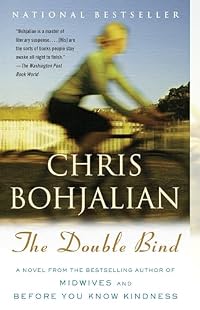
The Double Bind
by Chris Bohjalian 
On This Page
Description
Working at a homeless shelter, Laurel Estabrook encounters Bobbie Crocker, a man with a history of mental illness and a box of secret photos, but when Bobbie dies suddenly, Laurel embarks on an obsessive search for the truth behind the photos.Tags
Recommendations



Member Recommendations
Member Reviews
Spoiler-ey in generalization only.
What is it about an unreliable narrator that can make us skeptical, disbelieving and looking for lies, and yet still manages to deceive us and make for a jaw dropping moment when you finally see through? That’s what happened to me reading The Double Bind. It’s clear going in that Laurel is unraveling, but we don’t suspect more than just her storyline. The book’s/author’s conceit gets wrapped up in what’s hidden and when it’s revealed it’s pretty powerful.
At least it was to me. Maybe others saw through all along, but I didn’t and the moment I finally realized what I was reading was powerful and I literally said wow, my husband looking over at me thinking, oh no, I’m going to have to show more talk about her book now. Some found the quotidian minutiae tedious, but I admit I didn’t notice. Each section of the narrative had something to advance the story or the reader’s knowledge; some of it hidden well enough that I missed it, but stayed interested and immersed.
For some strange reason I have no notes for this book (other than the ubiquitous character with gray eyes, something I’ve NEVER seen IRL, but I digress). One of the most enchanting and magical elements of the book is the fact that it seems that a real person inspired them. Bohjalian explains in an author’s note that he came to know about some photographs left behind in a shelter when a homeless man died. The photos were technically and artistically excellent and many were of famous people of the 50s and 60s. The man’s name was Bob “Soupy” Campbell and his actual photos are interspersed throughout the book. This fascinating mystery of how a seemingly successful photographer could become destitute was the impetus for The Double Bind. I have to applaud Bohjalian’s imagination and how much further he took the story than most writers probably would.
That’s about all I can say without giving away more. show less
What is it about an unreliable narrator that can make us skeptical, disbelieving and looking for lies, and yet still manages to deceive us and make for a jaw dropping moment when you finally see through? That’s what happened to me reading The Double Bind. It’s clear going in that Laurel is unraveling, but we don’t suspect more than just her storyline. The book’s/author’s conceit gets wrapped up in what’s hidden and when it’s revealed it’s pretty powerful.
At least it was to me. Maybe others saw through all along, but I didn’t and the moment I finally realized what I was reading was powerful and I literally said wow, my husband looking over at me thinking, oh no, I’m going to have to show more talk about her book now. Some found the quotidian minutiae tedious, but I admit I didn’t notice. Each section of the narrative had something to advance the story or the reader’s knowledge; some of it hidden well enough that I missed it, but stayed interested and immersed.
For some strange reason I have no notes for this book (other than the ubiquitous character with gray eyes, something I’ve NEVER seen IRL, but I digress). One of the most enchanting and magical elements of the book is the fact that it seems that a real person inspired them. Bohjalian explains in an author’s note that he came to know about some photographs left behind in a shelter when a homeless man died. The photos were technically and artistically excellent and many were of famous people of the 50s and 60s. The man’s name was Bob “Soupy” Campbell and his actual photos are interspersed throughout the book. This fascinating mystery of how a seemingly successful photographer could become destitute was the impetus for The Double Bind. I have to applaud Bohjalian’s imagination and how much further he took the story than most writers probably would.
That’s about all I can say without giving away more. show less
It's difficult to overstate how much I disliked this book. If you enjoy being elaborately set up for a "Gotcha!" moment--and clearly, many people do--then, by all means, read it. If, like me, you do not, then stay far away. The last time I remember feeling this way about a book was when I read Lionel Shriver's Big Brother. Bohjalian's premise is more interesting and well-executed than I remember Shriver's being, but it all came to a cheap device for me in the end, despite the author's stated reverence for his source material in the acknowledgments.
Audiobook performed by Susan Denaker
From the book jacket When college sophomore Laurel Estabrook is attacked while riding her bicycle through Vermont’s back roads, her life is forever changed. Formerly outgoing, Laurel withdraws into her photography and begins to work at a homeless shelter. There she meets Bobbie Crocker, a man with a history of mental illness and a box of photographs he won’t let anyone see. When Bobbie dies, Laurel discovers that he was telling the truth; before he was homeless, Bobbie Crocker was a successful photographer. As Laurel’s fascination with Bobbie’s former life begins to merge into obsession, she becomes convinced that some of his photographs reveal a deeply hidden, dark family secret.
My show more Reaction
Well, this definitely went in a direction I was not expecting! I don’t really want to say much more because I don’t want to give anything away.
Bohjalian crafts a compelling and intricate scenario with layer upon layer of complexity. I loved the way he drew me in, made me believe in Laurel – and Bobbie – and then forced me to reconsider the veracity of their claims. Throughout the work I am intrigued by and sympathetic to both Laurel and Bobbie, and particularly to the former as Bohjalian tells most of the story from Laurel’s perspective. The suspense builds relentlessly in the last five or six chapters, and I’m left breathless and drained at the end. And … wanting to start over again to see what clues Bohjalian left that I missed the first time around.
In the Author’s Note preceding the book, Bohjalian tells how he was inspired to write the novel when a friend shared with him a box of photographs that had been taken by a homeless man, Bob “Soupy” Cmpbell. Some of those extraordinary photos are sprinkled throughout the book.
The audio book is capably performed by Susan Denaker. She has good pacing and really brought Laurel to life for me. I could understand her hurt and confusion and frustration. show less
From the book jacket When college sophomore Laurel Estabrook is attacked while riding her bicycle through Vermont’s back roads, her life is forever changed. Formerly outgoing, Laurel withdraws into her photography and begins to work at a homeless shelter. There she meets Bobbie Crocker, a man with a history of mental illness and a box of photographs he won’t let anyone see. When Bobbie dies, Laurel discovers that he was telling the truth; before he was homeless, Bobbie Crocker was a successful photographer. As Laurel’s fascination with Bobbie’s former life begins to merge into obsession, she becomes convinced that some of his photographs reveal a deeply hidden, dark family secret.
My show more Reaction
Well, this definitely went in a direction I was not expecting! I don’t really want to say much more because I don’t want to give anything away.
Bohjalian crafts a compelling and intricate scenario with layer upon layer of complexity. I loved the way he drew me in, made me believe in Laurel – and Bobbie – and then forced me to reconsider the veracity of their claims. Throughout the work I am intrigued by and sympathetic to both Laurel and Bobbie, and particularly to the former as Bohjalian tells most of the story from Laurel’s perspective. The suspense builds relentlessly in the last five or six chapters, and I’m left breathless and drained at the end. And … wanting to start over again to see what clues Bohjalian left that I missed the first time around.
In the Author’s Note preceding the book, Bohjalian tells how he was inspired to write the novel when a friend shared with him a box of photographs that had been taken by a homeless man, Bob “Soupy” Cmpbell. Some of those extraordinary photos are sprinkled throughout the book.
The audio book is capably performed by Susan Denaker. She has good pacing and really brought Laurel to life for me. I could understand her hurt and confusion and frustration. show less
Just finished this book and must say that I hated it. The book begins with a brutal attack on Laurel Estabrook, a young female college student. Subsequent to the attack, she becomes disengaged from previous activities and begins volunteering in a homeless shelter. This becomes her career path as she becomes a masters degree level social worker.
Early in her career, one of the shelter's clients dies leaving only an estate of old photographs and negatives. Laurel's boss, knowing that she has a talent for photography, entrusts the photos to Laurel for cataloging and perhaps mounting a fund raising exhibition for the shelter. Among the photos is one of Laurel on the day she was attacked.
The author leads us through a charade of The Great show more Gatsby as Laurel's coping mechanisms breakdown while she researches the photos. The Gatsby provides an alternative reality to the horrible reality behind that photo.
In the acknowledgments at the end of the book, the author indicates that the book was inspired by photos actually left behind by a homeless man. He also cites two books about mental illness in men. And the publisher notes that a portion of the proceeds from this book will go to Burlington's Committee on Temporary Shelter.
What I hate about this book is the author's seeming complete insensitivity to our culture's bias of violence toward women and the culture of silence surrounding that violence. He goes to great length to manipulate the reader through the contrivance of the Great Gatsby, the plight of the homeless, and the link between homelessness and mental illness. In doing so he uses the vehicle of a brutal attack against a young woman. Yet even in his acknowledgments at the end of this book, he does not address the issue of violence against women, the emotional scars left by that violence, and the culturally imposed silence and shame surrounding it.
While the author generates great sympathy for the fictional homeless Bobbie Crocker, his failure to address Laurel's issues leaves me wondering if the author's underlying belief is that she brought her attack on herself....a thought more chilling than the end of this disturbing, insensitive work of fiction. show less
Early in her career, one of the shelter's clients dies leaving only an estate of old photographs and negatives. Laurel's boss, knowing that she has a talent for photography, entrusts the photos to Laurel for cataloging and perhaps mounting a fund raising exhibition for the shelter. Among the photos is one of Laurel on the day she was attacked.
The author leads us through a charade of The Great show more Gatsby as Laurel's coping mechanisms breakdown while she researches the photos. The Gatsby provides an alternative reality to the horrible reality behind that photo.
In the acknowledgments at the end of the book, the author indicates that the book was inspired by photos actually left behind by a homeless man. He also cites two books about mental illness in men. And the publisher notes that a portion of the proceeds from this book will go to Burlington's Committee on Temporary Shelter.
What I hate about this book is the author's seeming complete insensitivity to our culture's bias of violence toward women and the culture of silence surrounding that violence. He goes to great length to manipulate the reader through the contrivance of the Great Gatsby, the plight of the homeless, and the link between homelessness and mental illness. In doing so he uses the vehicle of a brutal attack against a young woman. Yet even in his acknowledgments at the end of this book, he does not address the issue of violence against women, the emotional scars left by that violence, and the culturally imposed silence and shame surrounding it.
While the author generates great sympathy for the fictional homeless Bobbie Crocker, his failure to address Laurel's issues leaves me wondering if the author's underlying belief is that she brought her attack on herself....a thought more chilling than the end of this disturbing, insensitive work of fiction. show less
I just stumbled across this book and decided to give it a shot because I typically like "psychological thrillers" on film and decided I might like to read on. Wow. A.Maze.Ing. By far one of the most engagingly complex novels I've read in a while. The author's descriptive detail and "back story" asides were usually enriching rather than distracting, and he very successfully creates characters that come to life in the mind's eye.
I just came off of reading Juliette, which was very engaging...and The Double Bind was even more difficult to put down! I am thrilled to discover there are still writers out there telling original stories with well-crafted prose. Can't wait to find another Bohjalian book.
I just came off of reading Juliette, which was very engaging...and The Double Bind was even more difficult to put down! I am thrilled to discover there are still writers out there telling original stories with well-crafted prose. Can't wait to find another Bohjalian book.
This is the kind of novel I would never pick up myself, even with stellar reviews and recommendations from my fellow Girls Just Reading cohorts. In fact, if it wasn’t part of the reading challenge I am involved in with Julie, I still wouldn’t have read this novel. I can tell you right now that would have been a, quoting Vivian from Pretty Woman, “big mistake, huge mistake”.
This novel was a real page turner for me. I loved Laurel. I loved how she overcame the most horrific thing that can happen to anyone: being attacked, almost raped and killed while bicycling through the woods in Vermont. If it wasn’t for other cyclists, she wouldn’t have survived. After the attack, she moved on with her life. She finished college, she show more started working at a homeless shelter, she dated. I loved how strong she was. With everything she went through, she learned to rely on herself.
When Bobbie Crocker, one of the shelter charges dies suddenly, Laurel is given the task of cataloging the photographs he had with him. And here is where the mystery begins. Through these photographs, Laurel begins to unravel the truth about who Bobbie Crocker was, where he came from, who his family was. Imagine my surprise when Mr. Bohjalian incorporated The Great Gatsby into this novel, making Jay Gatsby, Daisy Buchanan, and others real characters instead of fictional classics.
The Double Bind totally blew my mind. Seriously. It was quick moving and kept me on the edge of my seat. It was a real page turner. I was as invested in finding the truth about Bobbie Crocker as Laurel was. The closer she came to the truth, the more addicted I became to words on a page. I had to do that thing where I fight with myself because all I want to do is flip to the final pages and satisfy my curiosity. I’m really glad I didn’t because the final three pages rocked. I did not see the final twist in the novel coming at all. I was so shocked the first thing I did was text Julie, “Holy Beep!!!”
If you have read this novel already, it’s worth a revisit and if you haven’t, then you need to go pick it up soon. And be prepared to have your mind blown. show less
This novel was a real page turner for me. I loved Laurel. I loved how she overcame the most horrific thing that can happen to anyone: being attacked, almost raped and killed while bicycling through the woods in Vermont. If it wasn’t for other cyclists, she wouldn’t have survived. After the attack, she moved on with her life. She finished college, she show more started working at a homeless shelter, she dated. I loved how strong she was. With everything she went through, she learned to rely on herself.
When Bobbie Crocker, one of the shelter charges dies suddenly, Laurel is given the task of cataloging the photographs he had with him. And here is where the mystery begins. Through these photographs, Laurel begins to unravel the truth about who Bobbie Crocker was, where he came from, who his family was. Imagine my surprise when Mr. Bohjalian incorporated The Great Gatsby into this novel, making Jay Gatsby, Daisy Buchanan, and others real characters instead of fictional classics.
The Double Bind totally blew my mind. Seriously. It was quick moving and kept me on the edge of my seat. It was a real page turner. I was as invested in finding the truth about Bobbie Crocker as Laurel was. The closer she came to the truth, the more addicted I became to words on a page. I had to do that thing where I fight with myself because all I want to do is flip to the final pages and satisfy my curiosity. I’m really glad I didn’t because the final three pages rocked. I did not see the final twist in the novel coming at all. I was so shocked the first thing I did was text Julie, “Holy Beep!!!”
If you have read this novel already, it’s worth a revisit and if you haven’t, then you need to go pick it up soon. And be prepared to have your mind blown. show less
The first thing I did before I started this book was head to Wikipedia and read a summary of The Great Gatsby, since it's been 12 years since I read it, and it's really an integral part of this book. I recommend that to anyone who picks this up. I often start thinking about what I'm going to say about a book before I finish it. As I neared the end of this, my thoughts were "this wasn't as good as Midwives or Water Witches". Then, Bohjalian gives you a very M. Night Shyamalan-esque twist that completely redeems the story and made me go back and reread parts, to see if I should have seen it coming. Laurel's behavior throughout the book is very strange, but by the end, it all makes sense. All in all, this is a slow starter, but it's worth show more it in the end. show less
Members
- Recently Added By
Lists

Best Contemporary Literary Fiction (Around the Last 30 Years)
388 works; 122 members

Top Five Books of 2013
1,562 works; 715 members

Recommend the 20 best books you've read in the last five years
2,168 works; 601 members

Top Five Books of 2015
811 works; 241 members

Stories Inspired by Other Fiction
127 works; 24 members

Books Read in 2015
3,298 works; 129 members
5 Best 5 Years
71 works; 4 members

Books Read in 2010
631 works; 11 members

Literature About Mental Illness
37 works; 5 members

Books Read in 2021
5,361 works; 113 members

Books We Couldn't Put Down
443 works; 197 members
Author Information

37+ Works 28,766 Members
Chris Bohjalian (born on August 12, 1962 in White Plains, New York) graduated from Amherst College and worked as an account representative for J. Walter Thompson advertising agency in New York in the mid-1980s. Bohjalian is an American novelist and the author of 15 novels, including the bestsellers Midwives and The Sandcastle Girls. His first show more novel, A Killing in the Real World, was released in 1988. His other novels include Water Witches, The Law of Similars, Before You Know Kindness, Skeletons at the Feast, and The Night Strangers. Past the Bleachers and Midwives were made into Hallmark Hall of Fame movies and Secrets of Eden was made into a Lifetime Television movie. He won the New England Book Award in 2002. He also contributes to numerous publications including Cosmopolitan, Reader's Digest, Boston Globe Sunday Magazine and the Burlington Free Press. Bohjalian's The Guest Room is a New York Times bestseller. (Bowker Author Biography) show less
Chris Bohjalian is a LibraryThing Author, an author who lists their personal library on LibraryThing.
Some Editions
Awards and Honors
Distinctions
Work Relationships
Was inspired by
Common Knowledge
- Canonical title
- The Double Bind
- Original publication date
- 2007
- People/Characters
- Laurel Estabrook; Katherine Maguire; Bobbie Crocker; Talia Rice; Whitaker Nelson; Pamela Buchanan Marshfield (show all 10); David Fuller; Jay Gatsby; Daisy Fay Buchanan; Tom Buchanan
- Important places
- Vermont, USA
- Epigraph
- "Oh, I know who Pauline Kael is," he said. "I wasn't born homeless, you know."
Nick Hornby- A Long Way Down - Dedication
- For Rose Mary Muench and in memory of Frederick Meunch (1929-2004)
- First words
- Laurel Estabrook was nearly raped the fall of her sophomore year of college.
- Last words
- (Click to show. Warning: May contain spoilers.)She claims to have no conscious recollection at all that she was mutilated and left for dead in the woods...
- Blurbers
- Maguire, Gregory; Mosher, Howard Frank
Classifications
Statistics
- Members
- 2,792
- Popularity
- 6,495
- Reviews
- 172
- Rating
- (3.64)
- Languages
- 6 — Chinese, Dutch, English, French, Portuguese, Spanish
- Media
- Paper, Audiobook, Ebook
- ISBNs
- 21
- ASINs
- 8