On This Page
Description
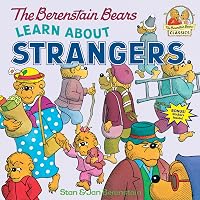
The Berenstain Bear cubs learn not to be overly friendly with strangers and give their rules for dealing with them.Tags
Recommendations







Member Reviews
I am in general no fan of the Berenstain Bears books,* which annoy me on multiple levels: didacticism, role-based names ("Brother" and "Sister" and "Mama" and "Papa"), gender-stereotyped parental roles .... but this one was pretty well done for the "don't talk to strangers" genre. It addressed not just the "don't go with strangers", but also how not to be unnecessarily afraid of strangers, too, which I appreciated.
* Note -- My 6yo has loved these Berenstain Bears books since discovering them at 3yo. So, I read them even though I'm not a fan. Her perspective is at least as important as mine, in this review!
* Note -- My 6yo has loved these Berenstain Bears books since discovering them at 3yo. So, I read them even though I'm not a fan. Her perspective is at least as important as mine, in this review!
When it comes to children's series that provide life lessons under the guise of entertaining stories, Berenstain Bears is at the top of the class. Need a book to teach kids about doctor visits, first days of school, or learning how to share? Look no further than the familiar and friendly family of Berenstain Bears. As the title suggests, this particular book provides some life lessons on dealing with strangers.
The story begins with Sister's sweet but naive familiarity with everyone. She is friends with the world. She likes to say hello to every single bear she meets and have conversations with the first bear she sees in the park. Brother Bear is worried. He talks to their parents about Sister's over-familiarity with bears she doesn't show more know. Papa decides to solve the problem by showing sister newspaper articles about bad bears and abductions, to scare her away from strangers.
His plan works a little too well. Sister does stay away from strangers, but at a cost. The world suddenly looks like a bleak and dangerous place to her. No one, and no place, is safe. Seeing her daughter's melancholy, Mama Bear decides to step in. She helps Sister understand that most strangers are good bears, but the occasional rotten apple has a hidden worm. Sister learns how to balance her kind heart with more prudence, and all is well in the Bear family again. As is often the case, Papa Bear is portrayed as well-meaning but ineffectual, and Mama Bear is the one to solve the problem. I dislike this unfair representation of fathers, which is typical of of the series, but other than that complaint, I like the book. I appreciate the way it handles its central issue. The authors emphasize the necessity for caution, but not at the expense of losing trust in humanity. This is exactly the lesson I want my girls to learn. Also, the story and its appealing illustrations, using familiar characters, is fun and easy to read. My daughters love reading Berenstain Bear stories, and they don't even realize they are learning important lessons. show less
The story begins with Sister's sweet but naive familiarity with everyone. She is friends with the world. She likes to say hello to every single bear she meets and have conversations with the first bear she sees in the park. Brother Bear is worried. He talks to their parents about Sister's over-familiarity with bears she doesn't show more know. Papa decides to solve the problem by showing sister newspaper articles about bad bears and abductions, to scare her away from strangers.
His plan works a little too well. Sister does stay away from strangers, but at a cost. The world suddenly looks like a bleak and dangerous place to her. No one, and no place, is safe. Seeing her daughter's melancholy, Mama Bear decides to step in. She helps Sister understand that most strangers are good bears, but the occasional rotten apple has a hidden worm. Sister learns how to balance her kind heart with more prudence, and all is well in the Bear family again. As is often the case, Papa Bear is portrayed as well-meaning but ineffectual, and Mama Bear is the one to solve the problem. I dislike this unfair representation of fathers, which is typical of of the series, but other than that complaint, I like the book. I appreciate the way it handles its central issue. The authors emphasize the necessity for caution, but not at the expense of losing trust in humanity. This is exactly the lesson I want my girls to learn. Also, the story and its appealing illustrations, using familiar characters, is fun and easy to read. My daughters love reading Berenstain Bear stories, and they don't even realize they are learning important lessons. show less
I am in general no fan of the Berenstain Bears books,* which annoy me on multiple levels: didacticism, role-based names ("Brother" and "Sister" and "Mama" and "Papa"), gender-stereotyped parental roles .... but this one was pretty well done for the "don't talk to strangers" genre. It addressed not just the "don't go with strangers", but also how not to be unnecessarily afraid of strangers, too, which I appreciated.[return][return]* Note -- My 6yo has loved these Berenstain Bears books since discovering them at 3yo. So, I read them even though I'm not a fan. Her perspective is at least as important as mine, in this review!
I liked this book for a number of reasons. It's informative and an engaging way to teach kids about stranger danger. As with all of the Berenstein Bears books, the illustrations do such a great job with reinforcing the story as well as adding depth to it. Mama uses apples as a metaphor to explain stranger danger which I think gives children a very good visual. The story finishes by listing a set of rules when it comes to interacting with strangers. Overall, I think this is a great book with a great message for children!
I really enjoyed reading this book because it was informative but also not losing touch of the fictional theme. It is important for students to know at a young age to not talk to strangers and I feel like that theme was emphasized very well throughout the book. It allows the reader to comprehend strangers and safety. As a student, attending schools opens them up to the world and they are too young to understand how scary and dangerous it can be, that is why this book should be read early on so it is implemented sooner than later. The way the book was worded and illustrated is the perfect audience for K-3rd grade. The story explains how “you can’t always tell from the outside which are the ‘bad apples.’” The mother bear cuts show more the apple open and show how a worm is growing in the apple. This visual example is far easier to show students how even if a stranger looks trustworthy that you cannot always tell. The big theme to take away from the book is that that not all strangers are trustworthy, using common sense is the best bet. show less
I liked the story in that the book was informative while also sticking to a fantasy story theme. The message of never talking to strangers is emphasized in the main theme. I liked how the book makes the reader think about strangers and overall safety. Students need to know stranger safety early on and this book is a great tool to implement that. The writing and illustrations are helpful in the story by showing a metaphor about strangers. The story explains how “you can’t always tell from the outside which are the ‘bad apples.’” The mother bear cuts the apple open and show how a worm is growing in the apple. This visual example is far easier to show students how even if a stranger looks trustworthy that you cannot always tell. show more The big theme to take away from the book is that that not all strangers are trustworthy, using common sense is the best bet. show less
A bit old-fashioned now, but the message is overall solid, stranger danger is an indispensable lesson for a child to learn.
Members
- Recently Added By
Author Information

546+ Works 176,638 Members
Stan Berenstain was born in 1923 in Philadelphia, the same year and place as his future wife, Jan. They met as students at the Philadelphia College of Art. World War II delayed their career plans: Stan joined the army as a medical assistant while Jan supported the war effort by working in an airplane factory. They married in 1946 and together show more began drawing cartoons for the McCall's/Good Housekeeping It's All in the Family series. They worked on this feature from 1956 through 1990. The Big Honey Hunt, published in 1962, was their first book for children. This book about a family of bears, written for Dr. Seuss's Beginner Books series, was so popular that Dr. Seuss himself, Theodore Geisel, encouraged them to write more stories. Geisel's advice launched the Berenstains on life-career writing and illustrating the very successful Berenstain Bears books. The Berenstain Bears' New Baby, published in 1974, was the beginning of the First Time Books series. The Children's Choice Award was given to The Berenstain Bears' New Neighbors in 1995. The Berenstains were also honored for their work in children's literature when they received the Ludington Award in 1989. There have been television shows based on the Berenstain Bears books, as well as CD-ROMs and videos. Stan Berenstain passed away on November 26th, 2005, after a lengthy battle with lymphoma. He was 82. (Bowker Author Biography) show less

566+ Works 194,731 Members
Jan Berenstain was born Jan Grant on July 26, 1923 in Philadelphia, Pennsylvania. She met Stan Berenstain on their first day of classes in 1941 at the Philadelphia Museum School of Industrial Art. During World War II, Stan served as a medical illustrator in an Army hospital and Jan worked as a draftswoman in the Army Corps of Engineers and as an show more aircraft riveter. They married in 1946 and together began drawing cartoons for the McCall's/Good Housekeeping All in the Family series. They worked on this feature from 1956 through 1990. They also published artwork in magazines like Colliers and the Saturday Evening Post. The Big Honey Hunt, published in 1962, was their first book for children. This book, which was written for Dr. Seuss's Beginner Books series, was so popular that Dr. Seuss himself, Theodore Geisel, encouraged them to write more stories. His advice launched them on a life-career writing and illustrating the Berenstain Bears books. The Berenstain Bears' New Baby, published in 1974, was the beginning of the First Time Books series. She wrote more than 300 books during her lifetime. The couple received numerous awards including the Children's Choice Award for The Berenstain Bears' New Neighbors in 1995 and the Ludington Award in 1989 for their work in children's literature. There have been television shows based on the Berenstain Bears books, as well as CD-ROMs and videos. She died after a stroke on February 24, 2012 at the age of 88. (Bowker Author Biography) show less
Series

Common Knowledge
- Canonical title
- The Berenstain Bears Learn About Strangers
- Original publication date
- 1985
- People/Characters
- Brother Bear [Berenstain Bears series]; Sister Bear [Berenstain Bears series]; Papa Bear [Berenstain Bears series]; Mama Bear [Berenstain Bears series]
- Important places
- Bear Country
- Epigraph
- Bear Country is safe
When every small cub there
Learns some special lessons
From ma and papa bear. - First words
- Brother and Sister Bear, who lived with their mama and papa in the big tree house down a sunny dirt road deep in Bear Country, looked quite a lot alike.
- Last words
- (Click to show. Warning: May contain spoilers.)Common sense is what keeps us safe by telling us what to do in situations that are not covered by rules.
- Original language
- English
Classifications
Statistics
- Members
- 3,398
- Popularity
- 4,958
- Reviews
- 36
- Rating
- (3.82)
- Languages
- Czech, English, French
- Media
- Paper, Audiobook, Ebook
- ISBNs
- 25
- ASINs
- 8