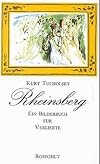
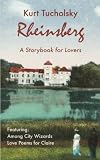
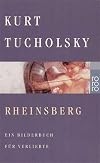
Rheinsberg: A Storybook for Lovers
by Kurt Tucholsky
On This Page
Description
One summer before World War I, a young couple escapes on a romantic weekend getaway to the small German town of Rheinsberg, north of Berlin, in the midst of a rural landscape filled with country houses and castles, cobble-stone streets, lush forests, and dreamy lakes. The story of Wolfie and Claire, told with a fresh, new style of ironic humor, became Kurt Tucholsky's first literary success and the blueprint for love for an entire generation. This edition features an afterword by Dr. Peter show more Boethig, the director of the Kurt Tucholsky Museum in Rheinsberg. show lessTags
Recommendations

























Member Reviews
Rheinsberg: The Fragile Charm of a Lost World
The original German book from 1912 is almost exactly the size and shape of a modern iphone. It fits neatly in a man’s pocket or a woman’s purse. Less than a hundred pages, you can read it easily between dinner and bedtime. The young Kurt Tucholsky’s first book, it was an instant hit, selling tens of thousands of copies from the start. Special editions with leather and Japanese silk bindings became collectors’ items. It has been reissued many times in Germany. Now it is available in a fine English translation by Cindy Opitz, a mere 102 years later. I mean, why rush? The new English edition, somewhat larger in format, comes with lots of vintage photographs of the Rheinsberg area, and a show more few extra writings by the author, Ogden Nash-like lyrics and a short magical realism piece, as a bonus. Also a brief historical note to put things in context. You can still read the entire new Berlinica edition, even at a leisurely pace, in one sitting. But it is a book with both literary and artifactual value, something to take out over and over in quiet moments. Preferably by the fire with a glass of port. The perfect gift for a loved one, -- well, a loved one with taste.
The prose, in both the original German and in the English translation, is rather unassuming. Why was it such a success in 1912 and why do readers still love it today? The plot line, such as it is, is based on a real weekend outing by the young author and is girlfriend Elsa Weil. Renamed Wolfgang and Claire, they banter and squabble incessantly as they leave congested Berlin by train for a quiet three-day retreat in the park-like countryside around the small castle town of Rheinsberg. We are alerted gently that they are not married, not even engaged. Claire is amused that her parents think she’s visiting a girlfriend. Wolfie assures her that he’ll be her chaperone. They argue about how to identify a tree, acacia, no it’s a magnolia. And a bird, a woodpecker, no it’s a barn owl. Her grammar is atrocious, but she’s smart, studied medicine. He forgets things, but is good company, takes her to tour the castle and go boating on the lake. Their relationship is a bit like the comedy team of George Burns and Gracie Allen. She’s ditzy but entertaining, he gets it. Occasionally Claire’s hair comes down, the lights go out and the story resumes later.
In 1912 love affairs were common enough, but talking about it wasn’t. In England, honest novels were shot through with tension and anxiety, think D. H. Lawrence. So Tucholsky’s light touch, celebrating a young couple’s fling without a lot of fuss and angst, was refreshing, somehow liberating. There is just enough of an edge to keep it from descending into sentimental kitsch. No wonder it was a treasured gift. The well-worn 1912 edition I found in the library has a handwritten note in old German handwriting “von deinem Hasen,” from your rabbit….A century later, when honest novels are weighted down with too much information, Tucholsky’s style is again something to appreciate.
The gentle sensibility that marks Tucholsky’s Rheinsberg was short-lived, and soon brutalized by World War I and its terrifying aftermath. Tucholsky’s books were burned in 1933. He died in exile, possibly suicide, in Sweden a few years later, physically safe, but mentally destroyed. Elsa Weil, a successful medical doctor, was sent to Auschwitz and perished. The world that had nurtured their special talents was lost.
Knowing this, it is impossible to enjoy "Rheinsberg" quite the way it was read before the catastrophes of the twentieth century. But with this new translation, it is possible for a wider audience to recover at least a sense of the fragile charm of that earlier era. This is a book that could be read with pleasure more than once. Fortunately, it is quite short. show less
The original German book from 1912 is almost exactly the size and shape of a modern iphone. It fits neatly in a man’s pocket or a woman’s purse. Less than a hundred pages, you can read it easily between dinner and bedtime. The young Kurt Tucholsky’s first book, it was an instant hit, selling tens of thousands of copies from the start. Special editions with leather and Japanese silk bindings became collectors’ items. It has been reissued many times in Germany. Now it is available in a fine English translation by Cindy Opitz, a mere 102 years later. I mean, why rush? The new English edition, somewhat larger in format, comes with lots of vintage photographs of the Rheinsberg area, and a show more few extra writings by the author, Ogden Nash-like lyrics and a short magical realism piece, as a bonus. Also a brief historical note to put things in context. You can still read the entire new Berlinica edition, even at a leisurely pace, in one sitting. But it is a book with both literary and artifactual value, something to take out over and over in quiet moments. Preferably by the fire with a glass of port. The perfect gift for a loved one, -- well, a loved one with taste.
The prose, in both the original German and in the English translation, is rather unassuming. Why was it such a success in 1912 and why do readers still love it today? The plot line, such as it is, is based on a real weekend outing by the young author and is girlfriend Elsa Weil. Renamed Wolfgang and Claire, they banter and squabble incessantly as they leave congested Berlin by train for a quiet three-day retreat in the park-like countryside around the small castle town of Rheinsberg. We are alerted gently that they are not married, not even engaged. Claire is amused that her parents think she’s visiting a girlfriend. Wolfie assures her that he’ll be her chaperone. They argue about how to identify a tree, acacia, no it’s a magnolia. And a bird, a woodpecker, no it’s a barn owl. Her grammar is atrocious, but she’s smart, studied medicine. He forgets things, but is good company, takes her to tour the castle and go boating on the lake. Their relationship is a bit like the comedy team of George Burns and Gracie Allen. She’s ditzy but entertaining, he gets it. Occasionally Claire’s hair comes down, the lights go out and the story resumes later.
In 1912 love affairs were common enough, but talking about it wasn’t. In England, honest novels were shot through with tension and anxiety, think D. H. Lawrence. So Tucholsky’s light touch, celebrating a young couple’s fling without a lot of fuss and angst, was refreshing, somehow liberating. There is just enough of an edge to keep it from descending into sentimental kitsch. No wonder it was a treasured gift. The well-worn 1912 edition I found in the library has a handwritten note in old German handwriting “von deinem Hasen,” from your rabbit….A century later, when honest novels are weighted down with too much information, Tucholsky’s style is again something to appreciate.
The gentle sensibility that marks Tucholsky’s Rheinsberg was short-lived, and soon brutalized by World War I and its terrifying aftermath. Tucholsky’s books were burned in 1933. He died in exile, possibly suicide, in Sweden a few years later, physically safe, but mentally destroyed. Elsa Weil, a successful medical doctor, was sent to Auschwitz and perished. The world that had nurtured their special talents was lost.
Knowing this, it is impossible to enjoy "Rheinsberg" quite the way it was read before the catastrophes of the twentieth century. But with this new translation, it is possible for a wider audience to recover at least a sense of the fragile charm of that earlier era. This is a book that could be read with pleasure more than once. Fortunately, it is quite short. show less
 This review was written for LibraryThing Early Reviewers.
A somewhat charming story about a rather silly (baby-talk, indulgence, gentle teasing) pair of lovers on a brief get-away from Berlin. They do all the touristy things: visit the castle, row on the lake, etc. This was written in 1912 and is based on real characters (the author and the doctor who later became his wife and, still later, his ex-wife). In addition to the 58 page story, this edition contains a translation of the humorous Preface to the Fiftieth Thousand [copies]; three love poems, and another short story (Among City Wizards). The afterword contains some biographical information.
Kurt Tucholsky was a German-Jewish journalist and satirist. Rheinsberg is one of his early successes. It’s playful and was probably daring for the show more time. Perhaps not the greatest literature, but it is historically interesting.
The original German edition was illustrated by Kurt Szafranski. Alas, the edition I have is illustrated with photographs (both contemporary with the book and modern photos of the sights mentioned). The photographs are interesting, but the original illustrations (found with a Google image search of the illustrator) add to the somewhat tongue-in-cheek charm of the story. I wish they were in my copy. show less
Kurt Tucholsky was a German-Jewish journalist and satirist. Rheinsberg is one of his early successes. It’s playful and was probably daring for the show more time. Perhaps not the greatest literature, but it is historically interesting.
The original German edition was illustrated by Kurt Szafranski. Alas, the edition I have is illustrated with photographs (both contemporary with the book and modern photos of the sights mentioned). The photographs are interesting, but the original illustrations (found with a Google image search of the illustrator) add to the somewhat tongue-in-cheek charm of the story. I wish they were in my copy. show less
This review was written for LibraryThing Early Reviewers.Rheinsberg – ein Bilderbuch für Verliebte is a very light-hearted novella by the German author Kurt Tucholsky. It describes the weekend trip of a couple-in-love, Wolfgang and Claire, from Berlin to spend a few days in Reinsberg, a small town about 75 kilometres north-west of Berlin.
The unmarried pair of lovers, Wolfgang and Claire, travel as if they are a newly wed pair, adopting the name Mr and Mrs Gambetta. They spend the weekend sightseeing, visiting the Castle, making a boat trip on the lake, and going to the cinema.
They are elated and naughty, the way young lovers playfully fool everyone around them, while sharing their secret together. On the train, Claire makes herself appear a young coy mistress to the comportly huntsman show more sharing their compartment, and vis-a-vis the medical student Lissy Aachner they pretend to belong to the landed gentry of the local countryside denying any knowledge or understanding of life in the big city. The most remarkable about this short novella is the language used by the two lovers: overly sweet, mixed with irony and sarcasm, the language of a lover's couple.
The story may be based on the author's weekend trip to Rheinsberg with his girlfriend Else Weil in August 1911, the year before publication of the novella. Tucholsky married her in 1920, for a short marriage which was dissolved in 1924. show less
The unmarried pair of lovers, Wolfgang and Claire, travel as if they are a newly wed pair, adopting the name Mr and Mrs Gambetta. They spend the weekend sightseeing, visiting the Castle, making a boat trip on the lake, and going to the cinema.
They are elated and naughty, the way young lovers playfully fool everyone around them, while sharing their secret together. On the train, Claire makes herself appear a young coy mistress to the comportly huntsman show more sharing their compartment, and vis-a-vis the medical student Lissy Aachner they pretend to belong to the landed gentry of the local countryside denying any knowledge or understanding of life in the big city. The most remarkable about this short novella is the language used by the two lovers: overly sweet, mixed with irony and sarcasm, the language of a lover's couple.
The story may be based on the author's weekend trip to Rheinsberg with his girlfriend Else Weil in August 1911, the year before publication of the novella. Tucholsky married her in 1920, for a short marriage which was dissolved in 1924. show less
What a charming little novel! A fictional re-telling of a weekend Tucholsky spent with his lover, it's no wonder that this is a bestseller the world over. It's high time that it's finally published in English! Though a short story, this pleasant edition has photographs of Tucholsky, his girlfriend, and the hotel and woods of Rheinsberg from the time of the novel. Simply wonderful!
This review was written for LibraryThing Early Reviewers.So richtig bewerten kann ich das Buch nicht, weil ich einfach nicht gut reingekommen bin. Schade eigentlich, denn ich lese Tucholsky sonst so gern!
Oct 20, 2010German
Ratings
Members
- Recently Added By
Author Information

Kurt Tucholsky was the most renowned journalist of Weimar Germany, a poet, lyricist, satirist, and storyteller, a democrat, a fighter, a lady's man, a theater-lover, and a political animal. Tucholsky vehemently and early on opposed WWI militarism. The war, in which he was drafted, turned him into a lifelong pacifist.
Some Editions
Awards and Honors
Notable Lists
Series
Belongs to Publisher Series
rororo (261)
Work Relationships
Is contained in
Has as a student's study guide
Common Knowledge
- Canonical title
- Rheinsberg: A Storybook for Lovers
- Original title
- Rheinsberg
- Original publication date
- 1912
- Important places*
- Rheinsberg, Brandenburg, Deutschland
- Dedication*
- Unsern lieben Frauen
M. W.
K. F.
C. P. - First words*
- Seinen eigentlichen Anfang nahm das Abenteuer erst, als sie in Löwenberg ausstiegen.
- Last words*
- (Click to show. Warning: May contain spoilers.)In die grosse Stadt, in der es wieder Mühen für sie gab, graue Tage und sehnsüchtige Telephongespräche, verschwiegene Nachmittage, Arbeit und das ganze Glück ihrer grossen Liebe.
*Some information comes from Common Knowledge in other languages. Click "Edit" for more information.
Classifications
- Genres
- Fiction and Literature, General Fiction
- DDC/MDS
- 830 — Literature & rhetoric German & related literatures German literature and literatures of related languages
- LCC
- PT2642 .U4 .R5413 — Language and Literature German, Dutch and Scandinavian literatures German literature Individual authors or works 1860/70-1960
- BISAC
Statistics
- Members
- 213
- Popularity
- 152,600
- Reviews
- 5
- Rating
- (3.79)
- Languages
- 7 — Dutch, English, French, German, Italian, Spanish, Swedish
- Media
- Paper, Audiobook, Ebook
- ISBNs
- 43
- ASINs
- 15