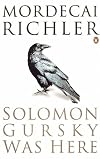
Solomon Gursky Was Here
by Mordecai Richler
On This Page
Description
Berger, son of the failed poet L.B. Berger, is in the grips of an obsession. The Gursky family with its colourful bootlegging history, its bizarre connections with the North and the Inuit, and its wildly eccentric relations, both fascinates and infuriates him. His quest to unravel their story leads to the enigmatic Ephraim Gursky: document forger in Victorian England, sole survivor of the ill-fated Franklin expedition and charasmatic religious leader of the Arctic. Of Ephraim's three show more grandsons, Bernard has fought, wheeled and cheated his way to the head of a liquor empire. His brother Morrie has reluctantly followed along. But how does Ephraim's protege, Solomon, fit in? Elusive, mysterious and powerful, Solomon Gursky hovers in the background, always out of Moses' grasp, but present-like an omen. show lessTags
Recommendations

























Member Recommendations
Member Reviews
The Gursky family is populated with legendary characters. The most legendary is Ephraim, apparently one of two survivors of the ill-fated Franklin expedition, but it is his grandson Solomon that attracts the attention of would-be writer Moses Berger. Moses knows the later generation of Gurskys, the nieces and nephews of Solomon, but Solomon himself has always been an elusive figure. Moses is set on writing Solomon’s biography and sorting out the legend from the truth.
This book took Mordecai Richler about 10 years to write, and it is intricately constructed, told in a non-linear manner. We cross time and space and come back again, from Ephraim to Lucy, from Bernie to Isaac, from Lionel to Solomon (fleetingly), from the high north to show more Magog to Victorian England. Motifs recur, such as the raven, and some events are retold from different perspectives, adding to the reader’s understanding (or perhaps muddying it, if the truth is not certain).
What drew me in to this book was the Franklin expedition angle, and Richler delivered on that excellently. Vivid descriptions of the expedition in its glory, and equally vivid, to the point of horrific, imaginings of the crew’s decline in the weather conditions for which they were so utterly unprepared.
And as an aviation enthusiast, I loved the descriptions of Otters and Cessnas used to fly people in to Yellowknife and points further north, and of course the mystery surrounding Solomon’s Gypsy Moth.
I would recommend this if you, like me, enjoyed Barney’s Version, or really if you’re looking to try out a book by Richler. The Franklin expedition angle is handled well, and if you’ve read Frozen in Time, by Owen Beattie, that was one of the books Richler referred to while writing Solomon Gursky.
A word of warning: because of the setting and time periods, there are a fair number of instances of characters saying things that are prejudiced against other characters, so maybe don’t read a large-print edition on the bus... show less
This book took Mordecai Richler about 10 years to write, and it is intricately constructed, told in a non-linear manner. We cross time and space and come back again, from Ephraim to Lucy, from Bernie to Isaac, from Lionel to Solomon (fleetingly), from the high north to show more Magog to Victorian England. Motifs recur, such as the raven, and some events are retold from different perspectives, adding to the reader’s understanding (or perhaps muddying it, if the truth is not certain).
What drew me in to this book was the Franklin expedition angle, and Richler delivered on that excellently. Vivid descriptions of the expedition in its glory, and equally vivid, to the point of horrific, imaginings of the crew’s decline in the weather conditions for which they were so utterly unprepared.
And as an aviation enthusiast, I loved the descriptions of Otters and Cessnas used to fly people in to Yellowknife and points further north, and of course the mystery surrounding Solomon’s Gypsy Moth.
I would recommend this if you, like me, enjoyed Barney’s Version, or really if you’re looking to try out a book by Richler. The Franklin expedition angle is handled well, and if you’ve read Frozen in Time, by Owen Beattie, that was one of the books Richler referred to while writing Solomon Gursky.
A word of warning: because of the setting and time periods, there are a fair number of instances of characters saying things that are prejudiced against other characters, so maybe don’t read a large-print edition on the bus... show less
I can’t say I’ve understood this book. Yes it’s fiction and is not claiming that all this happened. But there’s too much revisiting of events with some skepticism about what really happened. Too much of what is relayed is unbelievable. Much is in the realm of taking this on faith. I read this like I read a Thomas Pynchon novel, just taking in what appears to be happening at the moment. Not trying to make it fit with the rest. Normally I like to summarize the plot. Here I can‘t do that. Fortunately at the beginning of the book we are supplied with a family tree so we know who marries who and who begets who. The details come later.
At the center of the book is a rich Canadian family with ties to both Montreal and the arctic. Some show more current descendents are trying to find out about their ancestors. All things point to a mid nineteenth century person, Ephraim Gursky. Most of the documented evidence of him centers in England. Born in Liverpool and as a young man he moved to London. He is deeply religious, streetwise, muscular, intelligent, poor, Jewish, well read, able to convince others, a master of languages, and on the wrong side of the law. He’s in and out of prisons and eventually a court orders his expulsion from the country. Here’s where the documented trail becomes thin. He appears to be part of an ill-fated exploration for a northwest passage across the Canadian arctic. Their ship is captured by ice and no one is known to survive, except, in theory, the now mythical Ephraim.
The legend of Ephraim grows with each investigator who tries to uncover the truth. He has mastered survival in the brutal cold by learning how to eat available animal and plant life including it would seem the bodies of those who died. He learns the languages of the indigenous people of the arctic and they treat him as a god. He masters fermenting and readily addicts the natives to his alcoholic creations. He demands much from them including their women. He is rumored to have fathered more the twenty progeny which he abandons as he moves quickly among many communities leaving little trace of his movement. Many seem to have a unique characteristic, they have both a blue and a green eye. People with this feature keep turning up throughout the book. Yiddish also appears throughout the book, fortunately often followed by an English translation. As do people wearing a tallis under their clothes. Also ravens are everywhere. Even on the book’s cover. They show up in the strangest places with some hint that Ephraim became a raven.
Ephraim’s grandsons, three brothers, Bernard, Solomon, and Morrie, are fabulously wealthy, based on ownership of hotels and a liquor company, McTavish, and much more. Bernard, the eldest, CEO of McTavish, has lavished his wealth on many philanthropies, he has worked with celebrities and several heads of state. The brothers are conscious that all is based on illegal activities including running liquor during prohibition and long before. They are protective of their background and worked at making it difficult for people to track where they came from. The second brother, Solomon, is more the free spirit, a prolific fornicator, and constantly drunk. He became a decorated flyer in World War I. In a sense the family wealth stems from his activities as a young man, cheating in a card game and taking ownership of a hotel and more. He is a thorn in the side of Bernard and dies young while flying off into the far north. The third brother wants as little to do with the business as possible.
Succession becomes an issue. The family realizes McTavish, being a public company, could be ousted from control by a hostile takeover. Others can see the advantages of their company. The newer family members also wonder about Ephraim and now focus on Solomon who dies mysteriously leading to lots of speculation and potential investigations. The book explores what they find out but it’s more of the same sorts of issues and events.
I enjoyed the book and recommend it. show less
At the center of the book is a rich Canadian family with ties to both Montreal and the arctic. Some show more current descendents are trying to find out about their ancestors. All things point to a mid nineteenth century person, Ephraim Gursky. Most of the documented evidence of him centers in England. Born in Liverpool and as a young man he moved to London. He is deeply religious, streetwise, muscular, intelligent, poor, Jewish, well read, able to convince others, a master of languages, and on the wrong side of the law. He’s in and out of prisons and eventually a court orders his expulsion from the country. Here’s where the documented trail becomes thin. He appears to be part of an ill-fated exploration for a northwest passage across the Canadian arctic. Their ship is captured by ice and no one is known to survive, except, in theory, the now mythical Ephraim.
The legend of Ephraim grows with each investigator who tries to uncover the truth. He has mastered survival in the brutal cold by learning how to eat available animal and plant life including it would seem the bodies of those who died. He learns the languages of the indigenous people of the arctic and they treat him as a god. He masters fermenting and readily addicts the natives to his alcoholic creations. He demands much from them including their women. He is rumored to have fathered more the twenty progeny which he abandons as he moves quickly among many communities leaving little trace of his movement. Many seem to have a unique characteristic, they have both a blue and a green eye. People with this feature keep turning up throughout the book. Yiddish also appears throughout the book, fortunately often followed by an English translation. As do people wearing a tallis under their clothes. Also ravens are everywhere. Even on the book’s cover. They show up in the strangest places with some hint that Ephraim became a raven.
Ephraim’s grandsons, three brothers, Bernard, Solomon, and Morrie, are fabulously wealthy, based on ownership of hotels and a liquor company, McTavish, and much more. Bernard, the eldest, CEO of McTavish, has lavished his wealth on many philanthropies, he has worked with celebrities and several heads of state. The brothers are conscious that all is based on illegal activities including running liquor during prohibition and long before. They are protective of their background and worked at making it difficult for people to track where they came from. The second brother, Solomon, is more the free spirit, a prolific fornicator, and constantly drunk. He became a decorated flyer in World War I. In a sense the family wealth stems from his activities as a young man, cheating in a card game and taking ownership of a hotel and more. He is a thorn in the side of Bernard and dies young while flying off into the far north. The third brother wants as little to do with the business as possible.
Succession becomes an issue. The family realizes McTavish, being a public company, could be ousted from control by a hostile takeover. Others can see the advantages of their company. The newer family members also wonder about Ephraim and now focus on Solomon who dies mysteriously leading to lots of speculation and potential investigations. The book explores what they find out but it’s more of the same sorts of issues and events.
I enjoyed the book and recommend it. show less
This is an ambitious, confusing and sometimes crazy mixture of fact and fantasy. It tells the story of an ultimately rich Jewish Canadian family from the early nineteenth century to the 1980s. The story is loosely held together by Moses Berger, an alcoholic writer obsessed with the family who has accumulated scraps of information over a lifetime.
At the heart of the story are the legends of the family's founding father Ephraim, a small-time criminal in London who somehow inveigles himself a place on Franklin's ill-fated expedition to find the North-West passage. In Richler's version of the story, Ephraim is the only survivor, first through cannibalism and then by persuading the local Inuit to follow his religious cult.
Ephraim's three show more grandsons are Bernard, Solomon and Morrie, who we first meet in a remote hotel in rural Saskatchewan where their father is a horse trader. Solomon bets their entire future in a poker game and wins the hotel, and the money that enables them to start a business, initially as bootleggers but eventually as a respectable business, which is run by the controlling patriarch Bernard after the charismatic Solomon disappears in a mysterious plane crash.
These are just two of the many strands of a tale that encompasses many disparate elements, and allows Richler to indulge his interests in history, Inuit customs, Judaism and much else besides.
The book is deliberately muddled, partly to reflect Moses's addled mind, and partly to allow some surprising revelations to be held back until quite late. For me it is too long, and I did feel that the female characters' roles were very limited, but the best parts are very good indeed.
I read it as part of Goodreads' The Mookse and the Gripes group's project to analyse the 1990 Booker prize shortlist. 1990 was another very strong year, and I can't place this one any higher that fifth, but in other years it might have been a strong contender, and I would be interested in reading more Richler. show less
At the heart of the story are the legends of the family's founding father Ephraim, a small-time criminal in London who somehow inveigles himself a place on Franklin's ill-fated expedition to find the North-West passage. In Richler's version of the story, Ephraim is the only survivor, first through cannibalism and then by persuading the local Inuit to follow his religious cult.
Ephraim's three show more grandsons are Bernard, Solomon and Morrie, who we first meet in a remote hotel in rural Saskatchewan where their father is a horse trader. Solomon bets their entire future in a poker game and wins the hotel, and the money that enables them to start a business, initially as bootleggers but eventually as a respectable business, which is run by the controlling patriarch Bernard after the charismatic Solomon disappears in a mysterious plane crash.
These are just two of the many strands of a tale that encompasses many disparate elements, and allows Richler to indulge his interests in history, Inuit customs, Judaism and much else besides.
The book is deliberately muddled, partly to reflect Moses's addled mind, and partly to allow some surprising revelations to be held back until quite late. For me it is too long, and I did feel that the female characters' roles were very limited, but the best parts are very good indeed.
I read it as part of Goodreads' The Mookse and the Gripes group's project to analyse the 1990 Booker prize shortlist. 1990 was another very strong year, and I can't place this one any higher that fifth, but in other years it might have been a strong contender, and I would be interested in reading more Richler. show less
this was a re-read for me... but i last read it when it was published (1989) and have a crap memory. so all i retained was the barest of strings, and the sense of just loving this story.
i have to say that i get so much enjoyment out of reading richler (and, as with carol shields, i get bummed fairly frequently over the fact they are no longer here to share new work with us). if the word 'romp' were ever well used in reviewing a book, it would be for this novel. it's a total romp. (can't believe i'm using that word!) it's epic and grand, fun and sharp, and for all its literariness, there is also an interesting mystery.
in her review for the NY Times, Francine Prose says this of the book:
"In this, his ninth and most complex novel, Mr. show more Richler, a Canadian, is after something ambitious and risky, something slightly Dickensian, magical realist: ''Two Hundred Years of Jewish-Canadian Solitude.'' Richler fans will find the scenes one expects in his work -funny, biting, snide-sympathetic takes on Montreal Jewish life - incorporated into a fanciful superstructure of history, geography, myth... Regardless of what its author may actually have experienced, ''Solomon Gursky Was Here'' reads as if it were great fun to write. Dense, intricately plotted, it takes exuberant, nose-thumbing joy in traditional storytelling with all its nervy cliffhangers and narrative hooks, its windfall legacies, stolen portraits, murders and revenges, its clues that drop on the story line with a satisfying thud."
and i think the cool thing prose hit on in her review was the aspect of fun -- as i was reading i kept hoping richer had as much fun writing this as i was having reading it. there seems to be a whole lot of mischievous joy seeping from the pages, and that was a great experience!
(here's the link to prose's review, if you are interested, written 08 april 1990: https://www.nytimes.com/books/97/12/21/home/richler-gursky.html ) show less
i have to say that i get so much enjoyment out of reading richler (and, as with carol shields, i get bummed fairly frequently over the fact they are no longer here to share new work with us). if the word 'romp' were ever well used in reviewing a book, it would be for this novel. it's a total romp. (can't believe i'm using that word!) it's epic and grand, fun and sharp, and for all its literariness, there is also an interesting mystery.
in her review for the NY Times, Francine Prose says this of the book:
"In this, his ninth and most complex novel, Mr. show more Richler, a Canadian, is after something ambitious and risky, something slightly Dickensian, magical realist: ''Two Hundred Years of Jewish-Canadian Solitude.'' Richler fans will find the scenes one expects in his work -funny, biting, snide-sympathetic takes on Montreal Jewish life - incorporated into a fanciful superstructure of history, geography, myth... Regardless of what its author may actually have experienced, ''Solomon Gursky Was Here'' reads as if it were great fun to write. Dense, intricately plotted, it takes exuberant, nose-thumbing joy in traditional storytelling with all its nervy cliffhangers and narrative hooks, its windfall legacies, stolen portraits, murders and revenges, its clues that drop on the story line with a satisfying thud."
and i think the cool thing prose hit on in her review was the aspect of fun -- as i was reading i kept hoping richer had as much fun writing this as i was having reading it. there seems to be a whole lot of mischievous joy seeping from the pages, and that was a great experience!
(here's the link to prose's review, if you are interested, written 08 april 1990: https://www.nytimes.com/books/97/12/21/home/richler-gursky.html ) show less
I found this rambling and meandering and gave up after Chapter 8. Perhaps if I'd finished the book, the overall coherence would have emerged - along with a sense of satisfaction. I just didn't have the patience to slog through page after page of seemingly endless disconnected vignettes with no sense of progression. Richler is wildly inventive, entertaining, and very funny; he excels at inventing preposterous situations, riddled with hilarious dialog (and peppered with profanity). But 400 pages of this is too much. Not the novel for me.
Grandissimo libro. Storia epica, di difficile lettura perche' si dipana su piu' di un secolo e procede a flashback, richiedendo attenzione ai diversi livelli su cui si sviluppa la (?) le!- storie. Ma questo è un grande scrittore, che gia' ne La versione di Barney (ultimo suo libro, ma primo nella mia lettura) aveva dato prova della sua maestria nella gestione di materia narrativa complessa e mutevole. Qui pero' è stato davvero grande. A pagina 540 - ovvero a circa 40 pagine dalla fine - ho scoperto qualcosa che per cinque lunghissimi minuti mi ha fatto soppesare la possibilità di reiniziare da capo la lettura. Per quei shoymer shabos interessati al variopinto mondo dell'ebraismo - io non lo sono - questo testo sara' davvero un must.
This was my second reading of the book, and twenty years later I found it still an intelligent and hilarious, if a bit biting, romp through Canadian Jewish history.
Members
- Recently Added By
Lists

The Guardian's 1000 Novels Everyone Must Read
1,005 works; 548 members

The Best of Canadian Literature
235 works; 33 members

Jewish Books
367 works; 24 members
20th Century Literature
1,161 works; 55 members
Booker Prize
491 works; 62 members

Man Booker Prize Longlist 1990
6 works; 2 members

Books Set in Canada
57 works; 10 members

New Canadian Library
191 works; 7 members

Which Books Made You Laugh Out Loud (Literally)
23 works; 2 members

Booker Prize Shortlist: Titles Not Yet Read
161 works; 4 members

Best Books of the 20th Century
193 works; 5 members

Books Read in 2017
4,249 works; 130 members

Fiction with Men's Given Names in the Title
302 works; 11 members

Books by Jewish Authors
68 works; 5 members

Canadian Historical Fiction 🇨🇦
157 works; 8 members

Books with a Character's Name as the Title
130 works; 10 members
Author Information

53+ Works 9,078 Members
Novelist, journalist and screenwriter Mordecai Richler was born on January 27, 1931 in Montreal, Quebec, Canada. He attended Sir George Williams College for two years. He lived in Paris, Spain and England, and while in England worked as a journalist and radio and television scriptwriter. His fourth novel, The Apprenticeship of Duddy Kravitz show more (1959), was received with far more enthusiasm than previous efforts. He has written a number of screenplays (including Fun with Dick and Jane and the script for The Apprenticeship of Duddy Kravitz). His awards include the Governor-General Awards, the Commonwealth Writer's Prize and the Ruth Schwartz Children's Book Award. (Bowker Author Biography) Mordecai Richler, the author of such distinguished novels as "The Apprenticeship of Duddy Kravitz," "St. Urbain's Horseman," & "Solomon Gursky Was Here," was born in Montreal in 1931. He has won the Commonwealth Prize, the Paris Review Humour Prize, & was nominated for an Academy Award for his screenplay of "Duddy Kravitz." Over the years he has contributed to "Atlantic Monthly," "GQ," "Esquire," "Harper's," "The New York Review of Books," "The New York Times Book Review," & "The New Yorker" (which will publish a portion of "On Snooker"). Richler is married & has five children; he now divides his time between winters in London & seven months at a cottage on Lake Memphremagog in Quebec. (Publisher Provided) show less
Some Editions
Awards and Honors
Awards
Common Knowledge
- Canonical title
- Solomon Gursky Was Here
- Original title
- Solomon Gursky Was Here
- Original publication date
- 1989
- People/Characters
- Solomon Gursky; Moses Berger; Bernard Gursky; Harvey Schwartz; Lucy Gursky; Henry Gursky (show all 14); Morrie Gursky; Nathan Gursky; Isaac Gursky; Ida Gursky; Charna Gursky; Aaron Gursky; Ephraim Gursky; Kathleen O'Brien
- Important places
- Montréal, Québec, Canada
- Important events
- Franklin's Lost Expedition (1845 | 1854)
- Dedication
- For Florence
- First words
- One morning--during the record cold spell of 1851--a big menacing black bird, the likes of which had never been seen before, soared over the crude mill town of Magog, hard by the Vermont border, swooping low again and again.
- Last words
- (Click to show. Warning: May contain spoilers.)He watched the bird soar higher and higher, until he lost it in the sun.
Classifications
Statistics
- Members
- 978
- Popularity
- 26,983
- Reviews
- 15
- Rating
- (3.87)
- Languages
- 6 — Dutch, English, French, German, Italian, Spanish
- Media
- Paper, Audiobook, Ebook
- ISBNs
- 30
- ASINs
- 8