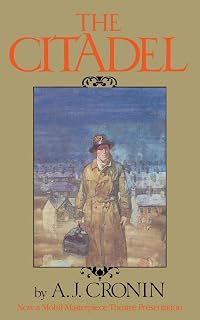
The Citadel
by A. J. Cronin
On This Page
Description
The Citadel follows the life of Andrew Manson, a young and idealistic Scottish doctor, as he navigates the challenges of practicing medicine across interwar Wales and England. Based on A.J. Cronin's own experiences as a physician, this book boldly confronts traditional medical ethics, and has been noted as one of the inspirations for the formation of the National Health Service. This story has been adapted into several successful film, radio, and television productions around the world, show more including the Oscar-nominated 1938 film starring Robert Donat, Rosalind Russell, Ralph Richardson, and Rex Harrison. show lessTags
Recommendations



















Member Recommendations

anonymous user Cronin's autobiography is the natural companion volume to a novel in which he drew heavily on his own experience as a physician. Some episodes were transferred almost verbatim; others were transformed completely.
Member Reviews
"If we go on trying to make out that everything's wrong outside the profession and everything is right within, it means the death of scientific progress."
First published in 1937 and set during the interwar years 'The Citadel' shines a light on the medical establishment in Britain at the time through the eyes of a young newly qualified Scottish doctor. Andrew Manson, takes up his first clinical post as an assistant to a GP in a small Welsh mining community where disease and poverty is rife, sanitation poor and operations are performed on kitchen tables before moving as his career progresses to the fashionable, greedy world of London with its private clinics, hypochondriac patients and rich awards. Manson arrives with a bagful of show more enthusiasm and idealism but soon comes face to face with the realism of his chosen profession.
Archibald Joseph Cronin was born in Cardross, Dunbartonshire, in 1896, and was destined either for the Church or medicine: he chose medicine. Cronin trained in various hospitals in Scotland, Dublin and South Wales. He was appointed as a Medical Inspector of Mines and reported on coal-dust inhalation and lung disease before subsequently moving to London and private practice. This novel is therefore semi-autobiographical in nature as he draws on his professional career as a background.
The novel has two specific areas of emphasis. Firstly, the work of the doctor in a poor community and how his work is transformed when he moves to a city and private practice. Secondly the competence, or incompetence, of doctors and their need to keep their skills up to date. Manson is often critical of the quality of other doctors' work.
In the small Welsh mining village, the men, as miners, can change doctors through a company insurance scheme whenever they wish, their choices often based on the doctor's own popularity rather than his ability. Manson is outspoken and critical of the way in which the service is funded which lands him in trouble.
But the climax comes when Manson is asked to treat the daughter of an old friend who has tuberculosis. Manson has her admitted to an established London hospital but when the treatment provided there shows no signs of benefit he recommends a new therapy. His senior disagrees and Manson removes his young patient to a newly built hospital with an un-medically qualified boss. However, despite the success of the treatment and his patient's subsequent discharge, when Manson’s London colleagues hear about this he is referred to the General Medical Council (GMC) to be investigated with the potential outcome of him being struck off the Medical Register.
In many respects this novel is a creature of its time. Cronin identified many of the issues in clinical practice which needed to be tackled , including better supervision of young doctors, postgraduate education programmes and the novel's popularity along with the cinematic portrayal helped towards the establishment of the NHS a decade or so later. However, some of the issues, in particular affordability, are still relevant today.
This isn't perhaps great literature. Manson despite his revolutionary zeal isn't always a particularly likeable character, he is often, selfish, arrogant and uncaring, but Cronin still manages to present an interesting and entertaining story. I am always interested in novels that feature social history and this book had the power to change public attitudes and behaviour towards health as well as professional thinking and for that reason alone deserves to be more widely read today. show less
First published in 1937 and set during the interwar years 'The Citadel' shines a light on the medical establishment in Britain at the time through the eyes of a young newly qualified Scottish doctor. Andrew Manson, takes up his first clinical post as an assistant to a GP in a small Welsh mining community where disease and poverty is rife, sanitation poor and operations are performed on kitchen tables before moving as his career progresses to the fashionable, greedy world of London with its private clinics, hypochondriac patients and rich awards. Manson arrives with a bagful of show more enthusiasm and idealism but soon comes face to face with the realism of his chosen profession.
Archibald Joseph Cronin was born in Cardross, Dunbartonshire, in 1896, and was destined either for the Church or medicine: he chose medicine. Cronin trained in various hospitals in Scotland, Dublin and South Wales. He was appointed as a Medical Inspector of Mines and reported on coal-dust inhalation and lung disease before subsequently moving to London and private practice. This novel is therefore semi-autobiographical in nature as he draws on his professional career as a background.
The novel has two specific areas of emphasis. Firstly, the work of the doctor in a poor community and how his work is transformed when he moves to a city and private practice. Secondly the competence, or incompetence, of doctors and their need to keep their skills up to date. Manson is often critical of the quality of other doctors' work.
In the small Welsh mining village, the men, as miners, can change doctors through a company insurance scheme whenever they wish, their choices often based on the doctor's own popularity rather than his ability. Manson is outspoken and critical of the way in which the service is funded which lands him in trouble.
But the climax comes when Manson is asked to treat the daughter of an old friend who has tuberculosis. Manson has her admitted to an established London hospital but when the treatment provided there shows no signs of benefit he recommends a new therapy. His senior disagrees and Manson removes his young patient to a newly built hospital with an un-medically qualified boss. However, despite the success of the treatment and his patient's subsequent discharge, when Manson’s London colleagues hear about this he is referred to the General Medical Council (GMC) to be investigated with the potential outcome of him being struck off the Medical Register.
In many respects this novel is a creature of its time. Cronin identified many of the issues in clinical practice which needed to be tackled , including better supervision of young doctors, postgraduate education programmes and the novel's popularity along with the cinematic portrayal helped towards the establishment of the NHS a decade or so later. However, some of the issues, in particular affordability, are still relevant today.
This isn't perhaps great literature. Manson despite his revolutionary zeal isn't always a particularly likeable character, he is often, selfish, arrogant and uncaring, but Cronin still manages to present an interesting and entertaining story. I am always interested in novels that feature social history and this book had the power to change public attitudes and behaviour towards health as well as professional thinking and for that reason alone deserves to be more widely read today. show less
I can enjoy vintage fiction works that have something important to say, even when the writing styles may be dated—as is the case with this classic novel. What's more, it isn't a short or fast-paced read, but Andrew's experiences in the first phases had me interested enough to see where his journey would go.
It was something to watch his idealist's eyes open to lamentable realities concerning the state of the medical field he'd entered. Then with the thickening of the plot, the heightening of the conflict, and my growing care for some of the characters, I truly became invested.
And I appreciate a flawed protagonist; it isn't my thing for lead characters to come off as virtually perfect. Still, during the phase when Andrew changes into a show more fairly colossal jerk, although the author does show the gradual process of Andrew's reasoning and how he justifies himself on his way down, I found it a little hard to put up with his jerkiness and keep reading.
Also, I'm not a fan of the story's handling of the character Christine, ultimately, or how some critical matters play out in her marriage to Andrew. A big part of the issue may come down to this 1937 novel being a product of its period, as the author aimed to write a morality tale during a time when the culture/media promoted certain "wifely ideals."
On a different note, while the instances of more colorful language are left to the reader's imagination, I'd say that as the characters' uses of "damn" and "hell" in their nonliteral senses eventually increased, they became repetitive to the point of excess.
Nevertheless, I was sure that Andrew's journey as a man and as a doctor would come around in this story that, again, has something important and meaningful to say—including something about the folly of valuing, defending, and upholding institutions for their own sake while lacking or losing what should be the institutions' real concerns: human lives and wellbeing.
Plus, the reading made me curious to watch the 1983 British television mini series based on the novel. So! We'll see how that goes.
(Does that screen adaptation handle Christine's character any differently? Just asking. If you happen to know the answer—don't tell me.) show less
It was something to watch his idealist's eyes open to lamentable realities concerning the state of the medical field he'd entered. Then with the thickening of the plot, the heightening of the conflict, and my growing care for some of the characters, I truly became invested.
And I appreciate a flawed protagonist; it isn't my thing for lead characters to come off as virtually perfect. Still, during the phase when Andrew changes into a show more fairly colossal jerk, although the author does show the gradual process of Andrew's reasoning and how he justifies himself on his way down, I found it a little hard to put up with his jerkiness and keep reading.
Also, I'm not a fan of the story's handling of the character Christine, ultimately, or how some critical matters play out in her marriage to Andrew. A big part of the issue may come down to this 1937 novel being a product of its period, as the author aimed to write a morality tale during a time when the culture/media promoted certain "wifely ideals."
On a different note, while the instances of more colorful language are left to the reader's imagination, I'd say that as the characters' uses of "damn" and "hell" in their nonliteral senses eventually increased, they became repetitive to the point of excess.
Nevertheless, I was sure that Andrew's journey as a man and as a doctor would come around in this story that, again, has something important and meaningful to say—including something about the folly of valuing, defending, and upholding institutions for their own sake while lacking or losing what should be the institutions' real concerns: human lives and wellbeing.
Plus, the reading made me curious to watch the 1983 British television mini series based on the novel. So! We'll see how that goes.
(Does that screen adaptation handle Christine's character any differently? Just asking. If you happen to know the answer—don't tell me.) show less
Written by Scottish author and physician A.J. Cronin, The Citadel is about a young doctor, Andrew Manson, who embarks on work in the coal mining country in Wales and eventually becomes a well-paid physician in London. He marries a local teacher, Christine, and she accompanies him on his journey from poverty to wealth. The book takes a look at the inequities of the British medical system, and has a somewhat disparaging view of doctors who make their wealth off their patients. Given the wealth vs happiness/freedom theme running throughout the book, I find this an interesting read here in 2025, when we seem to have moved over to the ‘greed is good’ philosophy. One more note: Ironic, isn’t it, that the same doctor who fights against show more lung diseases as a direct result from the dust in coal mines is a smoker. I get it - this book was written in the 1930s, when not much was known about the direct link between smoking and lung cancer. But still.
It’s written in a dramatic style, likely a very common style in the 1930s, when the book was written. Easy to read, full of moral quandaries, it’s an engaging story. I found it a compulsive read. show less
It’s written in a dramatic style, likely a very common style in the 1930s, when the book was written. Easy to read, full of moral quandaries, it’s an engaging story. I found it a compulsive read. show less
I found "The Citadel" a slightly contrived novel in the way it takes the reader through a series of different medical situations in the Britain of the inter-war years, ranging from emergency treatment down a mine to pandering to rich hypochondriacs, and exploring the compounding issues of the lure of money and the lack of continuing assessment and training of doctors. This discourse is set within a story of the life of a recently qualified doctor and his wife, jolting through these different settings, but neither of them seem all that real. Whilst the NHS as it has developed may have removed many of the problems identified, and of course treatment has become both more scientific and more technological since Cronin's time, I am reminded show more of a comment from a friend high up in the NHS that in the 21st century medicine is the only profession in the UK to retain a powerful controlling body of a mediaeval guild, not necessarily acting in the interests of patients. show less
A good, old-fashioned novel (in the best sense): a story of engaging people doing interesting things, well-told.
The theme is the public health in the UK before the 1948 Act which introduced the National Health service. Incompetence and corruption amongst the medical class are exposed; our hero, Manson, works doggedly towards his own solutions, soon to be sanctioned in law (after the end of the narrative).
On the human side, we join Manson as a new graduate serving in the Welsh valleys, and follow this pilgrim's progress through triumph and disaster until, in the end, we leave him on the brink of fulfilling his dream: a group medical practice founded with the patients' interests at heart.
Interesting, from an historical perspective; show more important politically; refreshing artistically. show less
The theme is the public health in the UK before the 1948 Act which introduced the National Health service. Incompetence and corruption amongst the medical class are exposed; our hero, Manson, works doggedly towards his own solutions, soon to be sanctioned in law (after the end of the narrative).
On the human side, we join Manson as a new graduate serving in the Welsh valleys, and follow this pilgrim's progress through triumph and disaster until, in the end, we leave him on the brink of fulfilling his dream: a group medical practice founded with the patients' interests at heart.
Interesting, from an historical perspective; show more important politically; refreshing artistically. show less
A cidadela oferece um panorama das condições de trabalho dos médicos no início do século XX. Por meio do protagonista, o recém-formado Dr. Andrew Manson, jovem idealista e sonhador, o autor apresenta as dificuldades do exercício da profissão na região do sul do País de Gales, onde a mineração era a atividade principal, o que acarretava tragédias, fosse em acidentes ou em consequências na questão respiratória.
Andrew Manson inicia sua jornada profissional em uma pequena aldeia, chamada Drineffy, onde se dedica com paixão aos seus pacientes, revelando um lado mais humanitário e altruísta do ofício da medicina. Com o passar do tempo, o rapaz encontra novas oportunidades de trabalho e, claro, também encontra o amor, ao show more lado da professora Christine Barlow. É em Londres que Manson se depara com os maiores questionamentos de sua vida até então: entra em contato com a classe médica mais conceituada e com os luxos aos quais eles têm acesso.
O texto de Cronin em A cidadela evidencia o drama das escolhas éticas na prática da medicina e o confronto entre abdicar de luxo e conforto pelo ofício mais humano e a esperteza de saber enriquecer por meio da profissão. Essas questões são, ainda, muito relevantes e atuais, tornando esta obra fundamental para aqueles que praticam medicina e também para aqueles que têm um ideal ao qual se apegar. show less
Andrew Manson inicia sua jornada profissional em uma pequena aldeia, chamada Drineffy, onde se dedica com paixão aos seus pacientes, revelando um lado mais humanitário e altruísta do ofício da medicina. Com o passar do tempo, o rapaz encontra novas oportunidades de trabalho e, claro, também encontra o amor, ao show more lado da professora Christine Barlow. É em Londres que Manson se depara com os maiores questionamentos de sua vida até então: entra em contato com a classe médica mais conceituada e com os luxos aos quais eles têm acesso.
O texto de Cronin em A cidadela evidencia o drama das escolhas éticas na prática da medicina e o confronto entre abdicar de luxo e conforto pelo ofício mais humano e a esperteza de saber enriquecer por meio da profissão. Essas questões são, ainda, muito relevantes e atuais, tornando esta obra fundamental para aqueles que praticam medicina e também para aqueles que têm um ideal ao qual se apegar. show less
This is an exceptionally engaging story of a young, idealistic doctor as he embarks on his medical practice. Dr. Manson joins a practice in a remote, isolated Welsh mining town. It is a baptism by fire. His supervising physician is incapacitated by a stroke and this doctor’s miserly wife withholds money, support and information from Dr. Manson. Manson’s idealism and enthusiasm carries him through many discouraging, lonely months. Eventually he meets a young school teacher and falls in love. Manson and Christine leave this mining town for another position and again throw themselves into medicine and village life. Eventually Dr. Manson takes his practice to London where he succumbs to the temptations of making money by sacrificing his show more medical integrity.
In some ways the decline and redemption of Dr. Manson is too predictable and unrealistic; however Cronin wrote The Citadel in (1937) and for that time this was a revolutionary account of an ordinary man’s life. show less
In some ways the decline and redemption of Dr. Manson is too predictable and unrealistic; however Cronin wrote The Citadel in (1937) and for that time this was a revolutionary account of an ordinary man’s life. show less
Members
- Recently Added By
Lists

Best medical fiction
26 works; 17 members

Best books made into television
66 works; 4 members

1930s
262 works; 5 members

Books Read in 2020
4,379 works; 124 members

Tagged Doctors
15 works; 5 members

Publisher's Weekly Bestsellers Part I - 1895-1939
399 works; 8 members
Author Information

120+ Works 6,617 Members
A.J. (Archibald Joseph) Cronin was born in Cardross, Scotland on July 19, 1896. He was educated at the University of Glasgow Medical School and served as a surgeon in the Royal Navy during World War I. After the war, he investigated occupational diseases in the coal industry and worked as a general practitioner in Wales and London. His first show more novel, Hatter's Castle, written in 1931, was an immediate success, and Cronin gave up the practice of medicine to become a full-time author. Hatter's Castle was adapted into a film in 1941. His other works include Shannon's Way, The Judas Tree, A Song of Sixpence, and A Thing of Beauty. He drew on his medical background in writing his books, and his most popular character was Doctor Finlay, which provided the background for the television series, Doctor Finlay's Casebook. Many of his books were made into films including The Stars Look Down, The Citadel, The Keys of the Kingdom, and The Green Years. He died on January 6, 1981. (Bowker Author Biography) show less
Awards and Honors
Awards
Distinctions
Notable Lists
Series
Belongs to Publisher Series
The Albatross Giant Series (G 105)
rororo (39-40)
Work Relationships
Is contained in
Has the adaptation
Is abridged in
Reader's Digest Condensed Books 1982 v03: The Man from St. Petersburg / Pioneer Women: Voices from the Kansas Frontier / No Escape / The Citadel by Reader's Digest
Reader's Digest Condensed Books: “… But There Are Always Miracles” • Sphinx • The Citadel • The Lantern Network by Reader's Digest
Common Knowledge
- Canonical title
- The Citadel
- Original title
- The Citadel
- Original publication date
- 1937
- People/Characters*
- Andrew Manson; Cristina Barlow; Denny; Mary Boland; Francis Lawrence; Florrie (show all 8); Freddie Hamson; Blodwen Page
- Important places
- Wales, UK
- Related movies
- The Citadel (1938 | IMDb); The Citadel (1950 | IMDb); The Citadel (1960 | IMDb); The Citadel (1960 | IMDb | TV series); La cittadella (1964 | IMDb); Tere Mere Sapne (1971 | IMDb) (show all 9); Madhura Swapnam (1982 | IMDb); The Citadel (1983 | IMDb | TV series); The Citadel (2003 | IMDb)
- Dedication
- To My Wife
- First words
- Late one October afternoon in the year 1921, a shabby young man gazed with fixed intensity through the window of a third-class compartment in the almost empty train labouring up the Penowell valley from Swansea.
- Quotations*
- E' solo quando le cose che vogliamo ottenere richiedono da parte nostra un grave sforzo che diventano preziose. Quando ti cadono in grembo non danno soddisfazione.
- Last words
- (Click to show. Warning: May contain spoilers.)When at last he turned away, hastening for fear he should be late, there in the sky before him a bank of cloud lay brightly, bearing the shape of battlements.
- Original language
- English
*Some information comes from Common Knowledge in other languages. Click "Edit" for more information.
Classifications
Statistics
- Members
- 1,339
- Popularity
- 17,952
- Reviews
- 27
- Rating
- (3.90)
- Languages
- 15 — Danish, Dutch, English, Estonian, Finnish, French, German, Greek, Hungarian, Italian, Norwegian (Bokmål), Russian, Spanish, Swedish, Portuguese (Portugal)
- Media
- Paper, Audiobook, Ebook
- ISBNs
- 82
- ASINs
- 65