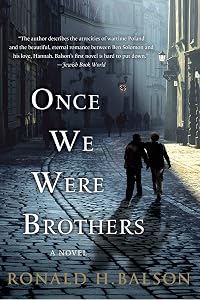
On This Page
Description
"The gripping tale about two boys, once as close as brothers, who find themselves on opposite sides of the Holocaust. Elliot Rosenzweig, a respected civic leader and wealthy philanthropist, is attending a fundraiser when he is suddenly accosted and accused of being a former Nazi SS officer named Otto Piatek, "the butcher of Zamosc." Although the charges are denounced as preposterous, his accuser, Ben Solomon, is convinced he is right. Solomon persuades attorney Catherine Lockhart to take his show more case, revealing that the true Piatek was abandoned as a child and raised by Solomon's family only to betray them during the Nazi occupation. But has he accused the right man? Once We Were Brothers is the compelling tale of two boys and a family who struggle to survive in war-torn Poland and a young love that incredibly endures through the unspeakable cruelty of the Holocaust. Two lives, two worlds, and sixty years converge in an explosive race to redemption that makes for an enthralling tale of love, survival, and ultimately the triumph of the human spirit"-- show lessTags
Recommendations

Member Reviews
This novel is as exciting and interesting as historical fiction can be. With a very public opening confrontation between a retired Chicago holocaust victim and one of the most powerful philanthropists in the city, Once We Were Brothers provides a level of suspense that continues through to the last pages of the novel. The story of why the former Park District employee, Ben Solomon, engages in this confrontation leads back to Poland in 1929 and through Ben's experience of the holocaust during the War. It is his fervent belief that his story is true that leads him to seek out an attorney, Catherine Lockhart, and her story in turn and her own discovery of why she needed to help Ben is as inspirational as Ben's own journey from Poland to show more Chicago.
The novel narrates Ben's journey through flashbacks to Ben's life in Zamosc Poland that begins when he was growing up in a family that had taken in a young German boy, Otto Piatek, who would become as close to Ben as any real brother could have been. In between episodes of this story are interspersed events in current day Chicago, 2004, where we meet Catherine Lockhart and Liam Taggart, her friend, who assists in finding evidence to support Ben's claim that the wealthy philanthropist, Elliot Rosenzweig, is actually the former Nazi SS officer, Otto Piatek. How these narratives come together and whether Ben is able to prove his claim provide for great reading.
This is not a typical story of the holocaust nor is it just about an old man identified as a former Nazi. It is much more and I would encourage anyone interested in what it means to be human and care about another human to read this novel. It is a fictional portrayal but it has aspects that impressed me as much as the best non-fiction I have read about the holocaust. In the end it was not the history that moved me as much as the character of Catherine and how she changed and grew to know herself in a way that made her a better person. show less
The novel narrates Ben's journey through flashbacks to Ben's life in Zamosc Poland that begins when he was growing up in a family that had taken in a young German boy, Otto Piatek, who would become as close to Ben as any real brother could have been. In between episodes of this story are interspersed events in current day Chicago, 2004, where we meet Catherine Lockhart and Liam Taggart, her friend, who assists in finding evidence to support Ben's claim that the wealthy philanthropist, Elliot Rosenzweig, is actually the former Nazi SS officer, Otto Piatek. How these narratives come together and whether Ben is able to prove his claim provide for great reading.
This is not a typical story of the holocaust nor is it just about an old man identified as a former Nazi. It is much more and I would encourage anyone interested in what it means to be human and care about another human to read this novel. It is a fictional portrayal but it has aspects that impressed me as much as the best non-fiction I have read about the holocaust. In the end it was not the history that moved me as much as the character of Catherine and how she changed and grew to know herself in a way that made her a better person. show less
The World War 2 experiences were compelling and deftly told, and the main plot line was interesting. I also really cared about the characters during the war. But, i tired of the lawyer complaining. In literally every chapter, her time was important and her client needed to speed up his story. OK, we get it. There are a few other minor issues with what is ultimately a good book, one that you will be glad you read.
I listened to this book in a half/half situation because Libby took it back for someone’s hold and I had to wait to get it back. (Major downside to Libby…booo…but free…yayyy!)
I can’t tell you how moving this story was, I think in this instance, because of the narrator. I was sucked right into Ben’s story and it was an amazing way to hear about the Polish devastation during WWII. He was an amazing character, flanked by two other amazing characters in Liam and Catherine. I was teary many times throughout the story. Waiting for the ability to borrow it for the second half was torture…I needed to know if Ben was right about Otto and what would happen if he was!
A beautifully written story and one that will definitely stay show more with me, as well as propel me to find and try other books by this author. Listen and enjoy!! show less
I can’t tell you how moving this story was, I think in this instance, because of the narrator. I was sucked right into Ben’s story and it was an amazing way to hear about the Polish devastation during WWII. He was an amazing character, flanked by two other amazing characters in Liam and Catherine. I was teary many times throughout the story. Waiting for the ability to borrow it for the second half was torture…I needed to know if Ben was right about Otto and what would happen if he was!
A beautifully written story and one that will definitely stay show more with me, as well as propel me to find and try other books by this author. Listen and enjoy!! show less
As holocaust stories go, this one was only partly believable. I think Otto was painted as too good in the beginning to have turned so horrible in the end. He not only participated, but he relished his participation. The singleness of his corruption did not always fit with the actions he sometimes took...after all he had opportunities to kill Ben that he did not take.
Despite this, I found the book interesting and kept reading to the very end.
I suppose another problem for me with stories of justice found is that when the atrocity is committed in a man's youth and he lives to a ripe old age and profits from his sins, is there really justice? Didn't he get away with it? Don't we have to believe in a higher power and a later reckoning to show more believe in justice at all? show less
Despite this, I found the book interesting and kept reading to the very end.
I suppose another problem for me with stories of justice found is that when the atrocity is committed in a man's youth and he lives to a ripe old age and profits from his sins, is there really justice? Didn't he get away with it? Don't we have to believe in a higher power and a later reckoning to show more believe in justice at all? show less
I ended up liking this book more than I thought I would. The story is of Ben Solomon, an elderly man living in the United States who recognizes an important local civic leader as the Nazi officer responsible for the demise of his family and the theft of his family money and jewels. Solomon finds a lawyer, Catherine Lockhart, who is reluctant to take his case to identify the man as an ex-Nazi, but she is eventually convinced by her private investigator Liam to do so.
As the story opens, Ben tells his personal story to Catherine in order to convince her to take his case. Ben's story is long and involved. Both I as the reader and Catherine as a character in the book want him to finish with his long story. However, the details of Ben's story show more are most important for getting the entire picture of what really happened.
The last third of the book (obviously you realize by now that Catherine has agreed to take the case) seemed pretty "legalese" to me. That once would have turned me off, but since my daughter is a lawyer, I now allow myself to read about how laws play themselves out when a case is to be considered for jury trial.
I grew to really love the old man Ben Solomon, maybe because he, like myself, was Jewish and lost family in the war, or maybe just because he was a kind, elderly man living a quiet life and appreciating what he had.
I usually don't like to read novels about the Holocaust because there is so much about what really happened that can be misused in novels. However, the research for this book brought alive the town of Zamość in a way which any town decimated by the Nazis needs to be brought into the public eye. Each town affected was individually important.
I'm not crazy about series books, but it seems that the team of Catherine and Liam lives on in more books by this same author. This book was the author's debut novel. I would be willing to read another book in this series in the future.
I plan to pass along this book to a an acquaintance who likes to read historical novels based about WWII. I think this novel is well worth her time. show less
As the story opens, Ben tells his personal story to Catherine in order to convince her to take his case. Ben's story is long and involved. Both I as the reader and Catherine as a character in the book want him to finish with his long story. However, the details of Ben's story show more are most important for getting the entire picture of what really happened.
The last third of the book (obviously you realize by now that Catherine has agreed to take the case) seemed pretty "legalese" to me. That once would have turned me off, but since my daughter is a lawyer, I now allow myself to read about how laws play themselves out when a case is to be considered for jury trial.
I grew to really love the old man Ben Solomon, maybe because he, like myself, was Jewish and lost family in the war, or maybe just because he was a kind, elderly man living a quiet life and appreciating what he had.
I usually don't like to read novels about the Holocaust because there is so much about what really happened that can be misused in novels. However, the research for this book brought alive the town of Zamość in a way which any town decimated by the Nazis needs to be brought into the public eye. Each town affected was individually important.
I'm not crazy about series books, but it seems that the team of Catherine and Liam lives on in more books by this same author. This book was the author's debut novel. I would be willing to read another book in this series in the future.
I plan to pass along this book to a an acquaintance who likes to read historical novels based about WWII. I think this novel is well worth her time. show less
This is a debut novel from this Author and was recommended to me for review by a Polish survivor of the camps.
I was pulled into this book from the first chapter, and found myself returning to read more at every opportunity I got. However, the characters portrayed in the book came across as being rather flat. The person I perceived as being the main protagonist was under-developed and could have been given so much more depth by the Author; there seemed to be so much more that could have been written into his background that would have turned him from the old befuddled fool that came out of the pages into a strong and resilient character that showed the human spirit can endure things we never think possible. Certain players in this novel show more professed to know nothing about the Holocaust, and this added an air of incredulity to the novel. I felt that if the Author had invested more time into the development of their characters, and explored the complexity of the human soul, they would have turned this book around and made it into something more than it actually is. Readers need to be aware that there are also some characters thrown into this book that are never heard from again, making one wonder what the point of including them in the first place actually was. Unless the Author was trying in some way to reflect how people suddenly ‘vanished’ during these years, it may have been better not to include them at all rather than to leave the reader wondering what happened to them and how the events taking place affected them. I really couldn’t connect with any of the characters in this novel, and that is not because I’ve not walked the path they did, it was just because they were so one-dimensional with no endearing traits at all.
Taking place in two eras, World War II and the present day, it was hard to accept that they were part of the same novel. In writing this book it is apparent that the Author spent a great deal of time researching the historical aspects of the pogrom in Poland, but not nearly enough time as some of the things that are written as facts are actually a little off skew. Despite this the historical parts of the book are extremely well written, and it was these parts more than anything that made this a page turner for me; to the point where when the storyline returned to modern day, I just wanted to hurry through them to get back to the past. In comparison to the skilful way in which the Author wrote about World War II, its run up and the way it affected the Jews in Poland, the modern day storyline was rather weakly written, and it is in this portion of the book that I found the plot to be rather predictable.
I wouldn’t say this was a must read for anyone that is interested in this period of time, and the depravity that accompanied it in some countries in Europe, but I will recommend it as a book that breathes a new life into a dismal subject as it looks at this whole area from a different viewpoint. Unfortunately, it could have used the talents of an expert editor in many places to polish out the rather amateurish feel it had, and this is what led to my rating it as I have.
Originally reviewed on: http://catesbooknuthut.com/2014/02/03/review-once-we-were-brothers-ronald-h-bals...
This work is licensed under a Creative Commons Attribution-NonCommercial-NoDerivs 3.0 Unported License. show less
I was pulled into this book from the first chapter, and found myself returning to read more at every opportunity I got. However, the characters portrayed in the book came across as being rather flat. The person I perceived as being the main protagonist was under-developed and could have been given so much more depth by the Author; there seemed to be so much more that could have been written into his background that would have turned him from the old befuddled fool that came out of the pages into a strong and resilient character that showed the human spirit can endure things we never think possible. Certain players in this novel show more professed to know nothing about the Holocaust, and this added an air of incredulity to the novel. I felt that if the Author had invested more time into the development of their characters, and explored the complexity of the human soul, they would have turned this book around and made it into something more than it actually is. Readers need to be aware that there are also some characters thrown into this book that are never heard from again, making one wonder what the point of including them in the first place actually was. Unless the Author was trying in some way to reflect how people suddenly ‘vanished’ during these years, it may have been better not to include them at all rather than to leave the reader wondering what happened to them and how the events taking place affected them. I really couldn’t connect with any of the characters in this novel, and that is not because I’ve not walked the path they did, it was just because they were so one-dimensional with no endearing traits at all.
Taking place in two eras, World War II and the present day, it was hard to accept that they were part of the same novel. In writing this book it is apparent that the Author spent a great deal of time researching the historical aspects of the pogrom in Poland, but not nearly enough time as some of the things that are written as facts are actually a little off skew. Despite this the historical parts of the book are extremely well written, and it was these parts more than anything that made this a page turner for me; to the point where when the storyline returned to modern day, I just wanted to hurry through them to get back to the past. In comparison to the skilful way in which the Author wrote about World War II, its run up and the way it affected the Jews in Poland, the modern day storyline was rather weakly written, and it is in this portion of the book that I found the plot to be rather predictable.
I wouldn’t say this was a must read for anyone that is interested in this period of time, and the depravity that accompanied it in some countries in Europe, but I will recommend it as a book that breathes a new life into a dismal subject as it looks at this whole area from a different viewpoint. Unfortunately, it could have used the talents of an expert editor in many places to polish out the rather amateurish feel it had, and this is what led to my rating it as I have.
Originally reviewed on: http://catesbooknuthut.com/2014/02/03/review-once-we-were-brothers-ronald-h-bals...
This work is licensed under a Creative Commons Attribution-NonCommercial-NoDerivs 3.0 Unported License. show less
When Ben and Otto were kids, Ben’s Jewish family took in a German boy, Otto, and raised him for a number of years. Shortly before WWII broke out, it was decided that Otto would be safer if he left the Jewish family to work with the Nazis. When Ben is in his 80s and living in Chicago, he comes face-to-face with well-known artist Elliot Rosenzweig, who claims to also be a Holocaust survivor, but Ben recognizes him as Otto and won’t back down. Ben hires lawyer Catherine to help prove that Elliot and Otto are one and the same.
I really liked this story. I wasn’t always crazy about Ben, nor was I crazy about Elliot. I agreed with Catherine through the first half that Ben had zero proof whatsoever and I felt like she was wasting her show more time – as a lawyer, she doesn’t have a lot of extra time. Unlike Catherine, who came around, I still felt through the entirety of the book that Ben had zero proof and was exasperated with him many times. However, yes, he had a compelling story, no question about it. Overall, I still really liked the book and am giving it a “very good” rating, but I also didn’t cry, which is surprising for me. Oh, just as an fyi (though it has no bearing on my rating one way or the other), I listened to the audio. show less
I really liked this story. I wasn’t always crazy about Ben, nor was I crazy about Elliot. I agreed with Catherine through the first half that Ben had zero proof whatsoever and I felt like she was wasting her show more time – as a lawyer, she doesn’t have a lot of extra time. Unlike Catherine, who came around, I still felt through the entirety of the book that Ben had zero proof and was exasperated with him many times. However, yes, he had a compelling story, no question about it. Overall, I still really liked the book and am giving it a “very good” rating, but I also didn’t cry, which is surprising for me. Oh, just as an fyi (though it has no bearing on my rating one way or the other), I listened to the audio. show less
Members
- Recently Added By
Lists

Crime and Mysteries to Read
746 works; 31 members
Author Information

16 Works 2,343 Members
Some Editions
Awards and Honors
Awards
Series

Common Knowledge
- Canonical title
- Once We Were Brothers
- Original publication date
- 2010
- People/Characters
- Elliot Rosenzweig; Ben Solomon; Catherine Lockhart; Hannah Solomon; Otto Piatek; Liam Taggart (show all 8); Adele Silverman; Jennifer Rosenzweig
- Important places
- Poland; Chicago, Illinois, USA
- Important events
- World War II, German Occupation of Poland
- Dedication
- To my wife, Monica, with whom I dance through life.
- First words
- Ben Solomon stood before his bathroom mirror fumbling with his bow tie.
- Quotations
- The doors of decision are one-way only. You can never go back.
They chip away and they chip away, taking your rights and dignity a piece at a time...
...even in the midst of a world gone mad, you can find hope to hold on to—things to look forward to. The human spirit is enduringly resilient.
Find a reason to turn your nose up at a culture, to denigrate a people because they’re different, and it’s not such a giant leap from ethnic subjugation to ethnic slaughter. - Last words
- (Click to show. Warning: May contain spoilers.)"The music beckons, Ben. Enjoy the dance."
Classifications
Statistics
- Members
- 976
- Popularity
- 27,030
- Reviews
- 56
- Rating
- (4.02)
- Languages
- English, German, Italian, Polish
- Media
- Paper, Audiobook, Ebook
- ISBNs
- 21
- ASINs
- 8