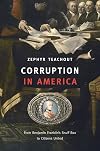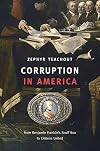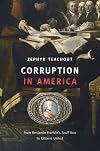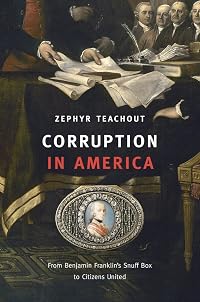
Corruption in America: From Benjamin Franklin's Snuff Box to Citizens United
by Zephyr Teachout
On This Page
Description
When Louis XVI presented Benjamin Franklin with a snuff box encrusted with diamonds and inset with the King's portrait, the gift troubled Americans: it threatened to "corrupt" Franklin by clouding his judgment or altering his attitude toward the French in subtle psychological ways. This broad understanding of political corruption-rooted in ideals of civic virtue-was a driving force at the Constitutional Convention. For two centuries the framers' ideas about corruption flourished in the show more courts, even in the absence of clear rules governing voters, civil officers, and elected officials. Should a law that was passed by a state legislature be overturned because half of its members were bribed? What kinds of lobbying activity were corrupt, and what kinds were legal? When does an implicit promise count as bribery? In the 1970s the U.S. Supreme Court began to narrow the definition of corruption, and the meaning has since changed dramatically. No case makes that clearer than Citizens United. In 2010, one of the most consequential Court decisions in American political history gave wealthy corporations the right to spend unlimited money to influence elections. Justice Anthony Kennedy's majority opinion treated corruption as nothing more than explicit bribery, a narrow conception later echoed by Chief Justice Roberts in deciding McCutcheon v. FEC in 2014. With unlimited spending transforming American politics for the worse, warns Zephyr Teachout, Citizens United and McCutcheon were not just bad law but bad history. If the American experiment in self-government is to have a future, then we must revive the traditional meaning of corruption and embrace an old ideal. show lessTags
Recommendations


Member Reviews
This book is a 300 pages answer why modern interpretation of corruption by the US courts may be limited, particularly for the case of Citizens United v. FED, which allowed big business to spend all it wants on political campaigning. This was one of the cases, about which the joke goes: “corporations are people, unless they aren’t”. The book argues that corruption is a much wider theme than just quid pro quo – direct exchange of money for favors.
It looks at over 200 years of debate on the subject in the US and starts with general ideas of ‘constitution framers’, following with several most influential, according to the author, courts’ decisions. While here in Ukraine we have both similar notably different problems with show more corruption, the most interesting thing for me was how alternative (to our judiciary system based on the continental/French model) court system works and how it can affect corruption.
One of the early case viewed in the detail is Yazoo scandal. To keep the story short, in 1794 Georgia’s state assembly decided sell more than 40,000,000 acres (160,000 km2) of land for $500,000. All but one deputies voting in favor had shares of the company, which bought the land. This caused an outrage and new re-elected assembly repealed the law the very next year. However, it did not stopped the company in re-seling parts of the land and by 1810 the case reached the US Supreme Court.
The Courts had three options: The first was Yazooism. This approach would forbid either judicial or legislative review of whether a law was passed corruptly. A law is a law, and the process by which it was passed is irrelevant. The second was a judicial review of corruption. The Court could void laws passed because of bribery. This approach requires courts to determine when a law is corruptly passed and distinguish those cases from the routine case of a law being passed with some private reasoning done by legislators. The third was a democratic review of corruption. The Court could treat the initial law not as void but voidable— capable of repeal. This approach gives legislators wide latitude to reverse their policies and grants of power.
The Court chose the first option, citing contracts protection.
Another interesting idea is usage of Montesquieu writings on political science. He defended an interesting (for me) opinion that in public sphere citizens should follow not their personal interest but public good:
But corruption was not limited to officials. The framers believed that a citizen could be corrupt: he could use his public roles for private gain instead of public good, he could be extractive instead of supportive of the polity. A citizen has several public functions: the vote, the jury, and public speaking about matters of public importance. When a citizen is petitioning the government, he is acting in his public role. Citizens are the foundation and fabric of the country and are fundamentally responsible for the integrity of their government. All citizens— especially powerful citizens— are responsible for ensuring that public resources generally serve public ends.
As a follower of Smith and his famous “It is not from the benevolence of the butcher, the brewer, or the baker that we expect our dinner, but from their regard to their own interest.” It was an unusual approach for me.
Another note of interest is the difference between the independence and liberty:
The Declaration of Independence was in part a declaration of freedom from corruption. While modern rhetoric often treats independence and liberty or freedom as interchangeable, liberty referred to either a Christian conception of rationally limited human action or a set of substantive privileges and immunities, or freedom from enslavement.53 Independence, on the other hand, was not invoked in the discussions of liberty and was more related to the rhetoric of corruption. Independence is the absence of (in) a power relationship (of the pendant). Independence was at its core a relational word, which symbolized the rejection of a kind of relationship. Dependence could refer to a kind of structural dependence (where a person is actually dependent upon others financially and therefore must do their bidding) or a psychological dependence (where a person’s character is corrupted by another’s influences to think and act differently), but most often it referred to the situation where financial dependence led to psychological dependence. It could be a direct kind of dependency, where a representative’s well-being and financial income depended upon a salary paid by the king, or a subtler kind of dependency, where people’s mental independence could become soft— corrupted—because they rather liked the gifts bestowed on them, the flattery given them, or other trinkets and phrases that obscured their independent judgment and capacity to think and decide as truly free men. In each instance, though to varying degrees, the dependent figure would shift his actions to align himself with the desires of the person who had power over him.
This book is a good overview of the subject, recommended show less
It looks at over 200 years of debate on the subject in the US and starts with general ideas of ‘constitution framers’, following with several most influential, according to the author, courts’ decisions. While here in Ukraine we have both similar notably different problems with show more corruption, the most interesting thing for me was how alternative (to our judiciary system based on the continental/French model) court system works and how it can affect corruption.
One of the early case viewed in the detail is Yazoo scandal. To keep the story short, in 1794 Georgia’s state assembly decided sell more than 40,000,000 acres (160,000 km2) of land for $500,000. All but one deputies voting in favor had shares of the company, which bought the land. This caused an outrage and new re-elected assembly repealed the law the very next year. However, it did not stopped the company in re-seling parts of the land and by 1810 the case reached the US Supreme Court.
The Courts had three options: The first was Yazooism. This approach would forbid either judicial or legislative review of whether a law was passed corruptly. A law is a law, and the process by which it was passed is irrelevant. The second was a judicial review of corruption. The Court could void laws passed because of bribery. This approach requires courts to determine when a law is corruptly passed and distinguish those cases from the routine case of a law being passed with some private reasoning done by legislators. The third was a democratic review of corruption. The Court could treat the initial law not as void but voidable— capable of repeal. This approach gives legislators wide latitude to reverse their policies and grants of power.
The Court chose the first option, citing contracts protection.
Another interesting idea is usage of Montesquieu writings on political science. He defended an interesting (for me) opinion that in public sphere citizens should follow not their personal interest but public good:
But corruption was not limited to officials. The framers believed that a citizen could be corrupt: he could use his public roles for private gain instead of public good, he could be extractive instead of supportive of the polity. A citizen has several public functions: the vote, the jury, and public speaking about matters of public importance. When a citizen is petitioning the government, he is acting in his public role. Citizens are the foundation and fabric of the country and are fundamentally responsible for the integrity of their government. All citizens— especially powerful citizens— are responsible for ensuring that public resources generally serve public ends.
As a follower of Smith and his famous “It is not from the benevolence of the butcher, the brewer, or the baker that we expect our dinner, but from their regard to their own interest.” It was an unusual approach for me.
Another note of interest is the difference between the independence and liberty:
The Declaration of Independence was in part a declaration of freedom from corruption. While modern rhetoric often treats independence and liberty or freedom as interchangeable, liberty referred to either a Christian conception of rationally limited human action or a set of substantive privileges and immunities, or freedom from enslavement.53 Independence, on the other hand, was not invoked in the discussions of liberty and was more related to the rhetoric of corruption. Independence is the absence of (in) a power relationship (of the pendant). Independence was at its core a relational word, which symbolized the rejection of a kind of relationship. Dependence could refer to a kind of structural dependence (where a person is actually dependent upon others financially and therefore must do their bidding) or a psychological dependence (where a person’s character is corrupted by another’s influences to think and act differently), but most often it referred to the situation where financial dependence led to psychological dependence. It could be a direct kind of dependency, where a representative’s well-being and financial income depended upon a salary paid by the king, or a subtler kind of dependency, where people’s mental independence could become soft— corrupted—because they rather liked the gifts bestowed on them, the flattery given them, or other trinkets and phrases that obscured their independent judgment and capacity to think and decide as truly free men. In each instance, though to varying degrees, the dependent figure would shift his actions to align himself with the desires of the person who had power over him.
This book is a good overview of the subject, recommended show less
Really enjoyed this book and learned a lot - more than I expected on both counts. A lot of interesting legal and political history.
Ratings
Members
- Recently Added By
Lists

Club Read's Recommended Nonfiction Written by Women
618 works; 30 members
Author Information

4 Works 290 Members
Awards and Honors
Common Knowledge
- Dedication
- To Aly, Waylon, Jed, Celia, Sargent, Zoe, Dewey, Esme, Garth, Elise, and Elve, my big-hearted, big-dreaming nieces and nephews
- First words
- When Benjamin Franklin left Paris in 1785 after several years representing American interests in France, Louis XVI gave him a gorgeous parting gift.
- Last words
- (Click to show. Warning: May contain spoilers.)There is no one walking below, holding the string: we need obstacles, restraints, an unbreakable connection between the public and the representatives.
Classifications
- Genres
- Politics and Government, Nonfiction, History, General Nonfiction
- DDC/MDS
- 364.1 — Society, government, & culture Social problems and social services Crime Criminal offenses
- LCC
- JK2249 .T43 — Political Science Political institutions and public administration (United States) Political institutions and public administration United States
- BISAC
Statistics
- Members
- 171
- Popularity
- 191,459
- Reviews
- 2
- Rating
- (4.11)
- Languages
- English
- Media
- Paper, Audiobook, Ebook
- ISBNs
- 7
- UPCs
- 1
- ASINs
- 4