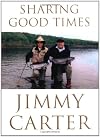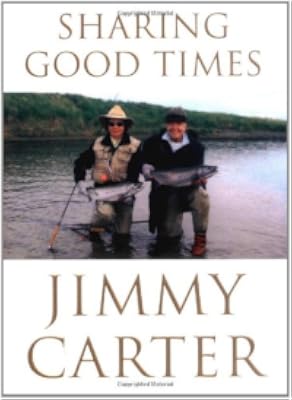
Sharing Good Times
by Jimmy Carter
On This Page
Description
The former president recalls some of the simple joys that he has experienced throughout the years, especially those that he has shared with members of his family, friends, and colleagues.Tags
Recommendations







Member Reviews
This is a concise biography from Carter, focusing on the good times had with family and friends over the years and across the globe. Along the way there is a refreshing, casual candor on encountering racism in his community and even sexism/patriarchy in his own marriage:
While most of the good times are outside fly-fishing, hunting, mountain climbing, seeking arrowheads, etc. the was some good times in the late '50s in jazz clubs:
Carter is a bid sad that his one annual week of Habitat for Humanity volunteering and other more trivial topics of his life are more widely known that the worldwide efforts of his Carter Center. Even he himself when writing of a Carter Center trip doesn't recalling the detail of the work as "good times" here, but the adventure travel bolted onto the trip. The org's focus is on Human rights, Conflict resolution, Election monitoring, Public health, Eradication of infectious diseases, Mental health. show less
She continued walking and replied, "Do it yourself. I have to get my own things ready."show more
I was startled and angry, considering her dismissive response a personal insult. But having no alternative, I was forced to accept the result of this exchange, and during the following days I was able to consider our relationship more objectively. It was obvious that my wife also considered this a seminal change, and from then on we carved out an unprecedented concept of equality and
mutual respect.
Our family teamwork in the campaign paid surprisingly rich dividends. By election day, we had shaken hands with several hundred thousand people, and I was elected governor. Since then, there has been no facet of our business, personal, or political lives that we haven't shared on a relatively equal basis. I have to admit, though, that on occasion, I long for the earlier days.
While most of the good times are outside fly-fishing, hunting, mountain climbing, seeking arrowheads, etc. the was some good times in the late '50s in jazz clubs:
One of our most memorable visits was to New Orleans, where I remember that our total bankroll was six hundred dol- lars. We found inexpensive hotel accommodations and spent most of our nights in the Bourbon Street and Royal Street nightclubs that had the best jazz performers. In one of them, we formed a special friendship with Billy Eckstine, and we later invited him to visit us in the White House. We had coffee and sweet rolls in the French Market early every morning before
going to bed to sleep until early afternoon. During two of our days, we obtained permission from the New Orleans Symphony manager to sit in the theater during their practice sessions, and on the other days we went to horse races and toured the cemeteries, waterfront, and other tourist attractions. We decided that we would splurge one night and have supper at Antoine's Restaurant, where we enjoyed pompano cooked in a paper bag (seven dollars) with potato slices that swelled up like small balloons. We then went to dance in the Blue Room above the Fairmont Hotel, and subsequently we would call long-distance from Plains to make special requests for our favorite songs.
In 1958 we drove to Miami, where Louis Armstrong was performing in the Fontainebleau Hotel, and we remember our astonishment when the stage rose from below the dance floor with him and his orchestra playing their initial song. While on the beach the next day, we made a spontaneous decision to go to Cuba and were soon on the way. We stayed in Havana for two days, casually noticing that the palace of the dictator, Fulgencio Batista, was surrounded by soldiers and stacked sand- bags and that many people were talking about a revolutionary lawyer named Fidel Castro, who was hiding in the hills. Since we had hotel rooms for only the first night, we spent the next one carousing in Havana and then flew without sleep to Miami the following day and drove back home.
The next year we went to Baltimore, primarily to hear performances by Sarah Vaughan. One evening happened to be especially memorable because the nightclub's sound system failed, and the audience sat in almost absolute silence for two hours, except for sustained applause each time she finished a song.
Carter is a bid sad that his one annual week of Habitat for Humanity volunteering and other more trivial topics of his life are more widely known that the worldwide efforts of his Carter Center. Even he himself when writing of a Carter Center trip doesn't recalling the detail of the work as "good times" here, but the adventure travel bolted onto the trip. The org's focus is on Human rights, Conflict resolution, Election monitoring, Public health, Eradication of infectious diseases, Mental health. show less
Jimmy Carter was president back in the years when I really didn't take much interest in who was leading our country. I was in elementary school and honestly don't think I cared much for him, mostly because I thought he had a funny southern accent, which seems very superficial of me, even as a kid. Nowadays, I wish I'd paid more attention. I think he was one of the good guys and it's a shame we can't say that about most of our political leaders these days.
I've not read any of Carter's other memoirs, although he has apparently written quite a few. I didn't really know much about his personal life, other than the peanut farming business, so it was nice to get some background and learn some personal information. But as a memoir, and as a show more book in general, the only word that really comes to mind when reading this, was that it was very "dry." Perhaps it was because Jimmy himself read the audio & maybe another reader could've given it a little more life. Or maybe not. I'm not sure. Overall, a fairly interesting and informative memoir, but definitely not the best I've read. show less
I've not read any of Carter's other memoirs, although he has apparently written quite a few. I didn't really know much about his personal life, other than the peanut farming business, so it was nice to get some background and learn some personal information. But as a memoir, and as a show more book in general, the only word that really comes to mind when reading this, was that it was very "dry." Perhaps it was because Jimmy himself read the audio & maybe another reader could've given it a little more life. Or maybe not. I'm not sure. Overall, a fairly interesting and informative memoir, but definitely not the best I've read. show less
Pretty basic book about the life of former President Jimmy Carter and his family. That being a former President comes with really cool perks. It is not a hard hitting book but does pull back the curtain a little on what a former President does after leaving the office.
Nice stories, but jumped around, and did a little political bashing, I could have done without. Some stories were repeates from other books
Ratings
Members
- Recently Added By
Lists

Presidential Autobiographies
37 works; 3 members
Author Information

78+ Works 13,541 Members
James Earl Carter Jr. was born on October 1, 1924 in Plains, Georgia. He graduated from the Naval Academy in Annapolis, Maryland in 1946, and spent seven years as an officer in the Navy. When his term was over, Carter returned to Plains and began his career in politics at the state level in 1962. In 1970, he was elected Governor of Georgia and six show more years later announced his candidacy for the Presidency. Carter campaigned against Gerald Ford and eventually won with 297 electoral votes, becoming the 39th President of the United States. As President, Carter established a National Energy Policy, expanded the National Park System and created the Department of Education. He was also instrumental in the Camp David Agreement of 1978, which helped to bring peace between Egypt and Israel. Carter established full diplomatic relations with the People's Republic of China and completed negotiations of the SALT II Nuclear Limitations Treaty with the Soviet Union. Upon completion of his term as President, he founded the Carter Center in Atlanta, a non-profit organization that works to prevent and resolve conflict and to enhance freedom and democracy around the world. In 2002, Carter received the Nobel Peace Prize. He has written several books including An Hour Before Daylight; Palestine: Peace Not Apartheid, Our Endangered Values, A Full Life: Reflections at Ninety, and Faith: A Journey for All. (Bowker Author Biography) Jimmy Carter who served as thirty-ninth president of the United States, was born in Plains, Georgia, in 1924. After leaving the White House he and his wife Rosalynn, founded the Atlanta-based Carter Center, a nonprofit organization that works to prevent and resolve conflicts, enhance freedom and democracy, and improve health around the world. (Publisher Provided) show less
Awards and Honors
Distinctions
Common Knowledge
- Canonical title
- Sharing Good Times
- People/Characters
- Jimmy Carter
Classifications
- Genres
- Biography & Memoir, Nonfiction, General Nonfiction, History
- DDC/MDS
- 973.926 — History & geography History of North America United States 1901- Cold War, Vietnam War, Digital Age (1953-2001) Jimmy Carter (1977-1981) Camp David Accords, Iran Hostage Crisis, Energy Crisis of the 70s
- LCC
- E873.2 .C379 — History of the United States United States Later twentieth century, 1961-2000 Carter's administration, 1977-1981
- BISAC
Statistics
- Members
- 295
- Popularity
- 109,195
- Reviews
- 4
- Rating
- (3.45)
- Languages
- English, French
- Media
- Paper, Audiobook, Ebook
- ISBNs
- 16
- ASINs
- 5